The Drowned Prophet
- Ship
- Tidewatch Captain
- Position
- ledger captain
- Faction
- Bog Witch Armada
- Territory
- Brine Gate Harbor
Backstory
He speaks in riddles, often tracing circles in the air as if conjuring the lost. Whispers of his visions cling to him, suggesting a debt to the Bog Witch line that leaves many wary.
Appearance
The Drowned Prophet: A Study in Watchers
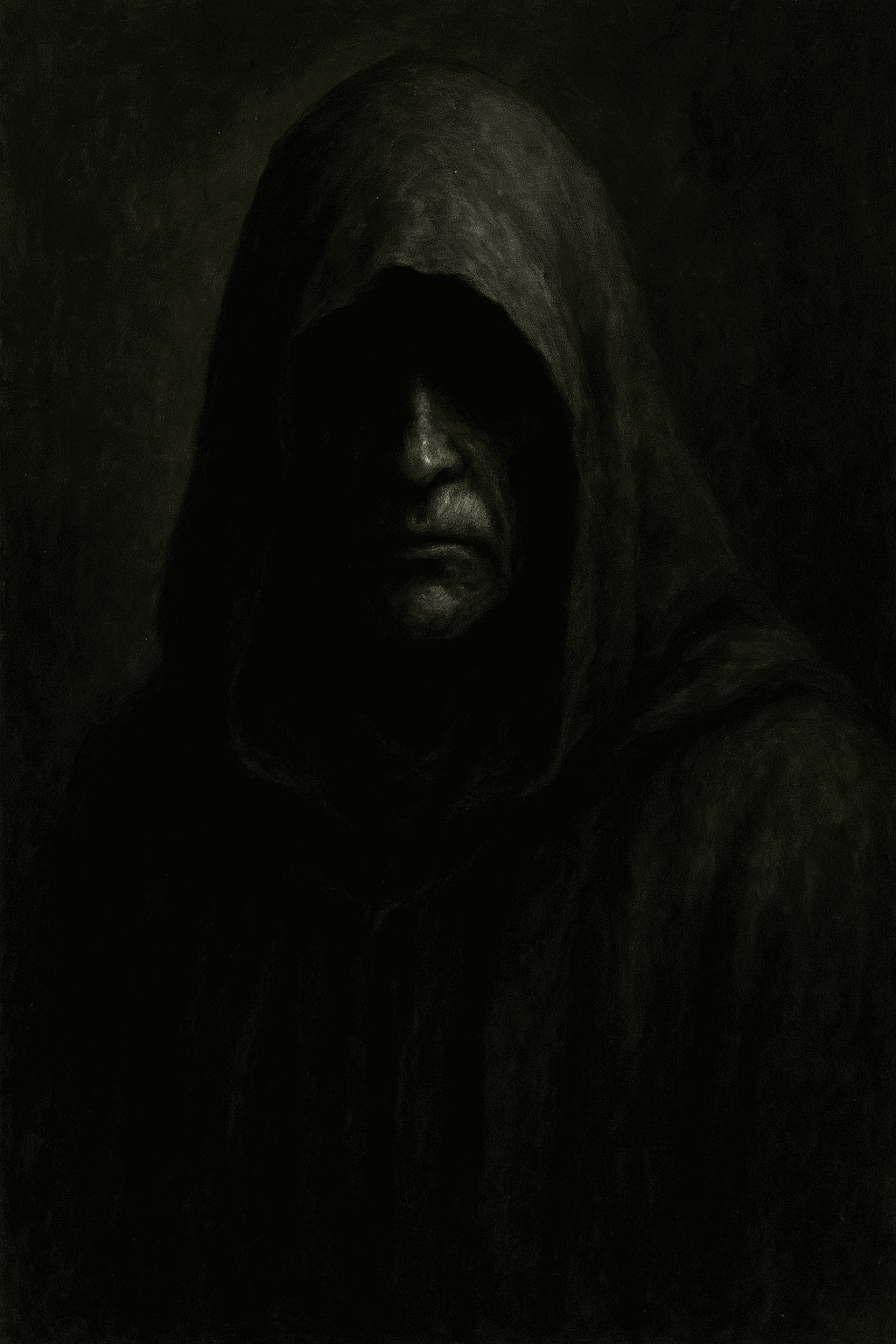
The man does not enter a room. He surfaces in it, the way something half-drowned might break the plane of dark water — sudden, quiet, already present before anyone has truly marked his arrival.
The Drowned Prophet has the habit of existing in the margins until the moment his attention settles upon you, at which point you become aware that he has been watching for some time.
His skin carries the palimpsest of
His skin carries the palimpsest of his histories. It is dark — not uniformly, but in the manner of someone whose bloodlines crossed the Atlantic by violence and commerce both.
There are the undertones of the Lowlands in him, a Scottish moorland pallor underneath that has been hammered bronze by Caribbean sun, then deepened further by decades spent in labor that knew heat as a lived environment rather than a prospect.
The result is a color without easy naming: burnt sienna where the light catches him fully, shadowed to the color of wet bark in the deeper folds of his neck and beneath his jaw.
His skin bears the testimony of
His skin bears the testimony of his years in the Spanish works — not as raised scars (those he wears inside), but as a subtle parchment quality, as though the flesh itself has been sun-cured into something closer to leather.
There are marks: the precise white line of an old surgical scar that runs from his left temple down to his cheekbone, and the darker, older burns that mottle the backs of his hands and wrists, weapons of the bondage years that no amount of time can fully efface.
His face is narrow, almost gaunt, with the bone structure of a man who has lived most of his life on rationed provisions and hard labor.
The eyes are his most unsettling
The eyes are his most unsettling feature — pale grey, nearly colorless in certain light, with the fixed quality of something that sees in multiple registers simultaneously.
Those who have worked under his command report that he seems to look not at you but through you, cataloging data points: your breath pattern, the dilation of your pupils, the minute tremor in your hands.
A man taught by Carib star-readers and honed by decades of observation through conditions that demanded perfect attention or death. His gaze does not settle comfortably on anything, and meeting it full-on produces in most the sensation of being assessed and found incomplete.
The hair is grey-shot, pulled back
The hair is grey-shot, pulled back in a severe queue bound with cord the color of storm-water. It was likely dark once — perhaps black, perhaps deep brown — but the years have bleached it to the shade of ash-wood.
He keeps it long, a throwback to old tradition, wearing it like armor or like penance: a constant reminder of durability, of survival, of the weight of accumulated years. There is white in the beard too — he keeps this sparse, trimmed short.
His hands are instruments. The fingers are long and precise, stained in the cuticles with what appears to be ink — the records, always the records — but also marked with the indelible traces of plant matter from his work as healer.
The nails are cut brutally short
The nails are cut brutally short, and there is an old, deep scar that runs through the webbing between thumb and forefinger on his left hand, pale and slick-looking.
Those who have required his medical attentions report that his hands move with the certainty of absolute knowledge: he does not hesitate, does not second-guess the placement of a blade or the pressure required to stop bleeding.
The clothes mark him as a man of authority without ostentation. He favors a coat of heavy charcoal wool, worn to grey at the seams, with buttons of dark horn that appear rarely polished.
The waistcoat beneath is equally severe
The waistcoat beneath is equally severe: an ochre-brown canvas, functional rather than decorative.
His breeches are dark grey, reinforced at the seams with thread that contrasts visibly — he repairs his own clothes with the same meticulous care he applies to everything else.
His boots are substantial, oiled leather gone to the color of old chestnuts, the heels worn down asymmetrically. Everything about his dress suggests a man who owns nothing superfluous, who has calculated the weight and wear of every garment.
There are no jewels, no medals
There are no jewels, no medals, no insignia of rank beyond the simple fact that men step aside when he walks, that conversation stills.
The scent that accompanies him is complex and particular: salt, certainly, but underneath that runs the green-dark smell of the plants he keeps — medicinal herbs and things less clearly medicinal, bundles of dried material hanging in arrangements that some suspect follows a grammar beyond mere utility.
There is ink in the scent, and something else that might be lamp oil. He does not smell of cologne or perfumed pomades; he smells of work and weather and the particular silence of a man who has learned to exist in the margins of other people's attention.
His bearing is upright without rigidity
His bearing is upright without rigidity, economical in its movements.
When he speaks — and he speaks rarely, in words measured as if each one costs him something — his voice carries all the accents he has accumulated: the rolling Scottish consonants underlaid with Spanish sibilants and what linguists might identify as Carib rhythm patterns.
The voice itself is low, not quite a whisper, but a voice that requires attention rather than volume to command a room.
Cold. Dark. Secretive
Cold. Dark. Secretive.
These are not poetic abstractions. They are descriptions of a man who has learned that visibility is a liability, that warmth attracts the wrong species of regard, and that secrets are the only currency that cannot be stolen, degraded, or diluted.
His body is the physical instantiation of this philosophy — a body trained to consume minimal resources, to broadcast minimal emotion, to occupy space as an observer rather than a participant.
Identity
- Gender
- Male
- Nationality
- Caribbean
- Origin
- England
- Ship · 1725
- Tidewatch
- Berth
- Captain
Frestagon Profile
Compiled by Dr. Frestagon from observation rather than testimony. Scores out of ten; the commentary is his own.
- Cunning (10) — at the ceiling. Assume premeditation.
- Lore (10) — at the ceiling. Assume premeditation.
- Command (10) — at the ceiling. Assume premeditation.
- Navigation (8) — formidable; rarely caught improvising.
- Strategy (7) — serviceable, and aware of its limits.
- Education (7) — serviceable, and aware of its limits.
- Intuition (7) — serviceable, and aware of its limits.
- Charm (2) — a documented weakness. Exploit with care.
- Empathy (2) — a documented weakness. Exploit with care.
Filed under seal. The subject has not seen this assessment.
Saltwell Profile
Leadership, as the Admiral's office measures it.
Blackwater Profile
Intelligence and tradecraft, by Blackwater reckoning.
Tidecrest Profile
A woman's appraisal — of a woman as she is, or of a man as he believes himself to be.