Vargo Knell
- Ship
- Blood Moon Captain
- Position
- pack leader
- Born
- 1625 · Rotterdam
- Faction
- Harbor Wolves
- Territory
- Brine Gate Harbor
Backstory
THE HARBOR WOLF: VARGO KNELL AND THE MATHEMATICS OF PREDATION
A Chronicle of the Brethren of the Coast1
The woman who bore him was called Mara — though that name came later, a Christian mercy from the Maroon elders who found her bleeding in the Spanish governor’s cane fields outside Spanish Town.
Her true name, the one she
Her true name, the one she whispered to her newborn son in the dark of their mountain cave, belonged to a language the planters had beaten out of her generation. She taught him what scraps remained: the word for water, for fire, for run.
Vargo Knell entered this world in 1670, in a limestone cavern fifteen miles inland from the coast, where the Blue Mountains held Jamaica2’s children of rebellion close and cold.
His mother’s milk came thin those early years — the Maroons rationed everything — but her grip on his small wrist was iron. She would not let him die.
When fever took her in his
When fever took her in his eighth year, she made him watch her die slowly so he would understand that gentleness was a luxury the enslaved could not afford.
The mountains raised him after that, teaching him to move like shadow learning to hunt, reading the scatter of birds and the angle of light through canopy to know where soldiers moved. But what the mountains could not give him was the sea.
That hunger came from blood — from some buccaneer who had left nothing but appetite for freedom and a crooked nose.
---
---
THE PRESS
At fourteen winters, the British came recruiting — or what Vargo later understood as recruitment, though the mechanics were more blunt. A naval press gang hauled him from the Port Royal3 docks where he’d been running contraband sugar for inland traders.
They saw what they wanted: a
They saw what they wanted: a lean boy with sun-blackened skin and eyes that read danger the way other men read clouds. The HMS Lombardy, a sixty-gun frigate bound for the Windward Passage4, needed bodies. They took his.
The apprenticeship that followed would have broken most boys. Vargo did not break. What the Navy taught him was precision.
The British warship moved with a mathematics that fascinated him — every rope’s tension calculated, every sail’s angle accounting for wind three points ahead.
He learned the high grammar of
He learned the high grammar of naval gunnery: elevation, weight, distance, the physics of iron speaking to wood. He learned that power, properly organized, could impose its will across three miles of open sea.
Most crucially, he learned the hierarchy of terror. Captains who understood that discipline without unpredictability bred contempt. Those who administered the cat-o’-nine-tails with theatrical caprice kept crews off-balance, compliant, afraid.
His superiors noted him. A pressed Maroon boy with a gift for numbers, for remembering wind patterns, for moving through the rigging without fear.
They promoted him to quartermaster’s mate
They promoted him to quartermaster’s mate within two years — a position that gave him access to the manifest, the stores ledger, the supply chain’s vulnerable arteries.
He learned what was there, and more importantly, where it could be stolen without detection.
By sixteen, he began his own accounting: silent trades with merchant captains, sugar and rum moved into hidden holds, Spanish silver diverted into coconut shells sunk in shallow coves. The mathematics of theft, he discovered, was purer than the mathematics of war. Less blood. Better margins.
---
---
THE CROSSING
When the Lombardy made port at Cartagena in 1688, he walked down the gangway and never looked back. The Navy records would eventually list him among the deserters — a minor notation in a ledger no one read anymore.
But Vargo Knell kept walking into
But Vargo Knell kept walking into the Spanish Main’s interior, where the Brethren of the Coast had begun their work in earnest, and where a man with his skills could write his own terms.
For three years he moved through the trade — merchantman raider, merchant captain’s second, intelligence runner for privateers whose letters of marque were worth less than the paper they bled onto.
He watched how crews turned rabid under weak command and how they crystallized under men who understood that fear and devotion were brothers. He observed which ship captains lasted and which ended in the sand with their heads on pikes.
The pattern was immutable: cunning without
The pattern was immutable: cunning without ruthlessness died to mutiny; ruthlessness without cunning died to naval justice. The successful ones — Bellamy, Vane, Teach — threaded that needle perfectly.
By 1691, at twenty-one years old, Vargo had already begun to gather men around him. Not through charisma — his charm was efficient rather than warm, a blade rather than a light. They gathered because he made money.
His first command, the Petrel, a twelve-gun sloop he’d seized from a Jamaican merchant, became legend not for the violence of her raids but for their precision. No unnecessary bloodshed. No wasted shot.
A ship approached flying Spanish colors
A ship approached flying Spanish colors; Vargo’s crew made port calls where the harbormaster’s ledgers were open to alteration; manifests were rewritten in invisible ink that bloomed only under lamp heat.
Within four years, he’d accumulated enough wealth to purchase the Hunter’s Horn, a Dutch-built frigate of thirty-two guns, and to attract captains like Harlen Cross6 and the calculating Stefano Timbro5 — men who recognized in him not a rival but a commander whose mathematics never failed.
---
THE WOLF IN THE HARBOR
THE WOLF IN THE HARBOR
The nickname came early, though its origins fractured into myth almost immediately. Some said it derived from his hunting style — a patience that seemed inhuman, the ability to track a merchant vessel across open water as though following spoor on land.
Others whispered it came from his scarred left hand, which bore the pale marks of a wolf bite sustained in childhood, a wound that never fully healed and gave his grip an uneven, predatory quality.
Still others claimed it was merely
Still others claimed it was merely an observation: a wolf was a hunter that lived at the margins, that thrived in winter, that understood hierarchy in its bones.
The truth, as always, was simpler and darker. Vargo Knell earned “Harbor Wolf” because of what he did to Vesper Cain in 1697.
Cain had been a rival, a capable captain with an irritating talent for claiming prizes Knell had marked. In the waters off Providencia, their conflict had escalated from mercantile competition to open hostility.
Vargo’s response was characteristic: he di
Vargo’s response was characteristic: he didn’t fight Cain directly. Instead, he systematically extracted every crew member worth salt, offering better shares and safer commands. He corrupted Cain’s quartermaster.
He intercepted three of Cain’s merchant targets with advance notice, removing them from the waters before Cain’s sails could break the horizon. He spread rumors through Port Royal’s taverns that Cain was dying of the French pox.
Within eighteen months, Cain’s ship was a rotting shell, his crew scattered, his credit exhausted. Knell had studied his prey for months before moving, reading patterns the way a wolf reads the breathing of its quarry in snow.
When Cain came to him —
When Cain came to him — broken, desperate, offering whatever service Knell would take — Vargo looked at the man and saw only the mathematics of predation complete.
He bought Cain’s ship for a fraction of its value, and hired the man himself as a sailing master. He kept him close enough to suffer visibility while distant enough to ensure irrelevance. Cain would have preferred death.
---
COMMAND
COMMAND
Now, in 1725, Vargo Knell captains the Hunter’s Horn with a crew of nearly two hundred, operates within a network of allied captains bound by mutual profit and unspoken codes, and commands a reputation that precedes him into every Caribbean port.
His men respect him because he is neither capricious nor soft. His enemies fear him because he is patient in ways that seem to violate natural law. His allies trust him because he has proven, across thirty-five years of predation, that he calculates every angle before moving.
The crooked nose he inherited from
The crooked nose he inherited from that unknown buccaneer father sits at an odd angle on his weathered face. His greying brown hair, kept short and practical, is streaked with salt-white.
His left hand, with its old wolf-bite scars running through his palm, works a rope or a dagger with equal precision. He is neither tall nor small, neither beautiful nor scarred into deformity. He is simply effective — a man whose presence in a room alters the pressure in the air, the way the entry of a predator does.
The Prophet warned of the crossing. Knell should have listened. But he never does.
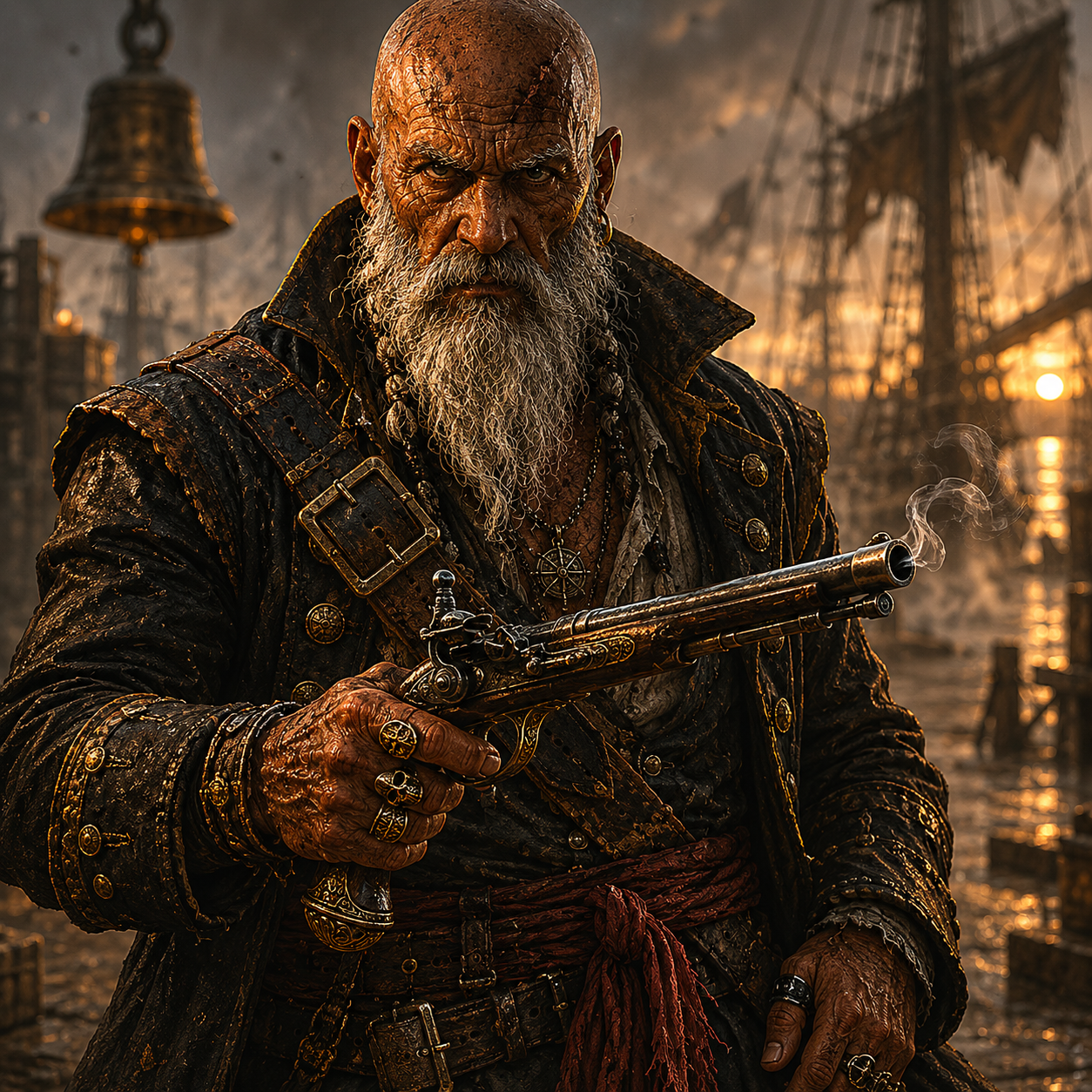
Appearance
VARGO KNELL: HARBOR WOLF A Composite Portrait
The face that meets you across a crew table is a calculation made flesh.
Fifty-some years have etched themselves into bone and weathered skin — not with the softness of age, but with the precise wear of a man who has learned to read his own mortality and found it useful.
His cheekbones sit high and prominent
His cheekbones sit high and prominent, cutting sharp angles beneath skin the color of old mahogany left long in salt spray: a deep tan that has forgotten how to lighten, darkened further by the Caribbean sun that took him at fourteen and never truly released him.
The jawline beneath carries the architectural confidence of a man accustomed to being obeyed; it doesn’t project softness.
His nose, bent at some point in his early manhood and never reset properly, angles slightly leftward — a subtle asymmetry that somehow adds to rather than detracts from the authority of his face. It tells a story of violence survived, and that story is intentional.
His eyes are the engine of
His eyes are the engine of the whole arrangement.
They are a pale grey-green, almost colorless in certain light, with a disconcerting directness that seems to catalog whatever they fall upon — a ship’s rigging, a rival captain’s hesitation, a crew member’s hunger or disloyalty.
The whites around them carry the delicate pink tracery of a man who has spent decades squinting into glare and watching horizons. They don’t soften when he smiles, which is the first and most important thing to know about Vargo Knell.
The smile happens — regularly, strategical
The smile happens — regularly, strategically — but the eyes remain unchanged, still taking inventory. Subordinates who mistake the smile for warmth tend to make costly errors exactly once.
The hair that frames this geography is a mixture that speaks to his peculiar station in the world: greying brown, still thick at the crown but showing the honest recession of middle years.
He wears it short, practical, the length a man chooses who has spent his life on a ship and has no patience for ceremony. Threads of silver catch the light when he moves, catching at the temples and running back along the sides.
Stubble, when it shows, comes in
Stubble, when it shows, comes in darker than the hair above it — another reminder that he is Dutch-born, Maroon-raised, sun-cooked, and made entirely of appetite tempered by discipline.
His skin itself is a map. A thin scar runs along his left cheekbone, legacy of some boarding gone very wrong; it doesn’t mar him so much as clarify him.
His hands, visible when he works charts or counts coin, are calloused in the precise pattern of a man who has handled rope and cutlass for forty years without sentiment.
The knuckles are slightly enlarged —
The knuckles are slightly enlarged — the wear of violence applied with consistency and calculation rather than rage.
His build is lean but not slight; he carries no excess flesh, the kind of practical slenderness that comes from a life where food was uncertain until very recently and comfort has never interested him.
His shoulders are still broad, though age has begun to thin them slightly. He moves with an economy that comes from having learned, at fourteen, that unnecessary motion catches the eye of overseers and gets men caned on the deck of a man-of-war.
When he stands, he stands full
When he stands, he stands full upright. No slouch, no apology.
His bearing carries the formal authority of a British naval officer married to something older and more feral — the predatory stillness of a man raised in mountain caves by Maroons who understood that movement advertised hunger to soldiers hunting them.
He doesn’t shift his weight idly. He doesn’t fidget. When Vargo Knell pauses, it is because he has calculated that pausing serves him. When he moves, every motion has already been audited for necessity.
His dress habits run to practical
His dress habits run to practical restraint. Wool breeches in grey or dark brown, aged by sun and salt. Linen shirts, off-white or ochre, worn open at the throat except in formal councils where he wears them buttoned and severe.
A coat in charcoal or dark russet, good quality but deliberately worn, patched at the elbows where the fabric has thinned.
His boots are the only concession to ostentation — good leather, well-maintained, the boots of a captain — but even these carry the scuff of actual wear.
He wears a single piece of
He wears a single piece of jewelry: a silver ring on his left hand, old enough that its origins are ambiguous, simple enough that it draws no attention. A knife at his belt, hilt wrapped in dark leather, kept sharp with the kind of attention other men reserve for prayer.
His voice, when it comes, carries the ghost accent of Rotterdam overlaid with the flattened vowels of the Caribbean and something harder underneath — the clipped efficiency of a man who learned to give orders in the rigging of a warship, where volume and clarity matter more than musicality.
He doesn’t raise it often. Crew members learn quickly to listen harder when Vargo drops to a conversational tone; it means he has moved from instruction to the space where disobedience becomes fatal.
He uses profanity rarely, and when
He uses profanity rarely, and when he does it carries the precise sting of a man who understands that casual swearing dilutes the word’s power. His speech favors short declarative sentences. Lengthy explanations bore him; he assumes his subordinates can trace the logic of an order without elaboration.
There is a quality to him, visible in stillness, that marks him as fundamentally unlike his peers. Other captains swagger. Other captains perform. Vargo Knell simply exists in the space he occupies, and the space restructures itself around him.
When he enters a crew meeting, men make room. Not because he demands it, but because the air itself seems to recognize hierarchy.
It is the same quality that
It is the same quality that must have made him, at fourteen, a target for promotion aboard the HMS Defiant: the readable intelligence of a predator wearing skin that could pass for manageable.
That quality has only deepened with age, sharpened by decades spent reading horizons, calculating risks, and harvesting the rewards of patience married to violence.
The nickname “Harbor Wolf” sits on him like a well-made garment. Not romantic, not metaphorical. Literal.
He moves through ports the way
He moves through ports the way a wolf moves through a forest — taking what he needs, leaving chaos behind him only when chaos serves his interests, otherwise invisible until he chooses otherwise.
Crew members use the nickname with the exact social register the situation demands: deference when he is close, mockery when he is distant enough to be safe, and a kind of protective reverence from those long enough in his service to understand that the wolf’s appetite, properly understood, keeps the smaller creatures fed.
At fifty-four, with a ship under him and a faction bearing his name, Vargo Knell presents as a man still absolutely dangerous, still precise in his appetites, and still capable of calculating whether a man’s continued existence serves the future better than his swift removal from it.
He is the Harbor Wolf because
He is the Harbor Wolf because he has learned to hunt in settled waters, because he understands that profit beats plunder, and because the only thing older men ever forget is that the young will always move too fast and the cunning will always move the fastest of all.
Identity
- Born
- 1625
- Gender
- Male
- Nationality
- Dutch
- Origin
- Rotterdam
- Ship · 1725
- Blood Moon
- Berth
- Captain
- Bounty
- 82000
Frestagon Profile
Compiled by Dr. Frestagon from observation rather than testimony. Scores out of ten; the commentary is his own.
- Cunning (10) — at the ceiling. Assume premeditation.
- Navigation (10) — at the ceiling. Assume premeditation.
- Command (10) — at the ceiling. Assume premeditation.
- Intuition (10) — at the ceiling. Assume premeditation.
- Strategy (9) — at the ceiling. Assume premeditation.
- Charm (7) — serviceable, and aware of its limits.
- Education (6) — serviceable, and aware of its limits.
- Lore (4) — middling; compensated for elsewhere.
Filed under seal. The subject has not seen this assessment, which is for the best.
Saltwell Profile
Leadership, as the Admiral's office measures it.
Blackwater Profile
Intelligence and tradecraft, by Blackwater reckoning.
Tidecrest Profile
A woman's appraisal — of a woman as she is, or of a man as he believes himself to be.