Aidan Flynn
- Ship
- Saltwell Flagship Captain
- Position
- frost lord
- Born
- 1663 · Kilkenny
- Faction
- Brass Lantern Guild
- Territory
- Brine Gate Harbor
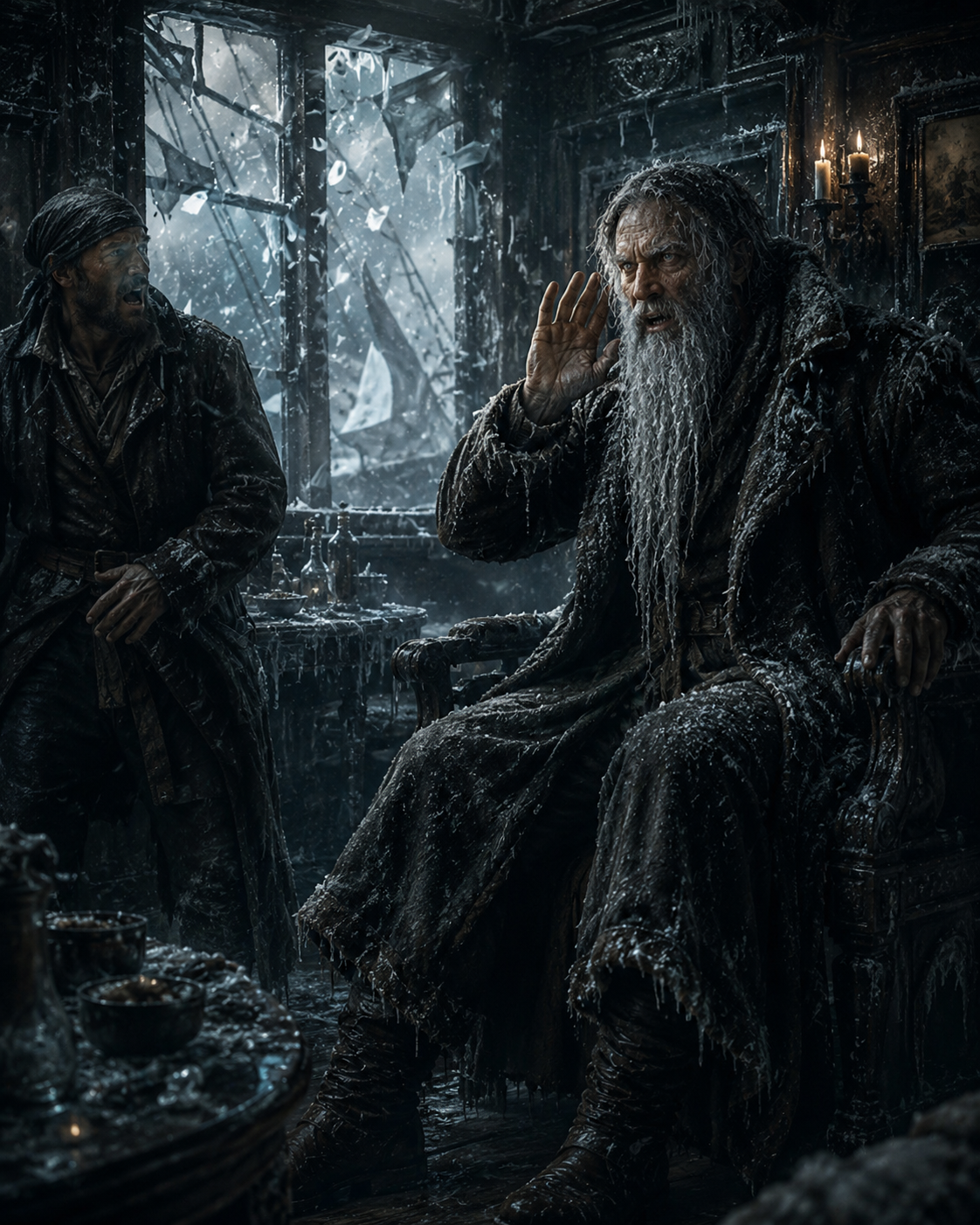
Backstory
AIDAN FLYNN: THE MAN WHO KEEPS THE COLD
A Chronicle of the Frost Fang
The first time you stand before Aidan Flynn’s quarters aboard the Saltwell Flagship1, you understand why men do not linger there. The air itself becomes foreign — not merely cool, but hostile. Your breath crystallizes before your face. The timbers sweat.
Water beads on iron and slides
Water beads on iron and slides downward in thin, gleaming trails, as though the very wood is weeping.
Flynn himself sits at his table — a slab of pale driftwood, almost bleached — and his fingers rest upon documents that do not wrinkle or soften, though the Caribbean should have reduced them to pulp weeks ago. The frost clings to their edges like a signature.
He is not a tall man. This surprises most who hear the weight of his reputation beforehand. Aidan Flynn stands perhaps five feet ten, lean-framed in the manner of a sailor who works rather than commands, whose muscle comes from operation rather than theater.
His hair is dark — not
His hair is dark — not black, but the iron-grey of someone who has earned every shade through proximity to cold that should not exist in these waters.
His skin bears the texture of old leather, weathered not by sun alone but by something more corrosive: the repeated shock of frigid air in a heated world, the microstructure of flesh that has learned to resent warmth.
But it is his hands that arrest you. The fingers are long and precise, and they carry a particular pallor beneath the callused surfaces.
When he writes — and he
When he writes — and he writes constantly, in a script so controlled it resembles engraving — the nails appear almost luminescent.
Men who have taken his grip speak of a sensation like handling ice carved into a human shape, a coldness that persists long after contact has ended, settling into the marrow of the hand that grasped him.
The nickname “Frost Fang” does not emerge from poetic embellishment. It carries weight because it describes a fact.
The Apprenticeship of Precision
The Apprenticeship of Precision
Jean-David Nau2 saw him first.
This was in the days when Flynn was still raw — Irish salt from Donegal waters, scarcely more than a boy, recruited into one of the raids that moved through the Caribbean like a scourge. Other captains would have ground him down or discarded him.
Nau instead watched. He observed the
Nau instead watched. He observed the young sailor’s hands, the way Flynn moved, the methodical incompleteness of his violence. Where other men raged, Flynn calculated.
Where crews spilled cargo in their hunger for plunder, Flynn seemed to be asking a different question: What is worth keeping, and how do we ensure it survives what comes next?
Nau was dying. This is not written in most chronicles, though those close enough to smell the infection on him knew.
He had perhaps five years remaining
He had perhaps five years remaining, and he spent a portion of them teaching Aidan Flynn something that most pirate captains never learned — that power’s highest application is not in destruction but in preservation.
In the control so absolute that nothing within your dominion can be touched without your consent. Not through walls or guards, but through environment. Through the manipulation of the very conditions that permit life.
When Flynn established his first vessel’s hold system — those ice-chambers retrofitted with mechanisms that drew water from trenches where light had never reached, where pressure crushed all warmth from existence — his crew believed him deranged.
The retrofitting consumed months. The mech
The retrofitting consumed months. The mechanism failed twice before functioning. The coldness it produced was so profound that men whose duties required them to work within it reported numbness in their extremities lasting hours after ascent.
But goods survived. A merchant’s cargo of spiced silks, loaded in Cartagena during a season when decay should have rendered them worthless within a fortnight, arrived in Port Royal3 still pristine.
A body — the evidence against a Spanish magistrate whose particular tastes had proven legally inconvenient — reached the court uncorrupted, its condition undeniable, its purpose served.
A shipment of documents, seized in
A shipment of documents, seized in circumstances too delicate to discuss openly, maintained its integrity through Caribbean heat that should have reduced them to illegible pulp.
The work was meticulous. Unglamorous. Entirely necessary.
Word traveled. Aidan Flynn became the man you contracted when ordinary solutions failed, when something required preservation that civilized law would not permit you to preserve. The Brass Lantern Guild4, ever practical, recognized utility when it manifested.
Bastion Vire himself recruited Flynn, unde
Bastion Vire5 himself recruited Flynn, understanding that a captain who sought neither advancement nor dominion but only function would never destabilize the careful hierarchies through which power flowed. Vire gave him the Saltwell Flagship.
He gave him autonomy. And in return, Flynn provided solutions to problems that could not be solved through conventional violence.
The Architecture of Enmity
The Twin Brothers of Edmund Alexander
The Twin Brothers of Edmund Alexander — Nathaniel and William7, known across the Brethren of the Coast6 as hunters of uncommon dedication — have sworn to see Aidan Flynn dead. This enmity does not originate in wounded pride or simple rivalry.
It stems from a contract gone wrong, or rather, a contract gone precisely as agreed, with consequences the brothers found intolerable.
Five years past, they hired Flynn to preserve something — a letter, sealed, originating from Spanish colonial administration and bearing evidence that would have implicated them in certain trafficking arrangements best left unproven.
The Alexanders believed Flynn’s reputation
The Alexanders believed Flynn’s reputation for discretion absolute. They paid him handsomely. They believed their secret sealed.
What they had not understood was that Aidan Flynn’s loyalty to the Guild superseded individual contracts.
When Bastion Vire required the contents of that letter — when the intelligence within it proved valuable in negotiations that benefited the Brass Lantern’s broader position — Flynn provided it. The seal was broken. The secret became leverage.
The brothers discovered their exposure, an
The brothers discovered their exposure, and they discovered who had made it possible.
Flynn did not defend himself. He does not, in his experience, require defense.
He merely continued his work aboard the Saltwell, maintaining his cold, fulfilling contracts with the steady indifference of a man for whom personal grievance is a waste of cognitive resource.
The brothers have made three attempts
The brothers have made three attempts against him — once by violence, twice by subterfuge. All failed. All will fail, those who understand Flynn’s particular nature suspect, because he operates in an environment they cannot replicate and cannot survive.
His quarters exist in a state of perpetual winter. His ship moves through waters where every soul aboard understands the rules of his command. An enemy would have to be willing to freeze in the dark to reach him, and most enemies, ultimately, prefer survival to revenge.
The Hearts He Keeps
Fiona MacKenzie visits the Saltwell quarte
Fiona MacKenzie8 visits the Saltwell quarterly, and when she does, men note a particular tension in Flynn’s movements — not softness, precisely, but a kind of permission.
She is a woman of practical disposition, a merchant who commands her own shipping interests and has no romantic inclination toward the conventional.
She and Flynn do not pretend affection where none exists; they instead maintain an arrangement of mutual regard built upon shared cynicism and, perhaps, upon the comfort of being in proximity to someone else who understands that warmth is a luxury not all are meant to experience.
He commands peers as well. Rodrigo
He commands peers as well. Rodrigo Costa9, his equal in the Guild hierarchy, respects him without requiring friendship — a rarer thing than it seems.
Anneke Visser10, sharp-minded and ruthless, once remarked that “Frost Fang” is an adequate captain precisely because he has never mistaken leadership for being loved.
Saskia Van Dijk11 has sworn alliance with him in the manner of soldiers who understand that their utility to one another exceeds the ordinary bonds of loyalty — they are, quite simply, stronger together, and both have the clarity to prefer function to sentiment.
Bastion Vire trusts him. This may
Bastion Vire trusts him. This may be the most significant relationship in Flynn’s life, though neither man would frame it that way. Vire commands; Flynn executes without variance. The arrangement is immaculate because both understand its fundamental nature: it exists to serve purposes beyond themselves.
The Cold Persists
In midsummer, when the Caribbean breathes heat that would kill lesser men, Aidan Flynn’s breath still carries frost. His staff — of pale ice and iron-core wood, standing as tall as his own chest — never melts. The temperature in his quarters does not rise.
The men who serve him understand
The men who serve him understand that they are serving a man for whom normal warmth is foreign, unpleasant, a contamination to be managed and endured rather than welcomed.
This is not metaphor. This is not legend.
This is Aidan Flynn: the Frost Fang of the Brass Lantern Guild, captain of the Saltwell, master of preservation, keeper of secrets that require the permanence only absolute cold can guarantee. He will not seek dominion. He will not hunger for greater power.
He will continue his work in
He will continue his work in the darkness of the hold, in quarters where breath condenses into visible ice, in a personal geography where warmth is an intrusion and every man who approaches understands that he enters a space fundamentally hostile to his survival.
And still they come. Because some problems can only be solved in the cold.
Appearance
AIDAN FLYNN: A PORTRAIT IN COLD
The first thing a man notices about Aidan Flynn is that the space around him breathes differently. Not metaphorically.
The air itself seems to contract and pale, as though caught between respect and revulsion — the way a candle flame hesitates before wind without the wind ever arriving.
You see him across the Saltwell’s
You see him across the Saltwell’s gun deck, and something in your body recognizes the wrongness before your mind catches up. The temperature has not dropped. Your skin does not prickle. Yet every animal sense you own screams: Do not approach.
He is not a tall man — this fact surfaces in you like betrayal, as though the weight of his reputation should have added inches to his frame.
Aidan Flynn stands perhaps five feet ten, built with the economical architecture of someone who works rather than commands, who climbs and hauls and operates rather than stands to be observed.
His shoulders are broad but ropey
His shoulders are broad but ropey, the muscle there speaks of precision rather than spectacle — the body of a man who learned violence from Jean-David Nau, who learned it as a surgeon learns anatomy, with the intent to understand exactly where the knife should fall and why. No excess. No theater.
His skin carries the texture of old leather — not merely weathered by Caribbean sun, though that sun has done its work. No. This is something else.
The flesh appears to have learned a different grammar of damage, repeated shocks of frigid air meeting tropical heat, so that the microstructure beneath the surface has become hostile to both extremes, settling instead into a kind of muted grey-bronze that suggests neither warmth nor health but rather something beyond the common spectrum of living flesh.
Freckles scatter across the bridge of
Freckles scatter across the bridge of his nose and the high shelf of his cheekbones — pale speckles that read almost Hibernian, almost Irish, almost like the ghost-marks of a younger man before the cold decided to live in him. His skin does not tan evenly.
It burns in patches and then goes grey, as though rebelling against the work of sun itself.
The face is narrow. Severe. It is the face of a man made lean not by starvation but by intention — by the constant discipline of a body kept in service of will. The jawline cuts sharp, angular, the chin pronounced and squared. His mouth is a line.
Not unkind, precisely, but unsentimental.
Not unkind, precisely, but unsentimental. The lips are thin and pale, often slightly parted — not from breathlessness but from the habit of a man calculating what comes next. When he smiles, which is rarely, it does not reach his eyes.
The smile is something he performs rather than feels, the social equivalent of a man checking a weapon before combat.
His eyes are the color of ice-melt under winter sky — pale blue, almost grey, with pupils ringed by something darker at the iris-edge, as though the boundary between his eyes and the world around them is sharper, more defined than in common men.
Those eyes do not dart. They
Those eyes do not dart. They do not scan. Instead they fix, with the patience of a man who has learned that stillness is a weapon more refined than motion.
When he looks at you, he appears already to have read you — your capacity for loyalty, your breaking point, the moment at which you will choose your own life over his orders. When he looks away, it feels like being released from interrogation.
His hair is dark — not the absolute black of youth, but iron-grey, the shade that comes from proximity to coldness that should not exist in these waters.
The individual hairs catch light different
The individual hairs catch light differently than they should, as though each strand carries a particular texture that refuses to absorb warmth the way hair ordinarily does.
It falls past his shoulders, tied back with a cord of pale leather — not ribbon, not silk, but something functional, something that might have been fashioned from the binding of a ship’s hold.
A few strands escape at the temple, and where they fall across his forehead they seem somehow paler than the rest, bleached the way rope bleaches when salt has worked it over repeatedly.
But it is his hands that
But it is his hands that arrest you.
The fingers are long. Precise. A craftsman’s fingers — the kind that hold a quill or a scalpel with equal competence.
When Flynn writes — and he writes constantly, sitting at his pale driftwood table in quarters that sweat condensation and refuse warmth — his penmanship resembles engraving. Each letter is finished. Each word is deliberate.
There is no nervous speed in
There is no nervous speed in it, no passion or urgency. Just the meticulous architecture of a man who believes that language itself can be made to cut.
The nails are pale. Not sickly pale, not the pallor of illness, but a kind of luminescence that reads as wrong in tropical light. They do not yellow. They do not take on the tobacco-stain of common sailors.
Instead they maintain a whitish gleam, as though perpetually dusted with frost — which is, in fact, what several men have claimed after shaking Flynn’s hand. The sensation persists, they say.
A coldness that settles into the
A coldness that settles into the bones of your palm and does not leave for hours. One man reported that the feeling lasted until the next day, spreading up through his wrist like an infection of winter.
His voice is quiet. This surprises those expecting the theatrical roar of a pirate captain.
Aidan Flynn speaks in a register that forces men to lean in, that creates an intimacy between speaker and listener that makes refusal almost impossible — because to refuse him, you must first break the space between you, and he has made that space feel sacred, or haunted, or worse.
His accent carries Ireland in it
His accent carries Ireland in it still — the Donegal flats and elisions that no years at sea could fully sand away. The letter ‘r’ stays slightly thickened. Words ending in ‘tion’ lose their ‘t’ and soften into the vowel.
When he speaks, his jaw moves minimally. The words arrive from somewhere deeper, as though generated in the chest cavity rather than the mouth.
His gait is economical. He does not stride. He does not walk with the rolling swagger of a sea-captain performing authority.
Instead Flynn moves with the deliberate
Instead Flynn moves with the deliberate placement of each foot that suggests a man counting — counting yards, counting time, counting the incremental distance toward some conclusion he has already calculated. His shoulders remain level. His arms do not swing.
He appears always to be moving within a specific envelope of space, as though the air around him is precious and must not be wasted on unnecessary gesture.
He wears the rust-dyed coat of the Brass Lanterns — copper-brown linen, heavy with wear, the buttons fashioned from some pale metal that might be tin or might be something older. The coat is practical rather than ceremonial. Pockets are deep and numerous.
The cuffs are reinforced. Beneath it
The cuffs are reinforced. Beneath it, a loose linen shirt — the collar often unlaced, revealing the thin scar tissue at the base of his throat where something once came very close to ending him, and did not.
A belt of blackened leather holds the weight of his cutlass, its basket-hilt forged iron that shows no shine, that appears instead to absorb light as though the metal itself distrusts illumination.
Around his neck, on a chain that has tarnished to near-black, hangs an ivory pendant carved in the shape of something predatory — a fang, or a claw, or perhaps something that exists only in waters too deep for common men to explore. The carving is ancient.
The ivory yellowed. Whatever it signifies
The ivory yellowed. Whatever it signifies, he touches it rarely, but when his hand rises to that cold small object, men grow quiet and careful.
His scent is not the common reek of Caribbean sailors — salt and tar and the rank decay of insufficient water.
Instead, Aidan Flynn carries the smell of cold itself: ozone, fresh like the air before a storm that will not come, layered beneath with something metallic, like copper or old iron left in winter rain. Some say they smell brine on him.
Others swear it is the scent
Others swear it is the scent of the deep places where light dies and pressure crushes warmth from existence.
He is the “Frost Fang” not by poetry but by reputation — by the fact that every man who crosses him learns that winter has come to the Caribbean, and that he alone controls the temperature at which the rest of them are permitted to survive.
He is also your mortal enemy’s brother, and that fact sits between you both like a curse that neither of you has spoken aloud.
Identity
- Born
- 1663
- Gender
- Male
- Nationality
- Irish
- Origin
- Kilkenny
- Ship · 1725
- Saltwell Flagship
- Berth
- Captain
- Bounty
- 96000
Saltwell Profile
Leadership, as the Admiral's office measures it.
Blackwater Profile
Intelligence and tradecraft, by Blackwater reckoning.
Tidecrest Profile
A woman's appraisal — of a woman as she is, or of a man as he believes himself to be.
Gazette Dispatches
Intelligence compiled by the Frestagon Signal Corps. Reliability: moderate.
⟳ read the fuller account**TITLE: From the Helm: June's Seafaring Updates**
**HOOK: Straight from the Frestagon Signal folks. Trust it as far as you can throw it.**
**CROWN ACTIVITY:** The HMS Relentless was clocked at 24°N, heading east-northeast. She's got two frigates tagging along, but their names are anyone's guess. Likely they're sweeping the Amber Coast trade lane. If you're piloting cargo in those waters, better steer south until the coast's clear. We sail smart or we don't sail at all.
**FACTION MOVEMENTS:** Captain de la Cruz and his Corsair Collective are steering three ships toward the eastern islands. They claim it's for "exploratory trade," but anyone with a nose can smell they're after arms. Over at Jade Harbor, our ears tell us the Dutch trading post has been hawking more gunpowder than usual. Keep your bearings sharp and your powder dry.
**MERCHANT TRAFFIC:** Fourteen merchant ships rolled in at Port Vanguard this month, a drop from the twenty-one in May. The Crown's tightening the noose, plain and simple. Sugar's up by 40%. If you're in the smuggling game, now's your cue. No sense dressing it up.
**WEATHER ADVISORY:** There's a monsoon brewing in the southeast, with barometers pointing to a landfall in three weeks. Ships anchored at Brine Harbor better check their hulls and secure their spots. Storm moorings are set at Sections 8 through 12. Batten down or stay ashore.
**PERSONNEL NOTE:*… continue in the Gazette →