Samuel Blackwater
- Ship
- Persistence Captain
- Position
- Admiral, Brine Gate Harbor. Commander of the Customs Squadron (interdiction, impoundment, slaver-hunting). Master of the harbor Customs House (joint civilian-naval office). Member of the Admiralty's three-person standing committee on Lent-Hand counter-operations (with Saltwell and Tidecrest). Captain of the flagship THE PAPER TIGER.
- Born
- 1600 · London
- Allegiance
- Ledger Syndicate
- Territory
- Brine Gate Harbor
Backstory
THE IRON HAMMER: A LIFE IN LEDGERS
Samuel Blackwater, 1600–2025
The smoke from his cabin pipe never quite clears.
It hangs in the salt-thick air
It hangs in the salt-thick air of whatever vessel carries him — the Paper Tiger now, though the name changes like the weather — and drifts toward the porthole glass where it catches the light and turns the colour of old brass.
The pipe itself is ancient, its bowl darkened to mahogany, and he turns it between his teeth with the methodical patience of a man reviewing account columns, searching not for the obvious entry but for the tremor in the hand that made it.
Samuel Blackwater does not look like a sledgehammer. He is lean, spare — the frame built not by gymnasium work but by decades of ship’s rations and the particular hunger that comes from never stopping.
His skin carries the pallor of
His skin carries the pallor of fog-dampened London1 streets, lightly freckled across the cheekbones, and his hair — dark brown, cut short and slicked back with ritual rather than vanity — betrays no silver despite the weight he carries in those grey eyes.
Those eyes are the colour of North Sea water in winter: cold, reflective, capable of holding light without warmth.
It is his hands that mark him first. The right hand is whole, unmarked except for the calluses of decades — rope, documents, other men’s fates.
The left ends at the knuckle
The left ends at the knuckle of the ring finger, the thumb intact but the next two fingers absent, cleanly taken at the second joint on a dawn in 1720 aboard the Summer Assize off Cornwall. A boarding-axe came down.
He did not make a sound, not because he was brave, but because he was already moving to the next task — the interrogation below, the inventory of the hold. The wound burned like a forge. He did not stop.
The Ledger’s Education
He came up from the Whitecross
He came up from the Whitecross Street smithy in London, son of a tradesman who understood that metal had no forgiveness and neither did the world. The forge taught him early: heat, pressure, and time transform base matter into something that holds an edge.
His father died when Samuel was fourteen — a miscalculation in the hammer-stroke, a moment’s inattention — and the lesson took root. Attention saves lives. Attention buys survival.
During the Civil War, he apprenticed to a printer nearby and set type for pamphlets that overthrew kings. Words on paper, he learned, could do what swords could not — they could persist. They could change the shape of thought itself.
He worked the press with the
He worked the press with the same methodical care he had learned in the smithy: each letter placed true, each line justified, each page a small act of defiance against men who believed they owned the right to silence.
The printers’ guild fed him poorly but taught him that power lives not in the strike but in what you document about it.
When plague emptied London’s streets in 1665, he went to sea.
Not for fortune — the young
Not for fortune — the young do not yet understand fortune — but to escape the smell of bodies stacked in plague pits, the screams at the pesthouse doors, the absolute silence that falls when an entire household dies in quarantine.
He signed aboard a merchant sloop and kept the log with the precision he had learned in the smithy and the printshop. Every entry dated, every coordinate marked, every transaction witnessed. The ledger as scripture.
The Brethren Years
By 1680, he had worked his
By 1680, he had worked his way into the circle around Roc Brasiliano, a man whose name still carries weight in the Caribbean’s deep channels.
Blackwater was not a figurehead — he possessed no charm that made men follow blindly — but he possessed something rarer: the ability to see what was actually happening beneath what men claimed was happening. In a world of lies, the man who keeps honest accounts becomes indispensable.
He rose through the ranks not by charisma but by calculation.
He was quartermaster aboard the Satisfacti
He was quartermaster aboard the Satisfaction2 when she took the Spanish frigate Margarita off Hispaniola in 1686, the haul distributed so fairly that men spoke of it in taverns across Port Royal3 for years afterward.
He was navigator aboard the Resolute when she outran a Royal Navy sloop through channels so narrow that the Navy captain believed it impossible — though Blackwater had simply consulted maps the Navy did not possess, records of passages that existed only in the ledgers of dead pilots and merchants.
His reputation arrived before he did. Dock workers called him “The Tariff-Iron” when they believed him out of earshot. It was what they whispered when his launch swung through the harbor at dusk, his silhouette unmistakable against the dying light.
The nickname did not refer to
The nickname did not refer to the missing fingers, though God knows they had come to symbolize the price of his attentions — a bleeding ledger written in flesh. It referred to the quality of his will. Iron does not bend, and neither does Blackwater once a course is committed to writ.
The Gazette and the Deeper Game
By 1710, he had begun to understand that the true power in the Brethren lay not in the taking of ships but in the taking of information. He founded the Urbanicity Gazette ostensibly as a commercial venture, a news-sheet for the Caribbean colonies.
In truth, it was a ledger
In truth, it was a ledger of a different kind — a carefully curated record of who knew what, when they knew it, and what that knowledge was worth. Every political marriage, every bankruptcy, every sudden disappearance of a merchant captain: all of it entered the accounts.
The printing press came through channels that were deliberately obscure. Vargo Knell4, who fenced goods that should not have surfaces and moved men who should not have existed, supplied both the equipment and the cover story.
The Gazette became the mask behind which something far older and more patient operated: an intelligence apparatus that would outlast empires.
By 1725, Blackwater held positions that
By 1725, Blackwater held positions that seemed to contradict one another. He was a captain, yet he spent more time in counting houses than on a quarterdeck.
He was a pirate, yet his wealth lay not in plunder but in knowledge — knowledge about debts, about shipments, about which magistrates could be bought and which magistrates bought other men.
His enemies included Sir Richard Carleton5, the Collector of Customs, who suspected (correctly) that Blackwater had infiltrated his own offices. His allies included men like John Saltwell6, who understood that in the age of empires, the man who reads the ledgers faster than the empire itself becomes, in fact, the empire.
The Reversal
The Reversal
The emergence of 2025 should have destroyed him. A man of 1725, suddenly displaced into a century of surveillance and data, should have been helpless. Instead, Blackwater thrived.
The skills translated perfectly: a ledger is a ledger whether kept in ink or in ones and zeroes. By 2025, he held positions of genuine power — editor, analyst, the man who arranged the data so that others could see patterns.
His wealth in the 2025 world
His wealth in the 2025 world exceeded his standing in 1725, his prestige soared, and yet something had shattered.
The PTSD that struck around 2014 came not from combat — he had seen combat his entire life — but from a different kind of recognition. In the 2025 archive, every choice he had made was documented.
Every intelligence operation, every betrayal, every man he had abandoned or sacrificed to the logic of the ledger: all of it existed in records that could be accessed. The anonymity of history was gone. The ledger had become transparent.
For a man who had built
For a man who had built his life on the mathematics of information asymmetry, the knowledge that he himself was now fully visible was a wound that SSRIs and therapy could manage but not heal.
He continues to work. The pipe smoke continues to rise from the cabin of whatever ship carries him now, and the grey eyes continue to read accounts with the same merciless precision they always have.
Samuel Blackwater, “The Iron Hammer,” has learned that some things, once struck into shape, never change their form. The hand that learned to count by firelight in a London smithy still counts. The man who set type for revolutions still reads and writes the stories that remake the world.
Iron does not bend. It only
Iron does not bend. It only endures.
ORIGIN: THE IRON IN THE SMITHY
Samuel Blackwater, London — 1600–1619
The Whitecross Street smithy did not
The Whitecross Street smithy did not announce itself to passersby.
It announced itself through smoke — thick, acrid plumes that rose from the forge-mouth in summer and hung in the winter air like a permanent fog that the Thames had somehow learned to produce inland.
The building itself was timber-framed, its upper storey leaning outward with the weight of two centuries, the windows so warped by heat that looking through them made the street outside seem to ripple as though seen from underwater.
Above the lintel, a barely legible
Above the lintel, a barely legible sign showed a hammer crossed with a quill: the mark of Thomas Blackwater, who had his son Samuel at age forty-two and saw no reason the boy should not learn the family trade by the time he could hold metal without dropping it.
Samuel was born in 1600 — the parish records say so, though no one at the smithy ever consulted them.
He was born into the smell of metal, the sound of hammer on anvil, the knowledge that the world broke itself into pieces and that his father’s hands could remake it.
His mother, Elizabeth Pearce, had come
His mother, Elizabeth Pearce, had come from a bookbinder’s family in Cheapside and died when Samuel was four years old — a fever that moved through her like a letter written in a hand nobody could read, and then she was gone. His father did not remarry.
Instead, he had his sister Margaret move into the upper storey, and she kept the household with the kind of brisk efficiency that comes from never expecting gratitude or warmth.
By the time Samuel was seven, his hands were already calloused.
Not from smithing — he was
Not from smithing — he was too young for that — but from the endless tasks that attended the forge: hauling water in wooden buckets, separating nails by size, learning to read the colour of heated metal the way other boys learned to read faces.
His father, taciturn and methodical, did not teach through words. He taught through demonstration and correction. The boy watched. The boy imitated. When Samuel’s grip was wrong, Thomas would adjust it by repositioning the fingers without comment.
When the stroke was weak, the hammer would simply be returned to the anvil and the work begun again. There was no room for failure because failure meant the metal cooled and the day’s labour was waste.
The Civil War came when Samuel
The Civil War came when Samuel was fourteen.
At first, it was only rumour — apprentices talking in the street, soldiers billeted in the parish, a sense that the orderly world of London had developed a crack running through its centre. Then it was real.
Committees arrived at the smithy, demanding that Thomas contribute metalwork for Commonwealth forces — horseshoes, barrel-bands, hinges for ammunition chests.
The money came, but it came
The money came, but it came in paper notes and broken promises, and by 1644, Thomas Blackwater had begun to understand that the war would not end and that his smithy, like everything else, was being consumed by it.
It was during this period that a man named William7 Ashford arrived at the forge.
Ashford was a printer — a man of perhaps fifty, with ink stains so permanently embedded in the creases of his hands that no amount of washing would remove them.
He came because he needed metal
He came because he needed metal — brackets for a printing press, fittings for what he claimed was a Commonwealth-sanctioned operation producing pamphlets for Cromwell’s forces.
He was a careful man, precise in his specifications, and he paid in actual coin supplemented by printed notes backed by genuine credit. Thomas Blackwater, exhausted by the war’s constant demands and his son’s growing restlessness, made a decision that would reshape both their lives.
He apprenticed Samuel to Ashford.
Samuel was sixteen when he walked
Samuel was sixteen when he walked away from Whitecross Street.
He did not leave angry — anger was not part of his temperament — but he left certain of something his father had never articulated: that the world could be remade by hands, but only if the hands were guided by something larger than themselves.
At his father’s forge, that something was the metal. At Ashford’s print-house in Aldersgate, Samuel would discover, it was the word.
The print-house itself was a cathedral
The print-house itself was a cathedral of labour. The air was thick with the smell of lamp-oil and lead-type, the floor perpetually stained with ink the colour of old blood.
Ashford’s operation was larger than any smithy — a dozen workers, multiple presses, a cellar where the lead was melted and cast. Samuel’s initial task was to manage the metal: pouring type, repairing broken sorts, maintaining the casting-moulds.
But Ashford, who had recognized something in the boy — a quality of attention, perhaps, or an absence of judgment — gradually moved him closer to the intellectual work.
Within two years, Samuel could set
Within two years, Samuel could set type. Within four, he could read the proofs without moving his lips, catch errors that other men would miss, and understand the architecture of a page well enough to suggest improvements.
The pamphlets they produced were seditious by statute — arguments for regicide, defences of parliamentary supremacy, careful anatomies of why the Crown’s authority was not divinely ordained.
Samuel’s hands, which had learned to read the colour of heated metal, learned instead to read the weight of words arranged in metal. The distinction seemed small. It was not.
In 1649, when King Charles was
In 1649, when King Charles was executed, Samuel was twenty-nine years old and had been working in the print-house for thirteen years. He watched London fracture and reform itself around the act.
He understood, in the way that printers understood such things, that the execution had been possible because of men like Ashford — because someone had to document the argument, set it in type, distribute it so that ordinary people could read the case against monarchy written in permanent metal.
But by 1650, the Commonwealth had begun to consolidate. Ashford’s more radical publications were no longer needed. The print-house contracted. Ashford, aging and exhausted, began to talk of retirement.
Samuel was restless in a way
Samuel was restless in a way he could not articulate. He had spent his entire life in London — the smithy, then the print-house, both within a ten-minute walk of his starting point. The Thames was five minutes south.
He had never looked at it twice until one morning in the autumn of 1651, when he found himself standing at the dock, watching a merchant-ship unload sugar and spices from the Caribbean, and something in his chest opened like a lock turning.
The Prosperity’s Gift was hiring. The captain, a man named Robert Howell, needed a clerk — someone who could keep logs, document cargo, verify manifests. Samuel had those skills.
He also had an absolute inability
He also had an absolute inability to remain still in a contracting world, and he had reached an age where the future seemed to demand movement or it would demand nothing at all.
He signed the articles in November 1651, just after his fifty-first birthday. He told his sister Margaret that he would return within a year. He did not return for thirty years.
By the time he came back to London, he had lost the capacity to recognize himself in the boy who had set type for pamphlets about regicide, and he had learned what the word ledger meant when it was kept in blood rather than ink.
ORIGIN: THE IRON IN THE SMITHY
ORIGIN: THE IRON IN THE SMITHY
Samuel Blackwater, London — 1600–1619
The Whitecross Street smithy did not announce itself to passersby.
It announced itself through smoke —
It announced itself through smoke — thick, acrid plumes that rose from the forge-mouth in summer and hung in the winter air like a permanent fog that the Thames had somehow learned to produce inland.
The building itself was timber-framed, its upper storey leaning outward with the weight of two centuries, the windows so warped by heat that looking through them made the street outside seem to ripple as though seen from underwater.
Above the lintel, a barely legible sign showed a hammer crossed with a quill: the mark of Thomas Blackwater, who had his son Samuel at age forty-two and saw no reason the boy should not learn the family trade by the time he could hold metal without dropping it.
Samuel was born in 1600 —
Samuel was born in 1600 — the parish records say so, though no one at the smithy ever consulted them.
He was born into the smell of metal, the sound of hammer on anvil, the knowledge that the world broke itself into pieces and that his father’s hands could remake it.
His mother, Elizabeth Pearce, had come from a bookbinder’s family in Cheapside and died when Samuel was four years old — a fever that moved through her like a letter written in a hand nobody could read, and then she was gone. His father did not remarry.
Instead, he had his sister Margaret
Instead, he had his sister Margaret move into the upper storey, and she kept the household with the kind of brisk efficiency that comes from never expecting gratitude or warmth.
By the time Samuel was seven, his hands were already calloused.
Not from smithing — he was too young for that — but from the endless tasks that attended the forge: hauling water in wooden buckets, separating nails by size, learning to read the colour of heated metal the way other boys learned to read faces.
His father, taciturn and methodical, did
His father, taciturn and methodical, did not teach through words. He taught through demonstration and correction. The boy watched. The boy imitated. When Samuel’s grip was wrong, Thomas would adjust it by repositioning the fingers without comment.
When the stroke was weak, the hammer would simply be returned to the anvil and the work begun again. There was no room for failure because failure meant the metal cooled and the day’s labour was waste.
The Civil War came when Samuel was fourteen.
At first, it was only rumour
At first, it was only rumour — apprentices talking in the street, soldiers billeted in the parish, a sense that the orderly world of London had developed a crack running through its centre. Then it was real.
Committees arrived at the smithy, demanding that Thomas contribute metalwork for Commonwealth forces — horseshoes, barrel-bands, hinges for ammunition chests.
The money came, but it came in paper notes and broken promises, and by 1644, Thomas Blackwater had begun to understand that the war would not end and that his smithy, like everything else, was being consumed by it.
It was during this period that
It was during this period that a man named William Ashford arrived at the forge.
Ashford was a printer — a man of perhaps fifty, with ink stains so permanently embedded in the creases of his hands that no amount of washing would remove them.
He came because he needed metal — brackets for a printing press, fittings for what he claimed was a Commonwealth-sanctioned operation producing pamphlets for Cromwell’s forces.
He was a careful man, precise
He was a careful man, precise in his specifications, and he paid in actual coin supplemented by printed notes backed by genuine credit. Thomas Blackwater, exhausted by the war’s constant demands and his son’s growing restlessness, made a decision that would reshape both their lives.
He apprenticed Samuel to Ashford.
Samuel was sixteen when he walked away from Whitecross Street.
He did not leave angry —
He did not leave angry — anger was not part of his temperament — but he left certain of something his father had never articulated: that the world could be remade by hands, but only if the hands were guided by something larger than themselves.
At his father’s forge, that something was the metal. At Ashford’s print-house in Aldersgate, Samuel would discover, it was the word.
The print-house itself was a cathedral of labour. The air was thick with the smell of lamp-oil and lead-type, the floor perpetually stained with ink the colour of old blood.
Ashford’s operation was larger than any
Ashford’s operation was larger than any smithy — a dozen workers, multiple presses, a cellar where the lead was melted and cast. Samuel’s initial task was to manage the metal: pouring type, repairing broken sorts, maintaining the casting-moulds.
But Ashford, who had recognized something in the boy — a quality of attention, perhaps, or an absence of judgment — gradually moved him closer to the intellectual work.
Within two years, Samuel could set type. Within four, he could read the proofs without moving his lips, catch errors that other men would miss, and understand the architecture of a page well enough to suggest improvements.
The pamphlets they produced were seditious
The pamphlets they produced were seditious by statute — arguments for regicide, defences of parliamentary supremacy, careful anatomies of why the Crown’s authority was not divinely ordained.
Samuel’s hands, which had learned to read the colour of heated metal, learned instead to read the weight of words arranged in metal. The distinction seemed small. It was not.
In 1649, when King Charles was executed, Samuel was twenty-nine years old and had been working in the print-house for thirteen years. He watched London fracture and reform itself around the act.
He understood, in the way that
He understood, in the way that printers understood such things, that the execution had been possible because of men like Ashford — because someone had to document the argument, set it in type, distribute it so that ordinary people could read the case against monarchy written in permanent metal.
But by 1650, the Commonwealth had begun to consolidate. Ashford’s more radical publications were no longer needed. The print-house contracted. Ashford, aging and exhausted, began to talk of retirement.
Samuel was restless in a way he could not articulate. He had spent his entire life in London — the smithy, then the print-house, both within a ten-minute walk of his starting point. The Thames was five minutes south.
He had never looked at it
He had never looked at it twice until one morning in the autumn of 1651, when he found himself standing at the dock, watching a merchant-ship unload sugar and spices from the Caribbean, and something in his chest opened like a lock turning.
The Prosperity’s Gift was hiring. The captain, a man named Robert Howell, needed a clerk — someone who could keep logs, document cargo, verify manifests. Samuel had those skills.
He also had an absolute inability to remain still in a contracting world, and he had reached an age where the future seemed to demand movement or it would demand nothing at all.
He signed the articles in November
He signed the articles in November 1651, just after his fifty-first birthday. He told his sister Margaret that he would return within a year. He did not return for thirty years.
By the time he came back to London, he had lost the capacity to recognize himself in the boy who had set type for pamphlets about regicide, and he had learned what the word ledger meant when it was kept in blood rather than ink.
ORIGIN: THE IRON IN THE SMITHY
Samuel Blackwater, London — 1600–1619
Samuel Blackwater, London — 1600–1619
The Whitecross Street smithy did not announce itself to passersby.
It announced itself through smoke — thick, acrid plumes that rose from the forge-mouth in summer and hung in the winter air like a permanent fog that the Thames had somehow learned to produce inland.
The building itself was timber-framed, its
The building itself was timber-framed, its upper storey leaning outward with the weight of two centuries, the windows so warped by heat that looking through them made the street outside seem to ripple as though seen from underwater.
Above the lintel, a barely legible sign showed a hammer crossed with a quill: the mark of Thomas Blackwater, who had his son Samuel at age forty-two and saw no reason the boy should not learn the family trade by the time he could hold metal without dropping it.
Samuel was born in 1600 — the parish records say so, though no one at the smithy ever consulted them.
He was born into the smell
He was born into the smell of metal, the sound of hammer on anvil, the knowledge that the world broke itself into pieces and that his father’s hands could remake it.
His mother, Elizabeth Pearce, had come from a bookbinder’s family in Cheapside and died when Samuel was four years old — a fever that moved through her like a letter written in a hand nobody could read, and then she was gone. His father did not remarry.
Instead, he had his sister Margaret move into the upper storey, and she kept the household with the kind of brisk efficiency that comes from never expecting gratitude or warmth.
By the time Samuel was seven
By the time Samuel was seven, his hands were already calloused.
Not from smithing — he was too young for that — but from the endless tasks that attended the forge: hauling water in wooden buckets, separating nails by size, learning to read the colour of heated metal the way other boys learned to read faces.
His father, taciturn and methodical, did not teach through words. He taught through demonstration and correction. The boy watched. The boy imitated. When Samuel’s grip was wrong, Thomas would adjust it by repositioning the fingers without comment.
When the stroke was weak, the
When the stroke was weak, the hammer would simply be returned to the anvil and the work begun again. There was no room for failure because failure meant the metal cooled and the day’s labour was waste.
The Civil War came when Samuel was fourteen.
At first, it was only rumour — apprentices talking in the street, soldiers billeted in the parish, a sense that the orderly world of London had developed a crack running through its centre. Then it was real.
Committees arrived at the smithy, demandin
Committees arrived at the smithy, demanding that Thomas contribute metalwork for Commonwealth forces — horseshoes, barrel-bands, hinges for ammunition chests.
The money came, but it came in paper notes and broken promises, and by 1644, Thomas Blackwater had begun to understand that the war would not end and that his smithy, like everything else, was being consumed by it.
It was during this period that a man named William Ashford arrived at the forge.
Ashford was a printer — a
Ashford was a printer — a man of perhaps fifty, with ink stains so permanently embedded in the creases of his hands that no amount of washing would remove them.
He came because he needed metal — brackets for a printing press, fittings for what he claimed was a Commonwealth-sanctioned operation producing pamphlets for Cromwell’s forces.
He was a careful man, precise in his specifications, and he paid in actual coin supplemented by printed notes backed by genuine credit. Thomas Blackwater, exhausted by the war’s constant demands and his son’s growing restlessness, made a decision that would reshape both their lives.
He apprenticed Samuel to Ashford
He apprenticed Samuel to Ashford.
Samuel was sixteen when he walked away from Whitecross Street.
He did not leave angry — anger was not part of his temperament — but he left certain of something his father had never articulated: that the world could be remade by hands, but only if the hands were guided by something larger than themselves.
At his father’s forge, that something
At his father’s forge, that something was the metal. At Ashford’s print-house in Aldersgate, Samuel would discover, it was the word.
The print-house itself was a cathedral of labour. The air was thick with the smell of lamp-oil and lead-type, the floor perpetually stained with ink the colour of old blood.
Ashford’s operation was larger than any smithy — a dozen workers, multiple presses, a cellar where the lead was melted and cast. Samuel’s initial task was to manage the metal: pouring type, repairing broken sorts, maintaining the casting-moulds.
But Ashford, who had recognized something
But Ashford, who had recognized something in the boy — a quality of attention, perhaps, or an absence of judgment — gradually moved him closer to the intellectual work.
Within two years, Samuel could set type. Within four, he could read the proofs without moving his lips, catch errors that other men would miss, and understand the architecture of a page well enough to suggest improvements.
The pamphlets they produced were seditious by statute — arguments for regicide, defences of parliamentary supremacy, careful anatomies of why the Crown’s authority was not divinely ordained.
Samuel’s hands, which had learned to
Samuel’s hands, which had learned to read the colour of heated metal, learned instead to read the weight of words arranged in metal. The distinction seemed small. It was not.
In 1649, when King Charles was executed, Samuel was twenty-nine years old and had been working in the print-house for thirteen years. He watched London fracture and reform itself around the act.
He understood, in the way that printers understood such things, that the execution had been possible because of men like Ashford — because someone had to document the argument, set it in type, distribute it so that ordinary people could read the case against monarchy written in permanent metal.
But by 1650, the Commonwealth had
But by 1650, the Commonwealth had begun to consolidate. Ashford’s more radical publications were no longer needed. The print-house contracted. Ashford, aging and exhausted, began to talk of retirement.
Samuel was restless in a way he could not articulate. He had spent his entire life in London — the smithy, then the print-house, both within a ten-minute walk of his starting point. The Thames was five minutes south.
He had never looked at it twice until one morning in the autumn of 1651, when he found himself standing at the dock, watching a merchant-ship unload sugar and spices from the Caribbean, and something in his chest opened like a lock turning.
The Prosperity’s Gift was hiring. The
The Prosperity’s Gift was hiring. The captain, a man named Robert Howell, needed a clerk — someone who could keep logs, document cargo, verify manifests. Samuel had those skills.
He also had an absolute inability to remain still in a contracting world, and he had reached an age where the future seemed to demand movement or it would demand nothing at all.
He signed the articles in November 1651, just after his fifty-first birthday. He told his sister Margaret that he would return within a year. He did not return for thirty years.
By the time he came back
By the time he came back to London, he had lost the capacity to recognize himself in the boy who had set type for pamphlets about regicide, and he had learned what the word ledger meant when it was kept in blood rather than ink.
ORIGIN: THE IRON IN THE SMITHY
Samuel Blackwater, London — 1600–1619
The Whitecross Street smithy did not
The Whitecross Street smithy did not announce itself to passersby.
It announced itself through smoke — thick, acrid plumes that rose from the forge-mouth in summer and hung in the winter air like a permanent fog that the Thames had somehow learned to produce inland.
The building itself was timber-framed, its upper storey leaning outward with the weight of two centuries, the windows so warped by heat that looking through them made the street outside seem to ripple as though seen from underwater.
Above the lintel, a barely legible
Above the lintel, a barely legible sign showed a hammer crossed with a quill: the mark of Thomas Blackwater, who had his son Samuel at age forty-two and saw no reason the boy should not learn the family trade by the time he could hold metal without dropping it.
Samuel was born in 1600 — the parish records say so, though no one at the smithy ever consulted them.
He was born into the smell of metal, the sound of hammer on anvil, the knowledge that the world broke itself into pieces and that his father’s hands could remake it.
His mother, Elizabeth Pearce, had come
His mother, Elizabeth Pearce, had come from a bookbinder’s family in Cheapside and died when Samuel was four years old — a fever that moved through her like a letter written in a hand nobody could read, and then she was gone. His father did not remarry.
Instead, he had his sister Margaret move into the upper storey, and she kept the household with the kind of brisk efficiency that comes from never expecting gratitude or warmth.
By the time Samuel was seven, his hands were already calloused.
Not from smithing — he was
Not from smithing — he was too young for that — but from the endless tasks that attended the forge: hauling water in wooden buckets, separating nails by size, learning to read the colour of heated metal the way other boys learned to read faces.
His father, taciturn and methodical, did not teach through words. He taught through demonstration and correction. The boy watched. The boy imitated. When Samuel’s grip was wrong, Thomas would adjust it by repositioning the fingers without comment.
When the stroke was weak, the hammer would simply be returned to the anvil and the work begun again. There was no room for failure because failure meant the metal cooled and the day’s labour was waste.
The Civil War came when Samuel
The Civil War came when Samuel was fourteen.
At first, it was only rumour — apprentices talking in the street, soldiers billeted in the parish, a sense that the orderly world of London had developed a crack running through its centre. Then it was real.
Committees arrived at the smithy, demanding that Thomas contribute metalwork for Commonwealth forces — horseshoes, barrel-bands, hinges for ammunition chests.
The money came, but it came
The money came, but it came in paper notes and broken promises, and by 1644, Thomas Blackwater had begun to understand that the war would not end and that his smithy, like everything else, was being consumed by it.
It was during this period that a man named William Ashford arrived at the forge.
Ashford was a printer — a man of perhaps fifty, with ink stains so permanently embedded in the creases of his hands that no amount of washing would remove them.
He came because he needed metal
He came because he needed metal — brackets for a printing press, fittings for what he claimed was a Commonwealth-sanctioned operation producing pamphlets for Cromwell’s forces.
He was a careful man, precise in his specifications, and he paid in actual coin supplemented by printed notes backed by genuine credit. Thomas Blackwater, exhausted by the war’s constant demands and his son’s growing restlessness, made a decision that would reshape both their lives.
He apprenticed Samuel to Ashford.
Samuel was sixteen when he walked
Samuel was sixteen when he walked away from Whitecross Street.
He did not leave angry — anger was not part of his temperament — but he left certain of something his father had never articulated: that the world could be remade by hands, but only if the hands were guided by something larger than themselves.
At his father’s forge, that something was the metal. At Ashford’s print-house in Aldersgate, Samuel would discover, it was the word.
The print-house itself was a cathedral
The print-house itself was a cathedral of labour. The air was thick with the smell of lamp-oil and lead-type, the floor perpetually stained with ink the colour of old blood.
Ashford’s operation was larger than any smithy — a dozen workers, multiple presses, a cellar where the lead was melted and cast. Samuel’s initial task was to manage the metal: pouring type, repairing broken sorts, maintaining the casting-moulds.
But Ashford, who had recognized something in the boy — a quality of attention, perhaps, or an absence of judgment — gradually moved him closer to the intellectual work.
Within two years, Samuel could set
Within two years, Samuel could set type. Within four, he could read the proofs without moving his lips, catch errors that other men would miss, and understand the architecture of a page well enough to suggest improvements.
The pamphlets they produced were seditious by statute — arguments for regicide, defences of parliamentary supremacy, careful anatomies of why the Crown’s authority was not divinely ordained.
Samuel’s hands, which had learned to read the colour of heated metal, learned instead to read the weight of words arranged in metal. The distinction seemed small. It was not.
In 1649, when King Charles was
In 1649, when King Charles was executed, Samuel was twenty-nine years old and had been working in the print-house for thirteen years. He watched London fracture and reform itself around the act.
He understood, in the way that printers understood such things, that the execution had been possible because of men like Ashford — because someone had to document the argument, set it in type, distribute it so that ordinary people could read the case against monarchy written in permanent metal.
But by 1650, the Commonwealth had begun to consolidate. Ashford’s more radical publications were no longer needed. The print-house contracted. Ashford, aging and exhausted, began to talk of retirement.
Samuel was restless in a way
Samuel was restless in a way he could not articulate. He had spent his entire life in London — the smithy, then the print-house, both within a ten-minute walk of his starting point. The Thames was five minutes south.
He had never looked at it twice until one morning in the autumn of 1651, when he found himself standing at the dock, watching a merchant-ship unload sugar and spices from the Caribbean, and something in his chest opened like a lock turning.
The Prosperity’s Gift was hiring. The captain, a man named Robert Howell, needed a clerk — someone who could keep logs, document cargo, verify manifests. Samuel had those skills.
He also had an absolute inability
He also had an absolute inability to remain still in a contracting world, and he had reached an age where the future seemed to demand movement or it would demand nothing at all.
He signed the articles in November 1651, just after his fifty-first birthday. He told his sister Margaret that he would return within a year. He did not return for thirty years.
By the time he came back to London, he had lost the capacity to recognize himself in the boy who had set type for pamphlets about regicide, and he had learned what the word ledger meant when it was kept in blood rather than ink.
ORIGIN: THE IRON IN THE SMITHY
ORIGIN: THE IRON IN THE SMITHY
Samuel Blackwater, London — 1600–1619
The Whitecross Street smithy did not announce itself to passersby.
It announced itself through smoke —
It announced itself through smoke — thick, acrid plumes that rose from the forge-mouth in summer and hung in the winter air like a permanent fog that the Thames had somehow learned to produce inland.
The building itself was timber-framed, its upper storey leaning outward with the weight of two centuries, the windows so warped by heat that looking through them made the street outside seem to ripple as though seen from underwater.
Above the lintel, a barely legible sign showed a hammer crossed with a quill: the mark of Thomas Blackwater, who had his son Samuel at age forty-two and saw no reason the boy should not learn the family trade by the time he could hold metal without dropping it.
Samuel was born in 1600 —
Samuel was born in 1600 — the parish records say so, though no one at the smithy ever consulted them.
He was born into the smell of metal, the sound of hammer on anvil, the knowledge that the world broke itself into pieces and that his father’s hands could remake it.
His mother, Elizabeth Pearce, had come from a bookbinder’s family in Cheapside and died when Samuel was four years old — a fever that moved through her like a letter written in a hand nobody could read, and then she was gone. His father did not remarry.
Instead, he had his sister Margaret
Instead, he had his sister Margaret move into the upper storey, and she kept the household with the kind of brisk efficiency that comes from never expecting gratitude or warmth.
By the time Samuel was seven, his hands were already calloused.
Not from smithing — he was too young for that — but from the endless tasks that attended the forge: hauling water in wooden buckets, separating nails by size, learning to read the colour of heated metal the way other boys learned to read faces.
His father, taciturn and methodical, did
His father, taciturn and methodical, did not teach through words. He taught through demonstration and correction. The boy watched. The boy imitated. When Samuel’s grip was wrong, Thomas would adjust it by repositioning the fingers without comment.
When the stroke was weak, the hammer would simply be returned to the anvil and the work begun again. There was no room for failure because failure meant the metal cooled and the day’s labour was waste.
The Civil War came when Samuel was fourteen.
At first, it was only rumour
At first, it was only rumour — apprentices talking in the street, soldiers billeted in the parish, a sense that the orderly world of London had developed a crack running through its centre. Then it was real.
Committees arrived at the smithy, demanding that Thomas contribute metalwork for Commonwealth forces — horseshoes, barrel-bands, hinges for ammunition chests.
The money came, but it came in paper notes and broken promises, and by 1644, Thomas Blackwater had begun to understand that the war would not end and that his smithy, like everything else, was being consumed by it.
It was during this period that
It was during this period that a man named William Ashford arrived at the forge.
Ashford was a printer — a man of perhaps fifty, with ink stains so permanently embedded in the creases of his hands that no amount of washing would remove them.
He came because he needed metal — brackets for a printing press, fittings for what he claimed was a Commonwealth-sanctioned operation producing pamphlets for Cromwell’s forces.
He was a careful man, precise
He was a careful man, precise in his specifications, and he paid in actual coin supplemented by printed notes backed by genuine credit. Thomas Blackwater, exhausted by the war’s constant demands and his son’s growing restlessness, made a decision that would reshape both their lives.
He apprenticed Samuel to Ashford.
Samuel was sixteen when he walked away from Whitecross Street.
He did not leave angry —
He did not leave angry — anger was not part of his temperament — but he left certain of something his father had never articulated: that the world could be remade by hands, but only if the hands were guided by something larger than themselves.
At his father’s forge, that something was the metal. At Ashford’s print-house in Aldersgate, Samuel would discover, it was the word.
The print-house itself was a cathedral of labour. The air was thick with the smell of lamp-oil and lead-type, the floor perpetually stained with ink the colour of old blood.
Ashford’s operation was larger than any
Ashford’s operation was larger than any smithy — a dozen workers, multiple presses, a cellar where the lead was melted and cast. Samuel’s initial task was to manage the metal: pouring type, repairing broken sorts, maintaining the casting-moulds.
But Ashford, who had recognized something in the boy — a quality of attention, perhaps, or an absence of judgment — gradually moved him closer to the intellectual work.
Within two years, Samuel could set type. Within four, he could read the proofs without moving his lips, catch errors that other men would miss, and understand the architecture of a page well enough to suggest improvements.
The pamphlets they produced were seditious
The pamphlets they produced were seditious by statute — arguments for regicide, defences of parliamentary supremacy, careful anatomies of why the Crown’s authority was not divinely ordained.
Samuel’s hands, which had learned to read the colour of heated metal, learned instead to read the weight of words arranged in metal. The distinction seemed small. It was not.
In 1649, when King Charles was executed, Samuel was twenty-nine years old and had been working in the print-house for thirteen years. He watched London fracture and reform itself around the act.
He understood, in the way that
He understood, in the way that printers understood such things, that the execution had been possible because of men like Ashford — because someone had to document the argument, set it in type, distribute it so that ordinary people could read the case against monarchy written in permanent metal.
But by 1650, the Commonwealth had begun to consolidate. Ashford’s more radical publications were no longer needed. The print-house contracted. Ashford, aging and exhausted, began to talk of retirement.
Samuel was restless in a way he could not articulate. He had spent his entire life in London — the smithy, then the print-house, both within a ten-minute walk of his starting point. The Thames was five minutes south.
He had never looked at it
He had never looked at it twice until one morning in the autumn of 1651, when he found himself standing at the dock, watching a merchant-ship unload sugar and spices from the Caribbean, and something in his chest opened like a lock turning.
The Prosperity’s Gift was hiring. The captain, a man named Robert Howell, needed a clerk — someone who could keep logs, document cargo, verify manifests. Samuel had those skills.
He also had an absolute inability to remain still in a contracting world, and he had reached an age where the future seemed to demand movement or it would demand nothing at all.
He signed the articles in November
He signed the articles in November 1651, just after his fifty-first birthday. He told his sister Margaret that he would return within a year. He did not return for thirty years.
By the time he came back to London, he had lost the capacity to recognize himself in the boy who had set type for pamphlets about regicide, and he had learned what the word ledger meant when it was kept in blood rather than ink.
Appearance
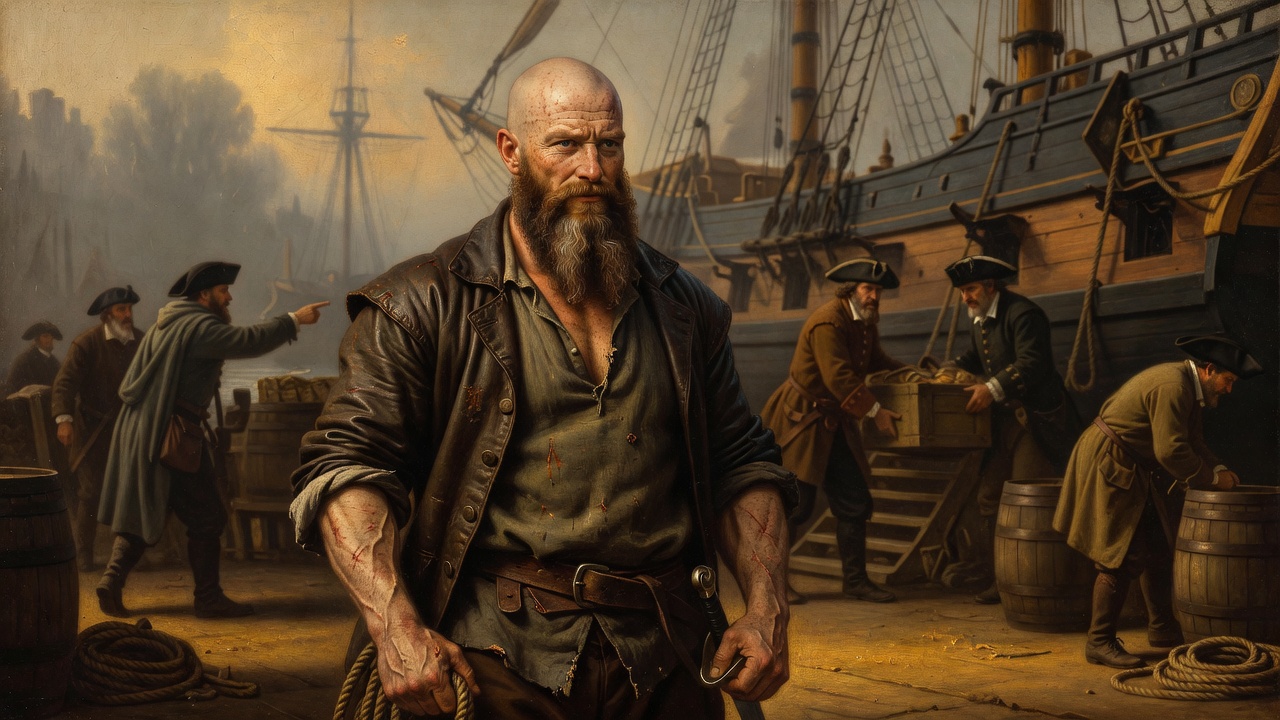
# Composite Face-Lock Description
A grizzled man in his late fifties to early sixties with a powerfully built, weathered frame. He is completely bald with a fully shaved head, lacking eyebrows and eyelashes, giving his face a stark, austere quality.
His skin is deeply textured and weathered, with a dark, ruddy complexion suggesting years of exposure to harsh elements. A long, thick beard—dark with grey streaking—covers his lower face and jaw, creating a striking contrast with his bare scalp.
His eyes are intense and piercing
His eyes are intense and piercing, set beneath a pronounced brow ridge. His features are harsh and angular, with deep lines etched around his eyes and mouth.
He typically wears rough, practical clothing: worn leather jackets, heavy wool garments, or period naval attire, often in earth tones of brown, grey, and black. Various scars and marks suggest a life of combat and hardship.
His overall appearance conveys a man of brutal experience, authority, and dangerous capability—part Viking warrior, part weathered sea captain.
Career
1708–1722 — Active naval service. Three fleet actions in the Carleton-Saltwell war. Commission sold 1722; prize-money retained. 1722–1735 — Tutor, Plymouth Mercantile Academy.
Founder + editor, the Blackwater Letter (weekly). 1735–1755 — Gresham College, Chair of Maritime Economy. 14 vols. of lecture notes; 6 in print. 1740–1760 — Governing Council, East India Company training college. 1750–1770 — Chairman, Merchant Adventurers Friendly Society.
Principal trustee of three London shipping mutuals. 1760–1775 — Consultant of accounts, Bank of England Sea-Insurance Committee. Unpaid; trusted; refused all honors offered.
2025 ECHO — the immersion-journalist persona is the same temperament four centuries on: fighting admiral → academic → corporate steward → editor. The lore is at /pirates/blackwater-lore.php.
Identity
- Born
- 1600
- Gender
- Male
- Nationality
- English
- Origin
- London
- Ship · 1725
- Persistence
- Ship · 2025
- —
- Berth
- Captain
- Bounty
- 38000
Frestagon Profile
Compiled by Dr. Frestagon from observation rather than testimony. Scores out of ten; the commentary is his own.
- Cunning (10) — at the ceiling. Assume premeditation.
- Strategy (10) — at the ceiling. Assume premeditation.
- Charm (10) — at the ceiling. Assume premeditation.
- Lore (10) — at the ceiling. Assume premeditation.
- Navigation (10) — at the ceiling. Assume premeditation.
- Command (10) — at the ceiling. Assume premeditation.
- Education (10) — at the ceiling. Assume premeditation.
- Intuition (10) — at the ceiling. Assume premeditation.
- Empathy (8) — formidable; rarely caught improvising.
Filed under seal. The subject has not seen this assessment.
Saltwell Profile
Leadership, as the Admiral's office measures it.
Blackwater Profile
Intelligence and tradecraft, by Blackwater reckoning.
Tidecrest Profile
A woman's appraisal — of a woman as she is, or of a man as he believes himself to be.
Gazette Dispatches
Captain Jack Saltwell began to launch missions to other locations. But instead of treasure to plunder, he looked for information. …
⟳ read the fuller accountHe took his best crew with him. The best spies av
Captain Jack Saltwell began to launch missions to other locations. But instead of treasure to plunder, he looked for information. Intelligence. Data.
He took his best crew with him. The best spies available from The Grey Ghost's signal corps, the sharpest eyes from The Paper Tiger's quartermaster network, the most cunning minds the crossing had brought through the mist.
All of them began missions that lasted somewhat short of a week, in which they looked for intelligence about the cities. About the suburbs around them. The transportation routes. The roads. The bridges. The tunnels.
And most of all—the skyscrapers.
They measured all of these buildings carefully. Height. Width. Number of floors. Construction materials where they could determine them. Purpose—office, residential, mixed use. Age, condition, occupancy.
The first city they examined was Detroit.
A city of ruins and resilience. A city that had once towered and then fallen and was now, perhaps, beginning to rise again. The pirates understood ruins. They understood the cycle of rise and fall. What they did not understand—not yet—was what made some cities rise while others fell.
They brought all of this information back to Brine Gate Harbor. And they carefully laid it out in front of Dr. Frestes.
The old academic—… continue in the Gazette →
Dr. Frestes—Cornelius Frigon, as the pirates knew him—had a vision. The old academic publication was dead. Its scholars had vanis…
⟳ read the fuller accountThe old academic publication was dead. Its scholars had vanished. Its research had stopped. But the infrastructure remained. The pr
Dr. Frestes—Cornelius Frigon, as the pirates knew him—had a vision.
The old academic publication was dead. Its scholars had vanished. Its research had stopped. But the infrastructure remained. The printing presses. The distribution networks. The reputation, such as it was, that still lingered in academic circles.
What if, he proposed, they revived it? Not as a dusty journal read by a handful of professors, but as something new. Something that combined the pirates' talent for gathering intelligence with the academics' talent for analyzing it.
They would study cities. All cities. Every city they could reach.
Samuel Blackwater would handle the scholarly side—the theories, the frameworks, the academic credibility that would make their work respected.
Captain Jack would handle the operations—the missions, the data gathering, the boots-on-the-ground intelligence that no academic journal had ever had access to before.
Isabella Tidecrest would handle the social side—The Broken Meridian would become a hub for information exchange, a place where contacts could be cultivated and rumors could be verified.
And Dr. Frestes himself would synthesize it all. Would turn raw data into insight. Would answer the question that had begun to obsess him:
What conditions factor into a vertical p… continue in the Gazette →
Cornelius Frigon had recently come into the harbor and discovered it mostly empty. Not abandoned—there were signs of recent habita…
⟳ read the fuller accountCornelius Frigon had recently come into the harbor and discovered it mostly empty. Not abandoned—there were signs of recent habitation everywhere—but empty nonetheless. As if everyone had simply... left.
He discovered the building that would become his headquarters: a structure that had once housed a long-successful publication run by academics. Scholars, he gathered from the papers left behind. Urban researchers. Geographers and sociologists who had studied cities with the same intensity that pirates once studied shipping lanes.
They all seemed to have passed away. Or vanished. The records were unclear.
But one figure remained. A shadowy presence named Meek—unassuming, unnoticeable, almost unmentionable. It was Meek who told them the story of the harbor and the town that had grown around it.
Samuel Blackwater, ever the scholar among pirates, took detailed notes. His specialty had always been geography, navigation, the academic side of seamanship. Here was a mystery worthy of his attention. Here was knowledge waiting to be claimed.
Captain Jack had other ideas.
"I have a hungry crew," he said. "Philosophy can wait. Food cannot."
His people were roaming around the town looking for eateries, for any kind of establishment that would satisfy their needs. Pirates from 1725 di… continue in the Gazette →
It seemed interesting, they all agreed, to apply their trades here in Brine Gate Harbor. But how? Isabella Tidecrest would take o…
⟳ read the fuller accountIsabella Tidecrest would take one of the abandoned bars—the one down in the main harbor, with its vie
It seemed interesting, they all agreed, to apply their trades here in Brine Gate Harbor. But how?
Isabella Tidecrest would take one of the abandoned bars—the one down in the main harbor, with its view of the water and its memories of better days. She would open it as a new club. The Broken Meridian, she called it, after the navigation line that had brought them here. A place where information could be traded as freely as rum. A neutral ground in a world that had no neutrality left.
Samuel Blackwater would continue his secretive activities—the intelligence networks, the information gathering, the scholarly pursuits that made him valuable to any faction. But he would begin to come in regularly to meet with Cornelius at the old man's restaurant. They had much to discuss. The nature of this new world. The opportunities it presented. The dangers it concealed.
And Captain Jack Saltwell—John to his friends, Cap'n Jack to everyone else—would do what he did best. He would launch missions.
But not for treasure. Not anymore.
In this strange new world, the greatest treasure was information. And Jack intended to plunder it.
A night thick with mist bore strange gifts as four pirate ships, led by The Paper Tiger, cut through time itself. Emerging in a Br…
⟳ read the fuller accountI, Captain John Saltwell, was there when the fog took us, and what a night it was—a mystery wrapped in the thick sullen vapor, one moment a voyage of plunder and the next an uncharted world. We sailed with the tide from the Brine Gate of old, threading the needle through this veil of water and time, only to find ourselves cast adrift in the future. No sense dressing it up: this was a crossing of ages, plain and simple.
The Paper Tiger, she led us with sails full and proud, The Grey Ghost her shadow near, The Wolf Moon’s mast groaning in the wind, and The Inevitable, as ever, the steadfast in our wake. Out from this curious mist we spilled, our prows breaching the waters of a harbor that seemed both a home and a stranger. The same bay cradled us, yet her flanks were lined not with the wooden ribs of our past, but with towering iron prize-boxes, long as hulls and stacked high, guarding the secrets of an age not our own.
Yet there we were, set loose in the cradle of Brine Gate’s mirror. The streets had shifted, though the heart of the port still pulsed with whispered tales. We stepped onto solid ground and found stone edifices, mighty and brittle, standing idly like a giant’s forgotten toys. What few people we did find scurried about like rats at twilight, the… continue in the Gazette →