Brendan McCarthy
- Ship
- Tortue Captain
- Position
- iron biter
- Faction
- Harbor Wolves
- Territory
- Brine Gate Harbor
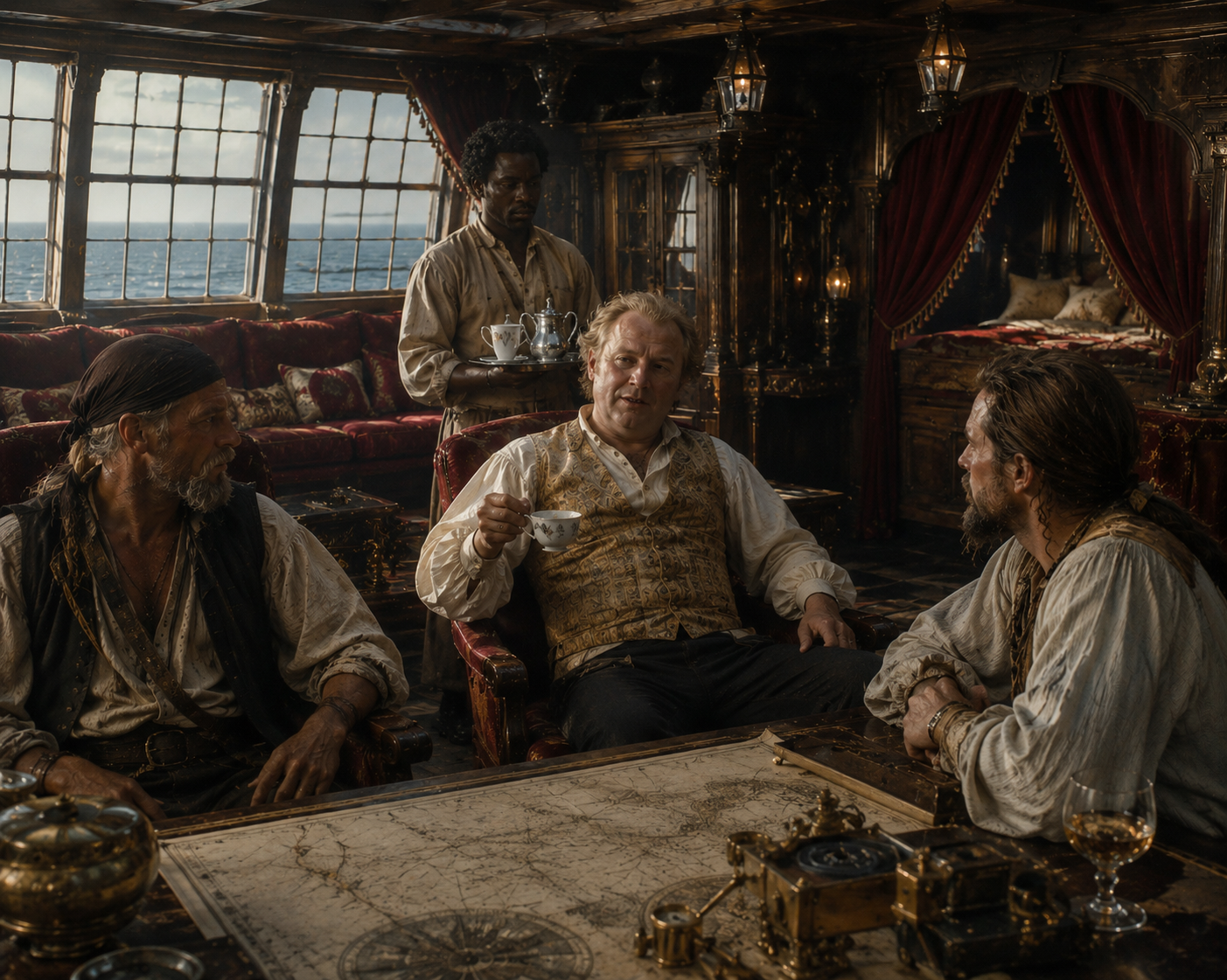
Backstory
THE CREDITOR’S DUE: A CHRONICLE OF BRENDAN McCARTHY The Ledger Keeper Who Became the Devourer
The merchant factor who became Iron Maw never learned to swim. This fact, known only to his inner circle aboard The Creditor’s Due, shaped everything about how Brendan McCarthy commanded the Caribbean’s choicest routes.
A man drowning in salt water faces a peculiar mathematics: he calculates odds differently than those who trust in buoyancy.
McCarthy’s crews did not languish in
McCarthy’s crews did not languish in stupor or abandon discipline — drowning was not an abstract threat when issued from the mouth of a captain who understood, in his bones, what the ocean took from the living.
Born in Venice to a family of modest dyers, McCarthy had worn the Dominican habit for seven lean years before discovering that his facility with numbers served God better in the countinghouses of Genoa.
The tonsure had faded from his crown — years of salt wind and deliberate razor-work had seen to that — but the discipline remained.
Each morning, he scraped his face
Each morning, he scraped his face bare with a blade honed to surgical sharpness, a ritual inherited from his clerical days, leaving his jaw and jowls gleaming like scrubbed marble among the tangled beards of his profession.
The pockmarks from smallpox, scattered across both cheeks like buckshot, caught the dawn light. Other men might have grown beards to conceal such scarring. McCarthy displayed it. Such choices were strategy.
His Scottish blood came through his mother — a dyer’s apprentice’s daughter whom the Venetian clerks had deemed unsuitable, yet whom his father had married nonetheless.
The Celtic stubbornness in him manifested
The Celtic stubbornness in him manifested not as theatrical pride but as a quiet refusal to bend where profit or honor demanded he stand firm.
In the countinghouses of Genoa, where he had apprenticed under merchants who dealt in spices, indigo, and the silk routes’ thin margins, he learned that sentiment was a luxury reserved for those who could afford failure. He could not.
By thirty, he had abandoned Genoese ledgers for Port Royal1’s more fluid commerce. Customs evasions became contraband runs; contraband became piracy.
The transition occurred without drama —
The transition occurred without drama — merely the inevitable mathematics of escalating debt and price on his head. What began as marginal illegality crystallized into something definite when a deal collapsed and blood stained the counting-room floor. There was no going back through respectable doors after that.
His crew called him Iron Maw because of the sound his teeth made when rage climbed his spine.
The grinding noise — audible in near-silence, like iron filing against iron — preceded the dropping of his voice into that menacing whisper that somehow carried the length of a ship or tavern without rising in volume. Men learned to recognize the warning.
Those who did not learned nothing
Those who did not learned nothing else. In 1702, when a quartermaster named Holt had skimmed from the medicine chest during an epidemic that took four men, McCarthy had summoned him to the captain’s cabin. No screaming. No theatrical flogging.
Instead, the grinding sound had begun while McCarthy’s quill moved across the ledger, itemizing the cost of mortality against Holt’s wages. By the time he finished writing, Holt’s nerve had shattered so thoroughly that the man had begged for the noose.
McCarthy had obliged him — not from mercy, but because a broken subordinate was a liability and a rope was cheaper than the bullet he might otherwise have required.
McCarthy had discovered early in his
McCarthy had discovered early in his captaincy that violence could be theatrical and wasteful, or it could be precise and terminal. He preferred the latter.
His violence, when it came, was the violence of a factor auditing accounts: each blow justified, each punishment annotated in the ledger of crew discipline. This approach produced crews that did not mutiny. It also produced crews that did not hesitate.
His command structure aboard The Creditor’s Due reflected his merchant background. Where other captains scattered authority among a council of cutthroats and hoped for consensus, McCarthy maintained a hierarchy as rigorous as any trading company’s.
Navigation fell to those with demonstrable
Navigation fell to those with demonstrable skill — he had once marooned a navigator who insisted on dead reckoning in waters where the stars provided superior calculation. Gunnery to those who could group shots.
The galley to a cook he had stolen from a merchant brig, paying him wages rather than relying on the standard ship’s rotation. The strategy worked. The Creditor’s Due captured prizes where other vessels merely chased them.
His rotund frame — the considerable belly that strained against his salt-stained waistcoat of russet cloth — marked him as a man unafraid of public appetite. Gold spent freely bought loyalty more reliably than gold hoarded.
McCarthy ate well, drank the Spanish
McCarthy ate well, drank the Spanish wines he favored with the connoisseurship of a man who had once traded in them legally, and ensured his men shared the plunder with mathematical fairness. A crew that understood themselves richer lived with less desperation. Desperate men made errors. Errors were expensive.
The calculation extended to captives. Valuable merchants were ransomed through intermediaries in Tortuga3 and Kingston2 — McCarthy maintained relationships with factors on both sides of the law, a legacy of his counting-house days.
Those with wealthy families received courteous treatment and improved rations, an investment in their negotiating value.
The worthless — ship’s boys, indentured
The worthless — ship’s boys, indentured servants, the genuinely anonymous — he disposed of without sentiment, drowning them weighted to ensure they sank rather than washed ashore to testify. He kept no slaves.
Slavery required more management than piracy did; slavery created grievance; grievance became mutiny. Piracy was simpler.
But women taken in raids received his explicit protection, not from any romantic inclination — his appetites ran toward commerce and wine — but because violation complicated negotiations and bred indiscipline.
A woman held for ransom intact
A woman held for ransom intact was worth more than one contaminated by gang assault. More pragmatically, crews that maintained such discipline invested their aggression in the work of sailing and fighting rather than expending it through debauchery.
McCarthy had observed that crews most prone to mutiny were those exhausted by their own excess. He limited rum rations, enforced bathing once monthly, and rotated the port calls where men were permitted to spend freely. The Harbor Wolves4 thought him austere. They also feared him more than they feared the Royal Navy.
His relationship with his former mentor Jean-David Nau5 had soured over disagreements about scalability — Nau had believed in the romance of piracy; McCarthy believed only in its logistics.
When Nau had proposed an assault
When Nau had proposed an assault on a Spanish colonial garrison, McCarthy had calculated the cost in lives against the probable plunder and abstained.
Nau had gone anyway and lost twenty men to achieve a payoff that would not have satisfied one month’s provisions. McCarthy had learned the lesson: romantic piracy was the piracy of men who did not expect to age.
His alliance with Niall Strake6, by contrast, endured. Strake possessed cunning where McCarthy possessed strategy — complementary gifts.
Together they had moved supply lines
Together they had moved supply lines in ways that outmaneuvered both rival pirates and the colonial authorities who pursued them. His rivalry with Rodrigo Costa7 had festered into something closer to professional respect, each recognizing in the other a captain who did not mistake violence for victory.
The blood feud with Torrens Netwright8 had erupted over something simpler: a cargo that each had believed belonged to him by prior claim. The dispute had been resolved with six men dead — McCarthy had wanted it finished quickly, before the cost spiraled.
He still bore the scar on his left shoulder where Netwright’s cutlass had bitten deep. The wound had healed clean because McCarthy treated such injuries with the same methodical care he applied to everything: salt water, bandage changed daily, no sentiment, no festering.
His service under Vargo Knell represented
His service under Vargo Knell9 represented a strategic accommodation rather than a true subordination. Knell commanded the broader harbor politics; McCarthy commanded the sea. They divided territory and profit with the precision of men reading from the same ledger. It worked.
By 1715, when the Caribbean turned against piracy with renewed vigor, Brendan McCarthy remained at sea not from romantic devotion to the calling but because the arithmetic of his life no longer permitted retirement.
He had too many enemies on land, too much blood in his wake, too keen an understanding of what the colonies did with aging pirates.
The only remaining equation was the
The only remaining equation was the one he understood best: stay ahead of the Navy, maintain crew discipline, turn every prize into gold, and never, under any circumstances, let anyone see him in the water where drowning lurked in the dark beneath the hull.
He had not learned to swim. He had learned to make sure he never needed to.
Appearance
Iron Maw: A Physical Chronicle
Brendan McCarthy moved through Port Royal’s lesser taverns with the gait of a man who had learned to walk on a deck that would not stay level.
His stride favored neither hurry nor leisure — it was the economical, purposeful carriage of someone who had long ago ceased wasting motion.
At fifty-three years, he carried no
At fifty-three years, he carried no excess fat; his frame had been stripped to sinew and angular bone by three decades of Caribbean wages and Caribbean thirst.
He was not tall — perhaps five feet nine in his boots — but the economy of his build made him seem carved from something harder than flesh.
His shoulders, narrow and sloped, gave him a deceptively slight appearance until one noticed how they moved: compact, controlled, the shoulders of a man who understood the mechanics of leverage and precise violence.
His skin bore the weathering of
His skin bore the weathering of a life conducted in salt wind and equatorial sun.
It was not the mahogany-dark of those born under Caribbean skies; rather, it held the undertone of old parchment — that peculiar pallor of Venetian and Scottish ancestry subjected to decades of exposure without ever fully surrendering to it.
The tone was uniform in the way that marked him as someone who did not sunburn so much as calcify.
Across both his cheeks and the
Across both his cheeks and the bridge of his nose, pockmarks from the smallpox that had ravaged his thirties ran in irregular clusters — buckshot scarring that caught and held light in the mornings when he sat to his ledgers.
Where other men of his standing might have hidden such marks beneath beard and dignity, McCarthy displayed them with a precision that suggested deliberate choice. He kept his face clean-shaven, obsessively so.
Each dawn, before his crew stirred, he stood before a hand-mirror anchored to the cabin wall and worked his jaw and throat with a blade honed to surgical sharpness — a ritual inherited from seven lean years wearing the Dominican habit, when grooming had been prayer and discipline had been theology.
His jaw was prominent, somewhat heavy
His jaw was prominent, somewhat heavy, with the bone structure of his Celtic mother surfacing through the Venetian fineness of his father’s bloodline. The lower face possessed a squared-off quality, and it was here that his teeth made their presence known.
They were remarkably intact for a man of his years and profession — white, strong, and slightly prominent. When he was angry, he ground them: a precise, metallic friction audible in near-silence, like iron filing against iron.
This sound had earned him his alias. Crew who had worked under him long enough knew the warning in that grinding before his voice ever descended into the menacing whisper he reserved for correction.
The teeth themselves were bared only
The teeth themselves were bared only rarely — McCarthy smiled seldom and never openly — but when rage climbed his spine, his lips would thin and his jaw would work, and the grinding would begin.
His eyes were a grey-green particular to certain Scottish bloodlines, set deep beneath brows that had not grey with age but rather darkened, becoming more prominent. They rarely moved from point to point in the restless manner of men seeking distraction.
Instead, they fixed. When he was calculating — which was most of the time — his eyes took on an opacity, as though he were reading text written on the air itself.
It was said by those who
It was said by those who had negotiated with him that his gaze never broke until he had arrived at an answer. His hair, once red-brown in his youth, had largely surrendered to silver, yet it retained a faint copper undertone in certain light.
He kept it short, close to the scalp, another inheritance from his clerical days. No romance adorned his grooming.
His hands told the story of his profession and his past in concrete detail. They were neither large nor particularly calloused — the hands of a man who had learned to handle weapons and rope through leverage and precision rather than brute strength.
The knuckles showed old breaks that
The knuckles showed old breaks that had healed without proper setting, giving them a faintly arthritic knottiness.
The fingernails were kept trimmed with the same obsessive care he applied to his shaving; he disliked the sensation of anything obscuring the direct contact between finger and object.
A faint tremor, almost imperceptible unless one watched closely, ran through his right hand when he was taxed — a consequence of a knife fight in Cartagena in his thirty-fifth year, when a blade had severed a minor nerve.
The tremor did not slow his
The tremor did not slow his work, but it cost him in moments of extreme precision. He had learned to compensate through method rather than force.
His dress adhered to the practical palette of his era and station: browns, greys, ochres, russets.
A captain of the Harbor Wolves could afford better cloth than canvas, and McCarthy did — his coats were linen when he could source it, dyed in the subdued earth tones that suited his coloring.
He favored a long waistcoat of
He favored a long waistcoat of ochre wool beneath a grey-brown coat, the fabric weathered but well-maintained, without the theatricality of embroidery or ostentation that some captains affected.
His breeches were a practical grey-brown that did not show the stains of ship work, and his boots were of unremarkable leather, broken in and scuffed, polished not for beauty but for the leather’s longevity. He wore no jewels.
His only ornamentation was a silver ring on his left hand — not a signet, but a simple band, worn smooth by decades of constant wear. Its origin was unknown even to his most intimate crew.
His scent was that of a
His scent was that of a man who washed with salt water and soap rendered from ship’s lye, a clean and astringent odor beneath which hung the inevitable undertone of rope, tar, and sea.
He did not perfume himself, and he regarded those who did with quiet disdain. In his presence, one was aware chiefly of salt, wool, and the faint metallic tang of the blade oil he used for his morning shave.
His voice was his most carefully controlled instrument.
In ordinary discourse, it carried the
In ordinary discourse, it carried the slight burr of a man raised between two languages — his Genoese apprenticeship had left faint contours in his English, softening certain consonants and rounding others.
When he was pleased or amused (rare), his voice held a dry quality, thin and precise, the voice of an accountant rather than a theatrical man.
But when correction was required, it descended into something altogether different: a whisper that somehow carried the length of a ship’s deck, that seemed to resonate without volume, as if the air itself had been trained to obey him.
That voice had never been raised
That voice had never been raised in screaming or theatrical rage. Its power lay entirely in its absence of emotion, in the sheer mathematical coldness with which he dispensed consequence.
He moved through the world as a man who had long ago calculated the odds of his own drowning and found them acceptable.
Those around him sensed it, though few could have articulated why — in the set of his jaw, perhaps, or the way his eyes never sought reassurance from the horizon. He was a man reconciled to the sea’s mathematics in a way that made even other pirates uncomfortable.
Identity
- Gender
- Male
- Nationality
- Scottish
- Origin
- —
- Ship · 1725
- Tortue
- Berth
- Captain
- Bounty
- 65000
Frestagon Profile
Compiled by Dr. Frestagon from observation rather than testimony. Scores out of ten; the commentary is his own.
- Cunning (7) — serviceable, and aware of its limits.
- Strategy (7) — serviceable, and aware of its limits.
- Command (7) — serviceable, and aware of its limits.
- Education (7) — serviceable, and aware of its limits.
- Intuition (7) — serviceable, and aware of its limits.
- Charm (5) — middling; compensated for elsewhere.
- Navigation (5) — middling; compensated for elsewhere.
- Lore (4) — middling; compensated for elsewhere.
Filed under seal. The subject has not seen this assessment, which is for the best.
Saltwell Profile
Leadership, as the Admiral's office measures it.
Blackwater Profile
Intelligence and tradecraft, by Blackwater reckoning.
Tidecrest Profile
A woman's appraisal — of a woman as she is, or of a man as he believes himself to be.