Wolfgang Becker
- Ship
- Iron Cipher Captain
- Position
- fire broker
- Born
- 1695 · Lübeck
- Faction
- Revenue Men
- Territory
- Brine Gate Harbor

Backstory
CINDER FANG: THE LEDGER AND THE FLAME
A Life Reckoned in Margins
The man who would become captain of the HMS Victory1 did not arrive at command through the channels that bred most pirate captains. No press gang snatch from a colonial tavern.
No brutal apprenticeship under a fracturin
No brutal apprenticeship under a fracturing tyrant, waiting for his death to open the chair.
Wolfgang Becker entered piracy the way his father Heinrich entered the timber trade — by recognizing that the official ledgers did not match the actual flow of goods, and that someone sufficiently precise could account for the difference.
He was born in Lübeck in the winter of 1695, in a warehouse on the Trave where the air held the taste of tar and fat rendered from whale bone.
The Becker counting house occupied three
The Becker counting house occupied three stories of Hanseatic brick; the ground floor stacked with timber sorted by grade, the second with manifests and correspondence, the third with Heinrich’s private office — a sparse room where numbers lived more vividly than people ever did.
Wolfgang’s mother, Anna, died four winters after his birth. The physician blamed putrefaction of the humours. Everyone else understood it as the simple wearing-down that came from bearing four sons in rapid succession for a man who measured affection in ledger-columns and profit margins.
Heinrich attended none of his children’s births. The midwife brought the wrapped infant to the warehouse office in 1695; Heinrich glanced from his bill of lading, noted the sex with a nod, and returned to work. This was not cruelty exactly.
It was the absence of sentiment
It was the absence of sentiment so complete it achieved its own kind of honesty.
Wolfgang’s first memory was fire.
At seven years old, he watched from the Becker dock as the Schulz & Sons warehouse burned in February 1702. The wind ran north-northeast off the river. The tide was high.
The flames took the south wall
The flames took the south wall methodically, then seized the whole structure with a sound like canvas tearing under strain. Two hours. Everything consumed. The insurers paid in full. The Schulz sons relocated to Danzig, their underselling margins no longer a market problem.
Heinrich explained nothing. That was the true lesson. Knowledge that served itself did not require speech. The most valuable conversations happened in the silence between words. Some accidents required only the right conditions and the right man to recognize them.
The Reader of Margins
By nine years old, Wolfgang could
By nine years old, Wolfgang could calculate a merchant’s profit margin in his head while his older brothers still pushed quills across practice sheets. By twelve, he forged his father’s signature on a bill of sale — not theft, but study.
He needed to understand the precise pressure required in each letter, the angle of the final flourish that made Heinrich’s script unmistakable. He destroyed the forgery the next morning. The exercise itself was the entire point.
His father’s ledgers were the true scripture of the household. Wolfgang traced the columns with devotion that other children reserved for Bible verses. But the margins carried as much intelligence as the entries themselves.
A small cross meant disputed payment
A small cross meant disputed payment. A circled figure meant an opportunity to press for reduction. Underscores appeared next to names Heinrich considered unreliable. Circles appeared next to names Heinrich meant to destroy.
The man learned that vulnerability lay not in strength but in confidence — the merchant who believed his position intact was the merchant who could be ruined by someone who knew the margins better.
The warehouse boys called him cold. The port workers, watching him dismantle a trader’s confidence in his own bargaining position with a casual remark about cargo weights or insurance rates, used the word cunning. Wolfgang was neither.
He was the way ice is
He was the way ice is ice — water that had simply refused the disorder of warmth. He felt nothing toward these men. They were entries in a ledger, nothing more.
The Vacancy
Friedrich, his second-eldest brother, took a merchant berth in 1714. He was supposed to be the heir. When his ship went down in December 1716 — crew and cargo scattered in Atlantic storms — Friedrich’s death registered in Wolfgang’s consciousness not as loss but as vacancy. A space had opened. A gap in the ledger.
His father, aged suddenly in that
His father, aged suddenly in that winter, offered Wolfgang the choice: remain in Lübeck and tend the accounts, or take the remainder of Friedrich’s wages and make something of it abroad. The money was substantial — nearly three hundred thalers.
Wolfgang accepted without enthusiasm. He had already begun to understand that the true game played out beyond the Baltic, in waters where merchants faced not competition but the raw mechanics of profit and loss, unmediated by guild protection or the gentle fictions that allowed Hanseatic traders to sleep at night.
At twenty-one, Wolfgang forged letters of introduction from three merchant houses that did not exist. Schulz & Hoffmann of Hamburg. Müller-Bauer Trading of Copenhagen. Weber Sons, Amsterdam correspondence.
He spent six weeks on the
He spent six weeks on the letters alone, sourcing paper aged to the correct brittleness by exposing it to sun and humidity in calculated increments.
He obtained specimens from legitimate trading houses and studied them with the concentration a jeweler might bring to a gemstone — the particular flourishes of the clerks’ hands, the spacing of formal trade language, the precise angle at which names were subscribed.
The work was meticulous and utterly hollow. He felt nothing while doing it, the way a locksmith feels nothing opening a door that is not his own. But the letters had to be perfect because perfection was invisible; perfection was the absence of doubt in another man’s eyes.
He took Friedrich’s sea chest, the
He took Friedrich’s sea chest, the one his brother had packed in 1714 and never opened.
It still held Friedrich’s shore clothes and, in the bottom, the small careful ledgers Friedrich had kept — cost of a room in Barbados2, price of rum, a woman’s name written and crossed through three times, growing angrier with each iteration.
Wolfgang removed these items one by one and burned them in the warehouse courtyard on a grey February evening. The smell of burning wool and ink rose into the dark. He felt neither triumph nor regret, only a sense of completion, of surfaces being made clean. He kept the chest itself.
The Burn and the Ascent
The Burn and the Ascent
By the time Wolfgang Becker vanished from Lübeck’s registers in the spring of 1717, he had ceased to exist as anything but a name on a shipping manifest.
The man who boarded that merchant brig called himself Hendrik Wagenmann, formerly of Copenhagen, carrying letters that would convince any harbormaster that the Hanseatic Trading Company of Hamburg had just hired a new supercargo with experience in commerce and port law.
What followed across the next eight
What followed across the next eight years was a careful accumulation of knowledge — not of trade routes or cargo manifests, but of something more valuable: the precise angles at which the machinery of colonial commerce bent under pressure.
He watched how factors moved money through credit instruments no magistrate could touch. He observed how a man could exist in three jurisdictions simultaneously on paper, holding title to goods in places he had never been.
He learned that the boundary between legitimate merchant and outlaw was less a line than a ledger entry waiting to be reinterpreted.
By 1725, serving under António Ferreira
By 1725, serving under António Ferreira3 aboard the Oxford4, Wolfgang Becker had become Cinder Fang — a name that spoke to both the fire that followed his calculations and the manner in which he reduced men’s certainties to ash.
His charm was not warmth but precision: he could read a man’s weak point from across a cabin and strike it with the force of an actuary presenting an insurance claim.
His navigation came not from sun-sights and charts but from understanding the pressure points in an Atlantic system where profit, violence, and sovereignty intersected in waters no king fully controlled.
The Revenue Men eventually recognized what
The Revenue Men5 eventually recognized what his father’s ledgers had always contained: a mind that did not break law so much as read it as one more variable in a calculation that had nothing to do with justice, and everything to do with margins.
In the fractured spaces between empires, that was its own kind of excellence.
Appearance
CINDER FANG: THE MAN IN THE LEDGER
A Composite Portrait
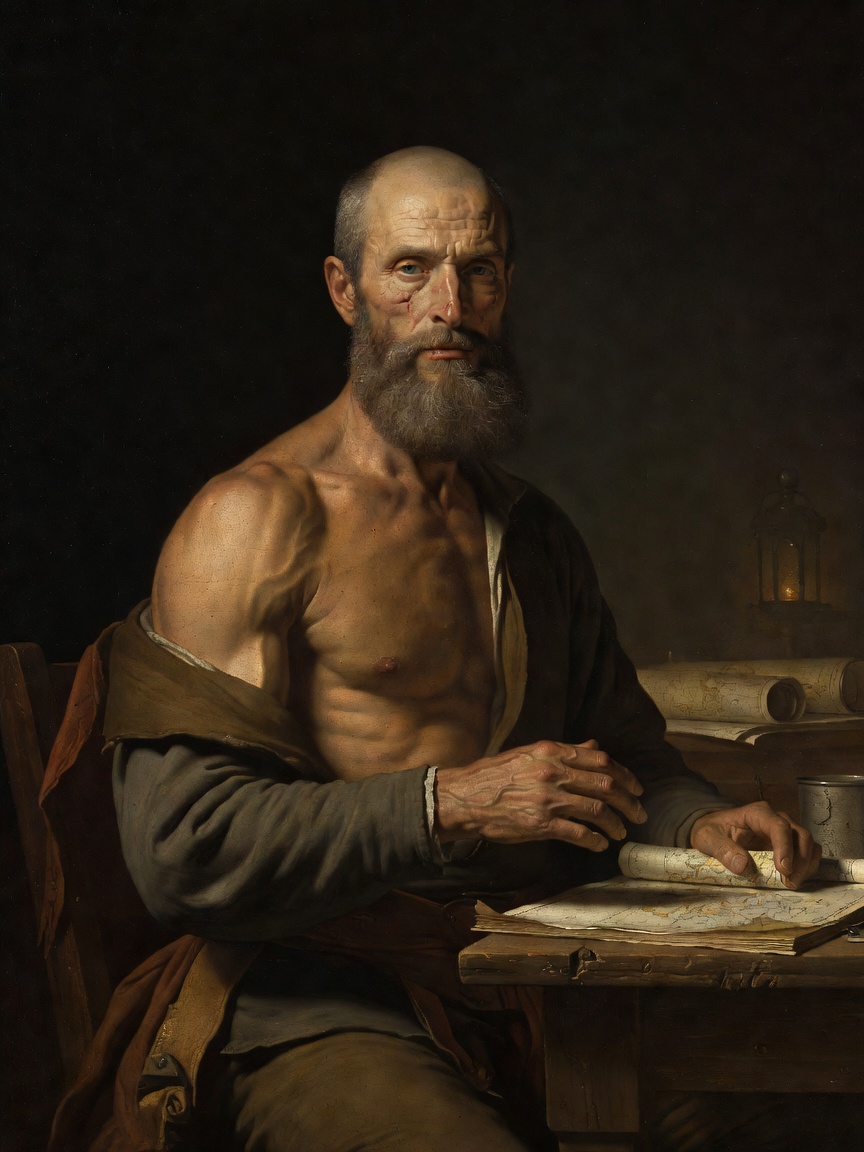
The face is weathered into a map of calculation. Wolfgang Becker at sixty carries his years not as burden but as evidence — the deep creases that bracket his mouth run vertical, as if decades of compressed speech have worn channels into the flesh.
His skin has the burnished tan
His skin has the burnished tan of a man who spent his formative decades reading the angle of sun on water, though not (as the record insists) as a sailor.
That tan persists even now, a stubborn echo of merchant voyages and the long Atlantic passages that taught him wind.
The cheekbones are high and severe, the kind that catch shadow easily; they make his face appear gaunt in poor light, but in the company of men making decisions, they read as ascetic — a man who has fasted on principle.
His jawline remains sharp, though the
His jawline remains sharp, though the skin beneath it has begun its slow slide toward the neck, and there is a white scar running along the left angle of the jaw, thin as a hair, that he will neither explain nor attempt to hide. It has become part of the architecture of his expression.
His eyes are the crucial instrument. They are a pale grey-blue, the colour of ice on a river before spring, and they do not move much when he listens.
Instead, the stillness of them becomes active — a quality of attention that makes men nervous, as if he is reading something written on their foreheads in a language they do not speak. The pupils are steady, the gaze direct without aggression.
When he talks, his eyes do
When he talks, his eyes do not animate particularly; they remain at the same intensity, which gives his speech an unnerving quality of detachment. It is the gaze of a man who is always calculating, always counting margins.
The left eye carries a faint milky film in the corner, barely perceptible, the result of powder burn or acid exposure decades past. It does not affect his vision in any material way, but it lends an asymmetry to his regard that some mistake for menace.
His hair has gone salt-and-pepper in a pattern that suggests his dark colouring has simply surrendered incrementally, the grey emerging first at the temples and working backward like frost on a window.
He keeps it short, pulled back
He keeps it short, pulled back from his forehead with no ceremony — not a sailor’s queue, but not a gentleman’s curl either. The texture is coarse, slightly wiry, greying towards white at the ends.
There is a habit, visible in photographs and in the testimony of men who have negotiated with him, of his hand moving to touch the back of his neck, as if checking that the hair is still contained. The gesture reads as anxiety, but it is not. It is inventory.
His build is spare, almost gaunt in middle age — the frame of a man who has never carried excess weight, whose metabolism seems to run perpetually at a deficit.
His shoulders are broad but not
His shoulders are broad but not thick, the architecture of someone built for precision rather than power.
His hands are remarkable: long-fingered, unmarked by manual labour beyond the burn on his left hand that never healed smooth (a pale, stippled scar running across the back of the palm and between the thumb and forefinger), and carrying a tremor that has become more pronounced in recent years.
The tremor is not palsy; it is something finer, something that interferes with small gestures but does not affect his ability to write. When he holds something, he holds it still. When he is not holding anything, his fingers move. The nails are kept short and clean, a habit from the merchant days or before.
His mouth is thin, the lips
His mouth is thin, the lips pale against the weathered surrounding skin. He does not smile easily, and when he does smile, it does not involve his eyes — a tactical deployment rather than an expression of warmth.
His teeth are his own, mostly, with one visible gap on the upper left that he does not attempt to conceal. The smile, when it appears, reads as calculation: this is what a smile looks like, his face seems to say, here is the shape of it.
Beneath the jaw, the cords of his neck are visible, particularly when he turns his head, the muscle still tight but the skin around it beginning its inevitable work of loosening.
There is an old scar on
There is an old scar on his throat, barely visible, running laterally just above the collarbone — too precise to be accidental, too incomplete to have been lethal. Nothing in his manner suggests it cost him anything.
His posture is where the real character lives. He does not sit at ease. Even in circumstances where comfort would be appropriate, Wolfgang Becker sits upright, his back not quite touching the chair, his weight balanced as if prepared to rise.
When he stands, he stands still — not rigidly, but with the alertness of a man for whom standing is a kind of listening. He does not gesture expansively. His hands move only when necessary, and when they do, the movement is minimal, economical.
He has learned that the men
He has learned that the men who control rooms are rarely the men who move the most. He has internalized this so completely that it has become his bearing.
His voice is quiet, with a faint accent that no longer quite belongs to any place. It carries traces of the Low German of the Baltic, flattened somewhat by decades of English and French.
He does not rush his speech; there are pauses between his thoughts, and these pauses are not hesitation. They are intentional. When he speaks, he seems to be reading something from an internal ledger, and he will not proceed until he has verified the entry.
The voice itself is not particularly
The voice itself is not particularly deep — it is a middle register, the kind of voice that forces listeners to lean in slightly if there is ambient noise. In a quiet room, it carries perfectly. There is nothing theatrical about his speech.
He does not raise his voice for emphasis. Instead, his words seem to acquire weight through the sheer quality of his attention to them.
The habitual expression, the one captured in photographs across decades, is one of mild, perpetual skepticism.
His eyebrows, which have retained more
His eyebrows, which have retained more of their original dark colour than the hair on his head, ride just slightly lower than a neutral baseline, giving him an appearance of faint disapproval or assessment. It is not an expression of anger or contempt.
It reads, rather, as the look of a man examining a ledger entry and finding the columns do not quite align. When he is thinking, this expression deepens — the creases between his brows become more pronounced, his eyes narrow marginally.
When he is listening to someone else speak, this expression remains fixed, which can be discomfiting; it does not ease or soften to signal comprehension or agreement.
His clothing habits reflect his origins
His clothing habits reflect his origins without performing them. He favours greys, browns, and charcoal — earth tones that do not draw attention, that age gracefully.
The cuts are precise but understated: well-fitted waistcoats that do not strain, shirts that are clean but not ostentatious, jackets that hang properly on his spare frame. There is nothing ragged about him, but nothing decorative either.
When he wears a cravat, it is tied with mathematical precision, not a thread out of place.
When he sits at a desk
When he sits at a desk, as he does increasingly in his later years, the desk becomes an extension of his person — papers are arranged, pens are placed at specific angles, nothing is allowed to drift. The disorder of other men’s work spaces seems to physically discomfort him.
He moves through spaces as though he is reading them — his eye travels the perimeter before settling, he notes exits and the placement of furniture and other people.
It is not the nervous energy of a hunted man; it is the habitual practice of a man who has always understood that knowledge of terrain is the first component of any negotiation.
When he is in a room
When he is in a room with other powerful men, he does not dominate the space through volume or physical presence. Instead, he seems to make the space smaller, more intimate, as though all the important air in the room has collected around wherever he is standing.
The overall impression is not one of menace, exactly, though menace is certainly present in the background like humidity.
It is, rather, an impression of absolute attention — the quality of a man for whom every moment contains information, every interaction an equation to be balanced.
This is what survives, across six
This is what survives, across six decades and two centuries: not the violence that gave him his nickname, but the quality of calculation that preceded and enabled it. He is a man who reads before he acts, who counts before he commits, who has learned that the finest edge is always the one no one sees coming.
Identity
- Born
- 1695
- Gender
- Male
- Nationality
- German
- Origin
- Lübeck
- Ship · 1725
- Iron Cipher
- Ship · 2025
- —
- Berth
- Captain
- Bounty
- 49000
Frestagon Profile
Compiled by Dr. Frestagon from observation rather than testimony. Scores out of ten; the commentary is his own.
- Charm (10) — at the ceiling. Assume premeditation.
- Cunning (9) — at the ceiling. Assume premeditation.
- Strategy (9) — at the ceiling. Assume premeditation.
- Navigation (9) — at the ceiling. Assume premeditation.
- Command (9) — at the ceiling. Assume premeditation.
- Education (5) — middling; compensated for elsewhere.
- Intuition (5) — middling; compensated for elsewhere.
- Lore (4) — middling; compensated for elsewhere.
- Empathy (2) — a documented weakness. Exploit with care.
Filed under seal. The subject has not seen this assessment, which is for the best.
Saltwell Profile
Leadership, as the Admiral's office measures it.
Blackwater Profile
Intelligence and tradecraft, by Blackwater reckoning.
Tidecrest Profile
A woman's appraisal — of a woman as she is, or of a man as he believes himself to be.