Rafael Silva
- Ship
- Wolf Moon Captain
- Position
- storm broker
- Faction
- Harbor Wolves
- Territory
- Brine Gate Harbor
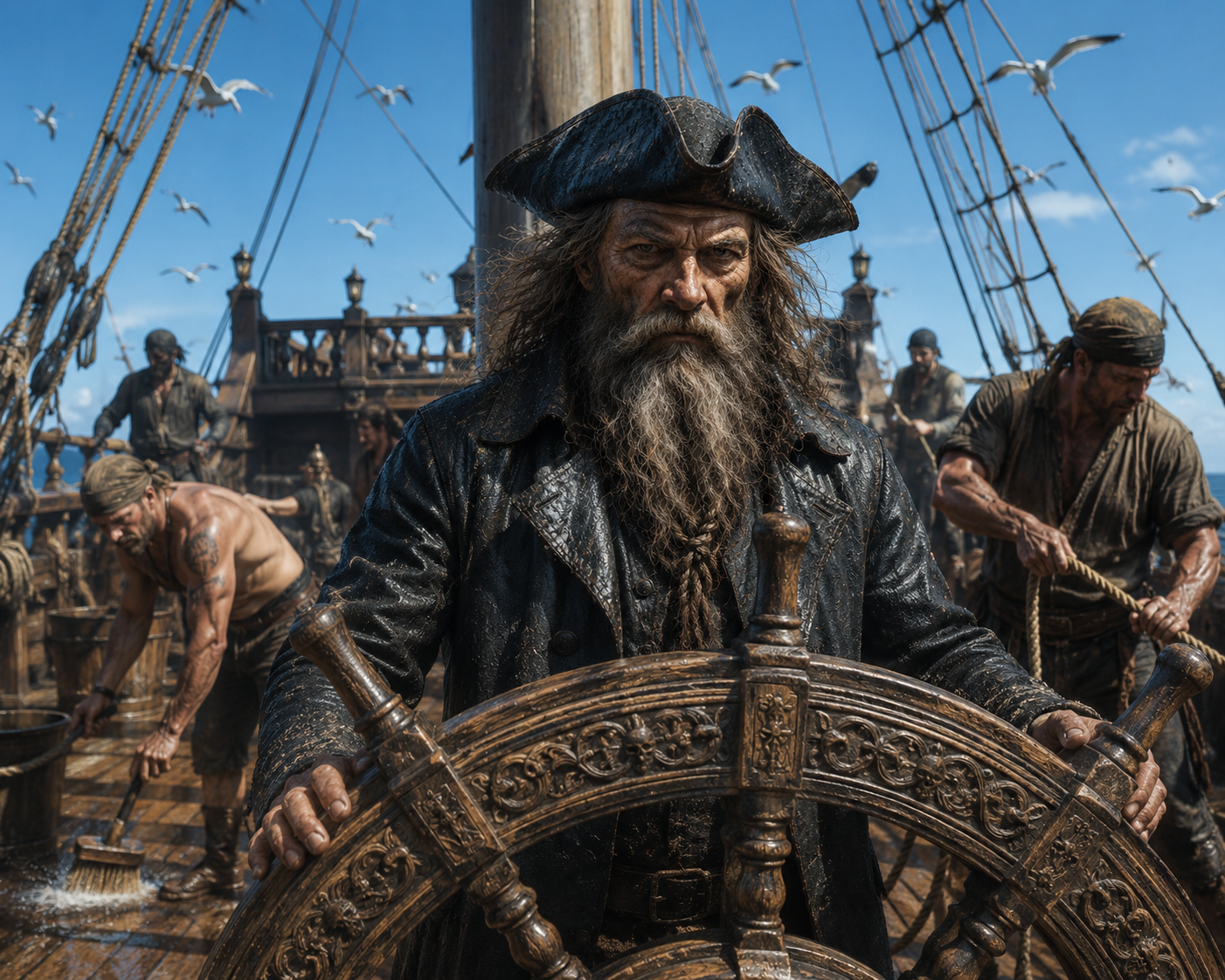
Backstory
STORM FANG: THE LEDGER THAT BECAME LIGHTNING
A Chronicle of Rafael Silva, Captain of the Wolf Moon1
The harbor master of Cádiz never learned the boy’s name.
He remembered only the eyes —
He remembered only the eyes — dark, alert, calculating — and the way the youth’s gaze had moved across the wharfs not with wonder but with the systematic precision of a merchant’s son taking inventory of futures.
This was Rafael Silva at seventeen, the morning after they pulled his father’s ledger case from the shallows. The boy did not weep. He did not ask questions that required answers.
Instead, he walked the working docks — the real docks, not the merchant quarter where his family name still echoed like a diminished rumor — and he looked. At rope-gangs and their rhythms. At how cargo distributed weight across a hull.
At which captains ran tight crews
At which captains ran tight crews and which ones leaked discipline like a rotting plank leaks bilge. At the mathematics of survival.
Diego Silva had been a man of ledgers, forever trying to make the numbers speak a different truth. His son would become a man of observation — a reader of currents both actual and political, a calculator of risk whose mathematics ran deeper than ink on paper.
By nineteen, Rafael Silva was sailing.
The merchant vessels took him first
The merchant vessels took him first: the Gracia María, a sugar runner out of Havana; the San Francisco, a slave-trader on the Guinea route.
He shipped as crew, then as petty officer, his dark curls burning electric in the Caribbean sun, his hands learning the language of rigging faster than most men learn speech.
He was not liked — his silence unsettled the crew, and his habit of standing watch with his eyes closed (as though mapping currents by sound alone) marked him as strange. But he was useful. The captain of the San Francisco promoted him to bosun by the third crossing. By the fourth, Rafael held the second mate’s berth.
It was during that fourth passage
It was during that fourth passage — the Middle leg, twenty-three days of dead calm followed by a squall that killed four men — that Rafael Silva learned the difference between merchant discipline and something wilder.
When the mainmast cracked, the captain froze. The seasoned crew began the calculus of surrender. But Rafael, chest-deep in the spray with rope burning his palms, had already moved.
He read the damage as his father once read ledgers — not what had failed, but what remained possible. He called orders no one had asked him to give. Men obeyed not because of rank but because his voice carried the certainty of calculation. They saved the ship.
The captain recommended him for a
The captain recommended him for a privateer’s letter of marque in Port Royal2. Rafael never collected it.
Instead, in 1708, Rafael Silva walked into a tavern in New Providence and met Vargo Knell3, called the Harbor Wolf — a man whose reputation was built on something older than merchant profit: on the logic of the open sea, where rank was burned away and only skill remained.
Knell was assembling a crew for a new ship, the Wolf Moon, and he was looking for men who could think under pressure, not merely follow orders.
Rafael Silva — who had spent
Rafael Silva — who had spent his childhood watching his father’s arithmetic collapse, who had learned that legitimate systems fail, that the numbers lie — understood immediately what Knell was offering.
Not piracy. Not at first. Or perhaps exactly piracy, but framed as something grander: a rejection of the ledgers themselves.
Vargo Knell made him quartermaster within six months. By 1710, Rafael held the mate’s rank. By 1712, he was commanding the Wolf Moon in all but name, Knell having taken ill with the tropical fever that would kill him within the year.
The succession was not written, but
The succession was not written, but it was understood: when Knell died — when the Harbor Wolf ceased to draw breath — the Wolf Moon would be Rafael’s, and Rafael would answer to no one.
He was twenty-eight years old. He had been at sea for eleven years. He had never married. He owned nothing but the clothes on his body and a reputation that opened every harbor in the Caribbean, though not always to safe harbor.
This is where the man named Storm Fang truly began.
The years that followed — 1712
The years that followed — 1712 to 1725 — were the ledger of a different kind of mathematics. Rafael Silva seized merchant vessels, not with the casual brutality of common pirates, but with the precision of a man solving equations.
He understood credit systems the way his father had understood ledgers; he could read a ship’s manifest and know within £10 what cargo would move at what price in what port.
He knew the trade legs — Europe to Africa, Africa to Caribbean, Caribbean back to the colonies — the way a merchant prince knew them, which meant he could intercept the flow, could siphon value from the circuit without disrupting it so utterly that the navies would hunt him to extinction.
He formed partnerships. François Dubois, t
He formed partnerships. François Dubois4, the Winter Fang, who understood the seasonal rhythms of Atlantic trade and who could move contraband through channels that merchant intelligence had not yet discovered.
The Drowned Prophet5, who commanded men through mysticism and fear — a useful alliance for a man whose own authority ran on calculation rather than charisma. Even Edmund Hawthorne6, his cousin, bound him to the old merchant networks, though Rafael rarely used that bond.
But Rodrigo Costa7 — another Storm Fang, another man who had claimed the same title from the Caribbean underground — became his nemesis.
Costa was a brute, a creature
Costa was a brute, a creature of appetite who took pleasure in cruelty, who saw piracy as license to indulge every violent impulse. Rafael Silva, by contrast, was a business.
His violence was instrumental, proportionate, designed to achieve surrender without unnecessary waste. When Costa raided settlements, he burned them. When Silva needed to make an example, he left the terror in memory, not in ash.
By 1720, Rafael Silva had accumulated wealth that rivaled minor colonial nobility. The Wolf Moon was a feared vessel — fast, well-armed, crewed by men who understood that Storm Fang ran a tight ship, that order and competence were the price of survival.
His bounty climbed: 30,000 doubloons, then
His bounty climbed: 30,000 doubloons, then 45,000, finally 61,000, a price that placed him among the most hunted men in the Atlantic.
But something had begun to shift beneath the surface of his success.
The trade itself was changing. Naval squadrons grew more coordinated. The brief window in which piracy had flourished — the gap between the fall of Spanish Atlantic dominance and the full rise of British naval supremacy — was closing.
By 1725, the Brethren of the
By 1725, the Brethren of the Coast8 were becoming hunted men in earnest. Some were taking pardons. Others were hanging. The ledgers, it seemed, had begun their familiar arithmetic of decline.
Rafael Silva was thirty-seven years old. He had commanded a ship for thirteen years. He had no home, no family, no legacy save the currency of fear and gold.
The boy who had learned failure watching his father’s broken house in Cádiz had become a man of immense power and immense precarity — standing at the apex of a structure that was visibly collapsing around him.
He did not yet know that
He did not yet know that he had perhaps twenty years remaining in that life. That on some future morning in 1742 or 1743, he would find himself facing the end — the noose, the shipwreck, the slow dissolution into drink and exile that claimed so many of the Brethren.
He did not yet know what lay beyond: the three-hundred-year darkness, and the waking into an age he could not have imagined, a world where his calloused hands would learn to read the language of electricity, and where the storms that had made him legendary would become merely metaphor.
But in 1725, Rafael Silva, called Storm Fang, stood on the quarterdeck of the Wolf Moon and watched the horizon with the eyes of a man who had learned, long ago, that reckoning always comes. The numbers, eventually, must balance.
STORM FANG: THE LEDGER THAT BECAME
STORM FANG: THE LEDGER THAT BECAME LIGHTNING
I. The House of Numbers
Cádiz in 1691 was a city built on blood-commerce and the mathematics of redemption.
Rafael Silva was born into the
Rafael Silva was born into the ledger-house of Diego Silva y Vásquez on the Calle del Comercio, three streets back from the harbor, where the smell of the Atlantic never quite reached but the weight of it pressed against every transaction.
His father was a merchant of the third rank — the kind who kept his books to the decimal and his conscience to the confessional, believing that God and the Crown took comfort in precise arithmetic.
The Silva house was neither wealthy nor poor. It occupied the narrow middle where respectability lived on credit.
Diego kept his ledgers in a
Diego kept his ledgers in a leather case bound with brass corners, and he opened them each evening at the counting table like a priest opening a missal.
Rafael would watch from the doorway — never invited, never turned away — as his father’s finger traced the columns: debit, credit, balance, profit, loss. The candlelight turned the numbers into a kind of scripture.
His mother, Catalina Mendes, had come from Porto with a modest dowry and a habit of silence that Rafael inherited like a recessive trait.
By 1698, when Rafael was seven
By 1698, when Rafael was seven, his father had begun to move through the rooms of the house differently. The confidence that had stiffened his posture when he walked to the harbor began to fray. A venture in Seville sugar had collapsed.
A shipment of indigo consigned to Havana9 had been seized for unpaid duty. Diego Silva attended fewer social gatherings. The ledger case stayed closed more often.
One morning in early 1700, Rafael found his mother in the kitchen, her hands still trembling from whatever conversation had taken place in the counting room. She did not explain. She did not need to. The body knows the mathematics of decline before the mind can speak it.
II. The Morning After
II. The Morning After
The harbor master of Cádiz never learned the boy’s name. He remembered only the eyes — dark, alert, calculating — and the way the youth’s gaze moved across the wharfs not with wonder but with the systematic precision of a merchant’s son taking inventory of futures.
This was Rafael Silva at seventeen, the morning after the drowned men hauled his father’s ledger case from the shallows off the Punta de San Felipe.
Diego Silva had walked into the
Diego Silva had walked into the Atlantic on a Tuesday in late February, during the kind of rain that falls so hard it becomes its own horizon. There was no note. There was no explanation.
There was only absence, and the case that had held his life, waterlogged and buckled, leaching ink into the harbor until the numbers became indecipherable and the columns ran together like blood in water.
Rafael did not weep. The men at the dock expected some show of collapse — a nobleman’s son unraveled by grief, requiring comfort or correction. Instead, the boy stood very still, his dark curls plastered to his forehead, his clothes soaked through, and he looked.
He looked at the pattern of
He looked at the pattern of the wharf. At how the rope-gangs moved in synchrony, their timing the difference between profit and disaster.
At which captains ran crews so tight the men moved like components in a machine, and which ones leaked discipline the way rotting planks leak bilge.
At the mathematics of survival — how a ship with a weak bosun ran aground, how a well-trimmed sail caught the wind even when the day itself seemed hostile, how a captain who did not know his men’s names did not know their limits, and therefore pushed them beyond.
He walked the working docks three
He walked the working docks three times that week. He spoke to no one.
By the fourth day, he had begun to understand the rhythm of the harbor not as chaos but as a kind of calculus — risk distributed across wood and rope and muscle, profit measured in the percentage of cargo that arrived without spoilage or theft, survival determined by the captain’s ability to read what was written in the color of the water and the pressure of the wind.
Catalina Silva had no sons to explain, no daughters to marry off to merchants of better standing. The creditors came and took the house on the Calle del Comercio in the spring.
Rafael was apprenticed to a rope-maker
Rafael was apprenticed to a rope-maker on the waterfront — the kind of work that paid in copper and kept a body near enough to the sea to understand it.
He lasted four months.
III. First Reading
In the summer of 1700, Rafael
In the summer of 1700, Rafael Silva shipped aboard the Gracia María, a sugar runner registered to the House of Montoya in Havana. He was not yet eighteen.
He had no official papers, no letter of recommendation, nothing but his hands and the way he watched things. The bosun took him on because the boy did not ask questions and did not require supervision.
Rafael understood from the first moment that the merchant navy was a system of hierarchies written in rope and scar tissue, and that promotion came not from loyalty but from the accurate reading of what other men needed and when.
He shipped as ordinary crew on
He shipped as ordinary crew on the Gracia María. Within six weeks, he had absorbed the rhythm of the watch, the idiosyncrasies of the rigging, the unspoken languages of the capstan and the helm. He did not make friends.
The crew marked him as strange — the way he stood watch with his eyes sometimes closed, as if mapping the currents by sound alone, the way his hands moved with the precision of a man working from a detailed mental map rather than instinct or training.
By the third voyage, he held a petty officer’s rating.
By the fourth, the captain —
By the fourth, the captain — a merchant-navy commander named Gregorio Salcedo — promoted him to bosun and began to notice something that would mark the rest of Rafael Silva’s life: the boy could think under pressure.
When the mainmast cracked during a squall off the Caicos, the captain froze — the sensible decision, the cautious decision, the decision that asked the crew to accept loss.
But Rafael, chest-deep in spray with rope burning his palms, had already read the damage the way his father once read ledgers. Not what had failed, but what remained possible. He called orders no captain had asked him to give.
Men obeyed not from discipline but
Men obeyed not from discipline but from the simple certainty that carried in his voice — the certainty of calculation.
They saved the ship.
IV. The Letter That Never Came
After that voyage, Captain Salcedo pressed
After that voyage, Captain Salcedo pressed a document into Rafael’s hands — a letter of marque, signed and sealed, offering him a commission with the English privateer fleet operating out of Port Royal. It was a gift. It was a ladder. It was a way to climb from the third mate’s narrow berth into something larger.
Rafael Silva held the letter for three days. Then he walked into the harbor at dawn and let it sink.
It was not defiance. It was clarity.
The letter offered him a place
The letter offered him a place in a system that had already proven itself to him — merchant navy, navy proper, privateers, all of them running the same ledger, the same columns, the same mathematics of profit that had drowned his father.
They offered him promotion within a world that could fold, collapse, and take him under.
In 1708, Rafael Silva walked into a tavern in New Providence and met a man named Vargo Knell, called the Harbor Wolf. Knell was assembling a crew for a new ship, the Wolf Moon, and he was looking for men who could think under pressure, not merely follow orders.
Rafael Silva understood immediately what K
Rafael Silva understood immediately what Knell was offering. Not piracy — not at first. Or perhaps exactly piracy, but framed as something older: a rejection of the ledgers themselves, a return to the oldest logic of the sea, where rank was burned away and only skill remained.
By autumn of that year, Rafael Silva held the quartermaster’s berth on the Wolf Moon.
By 1710, he held the master’s ring.
The ledger case that had held
The ledger case that had held his father’s life was gone. But Rafael Silva would spend the rest of his existence reading the currents underneath — the hidden calculations that moved men, gold, and ships. The storm in his name was not loud.
It was the kind of electricity that gathers at the edges of the body before the lightning strikes.
STORM FANG: THE LEDGER THAT BECAME LIGHTNING
I. The House of Numbers
I. The House of Numbers
Cádiz in 1691 was a city built on blood-commerce and the mathematics of redemption.
Rafael Silva was born into the ledger-house of Diego Silva y Vásquez on the Calle del Comercio, three streets back from the harbor, where the smell of the Atlantic never quite reached but the weight of it pressed against every transaction.
His father was a merchant of
His father was a merchant of the third rank — the kind who kept his books to the decimal and his conscience to the confessional, believing that God and the Crown took comfort in precise arithmetic.
The Silva house was neither wealthy nor poor. It occupied the narrow middle where respectability lived on credit.
Diego kept his ledgers in a leather case bound with brass corners, and he opened them each evening at the counting table like a priest opening a missal.
Rafael would watch from the doorway
Rafael would watch from the doorway — never invited, never turned away — as his father’s finger traced the columns: debit, credit, balance, profit, loss. The candlelight turned the numbers into a kind of scripture.
His mother, Catalina Mendes, had come from Porto with a modest dowry and a habit of silence that Rafael inherited like a recessive trait.
By 1698, when Rafael was seven, his father had begun to move through the rooms of the house differently. The confidence that had stiffened his posture when he walked to the harbor began to fray. A venture in Seville sugar had collapsed.
A shipment of indigo consigned to
A shipment of indigo consigned to Havana had been seized for unpaid duty. Diego Silva attended fewer social gatherings. The ledger case stayed closed more often.
One morning in early 1700, Rafael found his mother in the kitchen, her hands still trembling from whatever conversation had taken place in the counting room. She did not explain. She did not need to. The body knows the mathematics of decline before the mind can speak it.
II. The Morning After
The harbor master of Cádiz never
The harbor master of Cádiz never learned the boy’s name. He remembered only the eyes — dark, alert, calculating — and the way the youth’s gaze moved across the wharfs not with wonder but with the systematic precision of a merchant’s son taking inventory of futures.
This was Rafael Silva at seventeen, the morning after the drowned men hauled his father’s ledger case from the shallows off the Punta de San Felipe.
Diego Silva had walked into the Atlantic on a Tuesday in late February, during the kind of rain that falls so hard it becomes its own horizon. There was no note. There was no explanation.
There was only absence, and the
There was only absence, and the case that had held his life, waterlogged and buckled, leaching ink into the harbor until the numbers became indecipherable and the columns ran together like blood in water.
Rafael did not weep. The men at the dock expected some show of collapse — a nobleman’s son unraveled by grief, requiring comfort or correction. Instead, the boy stood very still, his dark curls plastered to his forehead, his clothes soaked through, and he looked.
He looked at the pattern of the wharf. At how the rope-gangs moved in synchrony, their timing the difference between profit and disaster.
At which captains ran crews so
At which captains ran crews so tight the men moved like components in a machine, and which ones leaked discipline the way rotting planks leak bilge.
At the mathematics of survival — how a ship with a weak bosun ran aground, how a well-trimmed sail caught the wind even when the day itself seemed hostile, how a captain who did not know his men’s names did not know their limits, and therefore pushed them beyond.
He walked the working docks three times that week. He spoke to no one.
By the fourth day, he had
By the fourth day, he had begun to understand the rhythm of the harbor not as chaos but as a kind of calculus — risk distributed across wood and rope and muscle, profit measured in the percentage of cargo that arrived without spoilage or theft, survival determined by the captain’s ability to read what was written in the color of the water and the pressure of the wind.
Catalina Silva had no sons to explain, no daughters to marry off to merchants of better standing. The creditors came and took the house on the Calle del Comercio in the spring.
Rafael was apprenticed to a rope-maker on the waterfront — the kind of work that paid in copper and kept a body near enough to the sea to understand it.
He lasted four months
He lasted four months.
III. First Reading
In the summer of 1700, Rafael Silva shipped aboard the Gracia María, a sugar runner registered to the House of Montoya in Havana. He was not yet eighteen.
He had no official papers, no
He had no official papers, no letter of recommendation, nothing but his hands and the way he watched things. The bosun took him on because the boy did not ask questions and did not require supervision.
Rafael understood from the first moment that the merchant navy was a system of hierarchies written in rope and scar tissue, and that promotion came not from loyalty but from the accurate reading of what other men needed and when.
He shipped as ordinary crew on the Gracia María. Within six weeks, he had absorbed the rhythm of the watch, the idiosyncrasies of the rigging, the unspoken languages of the capstan and the helm. He did not make friends.
The crew marked him as strange
The crew marked him as strange — the way he stood watch with his eyes sometimes closed, as if mapping the currents by sound alone, the way his hands moved with the precision of a man working from a detailed mental map rather than instinct or training.
By the third voyage, he held a petty officer’s rating.
By the fourth, the captain — a merchant-navy commander named Gregorio Salcedo — promoted him to bosun and began to notice something that would mark the rest of Rafael Silva’s life: the boy could think under pressure.
When the mainmast cracked during a
When the mainmast cracked during a squall off the Caicos, the captain froze — the sensible decision, the cautious decision, the decision that asked the crew to accept loss.
But Rafael, chest-deep in spray with rope burning his palms, had already read the damage the way his father once read ledgers. Not what had failed, but what remained possible. He called orders no captain had asked him to give.
Men obeyed not from discipline but from the simple certainty that carried in his voice — the certainty of calculation.
They saved the ship
They saved the ship.
IV. The Letter That Never Came
After that voyage, Captain Salcedo pressed a document into Rafael’s hands — a letter of marque, signed and sealed, offering him a commission with the English privateer fleet operating out of Port Royal. It was a gift. It was a ladder. It was a way to climb from the third mate’s narrow berth into something larger.
Rafael Silva held the letter for
Rafael Silva held the letter for three days. Then he walked into the harbor at dawn and let it sink.
It was not defiance. It was clarity.
The letter offered him a place in a system that had already proven itself to him — merchant navy, navy proper, privateers, all of them running the same ledger, the same columns, the same mathematics of profit that had drowned his father.
They offered him promotion within a
They offered him promotion within a world that could fold, collapse, and take him under.
In 1708, Rafael Silva walked into a tavern in New Providence and met a man named Vargo Knell, called the Harbor Wolf. Knell was assembling a crew for a new ship, the Wolf Moon, and he was looking for men who could think under pressure, not merely follow orders.
Rafael Silva understood immediately what Knell was offering. Not piracy — not at first. Or perhaps exactly piracy, but framed as something older: a rejection of the ledgers themselves, a return to the oldest logic of the sea, where rank was burned away and only skill remained.
By autumn of that year, Rafael
By autumn of that year, Rafael Silva held the quartermaster’s berth on the Wolf Moon.
By 1710, he held the master’s ring.
The ledger case that had held his father’s life was gone. But Rafael Silva would spend the rest of his existence reading the currents underneath — the hidden calculations that moved men, gold, and ships. The storm in his name was not loud.
It was the kind of electricity
It was the kind of electricity that gathers at the edges of the body before the lightning strikes.
STORM FANG: THE LEDGER THAT BECAME LIGHTNING
I. The House of Numbers
Cádiz in 1691 was a city
Cádiz in 1691 was a city built on blood-commerce and the mathematics of redemption.
Rafael Silva was born into the ledger-house of Diego Silva y Vásquez on the Calle del Comercio, three streets back from the harbor, where the smell of the Atlantic never quite reached but the weight of it pressed against every transaction.
His father was a merchant of the third rank — the kind who kept his books to the decimal and his conscience to the confessional, believing that God and the Crown took comfort in precise arithmetic.
The Silva house was neither wealthy
The Silva house was neither wealthy nor poor. It occupied the narrow middle where respectability lived on credit.
Diego kept his ledgers in a leather case bound with brass corners, and he opened them each evening at the counting table like a priest opening a missal.
Rafael would watch from the doorway — never invited, never turned away — as his father’s finger traced the columns: debit, credit, balance, profit, loss. The candlelight turned the numbers into a kind of scripture.
His mother, Catalina Mendes, had come
His mother, Catalina Mendes, had come from Porto with a modest dowry and a habit of silence that Rafael inherited like a recessive trait.
By 1698, when Rafael was seven, his father had begun to move through the rooms of the house differently. The confidence that had stiffened his posture when he walked to the harbor began to fray. A venture in Seville sugar had collapsed.
A shipment of indigo consigned to Havana had been seized for unpaid duty. Diego Silva attended fewer social gatherings. The ledger case stayed closed more often.
One morning in early 1700, Rafael
One morning in early 1700, Rafael found his mother in the kitchen, her hands still trembling from whatever conversation had taken place in the counting room. She did not explain. She did not need to. The body knows the mathematics of decline before the mind can speak it.
II. The Morning After
The harbor master of Cádiz never learned the boy’s name. He remembered only the eyes — dark, alert, calculating — and the way the youth’s gaze moved across the wharfs not with wonder but with the systematic precision of a merchant’s son taking inventory of futures.
This was Rafael Silva at seventeen
This was Rafael Silva at seventeen, the morning after the drowned men hauled his father’s ledger case from the shallows off the Punta de San Felipe.
Diego Silva had walked into the Atlantic on a Tuesday in late February, during the kind of rain that falls so hard it becomes its own horizon. There was no note. There was no explanation.
There was only absence, and the case that had held his life, waterlogged and buckled, leaching ink into the harbor until the numbers became indecipherable and the columns ran together like blood in water.
Rafael did not weep. The men
Rafael did not weep. The men at the dock expected some show of collapse — a nobleman’s son unraveled by grief, requiring comfort or correction. Instead, the boy stood very still, his dark curls plastered to his forehead, his clothes soaked through, and he looked.
He looked at the pattern of the wharf. At how the rope-gangs moved in synchrony, their timing the difference between profit and disaster.
At which captains ran crews so tight the men moved like components in a machine, and which ones leaked discipline the way rotting planks leak bilge.
At the mathematics of survival —
At the mathematics of survival — how a ship with a weak bosun ran aground, how a well-trimmed sail caught the wind even when the day itself seemed hostile, how a captain who did not know his men’s names did not know their limits, and therefore pushed them beyond.
He walked the working docks three times that week. He spoke to no one.
By the fourth day, he had begun to understand the rhythm of the harbor not as chaos but as a kind of calculus — risk distributed across wood and rope and muscle, profit measured in the percentage of cargo that arrived without spoilage or theft, survival determined by the captain’s ability to read what was written in the color of the water and the pressure of the wind.
Catalina Silva had no sons to
Catalina Silva had no sons to explain, no daughters to marry off to merchants of better standing. The creditors came and took the house on the Calle del Comercio in the spring.
Rafael was apprenticed to a rope-maker on the waterfront — the kind of work that paid in copper and kept a body near enough to the sea to understand it.
He lasted four months.
III. First Reading
III. First Reading
In the summer of 1700, Rafael Silva shipped aboard the Gracia María, a sugar runner registered to the House of Montoya in Havana. He was not yet eighteen.
He had no official papers, no letter of recommendation, nothing but his hands and the way he watched things. The bosun took him on because the boy did not ask questions and did not require supervision.
Rafael understood from the first moment
Rafael understood from the first moment that the merchant navy was a system of hierarchies written in rope and scar tissue, and that promotion came not from loyalty but from the accurate reading of what other men needed and when.
He shipped as ordinary crew on the Gracia María. Within six weeks, he had absorbed the rhythm of the watch, the idiosyncrasies of the rigging, the unspoken languages of the capstan and the helm. He did not make friends.
The crew marked him as strange — the way he stood watch with his eyes sometimes closed, as if mapping the currents by sound alone, the way his hands moved with the precision of a man working from a detailed mental map rather than instinct or training.
By the third voyage, he held
By the third voyage, he held a petty officer’s rating.
By the fourth, the captain — a merchant-navy commander named Gregorio Salcedo — promoted him to bosun and began to notice something that would mark the rest of Rafael Silva’s life: the boy could think under pressure.
When the mainmast cracked during a squall off the Caicos, the captain froze — the sensible decision, the cautious decision, the decision that asked the crew to accept loss.
But Rafael, chest-deep in spray with
But Rafael, chest-deep in spray with rope burning his palms, had already read the damage the way his father once read ledgers. Not what had failed, but what remained possible. He called orders no captain had asked him to give.
Men obeyed not from discipline but from the simple certainty that carried in his voice — the certainty of calculation.
They saved the ship.
IV. The Letter That Never Came
IV. The Letter That Never Came
After that voyage, Captain Salcedo pressed a document into Rafael’s hands — a letter of marque, signed and sealed, offering him a commission with the English privateer fleet operating out of Port Royal. It was a gift. It was a ladder. It was a way to climb from the third mate’s narrow berth into something larger.
Rafael Silva held the letter for three days. Then he walked into the harbor at dawn and let it sink.
It was not defiance. It was
It was not defiance. It was clarity.
The letter offered him a place in a system that had already proven itself to him — merchant navy, navy proper, privateers, all of them running the same ledger, the same columns, the same mathematics of profit that had drowned his father.
They offered him promotion within a world that could fold, collapse, and take him under.
In 1708, Rafael Silva walked into
In 1708, Rafael Silva walked into a tavern in New Providence and met a man named Vargo Knell, called the Harbor Wolf. Knell was assembling a crew for a new ship, the Wolf Moon, and he was looking for men who could think under pressure, not merely follow orders.
Rafael Silva understood immediately what Knell was offering. Not piracy — not at first. Or perhaps exactly piracy, but framed as something older: a rejection of the ledgers themselves, a return to the oldest logic of the sea, where rank was burned away and only skill remained.
By autumn of that year, Rafael Silva held the quartermaster’s berth on the Wolf Moon.
By 1710, he held the master’s
By 1710, he held the master’s ring.
The ledger case that had held his father’s life was gone. But Rafael Silva would spend the rest of his existence reading the currents underneath — the hidden calculations that moved men, gold, and ships. The storm in his name was not loud.
It was the kind of electricity that gathers at the edges of the body before the lightning strikes.
Appearance
STORM FANG: A COMPOSITE HEADSHOT
Rafael Silva sits for the crew photograph the way a man sits for judgment — spine straight, jaw set, eyes fixed on a point the artist cannot see. The light catches the curve of his left cheekbone and holds there, sketching a shadow that moves when he breathes.
He is forty-seven years old, and the salt has done its work with precision.
The face is narrow, almost severe
The face is narrow, almost severe, built on Spanish bones that speak of Andalusian lines running back generations through the merchant families of the southern coast.
His jaw is sharp, undercutting slightly toward the chin in a way that gives him the appearance of perpetual calculation — as though he is always dividing something into component parts.
The cheekbones sit high and pronounced, casting hollows beneath them that deepen when he draws his mouth tight, which is often. His nose is straight, unbroken despite forty years at sea, and slightly broad at the bridge — not elegant, but built for breathing through salt spray without flinching.
His eyes are the feature that
His eyes are the feature that arrests. They are dark — not black, but a brown so deep it reads as black in certain light — and they carry the peculiar quality of seeming to process what they see in real time.
The gaze does not linger; it moves, catalogs, calculates, and moves on. There is no rest in it.
A subordinate meeting those eyes for the first time often experiences the uncanny sensation of being read rather than merely observed, as though Silva is taking the measure of capability, loyalty, and risk simultaneously.
The brows above them are heavy
The brows above them are heavy and dark, angled slightly downward in a configuration that suggests either permanent skepticism or a structural tendency toward gravity. In sunlight, the brows show threads of silver — not many, but enough to mark his age in a way the rest of his face resists.
His skin bears the authentic patina of a maritime life. It is olive-toned, the foundational Mediterranean hue, but overlaid with the weathering that comes from decades of exposure to sun, salt wind, and the abrasive particulate of Caribbean air.
The texture is roughened, almost leather-like in places, with fine creases radiating from the outer corners of his eyes — not crow’s feet, precisely, but the permanent furrows of a man who has spent forty years squinting into brightness.
A vertical line runs between his
A vertical line runs between his brows, deepened by concentration or habit or both.
There is a faint scar — thin, nearly invisible to casual inspection — that runs from his left temple down toward his jaw, pale against the weathered skin, the kind of mark that comes from being cut by rope under tension rather than by blade.
His hair is his most visible feature, and it is absolutely uncompromising. It falls in dark, wild curls past his shoulders, shot through now with grey that concentrates at the temples and spreads like lightning outward.
The curls themselves appear to defy
The curls themselves appear to defy management — the morning after any attempt at ordering them, they return to their natural state, which is one of charged rebellion.
In the photograph, the light catches the grey threads and makes them luminous, creating an impression of electrical disturbance around his head. The hair is thick, showing no signs of recession, and maintains the texture of a man far younger. It moves when the wind shifts, which is always.
His mouth is thin-lipped and rarely at rest. When he speaks, the mouth barely moves; the words come from deeper in the throat, delivered with minimal ornamentation.
The teeth, visible when he does
The teeth, visible when he does smile (which is infrequently), are largely intact, with only one missing on the upper right side — a gap he makes no effort to conceal. His smile, when it occurs, pulls the mouth sideways rather than opening it, creating an asymmetrical expression that conveys amusement without warmth.
His hands, visible resting on the table in the photograph, are the hands of a working man, not a gentleman. The palms are calloused, the fingers slightly crooked from old breaks that healed improperly.
There is a burn scar across the back of his left hand — a long, pale streak of damaged skin — and his nails are cut short, perpetually stained with salt residue and what might be tar or engine grease. The fingers move with precision; there is no extraneous motion. When he reaches for something, he reaches directly.
His build is lean, almost sparse
His build is lean, almost sparse, in a way that suggests deliberate efficiency rather than malnutrition.
He stands at medium height — five feet nine inches, perhaps — but carries himself with the posture of a taller man, spine absolutely vertical, shoulders neither shrugged nor hunched. There is no waste in the way he moves.
When he shifts position, every motion has purpose. In the photograph, his jacket — a dark woolen thing, salt-stained at the cuffs — sits on his frame without excess fabric. His chest is narrow but deep; the breath he takes appears to come from the diaphragm rather than the shallow breathing of a nervous man.
His bearing is what strikes crew
His bearing is what strikes crew members most acutely. It is not the theatrical authority of certain captains, the kind that announces itself with volume and gesture.
Instead, it is the quieter authority of a man who has made decisions that could not be unmade and has learned to live inside them comfortably. He does not fill space; he occupies it.
When he enters a room, people feel the displacement of air around him — not because he is large, but because something in his presence produces a charge.
The crew calls it the “static
The crew calls it the “static effect.” At certain times, particularly before storms or before raids, his dark curls are said to stand slightly away from his scalp, as though he is generating an actual electrical disturbance.
This is almost certainly not literal, but it has been remarked upon frequently enough that no one contradicts it.
His voice, heard in the quiet of the photograph’s composition, is not loud. It is a low, measured tenor, with the faint accent of Cádiz underneath the Caribbean Castilian.
The words come in short bursts
The words come in short bursts or long, deliberate sentences — there is no middle register. When he is thinking, his jaw works slightly, as though he is still tasting something. His manner of speech favors the imperative: “Check the lines.” “Read the wind.” “Move.” Pleasantries are rare. Questions are rarer.
What the photograph cannot capture is the peculiar intensity of his stillness. Rafael Silva at rest is more unsettling to observe than Rafael Silva in motion. In motion, he is simply doing something.
At rest, he appears to be deciding — and the decision he is making seems to have consequences. This is why men watch him even when there is nothing obvious to watch. This is why the nickname Storm Fang fits him more accurately than simpler names might.
He is not the storm itself
He is not the storm itself. He is the fang — the visible, sharp point of something larger accumulating behind it.
The photographer notes one final detail that does not quite make the final print: when Silva moves his hand to adjust his collar, the static that has been building in the air makes a small, audible crack.
It might be fabric catching, or it might be something else. No one asks. They simply note it, the way sailors note unusual atmospheric pressure before weather shifts.
This is Rafael Silva in 1725
This is Rafael Silva in 1725 — and, oddly, this is also Rafael Silva in 2025, because forty-seven years of electrified calculation do not disappear simply because the century has changed. The electrician’s license and the work van are new costumes for an old logic.
Identity
- Gender
- Male
- Nationality
- Spanish
- Origin
- —
- Ship · 1725
- Wolf Moon
- Ship · 2025
- —
- Berth
- Captain
- Bounty
- 61000
Frestagon Profile
Compiled by Dr. Frestagon from observation rather than testimony. Scores out of ten; the commentary is his own.
- Cunning (8) — formidable; rarely caught improvising.
- Intuition (8) — formidable; rarely caught improvising.
- Strategy (7) — serviceable, and aware of its limits.
- Lore (7) — serviceable, and aware of its limits.
- Navigation (7) — serviceable, and aware of its limits.
- Charm (6) — serviceable, and aware of its limits.
- Command (6) — serviceable, and aware of its limits.
- Education (5) — middling; compensated for elsewhere.
Filed under seal. The subject has not seen this assessment, which is for the best.
Saltwell Profile
Leadership, as the Admiral's office measures it.
Blackwater Profile
Intelligence and tradecraft, by Blackwater reckoning.
Tidecrest Profile
A woman's appraisal — of a woman as she is, or of a man as he believes himself to be.