Brynn Ashdown
- Ship
- The Ghost Ledger Captain
- Position
- ledger captain
- Born
- 1695 · Bristol
- Faction
- Brine Gate Council
- Territory
- Brine Gate Harbor




Backstory
THE LEDGER OF BRYNN ASHDOWN, CALLED TIDE NEEDLE
Captain of the Assurance1, Councillor of the Brine Gate
The first thing you notice about Brynn Ashdown is that she does not move like a woman who has learned to apologize for her shape. She moves the way a blade moves through water: economical, unbothered by displacement, leaving barely a wake.
When she walks the weathered planks
When she walks the weathered planks of her own quarterdeck, her boots announce nothing. When she sits, she takes up space the way a man does — legs splayed, elbows wide — and no one dares remark on it.
She is a woman, and the fact of her womanhood has never deterred her from a single enterprise, nor has it ever entitled anyone to softness.
She came into the world in 1687, by the charred record that survives, somewhere along the Thames estuary. Her father kept ledgers for Bristol’s sugar merchants — a man whose hands conducted arithmetic on paper and larceny in practice.
Edmund Ashdown taught his daughter to
Edmund Ashdown taught his daughter to read early, not from affection but from utility. The child who reads becomes the child who observes.
The child who observes becomes the woman who understands that every number in her father’s books was a lie waiting to be prosecuted. Her mother, Catherine, died of fever when Brynn was eleven. No physician came. Disclosure cost more than death.
Brynn sat beside the cooling body and learned the architecture of the world: that kindness was what people called it when they failed to steal from you directly, and that principle was the luxury of the dead.
Three months later, Edmund Ashdown walked
Three months later, Edmund Ashdown walked into the Avon with stones in his pockets. The official record called it misadventure. Bristol nodded and moved forward. Brynn, thirteen and without inheritance or prospects, did the same — but in a different direction entirely.
She took thirty-two shillings from her brother’s room and walked to the docks at Bristol Channel. The merchant brig Prosperity asked no questions about passengers who could pay. She was tall for a girl, which helped obscure her sex.
She was thin like stripped branch-wood, which helped more. She had red-brown hair she kept bound tight and a way of meeting eyes that suggested looking back would cost you something. The voyage to the Caribbean took six weeks.
Brynn learned to move through a
Brynn learned to move through a crowded space without displacing air. She learned to read the men around her the way she had read her father’s ledgers — cataloguing the gap between what they claimed to be and what their hands actually did.
The crew were men of two varieties: those drowning slowly in rum and those drowning in salt and the numb machinery of routine. Both types understood the same language.
Port Royal2 in 1700 was honest about its dishonesty. It was a city built on stolen money and kept by the grace of distance from any authority that might care about such things.
Brynn walked off the Prosperity and
Brynn walked off the Prosperity and recognized home immediately — not the place itself, but the principle. Here the gap between principle and action had closed to nothing. Everyone stole. Everyone lied. Everyone did it openly enough that pretense became redundant.
For two years, she existed in the margins. Dock labour. Fish cleaning. Mending for ship captains whose hands were too scarred for delicate work. She saved every penny with the precision of someone doing arithmetic on her own survival.
She slept in a corner of a shared room that smelled of mould and desperation. She attended to the business of staying alive the way her father had attended to his ledgers: with an eye for the gap between stated value and actual worth. It was in a Port Royal taproom in 1702 that Gretel Boserupl Lange noticed her.
Brynn had cut the purse from
Brynn had cut the purse from a factor’s son with such clean economy that the merchant didn’t notice the theft until his hand discovered only air.
The knife came out of her sleeve, rode through leather, and vanished — all in the time the drunk man gestured at his own jest. What marked her for Gretel Boserupl’s attention was not the theft itself, but what Brynn didn’t take.
The ring on Holloway’s hand remained, heavy gold and loose. She’d examined his wrist, assessed the resistance, and decided the cost exceeded the gain. Every other petty thief in Port Royal would have stripped him clean. Brynn Ashdown stole like a woman who read consequences the way others read ledgers.
Gretel Boserupl Lange was scarred at
Gretel Boserupl Lange was scarred at the temple, grey threading through her black hair, and carried command the way other women carried grief — as a weight that had become muscle. She’d watched the whole transaction and when Brynn turned to leave, Gretel Boserupl’s voice found her like an anchor.
“The ring,” Gretel Boserupl said. “You left it on his hand.”
Brynn paused. Turned. Saw herself reflected in the older woman’s eyes and understood she had been read completely, down to the bone.
“It wasn’t loose,” Brynn said
“It wasn’t loose,” Brynn said.
Gretel Boserupl smiled.
What followed was not mentorship in any formal sense. Gretel Boserupl Lange did not teach so much as arrange for Brynn to learn. She placed her in the company of men who traded in information, theft, and the precise calculation of risk.
She showed her that the world
She showed her that the world ran on networks — networks of credit, of obligation, of men who owed favours and would repay them when the time arrived.
She demonstrated that cunning was not an accident of personality but a skill, like any other, and that it could be refined through attention and practice.
More importantly, she showed Brynn that a woman’s absence from the legitimate world was not a disability but an asset. Men expected to be robbed by men. They left their doors open for women.
By 1708, Brynn Ashdown had become
By 1708, Brynn Ashdown had become Tide Needle — a name that carried both affection and a precise description. She was the needle in the haystack that found the thread. She was the needle that drew blood in the dark.
She was the needle that could stitch together plans so tight that the seams never showed. She navigated the Assurance through an Azores gale that would have broken a less careful captain, and her crew sang about it in taverns from Kingston3 to Barbados4.
By 1710, she held command of her own vessel, and by 1714, she sat at the table where the Brine Gate Council5 made decisions about which merchants would be seized and which would be left to rot on the colonial auction block.
The reversal, when it came, arrived
The reversal, when it came, arrived not as a sudden catastrophe but as a slow erosion. First mate Harwick sold the Assurance’s route to Customs in 1714. The vessel survived the betrayal, but the crew scattered.
There were lean years after — years when even cunning could not conjure coin from an exhausted coast. A conman approached her in 2008 with a promise of financial security. She trusted him. The reverse mortgage defaulted.
At seventy-eight years old, Brynn Ashdown found herself dispossessed a second time, pushed out onto the precarious margins she had thought herself finally free of.
But the needle does not bend
But the needle does not bend. It merely grows sharper.
In 2025, she surfaces again — co-captain of the Assurance alongside Dirk Bakker6, “Coin Fang,” a man who understands far less than he assumes. She is older now.
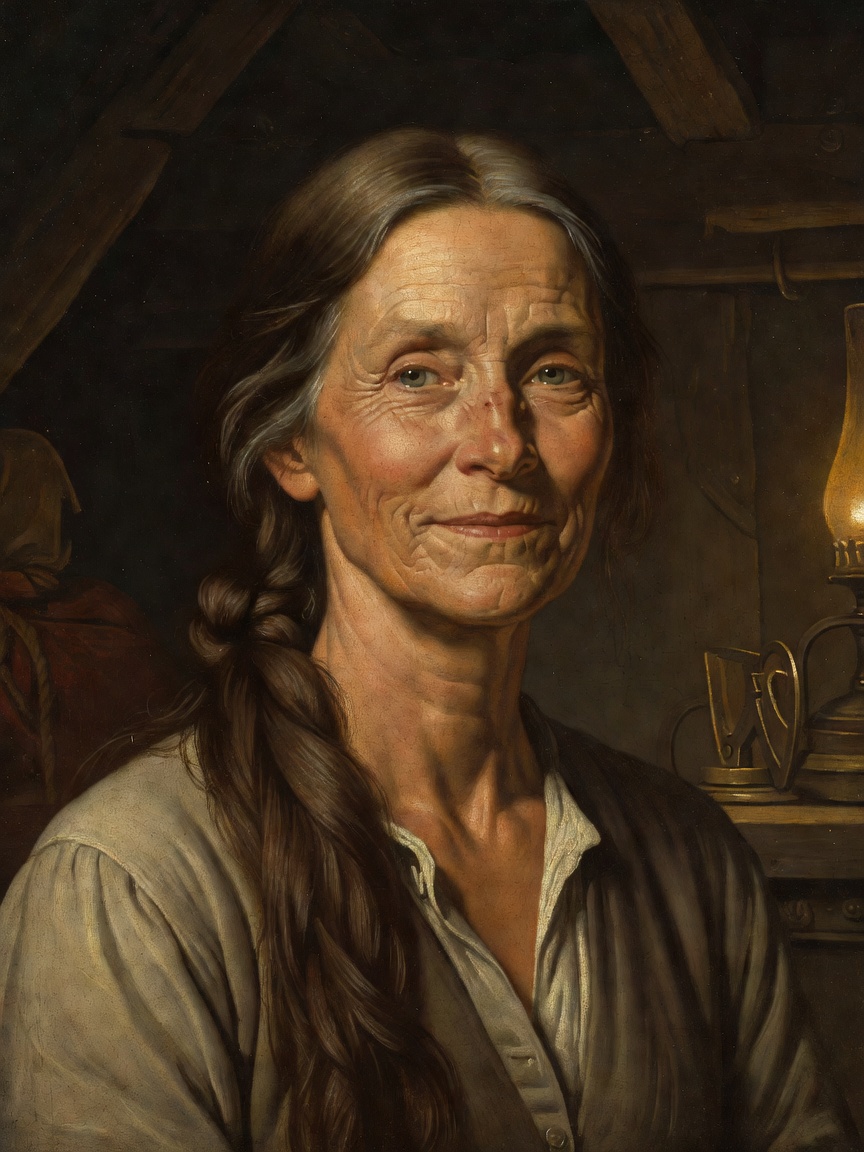
The sun-kissed bronze of her skin has deepened to the colour of old oak, and small freckles map her nose like the scattered coordinates of a life spent reading the horizon.
Her dark chestnut hair, still worn
Her dark chestnut hair, still worn long and wild, now carries grey like threads of silver through iron. She is striking the way a knife in lamplight is striking — not through beauty, but through the clarity of her purpose.
The wealth she commands now is nothing like the riches of her captaincy. The power is fractional, split between the Council and a thousand small, dangerous obligations.
But her status — her reputation for reading people the way others read maps, for executing plans with surgical precision, for stealing not what glitters but what matters — this remains unchanged.
She is aging gracefully, which is
She is aging gracefully, which is to say she is aging like a predator that has learned its hunting ground perfectly and will not loosen its grip. The Brine Gate Council knows her value.
Jett Crowe7, “Cold Wake,” still nurses the blood feud between them, but blood feuds respect cunning.
Charles Hopewell, Jr.8, who served with her in 1725 and searched for her in 2025, has learned something in those centuries that the world itself has been learning slowly: that Brynn Ashdown was never a pirate in spite of being a woman.
She was a pirate because she
She was a pirate because she was a woman who understood that the gap between what the world claims to be and what it actually does is not a flaw to be corrected, but a ledger to be read and exploited with absolute precision.
The needle finds its mark. It always does.
THE MAKING OF TIDE NEEDLE
Part One: Ash
Part One: Ash
The Thames at low tide smells like copper coins left in bilge water. Young Brynn Ashdown knew this smell the way other children know their mother’s hand — early, intimate, and never entirely escapable.
She was born into it in 1687, or so the burnt registry claims, though the month remains negotiable. Her father, Edmund Ashdown, kept ledgers for the sugar merchants at Bristol’s dock.
Her mother, Catherine Briggs before marria
Her mother, Catherine Briggs before marriage, kept silence the way other women kept house — thoroughly, without complaint, in service to the fiction that Edmund’s hands remained clean. They did not.
The household occupied a crooked terrace above Broad Street, two storeys of grey stone where the wind came sideways and the neighbours nursed grudges like cordials.
Brynn had one brother, Thomas, three years her senior, who inherited their father’s ledger-mind and mother’s talent for looking away. By age seven, Brynn was doing neither.
What she was doing instead was
What she was doing instead was watching.
The merchant houses of Bristol conducted their business with the carelessness of the very rich. They left papers on desks in unlocked rooms.
They spoke freely in the presence of servants and children, as though absence of attention implied absence of understanding. They carried purses as loose as conscience.
Edmund Ashdown had taught her to
Edmund Ashdown had taught her to read by age five — not from paternal pride, but because readable daughters were less trouble than unlettered ones. The ledgers lived on his desk, and the ledgers were full of numbers that did not match.
Sugar purchased: four hundredweight. Sugar delivered: three. The difference had a price, and the price had gone somewhere other than the merchant’s pocket.
By the time Brynn was nine, she understood that her father was a thief wearing a clerk’s collar.
By the time she was eleven
By the time she was eleven, she understood that this was the only honest work anyone in Bristol was doing.
Catherine died of a fever in the winter of 1698. She was thirty-four. No doctor came — Edmund could not afford the disclosure. Thomas wept in the upstairs chamber.
Brynn sat beside the body and thought about the gap between what people said they were and what they actually did. The gap, she concluded, was where everything real lived.
Kindness, duty, love — these were
Kindness, duty, love — these were the stories people told each other while they stole food from their own children’s mouths. Catherine had been kind. Kind had not kept the fever out.
Three months later, Edmund Ashdown drowned himself in the Avon. He walked into the water on a Tuesday morning, fully clothed, carrying stones in his coat pockets.
The official record called it an accident — a slip on the wet stone, a head struck on the pier edge, a tragedy of circumstance. Bristol nodded and moved forward. Thomas, now orphaned at fourteen, was taken in by their father’s eldest brother, a merchant of better luck and equal dishonesty. Brynn was thirteen.
The question of what to do
The question of what to do with Brynn had interested precisely no one. An uncle-twice-removed offered apprenticeship to a milliner. A cousin-in-law thought the textile works might find use for her fingers.
She was not beautiful enough to marry well, and not well-born enough to marry at all. The logical pathway led toward servitude or destitution, the two fates Bristol reserved for girls whose fathers had the good sense to drown early.
Instead, Brynn left.
Part Two: Port Royal
Part Two: Port Royal
She took thirty-two shillings from Thomas’s room — money their uncle had given him for indenture fees — and walked to the docks at Bristol Channel. She was tall for a girl, which helped. She was thin like a stripped branch, which helped more.
She had red-brown hair she kept bound tight and a way of looking at people that suggested she was better not looked at back.
A merchant brig called the Prosperity
A merchant brig called the Prosperity was taking on crew for the Caribbean trade. No one asked her name. No one asked her age.
Currency answered every question in the tight press of the dock shed, and shillings were shillings regardless of the hand that offered them. She bought a berth and a blind eye for five shillings, and by evening she was below deck in a hammock that stank of tar and sweat and the previous occupant’s dysentery.
The voyage took six weeks. Brynn learned the difference between what the world pretended ships were and what they actually were. Wooden floating tombs, mostly.
The crew were men of two
The crew were men of two types: those drowning slowly in drink and those drowning in salt spray and routine. She ate hard biscuit. She swabbed planks. She learned to tie knots with her eyes shut. She learned to move through a space without displacing air.
Port Royal in 1700 was a city built on stolen money and kept by the grace of distance from any authority that might care. It was brutal and utterly honest about its brutality.
Brynn walked off the Prosperity and understood immediately that this was a place where the gap between principle and action had closed to nothing.
For two years, she existed in
For two years, she existed in the spaces between legitimate trades. She worked as a dock labourer. She cleaned fish. She took in mending from ship captains whose hands were too calloused for delicate needlework. She saved every penny.
She slept in a rented corner of a shared room that reeked of mould and men. She attended to the business of staying alive with the same precision she had once applied to her father’s ledgers: minimal expenditure, maximum return, no wasted motion.
Then came the taproom, and the merchant, and the purse.
Part Three: The Cut
Part Three: The Cut
The merchant was named Holloway. Drunk on rum and his own importance, he’d come ashore from a Jamaica9 sugar fleet to celebrate a profitable season. His coat bore the insignia of a factor’s son — the clothes of a man accustomed to assuming the world owed him carelessness. His purse hung at his waist like a confession.
Brynn had watched him for two hours.
She had catalogued the taproom’s geometry
She had catalogued the taproom’s geometry: the keeper’s attention wandering toward a card game, the merchant’s bodyguards divided between beer and the company of women, the single moment when Holloway’s hand left his lap to gesture at a joke, leaving the purse vulnerable and visible as a scar.
What she did next was not theft. It was surgery.
Her fingers moved the way they had when she was small and learning to read difficult writing — with the precision of someone parsing meaning from chaos.
The knife came out of her
The knife came out of her sleeve, rode through the leather tie that held the purse, and vanished again, all in the time it took the merchant to laugh at his own jest. The purse was in her left hand before her right hand had finished its arc.
She’d already stepped two paces toward the bar — the natural direction of motion — when Holloway’s hand descended to find the knot severed.
His face went through several colours before he made any sound at all.
By then the coin was distributed
By then the coin was distributed: half to the tavern keeper (insurance), a quarter to a girl with missing teeth who’d distracted the bodyguards with her skirts, and the remainder split three ways among dock labourers who’d been drinking cheap rum in the corner. Brynn’s share was eight shillings and a reputation.
It was in that moment, watching the merchant stumble toward the door still trying to understand what had been taken, that she understood what her father had known and never had the nerve to say aloud. Crime was not corruption of the honest world.
It was the honest world made visible. Every merchant, every factor, every captain who sailed these waters operated under the same principle: take what you can hold, justify nothing, assume the world is loose in the hands of fools.
Brynn had simply stopped pretending otherw
Brynn had simply stopped pretending otherwise.
The woman in the corner — the one with the scar at her temple and the weight of command in her shoulders, nursing rum like it owed her money — watched the entire transaction. When Brynn finished and turned to leave, the woman’s voice found her like an anchor.
“The merchant’s ring,” it said. “You left it on his hand.”
Brynn paused. Turned. Saw herself reflecte
Brynn paused. Turned. Saw herself reflected in the older woman’s eyes and understood she had been read completely, down to the bone.
“It wasn’t loose,” Brynn said.
Gretel Boserupl Lange smiled.
By morning, the girl called Brynn
By morning, the girl called Brynn Ashdown was something new. The needle had found its mark and drawn blood. The tide had turned.
THE MAKING OF TIDE NEEDLE
Part One: Ash
The Thames at low tide smells
The Thames at low tide smells like copper coins left in bilge water. Young Brynn Ashdown knew this smell the way other children know their mother’s hand — early, intimate, and never entirely escapable.
She was born into it in 1687, or so the burnt registry claims, though the month remains negotiable. Her father, Edmund Ashdown, kept ledgers for the sugar merchants at Bristol’s dock.
Her mother, Catherine Briggs before marriage, kept silence the way other women kept house — thoroughly, without complaint, in service to the fiction that Edmund’s hands remained clean. They did not.
The household occupied a crooked terrace
The household occupied a crooked terrace above Broad Street, two storeys of grey stone where the wind came sideways and the neighbours nursed grudges like cordials.
Brynn had one brother, Thomas, three years her senior, who inherited their father’s ledger-mind and mother’s talent for looking away. By age seven, Brynn was doing neither.
What she was doing instead was watching.
The merchant houses of Bristol conducted
The merchant houses of Bristol conducted their business with the carelessness of the very rich. They left papers on desks in unlocked rooms.
They spoke freely in the presence of servants and children, as though absence of attention implied absence of understanding. They carried purses as loose as conscience.
Edmund Ashdown had taught her to read by age five — not from paternal pride, but because readable daughters were less trouble than unlettered ones. The ledgers lived on his desk, and the ledgers were full of numbers that did not match.
Sugar purchased: four hundredweight. Sugar
Sugar purchased: four hundredweight. Sugar delivered: three. The difference had a price, and the price had gone somewhere other than the merchant’s pocket.
By the time Brynn was nine, she understood that her father was a thief wearing a clerk’s collar.
By the time she was eleven, she understood that this was the only honest work anyone in Bristol was doing.
Catherine died of a fever in
Catherine died of a fever in the winter of 1698. She was thirty-four. No doctor came — Edmund could not afford the disclosure. Thomas wept in the upstairs chamber.
Brynn sat beside the body and thought about the gap between what people said they were and what they actually did. The gap, she concluded, was where everything real lived.
Kindness, duty, love — these were the stories people told each other while they stole food from their own children’s mouths. Catherine had been kind. Kind had not kept the fever out.
Three months later, Edmund Ashdown drowned
Three months later, Edmund Ashdown drowned himself in the Avon. He walked into the water on a Tuesday morning, fully clothed, carrying stones in his coat pockets.
The official record called it an accident — a slip on the wet stone, a head struck on the pier edge, a tragedy of circumstance. Bristol nodded and moved forward. Thomas, now orphaned at fourteen, was taken in by their father’s eldest brother, a merchant of better luck and equal dishonesty. Brynn was thirteen.
The question of what to do with Brynn had interested precisely no one. An uncle-twice-removed offered apprenticeship to a milliner. A cousin-in-law thought the textile works might find use for her fingers.
She was not beautiful enough to
She was not beautiful enough to marry well, and not well-born enough to marry at all. The logical pathway led toward servitude or destitution, the two fates Bristol reserved for girls whose fathers had the good sense to drown early.
Instead, Brynn left.
Part Two: Port Royal
She took thirty-two shillings from Thomas’
She took thirty-two shillings from Thomas’s room — money their uncle had given him for indenture fees — and walked to the docks at Bristol Channel. She was tall for a girl, which helped. She was thin like a stripped branch, which helped more.
She had red-brown hair she kept bound tight and a way of looking at people that suggested she was better not looked at back.
A merchant brig called the Prosperity was taking on crew for the Caribbean trade. No one asked her name. No one asked her age.
Currency answered every question in the
Currency answered every question in the tight press of the dock shed, and shillings were shillings regardless of the hand that offered them. She bought a berth and a blind eye for five shillings, and by evening she was below deck in a hammock that stank of tar and sweat and the previous occupant’s dysentery.
The voyage took six weeks. Brynn learned the difference between what the world pretended ships were and what they actually were. Wooden floating tombs, mostly.
The crew were men of two types: those drowning slowly in drink and those drowning in salt spray and routine. She ate hard biscuit. She swabbed planks. She learned to tie knots with her eyes shut. She learned to move through a space without displacing air.
Port Royal in 1700 was a
Port Royal in 1700 was a city built on stolen money and kept by the grace of distance from any authority that might care. It was brutal and utterly honest about its brutality.
Brynn walked off the Prosperity and understood immediately that this was a place where the gap between principle and action had closed to nothing.
For two years, she existed in the spaces between legitimate trades. She worked as a dock labourer. She cleaned fish. She took in mending from ship captains whose hands were too calloused for delicate needlework. She saved every penny.
She slept in a rented corner
She slept in a rented corner of a shared room that reeked of mould and men. She attended to the business of staying alive with the same precision she had once applied to her father’s ledgers: minimal expenditure, maximum return, no wasted motion.
Then came the taproom, and the merchant, and the purse.
Part Three: The Cut
The merchant was named Holloway. Drunk
The merchant was named Holloway. Drunk on rum and his own importance, he’d come ashore from a Jamaica sugar fleet to celebrate a profitable season. His coat bore the insignia of a factor’s son — the clothes of a man accustomed to assuming the world owed him carelessness. His purse hung at his waist like a confession.
Brynn had watched him for two hours.
She had catalogued the taproom’s geometry: the keeper’s attention wandering toward a card game, the merchant’s bodyguards divided between beer and the company of women, the single moment when Holloway’s hand left his lap to gesture at a joke, leaving the purse vulnerable and visible as a scar.
What she did next was not
What she did next was not theft. It was surgery.
Her fingers moved the way they had when she was small and learning to read difficult writing — with the precision of someone parsing meaning from chaos.
The knife came out of her sleeve, rode through the leather tie that held the purse, and vanished again, all in the time it took the merchant to laugh at his own jest. The purse was in her left hand before her right hand had finished its arc.
She’d already stepped two paces toward
She’d already stepped two paces toward the bar — the natural direction of motion — when Holloway’s hand descended to find the knot severed.
His face went through several colours before he made any sound at all.
By then the coin was distributed: half to the tavern keeper (insurance), a quarter to a girl with missing teeth who’d distracted the bodyguards with her skirts, and the remainder split three ways among dock labourers who’d been drinking cheap rum in the corner. Brynn’s share was eight shillings and a reputation.
It was in that moment, watching
It was in that moment, watching the merchant stumble toward the door still trying to understand what had been taken, that she understood what her father had known and never had the nerve to say aloud. Crime was not corruption of the honest world.
It was the honest world made visible. Every merchant, every factor, every captain who sailed these waters operated under the same principle: take what you can hold, justify nothing, assume the world is loose in the hands of fools.
Brynn had simply stopped pretending otherwise.
The woman in the corner —
The woman in the corner — the one with the scar at her temple and the weight of command in her shoulders, nursing rum like it owed her money — watched the entire transaction. When Brynn finished and turned to leave, the woman’s voice found her like an anchor.
“The merchant’s ring,” it said. “You left it on his hand.”
Brynn paused. Turned. Saw herself reflected in the older woman’s eyes and understood she had been read completely, down to the bone.
“It wasn’t loose,” Brynn said
“It wasn’t loose,” Brynn said.
Gretel Boserupl Lange smiled.
By morning, the girl called Brynn Ashdown was something new. The needle had found its mark and drawn blood. The tide had turned.
THE MAKING OF TIDE NEEDLE
THE MAKING OF TIDE NEEDLE
Part One: Ash
The Thames at low tide smells like copper coins left in bilge water. Young Brynn Ashdown knew this smell the way other children know their mother’s hand — early, intimate, and never entirely escapable.
She was born into it in
She was born into it in 1687, or so the burnt registry claims, though the month remains negotiable. Her father, Edmund Ashdown, kept ledgers for the sugar merchants at Bristol’s dock.
Her mother, Catherine Briggs before marriage, kept silence the way other women kept house — thoroughly, without complaint, in service to the fiction that Edmund’s hands remained clean. They did not.
The household occupied a crooked terrace above Broad Street, two storeys of grey stone where the wind came sideways and the neighbours nursed grudges like cordials.
Brynn had one brother, Thomas, three
Brynn had one brother, Thomas, three years her senior, who inherited their father’s ledger-mind and mother’s talent for looking away. By age seven, Brynn was doing neither.
What she was doing instead was watching.
The merchant houses of Bristol conducted their business with the carelessness of the very rich. They left papers on desks in unlocked rooms.
They spoke freely in the presence
They spoke freely in the presence of servants and children, as though absence of attention implied absence of understanding. They carried purses as loose as conscience.
Edmund Ashdown had taught her to read by age five — not from paternal pride, but because readable daughters were less trouble than unlettered ones. The ledgers lived on his desk, and the ledgers were full of numbers that did not match.
Sugar purchased: four hundredweight. Sugar delivered: three. The difference had a price, and the price had gone somewhere other than the merchant’s pocket.
By the time Brynn was nine
By the time Brynn was nine, she understood that her father was a thief wearing a clerk’s collar.
By the time she was eleven, she understood that this was the only honest work anyone in Bristol was doing.
Catherine died of a fever in the winter of 1698. She was thirty-four. No doctor came — Edmund could not afford the disclosure. Thomas wept in the upstairs chamber.
Brynn sat beside the body and
Brynn sat beside the body and thought about the gap between what people said they were and what they actually did. The gap, she concluded, was where everything real lived.
Kindness, duty, love — these were the stories people told each other while they stole food from their own children’s mouths. Catherine had been kind. Kind had not kept the fever out.
Three months later, Edmund Ashdown drowned himself in the Avon. He walked into the water on a Tuesday morning, fully clothed, carrying stones in his coat pockets.
The official record called it an
The official record called it an accident — a slip on the wet stone, a head struck on the pier edge, a tragedy of circumstance. Bristol nodded and moved forward. Thomas, now orphaned at fourteen, was taken in by their father’s eldest brother, a merchant of better luck and equal dishonesty. Brynn was thirteen.
The question of what to do with Brynn had interested precisely no one. An uncle-twice-removed offered apprenticeship to a milliner. A cousin-in-law thought the textile works might find use for her fingers.
She was not beautiful enough to marry well, and not well-born enough to marry at all. The logical pathway led toward servitude or destitution, the two fates Bristol reserved for girls whose fathers had the good sense to drown early.
Instead, Brynn left
Instead, Brynn left.
Part Two: Port Royal
She took thirty-two shillings from Thomas’s room — money their uncle had given him for indenture fees — and walked to the docks at Bristol Channel. She was tall for a girl, which helped. She was thin like a stripped branch, which helped more.
She had red-brown hair she kept
She had red-brown hair she kept bound tight and a way of looking at people that suggested she was better not looked at back.
A merchant brig called the Prosperity was taking on crew for the Caribbean trade. No one asked her name. No one asked her age.
Currency answered every question in the tight press of the dock shed, and shillings were shillings regardless of the hand that offered them. She bought a berth and a blind eye for five shillings, and by evening she was below deck in a hammock that stank of tar and sweat and the previous occupant’s dysentery.
The voyage took six weeks. Brynn
The voyage took six weeks. Brynn learned the difference between what the world pretended ships were and what they actually were. Wooden floating tombs, mostly.
The crew were men of two types: those drowning slowly in drink and those drowning in salt spray and routine. She ate hard biscuit. She swabbed planks. She learned to tie knots with her eyes shut. She learned to move through a space without displacing air.
Port Royal in 1700 was a city built on stolen money and kept by the grace of distance from any authority that might care. It was brutal and utterly honest about its brutality.
Brynn walked off the Prosperity and
Brynn walked off the Prosperity and understood immediately that this was a place where the gap between principle and action had closed to nothing.
For two years, she existed in the spaces between legitimate trades. She worked as a dock labourer. She cleaned fish. She took in mending from ship captains whose hands were too calloused for delicate needlework. She saved every penny.
She slept in a rented corner of a shared room that reeked of mould and men. She attended to the business of staying alive with the same precision she had once applied to her father’s ledgers: minimal expenditure, maximum return, no wasted motion.
Then came the taproom, and the
Then came the taproom, and the merchant, and the purse.
Part Three: The Cut
The merchant was named Holloway. Drunk on rum and his own importance, he’d come ashore from a Jamaica sugar fleet to celebrate a profitable season. His coat bore the insignia of a factor’s son — the clothes of a man accustomed to assuming the world owed him carelessness. His purse hung at his waist like a confession.
Brynn had watched him for two
Brynn had watched him for two hours.
She had catalogued the taproom’s geometry: the keeper’s attention wandering toward a card game, the merchant’s bodyguards divided between beer and the company of women, the single moment when Holloway’s hand left his lap to gesture at a joke, leaving the purse vulnerable and visible as a scar.
What she did next was not theft. It was surgery.
Her fingers moved the way they
Her fingers moved the way they had when she was small and learning to read difficult writing — with the precision of someone parsing meaning from chaos.
The knife came out of her sleeve, rode through the leather tie that held the purse, and vanished again, all in the time it took the merchant to laugh at his own jest. The purse was in her left hand before her right hand had finished its arc.
She’d already stepped two paces toward the bar — the natural direction of motion — when Holloway’s hand descended to find the knot severed.
His face went through several colours
His face went through several colours before he made any sound at all.
By then the coin was distributed: half to the tavern keeper (insurance), a quarter to a girl with missing teeth who’d distracted the bodyguards with her skirts, and the remainder split three ways among dock labourers who’d been drinking cheap rum in the corner. Brynn’s share was eight shillings and a reputation.
It was in that moment, watching the merchant stumble toward the door still trying to understand what had been taken, that she understood what her father had known and never had the nerve to say aloud. Crime was not corruption of the honest world.
It was the honest world made
It was the honest world made visible. Every merchant, every factor, every captain who sailed these waters operated under the same principle: take what you can hold, justify nothing, assume the world is loose in the hands of fools.
Brynn had simply stopped pretending otherwise.
The woman in the corner — the one with the scar at her temple and the weight of command in her shoulders, nursing rum like it owed her money — watched the entire transaction. When Brynn finished and turned to leave, the woman’s voice found her like an anchor.
“The merchant’s ring,” it said. “You
“The merchant’s ring,” it said. “You left it on his hand.”
Brynn paused. Turned. Saw herself reflected in the older woman’s eyes and understood she had been read completely, down to the bone.
“It wasn’t loose,” Brynn said.
Gretel Boserupl Lange smiled
Gretel Boserupl Lange smiled.
By morning, the girl called Brynn Ashdown was something new. The needle had found its mark and drawn blood. The tide had turned.
THE MAKING OF TIDE NEEDLE
Part One: Ash
Part One: Ash
The Thames at low tide smells like copper coins left in bilge water. Young Brynn Ashdown knew this smell the way other children know their mother’s hand — early, intimate, and never entirely escapable.
She was born into it in 1687, or so the burnt registry claims, though the month remains negotiable. Her father, Edmund Ashdown, kept ledgers for the sugar merchants at Bristol’s dock.
Her mother, Catherine Briggs before marria
Her mother, Catherine Briggs before marriage, kept silence the way other women kept house — thoroughly, without complaint, in service to the fiction that Edmund’s hands remained clean. They did not.
The household occupied a crooked terrace above Broad Street, two storeys of grey stone where the wind came sideways and the neighbours nursed grudges like cordials.
Brynn had one brother, Thomas, three years her senior, who inherited their father’s ledger-mind and mother’s talent for looking away. By age seven, Brynn was doing neither.
What she was doing instead was
What she was doing instead was watching.
The merchant houses of Bristol conducted their business with the carelessness of the very rich. They left papers on desks in unlocked rooms.
They spoke freely in the presence of servants and children, as though absence of attention implied absence of understanding. They carried purses as loose as conscience.
Edmund Ashdown had taught her to
Edmund Ashdown had taught her to read by age five — not from paternal pride, but because readable daughters were less trouble than unlettered ones. The ledgers lived on his desk, and the ledgers were full of numbers that did not match.
Sugar purchased: four hundredweight. Sugar delivered: three. The difference had a price, and the price had gone somewhere other than the merchant’s pocket.
By the time Brynn was nine, she understood that her father was a thief wearing a clerk’s collar.
By the time she was eleven
By the time she was eleven, she understood that this was the only honest work anyone in Bristol was doing.
Catherine died of a fever in the winter of 1698. She was thirty-four. No doctor came — Edmund could not afford the disclosure. Thomas wept in the upstairs chamber.
Brynn sat beside the body and thought about the gap between what people said they were and what they actually did. The gap, she concluded, was where everything real lived.
Kindness, duty, love — these were
Kindness, duty, love — these were the stories people told each other while they stole food from their own children’s mouths. Catherine had been kind. Kind had not kept the fever out.
Three months later, Edmund Ashdown drowned himself in the Avon. He walked into the water on a Tuesday morning, fully clothed, carrying stones in his coat pockets.
The official record called it an accident — a slip on the wet stone, a head struck on the pier edge, a tragedy of circumstance. Bristol nodded and moved forward. Thomas, now orphaned at fourteen, was taken in by their father’s eldest brother, a merchant of better luck and equal dishonesty. Brynn was thirteen.
The question of what to do
The question of what to do with Brynn had interested precisely no one. An uncle-twice-removed offered apprenticeship to a milliner. A cousin-in-law thought the textile works might find use for her fingers.
She was not beautiful enough to marry well, and not well-born enough to marry at all. The logical pathway led toward servitude or destitution, the two fates Bristol reserved for girls whose fathers had the good sense to drown early.
Instead, Brynn left.
Part Two: Port Royal
Part Two: Port Royal
She took thirty-two shillings from Thomas’s room — money their uncle had given him for indenture fees — and walked to the docks at Bristol Channel. She was tall for a girl, which helped. She was thin like a stripped branch, which helped more.
She had red-brown hair she kept bound tight and a way of looking at people that suggested she was better not looked at back.
A merchant brig called the Prosperity
A merchant brig called the Prosperity was taking on crew for the Caribbean trade. No one asked her name. No one asked her age.
Currency answered every question in the tight press of the dock shed, and shillings were shillings regardless of the hand that offered them. She bought a berth and a blind eye for five shillings, and by evening she was below deck in a hammock that stank of tar and sweat and the previous occupant’s dysentery.
The voyage took six weeks. Brynn learned the difference between what the world pretended ships were and what they actually were. Wooden floating tombs, mostly.
The crew were men of two
The crew were men of two types: those drowning slowly in drink and those drowning in salt spray and routine. She ate hard biscuit. She swabbed planks. She learned to tie knots with her eyes shut. She learned to move through a space without displacing air.
Port Royal in 1700 was a city built on stolen money and kept by the grace of distance from any authority that might care. It was brutal and utterly honest about its brutality.
Brynn walked off the Prosperity and understood immediately that this was a place where the gap between principle and action had closed to nothing.
For two years, she existed in
For two years, she existed in the spaces between legitimate trades. She worked as a dock labourer. She cleaned fish. She took in mending from ship captains whose hands were too calloused for delicate needlework. She saved every penny.
She slept in a rented corner of a shared room that reeked of mould and men. She attended to the business of staying alive with the same precision she had once applied to her father’s ledgers: minimal expenditure, maximum return, no wasted motion.
Then came the taproom, and the merchant, and the purse.
Part Three: The Cut
Part Three: The Cut
The merchant was named Holloway. Drunk on rum and his own importance, he’d come ashore from a Jamaica sugar fleet to celebrate a profitable season. His coat bore the insignia of a factor’s son — the clothes of a man accustomed to assuming the world owed him carelessness. His purse hung at his waist like a confession.
Brynn had watched him for two hours.
She had catalogued the taproom’s geometry
She had catalogued the taproom’s geometry: the keeper’s attention wandering toward a card game, the merchant’s bodyguards divided between beer and the company of women, the single moment when Holloway’s hand left his lap to gesture at a joke, leaving the purse vulnerable and visible as a scar.
What she did next was not theft. It was surgery.
Her fingers moved the way they had when she was small and learning to read difficult writing — with the precision of someone parsing meaning from chaos.
The knife came out of her
The knife came out of her sleeve, rode through the leather tie that held the purse, and vanished again, all in the time it took the merchant to laugh at his own jest. The purse was in her left hand before her right hand had finished its arc.
She’d already stepped two paces toward the bar — the natural direction of motion — when Holloway’s hand descended to find the knot severed.
His face went through several colours before he made any sound at all.
By then the coin was distributed
By then the coin was distributed: half to the tavern keeper (insurance), a quarter to a girl with missing teeth who’d distracted the bodyguards with her skirts, and the remainder split three ways among dock labourers who’d been drinking cheap rum in the corner. Brynn’s share was eight shillings and a reputation.
It was in that moment, watching the merchant stumble toward the door still trying to understand what had been taken, that she understood what her father had known and never had the nerve to say aloud. Crime was not corruption of the honest world.
It was the honest world made visible. Every merchant, every factor, every captain who sailed these waters operated under the same principle: take what you can hold, justify nothing, assume the world is loose in the hands of fools.
Brynn had simply stopped pretending otherw
Brynn had simply stopped pretending otherwise.
The woman in the corner — the one with the scar at her temple and the weight of command in her shoulders, nursing rum like it owed her money — watched the entire transaction. When Brynn finished and turned to leave, the woman’s voice found her like an anchor.
“The merchant’s ring,” it said. “You left it on his hand.”
Brynn paused. Turned. Saw herself reflecte
Brynn paused. Turned. Saw herself reflected in the older woman’s eyes and understood she had been read completely, down to the bone.
“It wasn’t loose,” Brynn said.
Gretel Boserupl Lange smiled.
By morning, the girl called Brynn
By morning, the girl called Brynn Ashdown was something new. The needle had found its mark and drawn blood. The tide had turned.
THE MAKING OF TIDE NEEDLE
Part One: Ash
The Thames at low tide smells
The Thames at low tide smells like copper coins left in bilge water. Young Brynn Ashdown knew this smell the way other children know their mother’s hand — early, intimate, and never entirely escapable.
She was born into it in 1687, or so the burnt registry claims, though the month remains negotiable. Her father, Edmund Ashdown, kept ledgers for the sugar merchants at Bristol’s dock.
Her mother, Catherine Briggs before marriage, kept silence the way other women kept house — thoroughly, without complaint, in service to the fiction that Edmund’s hands remained clean. They did not.
The household occupied a crooked terrace
The household occupied a crooked terrace above Broad Street, two storeys of grey stone where the wind came sideways and the neighbours nursed grudges like cordials.
Brynn had one brother, Thomas, three years her senior, who inherited their father’s ledger-mind and mother’s talent for looking away. By age seven, Brynn was doing neither.
What she was doing instead was watching.
The merchant houses of Bristol conducted
The merchant houses of Bristol conducted their business with the carelessness of the very rich. They left papers on desks in unlocked rooms.
They spoke freely in the presence of servants and children, as though absence of attention implied absence of understanding. They carried purses as loose as conscience.
Edmund Ashdown had taught her to read by age five — not from paternal pride, but because readable daughters were less trouble than unlettered ones. The ledgers lived on his desk, and the ledgers were full of numbers that did not match.
Sugar purchased: four hundredweight. Sugar
Sugar purchased: four hundredweight. Sugar delivered: three. The difference had a price, and the price had gone somewhere other than the merchant’s pocket.
By the time Brynn was nine, she understood that her father was a thief wearing a clerk’s collar.
By the time she was eleven, she understood that this was the only honest work anyone in Bristol was doing.
Catherine died of a fever in
Catherine died of a fever in the winter of 1698. She was thirty-four. No doctor came — Edmund could not afford the disclosure. Thomas wept in the upstairs chamber.
Brynn sat beside the body and thought about the gap between what people said they were and what they actually did. The gap, she concluded, was where everything real lived.
Kindness, duty, love — these were the stories people told each other while they stole food from their own children’s mouths. Catherine had been kind. Kind had not kept the fever out.
Three months later, Edmund Ashdown drowned
Three months later, Edmund Ashdown drowned himself in the Avon. He walked into the water on a Tuesday morning, fully clothed, carrying stones in his coat pockets.
The official record called it an accident — a slip on the wet stone, a head struck on the pier edge, a tragedy of circumstance. Bristol nodded and moved forward. Thomas, now orphaned at fourteen, was taken in by their father’s eldest brother, a merchant of better luck and equal dishonesty. Brynn was thirteen.
The question of what to do with Brynn had interested precisely no one. An uncle-twice-removed offered apprenticeship to a milliner. A cousin-in-law thought the textile works might find use for her fingers.
She was not beautiful enough to
She was not beautiful enough to marry well, and not well-born enough to marry at all. The logical pathway led toward servitude or destitution, the two fates Bristol reserved for girls whose fathers had the good sense to drown early.
Instead, Brynn left.
Part Two: Port Royal
She took thirty-two shillings from Thomas’
She took thirty-two shillings from Thomas’s room — money their uncle had given him for indenture fees — and walked to the docks at Bristol Channel. She was tall for a girl, which helped. She was thin like a stripped branch, which helped more.
She had red-brown hair she kept bound tight and a way of looking at people that suggested she was better not looked at back.
A merchant brig called the Prosperity was taking on crew for the Caribbean trade. No one asked her name. No one asked her age.
Currency answered every question in the
Currency answered every question in the tight press of the dock shed, and shillings were shillings regardless of the hand that offered them. She bought a berth and a blind eye for five shillings, and by evening she was below deck in a hammock that stank of tar and sweat and the previous occupant’s dysentery.
The voyage took six weeks. Brynn learned the difference between what the world pretended ships were and what they actually were. Wooden floating tombs, mostly.
The crew were men of two types: those drowning slowly in drink and those drowning in salt spray and routine. She ate hard biscuit. She swabbed planks. She learned to tie knots with her eyes shut. She learned to move through a space without displacing air.
Port Royal in 1700 was a
Port Royal in 1700 was a city built on stolen money and kept by the grace of distance from any authority that might care. It was brutal and utterly honest about its brutality.
Brynn walked off the Prosperity and understood immediately that this was a place where the gap between principle and action had closed to nothing.
For two years, she existed in the spaces between legitimate trades. She worked as a dock labourer. She cleaned fish. She took in mending from ship captains whose hands were too calloused for delicate needlework. She saved every penny.
She slept in a rented corner
She slept in a rented corner of a shared room that reeked of mould and men. She attended to the business of staying alive with the same precision she had once applied to her father’s ledgers: minimal expenditure, maximum return, no wasted motion.
Then came the taproom, and the merchant, and the purse.
Part Three: The Cut
The merchant was named Holloway. Drunk
The merchant was named Holloway. Drunk on rum and his own importance, he’d come ashore from a Jamaica sugar fleet to celebrate a profitable season. His coat bore the insignia of a factor’s son — the clothes of a man accustomed to assuming the world owed him carelessness. His purse hung at his waist like a confession.
Brynn had watched him for two hours.
She had catalogued the taproom’s geometry: the keeper’s attention wandering toward a card game, the merchant’s bodyguards divided between beer and the company of women, the single moment when Holloway’s hand left his lap to gesture at a joke, leaving the purse vulnerable and visible as a scar.
What she did next was not
What she did next was not theft. It was surgery.
Her fingers moved the way they had when she was small and learning to read difficult writing — with the precision of someone parsing meaning from chaos.
The knife came out of her sleeve, rode through the leather tie that held the purse, and vanished again, all in the time it took the merchant to laugh at his own jest. The purse was in her left hand before her right hand had finished its arc.
She’d already stepped two paces toward
She’d already stepped two paces toward the bar — the natural direction of motion — when Holloway’s hand descended to find the knot severed.
His face went through several colours before he made any sound at all.
By then the coin was distributed: half to the tavern keeper (insurance), a quarter to a girl with missing teeth who’d distracted the bodyguards with her skirts, and the remainder split three ways among dock labourers who’d been drinking cheap rum in the corner. Brynn’s share was eight shillings and a reputation.
It was in that moment, watching
It was in that moment, watching the merchant stumble toward the door still trying to understand what had been taken, that she understood what her father had known and never had the nerve to say aloud. Crime was not corruption of the honest world.
It was the honest world made visible. Every merchant, every factor, every captain who sailed these waters operated under the same principle: take what you can hold, justify nothing, assume the world is loose in the hands of fools.
Brynn had simply stopped pretending otherwise.
The woman in the corner —
The woman in the corner — the one with the scar at her temple and the weight of command in her shoulders, nursing rum like it owed her money — watched the entire transaction. When Brynn finished and turned to leave, the woman’s voice found her like an anchor.
“The merchant’s ring,” it said. “You left it on his hand.”
Brynn paused. Turned. Saw herself reflected in the older woman’s eyes and understood she had been read completely, down to the bone.
“It wasn’t loose,” Brynn said
“It wasn’t loose,” Brynn said.
Gretel Boserupl Lange smiled.
By morning, the girl called Brynn Ashdown was something new. The needle had found its mark and drawn blood. The tide had turned.
THE MAKING OF TIDE NEEDLE
THE MAKING OF TIDE NEEDLE
Part One: Ash
The Thames at low tide smells like copper coins left in bilge water. Young Brynn Ashdown knew this smell the way other children know their mother’s hand — early, intimate, and never entirely escapable.
She was born into it in
She was born into it in 1687, or so the burnt registry claims, though the month remains negotiable. Her father, Edmund Ashdown, kept ledgers for the sugar merchants at Bristol’s dock.
Her mother, Catherine Briggs before marriage, kept silence the way other women kept house — thoroughly, without complaint, in service to the fiction that Edmund’s hands remained clean. They did not.
The household occupied a crooked terrace above Broad Street, two storeys of grey stone where the wind came sideways and the neighbours nursed grudges like cordials.
Brynn had one brother, Thomas, three
Brynn had one brother, Thomas, three years her senior, who inherited their father’s ledger-mind and mother’s talent for looking away. By age seven, Brynn was doing neither.
What she was doing instead was watching.
The merchant houses of Bristol conducted their business with the carelessness of the very rich. They left papers on desks in unlocked rooms.
They spoke freely in the presence
They spoke freely in the presence of servants and children, as though absence of attention implied absence of understanding. They carried purses as loose as conscience.
Edmund Ashdown had taught her to read by age five — not from paternal pride, but because readable daughters were less trouble than unlettered ones. The ledgers lived on his desk, and the ledgers were full of numbers that did not match.
Sugar purchased: four hundredweight. Sugar delivered: three. The difference had a price, and the price had gone somewhere other than the merchant’s pocket.
By the time Brynn was nine
By the time Brynn was nine, she understood that her father was a thief wearing a clerk’s collar.
By the time she was eleven, she understood that this was the only honest work anyone in Bristol was doing.
Catherine died of a fever in the winter of 1698. She was thirty-four. No doctor came — Edmund could not afford the disclosure. Thomas wept in the upstairs chamber.
Brynn sat beside the body and
Brynn sat beside the body and thought about the gap between what people said they were and what they actually did. The gap, she concluded, was where everything real lived.
Kindness, duty, love — these were the stories people told each other while they stole food from their own children’s mouths. Catherine had been kind. Kind had not kept the fever out.
Three months later, Edmund Ashdown drowned himself in the Avon. He walked into the water on a Tuesday morning, fully clothed, carrying stones in his coat pockets.
The official record called it an
The official record called it an accident — a slip on the wet stone, a head struck on the pier edge, a tragedy of circumstance. Bristol nodded and moved forward. Thomas, now orphaned at fourteen, was taken in by their father’s eldest brother, a merchant of better luck and equal dishonesty. Brynn was thirteen.
The question of what to do with Brynn had interested precisely no one. An uncle-twice-removed offered apprenticeship to a milliner. A cousin-in-law thought the textile works might find use for her fingers.
She was not beautiful enough to marry well, and not well-born enough to marry at all. The logical pathway led toward servitude or destitution, the two fates Bristol reserved for girls whose fathers had the good sense to drown early.
Instead, Brynn left
Instead, Brynn left.
Part Two: Port Royal
She took thirty-two shillings from Thomas’s room — money their uncle had given him for indenture fees — and walked to the docks at Bristol Channel. She was tall for a girl, which helped. She was thin like a stripped branch, which helped more.
She had red-brown hair she kept
She had red-brown hair she kept bound tight and a way of looking at people that suggested she was better not looked at back.
A merchant brig called the Prosperity was taking on crew for the Caribbean trade. No one asked her name. No one asked her age.
Currency answered every question in the tight press of the dock shed, and shillings were shillings regardless of the hand that offered them. She bought a berth and a blind eye for five shillings, and by evening she was below deck in a hammock that stank of tar and sweat and the previous occupant’s dysentery.
The voyage took six weeks. Brynn
The voyage took six weeks. Brynn learned the difference between what the world pretended ships were and what they actually were. Wooden floating tombs, mostly.
The crew were men of two types: those drowning slowly in drink and those drowning in salt spray and routine. She ate hard biscuit. She swabbed planks. She learned to tie knots with her eyes shut. She learned to move through a space without displacing air.
Port Royal in 1700 was a city built on stolen money and kept by the grace of distance from any authority that might care. It was brutal and utterly honest about its brutality.
Brynn walked off the Prosperity and
Brynn walked off the Prosperity and understood immediately that this was a place where the gap between principle and action had closed to nothing.
For two years, she existed in the spaces between legitimate trades. She worked as a dock labourer. She cleaned fish. She took in mending from ship captains whose hands were too calloused for delicate needlework. She saved every penny.
She slept in a rented corner of a shared room that reeked of mould and men. She attended to the business of staying alive with the same precision she had once applied to her father’s ledgers: minimal expenditure, maximum return, no wasted motion.
Then came the taproom, and the
Then came the taproom, and the merchant, and the purse.
Part Three: The Cut
The merchant was named Holloway. Drunk on rum and his own importance, he’d come ashore from a Jamaica sugar fleet to celebrate a profitable season. His coat bore the insignia of a factor’s son — the clothes of a man accustomed to assuming the world owed him carelessness. His purse hung at his waist like a confession.
Brynn had watched him for two
Brynn had watched him for two hours.
She had catalogued the taproom’s geometry: the keeper’s attention wandering toward a card game, the merchant’s bodyguards divided between beer and the company of women, the single moment when Holloway’s hand left his lap to gesture at a joke, leaving the purse vulnerable and visible as a scar.
What she did next was not theft. It was surgery.
Her fingers moved the way they
Her fingers moved the way they had when she was small and learning to read difficult writing — with the precision of someone parsing meaning from chaos.
The knife came out of her sleeve, rode through the leather tie that held the purse, and vanished again, all in the time it took the merchant to laugh at his own jest. The purse was in her left hand before her right hand had finished its arc.
She’d already stepped two paces toward the bar — the natural direction of motion — when Holloway’s hand descended to find the knot severed.
His face went through several colours
His face went through several colours before he made any sound at all.
By then the coin was distributed: half to the tavern keeper (insurance), a quarter to a girl with missing teeth who’d distracted the bodyguards with her skirts, and the remainder split three ways among dock labourers who’d been drinking cheap rum in the corner. Brynn’s share was eight shillings and a reputation.
It was in that moment, watching the merchant stumble toward the door still trying to understand what had been taken, that she understood what her father had known and never had the nerve to say aloud. Crime was not corruption of the honest world.
It was the honest world made
It was the honest world made visible. Every merchant, every factor, every captain who sailed these waters operated under the same principle: take what you can hold, justify nothing, assume the world is loose in the hands of fools.
Brynn had simply stopped pretending otherwise.
The woman in the corner — the one with the scar at her temple and the weight of command in her shoulders, nursing rum like it owed her money — watched the entire transaction. When Brynn finished and turned to leave, the woman’s voice found her like an anchor.
“The merchant’s ring,” it said. “You
“The merchant’s ring,” it said. “You left it on his hand.”
Brynn paused. Turned. Saw herself reflected in the older woman’s eyes and understood she had been read completely, down to the bone.
“It wasn’t loose,” Brynn said.
Gretel Boserupl Lange smiled
Gretel Boserupl Lange smiled.
By morning, the girl called Brynn Ashdown was something new. The needle had found its mark and drawn blood. The tide had turned.
THE MAKING OF TIDE NEEDLE
Part One: Ash
Part One: Ash
The Thames at low tide smells like copper coins left in bilge water. Young Brynn Ashdown knew this smell the way other children know their mother’s hand — early, intimate, and never entirely escapable.
She was born into it in 1687, or so the burnt registry claims, though the month remains negotiable. Her father, Edmund Ashdown, kept ledgers for the sugar merchants at Bristol’s dock.
Her mother, Catherine Briggs before marria
Her mother, Catherine Briggs before marriage, kept silence the way other women kept house — thoroughly, without complaint, in service to the fiction that Edmund’s hands remained clean. They did not.
The household occupied a crooked terrace above Broad Street, two storeys of grey stone where the wind came sideways and the neighbours nursed grudges like cordials.
Brynn had one brother, Thomas, three years her senior, who inherited their father’s ledger-mind and mother’s talent for looking away. By age seven, Brynn was doing neither.
What she was doing instead was
What she was doing instead was watching.
The merchant houses of Bristol conducted their business with the carelessness of the very rich. They left papers on desks in unlocked rooms.
They spoke freely in the presence of servants and children, as though absence of attention implied absence of understanding. They carried purses as loose as conscience.
Edmund Ashdown had taught her to
Edmund Ashdown had taught her to read by age five — not from paternal pride, but because readable daughters were less trouble than unlettered ones. The ledgers lived on his desk, and the ledgers were full of numbers that did not match.
Sugar purchased: four hundredweight. Sugar delivered: three. The difference had a price, and the price had gone somewhere other than the merchant’s pocket.
By the time Brynn was nine, she understood that her father was a thief wearing a clerk’s collar.
By the time she was eleven
By the time she was eleven, she understood that this was the only honest work anyone in Bristol was doing.
Catherine died of a fever in the winter of 1698. She was thirty-four. No doctor came — Edmund could not afford the disclosure. Thomas wept in the upstairs chamber.
Brynn sat beside the body and thought about the gap between what people said they were and what they actually did. The gap, she concluded, was where everything real lived.
Kindness, duty, love — these were
Kindness, duty, love — these were the stories people told each other while they stole food from their own children’s mouths. Catherine had been kind. Kind had not kept the fever out.
Three months later, Edmund Ashdown drowned himself in the Avon. He walked into the water on a Tuesday morning, fully clothed, carrying stones in his coat pockets.
The official record called it an accident — a slip on the wet stone, a head struck on the pier edge, a tragedy of circumstance. Bristol nodded and moved forward. Thomas, now orphaned at fourteen, was taken in by their father’s eldest brother, a merchant of better luck and equal dishonesty. Brynn was thirteen.
The question of what to do
The question of what to do with Brynn had interested precisely no one. An uncle-twice-removed offered apprenticeship to a milliner. A cousin-in-law thought the textile works might find use for her fingers.
She was not beautiful enough to marry well, and not well-born enough to marry at all. The logical pathway led toward servitude or destitution, the two fates Bristol reserved for girls whose fathers had the good sense to drown early.
Instead, Brynn left.
Part Two: Port Royal
Part Two: Port Royal
She took thirty-two shillings from Thomas’s room — money their uncle had given him for indenture fees — and walked to the docks at Bristol Channel. She was tall for a girl, which helped. She was thin like a stripped branch, which helped more.
She had red-brown hair she kept bound tight and a way of looking at people that suggested she was better not looked at back.
A merchant brig called the Prosperity
A merchant brig called the Prosperity was taking on crew for the Caribbean trade. No one asked her name. No one asked her age.
Currency answered every question in the tight press of the dock shed, and shillings were shillings regardless of the hand that offered them. She bought a berth and a blind eye for five shillings, and by evening she was below deck in a hammock that stank of tar and sweat and the previous occupant’s dysentery.
The voyage took six weeks. Brynn learned the difference between what the world pretended ships were and what they actually were. Wooden floating tombs, mostly.
The crew were men of two
The crew were men of two types: those drowning slowly in drink and those drowning in salt spray and routine. She ate hard biscuit. She swabbed planks. She learned to tie knots with her eyes shut. She learned to move through a space without displacing air.
Port Royal in 1700 was a city built on stolen money and kept by the grace of distance from any authority that might care. It was brutal and utterly honest about its brutality.
Brynn walked off the Prosperity and understood immediately that this was a place where the gap between principle and action had closed to nothing.
For two years, she existed in
For two years, she existed in the spaces between legitimate trades. She worked as a dock labourer. She cleaned fish. She took in mending from ship captains whose hands were too calloused for delicate needlework. She saved every penny.
She slept in a rented corner of a shared room that reeked of mould and men. She attended to the business of staying alive with the same precision she had once applied to her father’s ledgers: minimal expenditure, maximum return, no wasted motion.
Then came the taproom, and the merchant, and the purse.
Part Three: The Cut
Part Three: The Cut
The merchant was named Holloway. Drunk on rum and his own importance, he’d come ashore from a Jamaica sugar fleet to celebrate a profitable season. His coat bore the insignia of a factor’s son — the clothes of a man accustomed to assuming the world owed him carelessness. His purse hung at his waist like a confession.
Brynn had watched him for two hours.
She had catalogued the taproom’s geometry
She had catalogued the taproom’s geometry: the keeper’s attention wandering toward a card game, the merchant’s bodyguards divided between beer and the company of women, the single moment when Holloway’s hand left his lap to gesture at a joke, leaving the purse vulnerable and visible as a scar.
What she did next was not theft. It was surgery.
Her fingers moved the way they had when she was small and learning to read difficult writing — with the precision of someone parsing meaning from chaos.
The knife came out of her
The knife came out of her sleeve, rode through the leather tie that held the purse, and vanished again, all in the time it took the merchant to laugh at his own jest. The purse was in her left hand before her right hand had finished its arc.
She’d already stepped two paces toward the bar — the natural direction of motion — when Holloway’s hand descended to find the knot severed.
His face went through several colours before he made any sound at all.
By then the coin was distributed
By then the coin was distributed: half to the tavern keeper (insurance), a quarter to a girl with missing teeth who’d distracted the bodyguards with her skirts, and the remainder split three ways among dock labourers who’d been drinking cheap rum in the corner. Brynn’s share was eight shillings and a reputation.
It was in that moment, watching the merchant stumble toward the door still trying to understand what had been taken, that she understood what her father had known and never had the nerve to say aloud. Crime was not corruption of the honest world.
It was the honest world made visible. Every merchant, every factor, every captain who sailed these waters operated under the same principle: take what you can hold, justify nothing, assume the world is loose in the hands of fools.
Brynn had simply stopped pretending otherw
Brynn had simply stopped pretending otherwise.
The woman in the corner — the one with the scar at her temple and the weight of command in her shoulders, nursing rum like it owed her money — watched the entire transaction. When Brynn finished and turned to leave, the woman’s voice found her like an anchor.
“The merchant’s ring,” it said. “You left it on his hand.”
Brynn paused. Turned. Saw herself reflecte
Brynn paused. Turned. Saw herself reflected in the older woman’s eyes and understood she had been read completely, down to the bone.
“It wasn’t loose,” Brynn said.
Gretel Boserupl Lange smiled.
By morning, the girl called Brynn
By morning, the girl called Brynn Ashdown was something new. The needle had found its mark and drawn blood. The tide had turned.
Appearance
HEADSHOT: BRYNN ASHDOWN, CALLED TIDE NEEDLE
Captain of the Assurance, Councillor of the Brine Gate
The face that meets you across a table is not the face that meets you across a deck. Both are hers.
In the formal gallery — the
In the formal gallery — the crew photograph taken under proper light, the kind of portrait a merchant would commission to hang in a coffee house or a council chamber — Brynn Ashdown presents as a woman of perhaps fifty winters, though the number sits uneasily on her frame.
The bone structure underneath is decisive: a long jaw that tapers slightly at the chin, high cheekbones that catch shadow like a sextant catches starlight, a nose that has been broken once (across the bridge, old break, healed true) and rides slightly off-center as a result.
Her eyes are a grey-green so pale they read almost silver in certain light, set deep enough that the orbital bones cast their own geography.
The brow is broad and unlined
The brow is broad and unlined in the way of a face that has learned early not to frown — frowning is a luxury, a tell, a weakness broadcast to the room.
Instead, the microexpressions live elsewhere: in the corners of the mouth (which turn down slightly when she’s thinking), in the tightness at the temples (which appears when she’s angry), in the almost imperceptible narrowing of the eyes (which signals that she’s made a decision and the world had better adapt).
Her skin is sun-kissed bronze, weathered the way leather weathers — not ruined by it, but seasoned. Small freckles scatter across her nose and upper cheeks in an asymmetrical map that suggests decades of exposure without the vanity of a hat brim.
There are marks here and there
There are marks here and there: a thin scar running from the corner of her left jaw down toward the collar bone (old, pale, deliberate — a blade work, not an accident), a cluster of smaller scars on her knuckles (work scars, not glamorous ones), a burn on the inside of her left wrist the size of a shilling (rope burn, rope-work gone wrong, years back).
Her hands in the photograph are weathered in the palms and calloused at the base of each finger, but the nails are kept clean and trim — not a vanity, but a practical choice. Dirty nails breed infection. Broken nails snag rope.
Her hair is dark chestnut, shot through with grey at the temples and again at the crown, worn long and wild, often knotted at the nape with whatever was at hand — a strip of cloth, a leather cord, a length of hemp.
In the formal portrait, it’s been
In the formal portrait, it’s been braided loosely, the kind of braid that suggests someone spent ten minutes on it and no more. The grey does not diminish her; it adds something harder to her appearance, the way iron adds a kind of weight to the aging face of a woman who has earned the right to look dangerous.
She is tall — taller than most men who sail under her, a fact that has mattered more in some eras than others. Her build is lean and muscled in the way of someone who has hauled rope and swung cutlasses for forty years. There is no softness in her frame.
The shoulders are broad and square, the back straight, the waist narrow, the hips spare. She moves, in the photograph and out of it, with an economy of motion that reads as predatory to those who know how to read such things. There is no wasted gesture.
There is no flourish. When she
There is no flourish. When she raises a hand, it goes to where it is needed. When she turns her head, her whole body turns with it — a habit of awareness, a shipboard habit, a habit of never letting anything approach unannounced.
Her habitual dress, in both eras, runs toward the practical. In the 1720s, she wore breeches and wool, boots that came to the knee, linen shirts dyed with walnut husks to soften the white into something less conspicuous.
No jewelry except a compass on a leather cord and a ring on her right hand — iron, not silver, a captain’s ring earned from Dirk Bakker in the years when they were learning how to be something other than orphans and dock workers.
In the 2025 photographs, she wears
In the 2025 photographs, she wears jeans (dark, worn), boots (always boots), a series of plain cotton or linen shirts in earth tones — browns, greys, ochres, ambers, russets — layered against the cold with a leather jacket that has been repaired more times than it has been worn whole.
She owns no makeup. She owns no perfume. She owns the kind of watch that keeps time and nothing more.
Her voice, when she speaks, carries less melody than men expect from a woman and more authority than they anticipate finding there. She does not raise her voice often, which makes the raising of it catastrophic.
More often, she simply speaks into
More often, she simply speaks into silence, and the silence absorbs the words and delivers them to the back of the room without her needing to project.
It is a trick of the throat and the breath, learned young, learned in Port Royal where speaking too loudly marked you as stupid or new.
She speaks English with the Bristol dock-accent of her childhood, a sound like stones turning in shallow water — not rough, but deliberate and unpolished.
When she slips into other languages
When she slips into other languages (and she does — French, Dutch, a working Spanish, enough Portuguese to negotiate prices), her accent vanishes. She becomes someone else. She has always been good at becoming someone else.
Her gait is a man’s gait: long-strided, weight distributed through the hips and thighs rather than the shoulders, the kind of walk that eats distance without appearing to hurry.
On a tilting deck, she moves the way a sailor moves — not fighting the motion, but partnering with it, the body adjusting a quarter-second before the swell peaks.
On solid ground, she walks the
On solid ground, she walks the same way, as though the earth were a ship and might move without warning. This habit of motion, learned at thirteen and never unlearned, marks her as irreducibly other to anyone who spends their life in cities.
What lingers, though — what actually distinguishes her in a photograph filled with weather-beaten pirates and scarred captains — is the way she holds attention without demanding it. She does not smile much, and when she does, the smile does not reach her eyes.
The eyes remain calculating, assessing, absent. This quality of absence-within-presence has been noted in every relation who has ever tried to determine what Brynn Ashdown is actually thinking. The answer appears to be: everything. Always.
Every word you say, every move
Every word you say, every move you make, every tell you broadcast without knowing it. She is watching. Even in the photograph, posed and still and dressed for the sitting, she is watching you.
This is why she is called Tide Needle: not because of any affectation or ornament, but because of precision. A needle does what it is made to do with absolute economy. It pierces. It passes through.
It leaves behind a single clean hole, a thread, a seam that holds. Brynn Ashdown, at any age, in any era, operates on the same principle. She sees the gap. She moves through it.
What remains in her wake is
What remains in her wake is order, or chaos, depending on whose perspective you’re reading from. On her own deck, it is order. Everywhere else, it is the kind of chaos that builds empires or burns them down.
She is, by any measure that matters, gorgeous. Not in the sense of softness or ornament, but in the sense of terrible precision. Striking because she does not try to strike. Powerful because she does not need to announce it.
Aging gracefully because she has never apologized for taking up space, and age, therefore, cannot diminish something that refused to diminish itself at twenty-five.
Identity
- Born
- 1695
- Gender
- Female
- Nationality
- English
- Origin
- Bristol
- Ship · 1725
- The Ghost Ledger
- Ship · 2025
- Assurance
- Berth
- Captain
Frestagon Profile
Compiled by Dr. Frestagon from observation rather than testimony. Scores out of ten; the commentary is his own.
- Cunning (10) — at the ceiling. Assume premeditation.
- Strategy (10) — at the ceiling. Assume premeditation.
- Charm (10) — at the ceiling. Assume premeditation.
- Command (8) — formidable; rarely caught improvising.
- Education (6) — serviceable, and aware of its limits.
- Intuition (6) — serviceable, and aware of its limits.
- Empathy (6) — serviceable, and aware of its limits.
- Navigation (5) — middling; compensated for elsewhere.
- Lore (2) — a documented weakness. Exploit with care.
Filed under seal. The subject has not seen this assessment, which is for the best.
Saltwell Profile
Leadership, as the Admiral's office measures it.
Blackwater Profile
Intelligence and tradecraft, by Blackwater reckoning.
Tidecrest Profile
A woman's appraisal — of a woman as she is, or of a man as he believes himself to be.
Gazette Dispatches
In the biting frost of Bristol’s winter, young Brynn Ashdown felt the weight of betrayal thicker than the snow upon Broad Street. …
⟳ read the fuller accountEleven winters had passed since Brynn Ashdown first saw the light of day, but this winter of 1698 bore a chill that no hearth could thaw. Standing beneath the lattice shadows of Broad Street, she clutched her father Edmund’s ledger, the spine worn from years of honest trade and whispered secrets. A bookkeeper by tradition, Edmund Ashdown had ensured the family’s prosperity with diligent quill and ink.
Yet, what Brynn found between the pages caused both her heart and feet to falter. Column by column, the numbers lay in obedient rows, but a clandestine hand had altered their meaning. Entries of grain and wool were fudged, inventories of barrels and casks were bloated. Each page turned betrayed another layer of deceit, as if her father’s steady hand had slipped into another’s grasp.
Inside the home, the braziers sputtered, casting long shadows that danced upon the walls—an eerie play mimicking Brynn’s unraveling world. Her father, seated at the table’s end, noticed not the ledger’s absence, nor the danger that brewed in his daughter’s gaze. For Edmund, the world was naught but profit and loss, a ledger of life’s gains and forfeitures.
It was in a moment of rare courage, spurred by the spirit of a youth not yet quenched by h… continue in the Gazette →