Marius Holt
- Ship
- Brass Promise Quartermaster
- Position
- Bosun-General of the Free Schools, Master of Rigging and Deck Crews, Keeper of Ship Discipline
- Faction
- City Health Inspectors
- Territory
- Brine Gate Harbor
Backstory
The man who would come to walk Port Royal1's fetid alleys with a ledger and brass calipers arrived by no ship of record.
The manifests from 1698 onward—those salvaged from the fires that took the city's records—carry no entry bearing his name, no notation of his passage.
Yet Marius Holt walked among us by 1702, his coal-black skin and tightly coiled hair marking him as a child of the Gold Coast, a man who had known the factories at Cape Coast before the English locked him in their holds.
What chain had carried him, and
What chain had carried him, and which storm or mutiny had broken it, he never committed to any breath that might be recorded. Such men do not.
The first written evidence of his existence in the Caribbean archive appears in the Port Authority ledger for July of 1702: a notation, sparse as salt-rot, that one "M.
Holt, Inspectr." had been sworn to assess the conditions of merchant vessels and warehousing in the lower town.
The handwriting—steady, formed with the pr
The handwriting—steady, formed with the precision of a man taught to read by careful, patient hands—suggests he was already literate when he took the post.
No enslaved man pulled from a ship's hold possessed such a gift without theft of knowledge, without hours stolen in the darkness, without the kind of dangerous hunger that separates the living from the merely breathing.
By the time the Port Authority required a man of uncommon detail and brutal honesty to inspect the rotting hulks stacked in the harbor—breeding grounds for yellow jack and ship-fever—Marius Holt possessed the reputation and the constitution for it.
What we know of his years
What we know of his years between escape and appointment remains fragmentary: a single reference in a privateer's letter (1701) mentions a man called "Holt the Auditor" who kept ship's stores aboard the *Mary Fortune*, a brigantine that sailed under no nation's flag but that of profit.
The correlation is probable but unconfirmed.
What matters is that Holt transformed escape into utility, bondage into ledgers, and the scars on his back into the foundation of a life spent protecting the vulnerable from the rot that commerce and negligence allowed to spread.
By the 1720s, when plague and
By the 1720s, when plague and commerce had both slackened, Marius Holt's name had become synonymous with precision, with a kind of austere care for the bodies of the enslaved, the sick, and the forgotten.
He died in 1727, during an outbreak of flux, and his three volumes of sanitary records—bound in calfskin he'd cured himself—remain the most detailed archive of Caribbean suffering and survival ever kept by a human hand that had itself known what it meant to be held, and then, against all odds, to be freed.
**The Flogging at Elmina (1699).** At nineteen, Marius stole a handful of coins from a drunken Portuguese slaver named de Souza while carrying the captain's supper to his quarters.
De Souza discovered the theft upon
De Souza discovered the theft upon waking, and the overseer Grayson ordered Marius flogged in the castle courtyard as an example—nine long lashes that opened his back in lines that would never fully fade. Marius counted each one as it fell.
The scars would remain for life: pale ridges that caught light, monuments to a theft that was less about greed than about the part of his mind that was learning to hate white enough to taste it, and to act on that hatred despite knowing the cost.
**Eleanor Vane's Mercy (1701).** A merchant's wife named Eleanor Vane watched the flogging from her balcony and, for reasons she never explained and Marius never asked, decided he had suffered enough.
She provided forged papers claiming him
She provided forged papers claiming him a freed man of mixed parentage, paid passage aboard the *Mary's Fortune*, and told him to disappear into the next life entirely.
That single act of inexplicable mercy—a woman of the colonial elite choosing to unmake her own world's logic—became the hinge upon which his entire survival turned. He never saw her again, and never spoke her name aloud in the thirty years that followed.
**The Auditor's Ledger (1701).** Serving as "Holt the Auditor" aboard the *Mary Fortune*, a privateer brigantine, Marius kept the ship's stores with a precision that bordered on obsession.
He logged every biscuit, every drop
He logged every biscuit, every drop of rum, every length of sail-rope in a hand-bound ledger that made the quartermaster weep with frustration.
He was not yet a man of official authority, but he was learning the grammar of power through the language of numbers: how a ledger could speak truth that a captain might wish to hide, how accounting was a form of justice, how the records of what was consumed could prove what was stolen.
**The Yellow Jack Summer (1705).** During the outbreak that took thirty souls in a fortnight, Marius emerged from the hold of a Barbados2 sugar-trader with a hand-drawn diagram of the ship's interior, comparing it against what he had observed with the precision of a man reading scripture.
His fingers were stained with charcoal
His fingers were stained with charcoal; his ledger pages bore notes cataloguing the precise location and state of rot in timber, the population of rats per cubic fathom, the color and consistency of seepage from the water-casks.
He spoke to a witness that morning: "The problem isn't the vessel. It's the men who own her... I write down what I find. The writing doesn't change what is." By this point, he had already understood his true calling: to make the invisible visible, to transform suffering into data that could not be ignored.
**The Training of Inspectors (1710s).** Holt became indispensable to the Port Authority in a way that transcended his official capacity.
He trained younger inspectors—nearly all o
He trained younger inspectors—nearly all of them native-born or English-descended—with a meticulousness that bordered on obsession.
He seemed to understand disease not as an abstraction but as a living thing with habits and preferences, a creature that favored certain angles of shadow, certain grades of filth, certain densities of human cargo.
His students learned not just inspection but empathy: they learned to see the enslaved and the desperate not as sources of profit but as bodies that could suffer, and that suffering could be prevented if someone cared enough to write it down.
**The Stone Cottage and the Final
**The Stone Cottage and the Final Years (1720-1727).** His cottage stood apart from Port Royal proper, built of stone that he'd apparently chosen himself, with windows positioned to catch the cross-breeze from the harbor.
The people of the city—both enslaved and merchant princes—called him "the Coal Man," without malice or regard. He was useful. That was sufficient.
In his final years, as plague slackened and commerce grew more predictable, he continued his inspections with the same austere precision, moving through the streets with the bearing of a man who owned nothing but owned the right to be present.
When flux took him in 1727
When flux took him in 1727, his ledgers passed to the Authority, where they remain—three volumes of testimony to what one man's rage, when transmuted into care, could preserve of the truth.
**The Flogging at Elmina (1699).** At nineteen, Marius stole a handful of coins from a drunken Portuguese slaver named de Souza while carrying the captain's supper to his quarters.
De Souza discovered the theft upon waking, and the overseer Grayson ordered Marius flogged in the castle courtyard as an example—nine long lashes that opened his back in lines that would never fully fade. Marius counted each one as it fell.
The scars would remain for life
The scars would remain for life: pale ridges that caught light, monuments to a theft that was less about greed than about the part of his mind that was learning to hate white enough to taste it, and to act on that hatred despite knowing the cost.
**Eleanor Vane's Mercy (1701).** A merchant's wife named Eleanor Vane watched the flogging from her balcony and, for reasons she never explained and Marius never asked, decided he had suffered enough.
She provided forged papers claiming him a freed man of mixed parentage, paid passage aboard the *Mary's Fortune*, and told him to disappear into the next life entirely.
That single act of inexplicable mercy—a
That single act of inexplicable mercy—a woman of the colonial elite choosing to unmake her own world's logic—became the hinge upon which his entire survival turned. He never saw her again, and never spoke her name aloud in the thirty years that followed.
**The Auditor's Ledger (1701).** Serving as "Holt the Auditor" aboard the *Mary Fortune*, a privateer brigantine, Marius kept the ship's stores with a precision that bordered on obsession.
He logged every biscuit, every drop of rum, every length of sail-rope in a hand-bound ledger that made the quartermaster weep with frustration.
He was not yet a man
He was not yet a man of official authority, but he was learning the grammar of power through the language of numbers: how a ledger could speak truth that a captain might wish to hide, how accounting was a form of justice, how the records of what was consumed could prove what was stolen.
**The Yellow Jack Summer (1705).** During the outbreak that took thirty souls in a fortnight, Marius emerged from the hold of a Barbados sugar-trader with a hand-drawn diagram of the ship's interior, comparing it against what he had observed with the precision of a man reading scripture.
His fingers were stained with charcoal; his ledger pages bore notes cataloguing the precise location and state of rot in timber, the population of rats per cubic fathom, the color and consistency of seepage from the water-casks.
He spoke to a witness that
He spoke to a witness that morning: "The problem isn't the vessel. It's the men who own her... I write down what I find. The writing doesn't change what is." By this point, he had already understood his true calling: to make the invisible visible, to transform suffering into data that could not be ignored.
**The Training of Inspectors (1710s).** Holt became indispensable to the Port Authority in a way that transcended his official capacity.
He trained younger inspectors—nearly all of them native-born or English-descended—with a meticulousness that bordered on obsession.
He seemed to understand disease not
He seemed to understand disease not as an abstraction but as a living thing with habits and preferences, a creature that favored certain angles of shadow, certain grades of filth, certain densities of human cargo.
His students learned not just inspection but empathy: they learned to see the enslaved and the desperate not as sources of profit but as bodies that could suffer, and that suffering could be prevented if someone cared enough to write it down.
**The Stone Cottage and the Final Years (1720-1727).** His cottage stood apart from Port Royal proper, built of stone that he'd apparently chosen himself, with windows positioned to catch the cross-breeze from the harbor.
The people of the city—both enslaved
The people of the city—both enslaved and merchant princes—called him "the Coal Man," without malice or regard. He was useful. That was sufficient.
In his final years, as plague slackened and commerce grew more predictable, he continued his inspections with the same austere precision, moving through the streets with the bearing of a man who owned nothing but owned the right to be present.
When flux took him in 1727, his ledgers passed to the Authority, where they remain—three volumes of testimony to what one man's rage, when transmuted into care, could preserve of the truth.
**The Flogging at Elmina (1699).** At
**The Flogging at Elmina (1699).** At nineteen, Marius stole a handful of coins from a drunken Portuguese slaver named de Souza while carrying the captain's supper to his quarters.
De Souza discovered the theft upon waking, and the overseer Grayson ordered Marius flogged in the castle courtyard as an example—nine long lashes that opened his back in lines that would never fully fade. Marius counted each one as it fell.
The scars would remain for life: pale ridges that caught light, monuments to a theft that was less about greed than about the part of his mind that was learning to hate white enough to taste it, and to act on that hatred despite knowing the cost.
**Eleanor Vane's Mercy (1701).** A merchan
**Eleanor Vane's Mercy (1701).** A merchant's wife named Eleanor Vane watched the flogging from her balcony and, for reasons she never explained and Marius never asked, decided he had suffered enough.
She provided forged papers claiming him a freed man of mixed parentage, paid passage aboard the *Mary's Fortune*, and told him to disappear into the next life entirely.
That single act of inexplicable mercy—a woman of the colonial elite choosing to unmake her own world's logic—became the hinge upon which his entire survival turned. He never saw her again, and never spoke her name aloud in the thirty years that followed.
**The Auditor's Ledger (1701).** Serving a
**The Auditor's Ledger (1701).** Serving as "Holt the Auditor" aboard the *Mary Fortune*, a privateer brigantine, Marius kept the ship's stores with a precision that bordered on obsession.
He logged every biscuit, every drop of rum, every length of sail-rope in a hand-bound ledger that made the quartermaster weep with frustration.
He was not yet a man of official authority, but he was learning the grammar of power through the language of numbers: how a ledger could speak truth that a captain might wish to hide, how accounting was a form of justice, how the records of what was consumed could prove what was stolen.
**The Yellow Jack Summer (1705).** During
**The Yellow Jack Summer (1705).** During the outbreak that took thirty souls in a fortnight, Marius emerged from the hold of a Barbados sugar-trader with a hand-drawn diagram of the ship's interior, comparing it against what he had observed with the precision of a man reading scripture.
His fingers were stained with charcoal; his ledger pages bore notes cataloguing the precise location and state of rot in timber, the population of rats per cubic fathom, the color and consistency of seepage from the water-casks.
He spoke to a witness that morning: "The problem isn't the vessel. It's the men who own her... I write down what I find. The writing doesn't change what is." By this point, he had already understood his true calling: to make the invisible visible, to transform suffering into data that could not be ignored.
**The Training of Inspectors (1710s).** Ho
**The Training of Inspectors (1710s).** Holt became indispensable to the Port Authority in a way that transcended his official capacity.
He trained younger inspectors—nearly all of them native-born or English-descended—with a meticulousness that bordered on obsession.
He seemed to understand disease not as an abstraction but as a living thing with habits and preferences, a creature that favored certain angles of shadow, certain grades of filth, certain densities of human cargo.
His students learned not just inspection
His students learned not just inspection but empathy: they learned to see the enslaved and the desperate not as sources of profit but as bodies that could suffer, and that suffering could be prevented if someone cared enough to write it down.
**The Stone Cottage and the Final Years (1720-1727).** His cottage stood apart from Port Royal proper, built of stone that he'd apparently chosen himself, with windows positioned to catch the cross-breeze from the harbor.
The people of the city—both enslaved and merchant princes—called him "the Coal Man," without malice or regard. He was useful. That was sufficient.
In his final years, as plague
In his final years, as plague slackened and commerce grew more predictable, he continued his inspections with the same austere precision, moving through the streets with the bearing of a man who owned nothing but owned the right to be present.
When flux took him in 1727, his ledgers passed to the Authority, where they remain—three volumes of testimony to what one man's rage, when transmuted into care, could preserve of the truth.
**The Flogging at Elmina (1699).** At nineteen, Marius stole a handful of coins from a drunken Portuguese slaver named de Souza while carrying the captain's supper to his quarters.
De Souza discovered the theft upon
De Souza discovered the theft upon waking, and the overseer Grayson ordered Marius flogged in the castle courtyard as an example—nine long lashes that opened his back in lines that would never fully fade. Marius counted each one as it fell.
The scars would remain for life: pale ridges that caught light, monuments to a theft that was less about greed than about the part of his mind that was learning to hate white enough to taste it, and to act on that hatred despite knowing the cost.
**Eleanor Vane's Mercy (1701).** A merchant's wife named Eleanor Vane watched the flogging from her balcony and, for reasons she never explained and Marius never asked, decided he had suffered enough.
She provided forged papers claiming him
She provided forged papers claiming him a freed man of mixed parentage, paid passage aboard the *Mary's Fortune*, and told him to disappear into the next life entirely.
That single act of inexplicable mercy—a woman of the colonial elite choosing to unmake her own world's logic—became the hinge upon which his entire survival turned. He never saw her again, and never spoke her name aloud in the thirty years that followed.
**The Auditor's Ledger (1701).** Serving as "Holt the Auditor" aboard the *Mary Fortune*, a privateer brigantine, Marius kept the ship's stores with a precision that bordered on obsession.
He logged every biscuit, every drop
He logged every biscuit, every drop of rum, every length of sail-rope in a hand-bound ledger that made the quartermaster weep with frustration.
He was not yet a man of official authority, but he was learning the grammar of power through the language of numbers: how a ledger could speak truth that a captain might wish to hide, how accounting was a form of justice, how the records of what was consumed could prove what was stolen.
**The Yellow Jack Summer (1705).** During the outbreak that took thirty souls in a fortnight, Marius emerged from the hold of a Barbados sugar-trader with a hand-drawn diagram of the ship's interior, comparing it against what he had observed with the precision of a man reading scripture.
His fingers were stained with charcoal
His fingers were stained with charcoal; his ledger pages bore notes cataloguing the precise location and state of rot in timber, the population of rats per cubic fathom, the color and consistency of seepage from the water-casks.
He spoke to a witness that morning: "The problem isn't the vessel. It's the men who own her... I write down what I find. The writing doesn't change what is." By this point, he had already understood his true calling: to make the invisible visible, to transform suffering into data that could not be ignored.
**The Training of Inspectors (1710s).** Holt became indispensable to the Port Authority in a way that transcended his official capacity.
He trained younger inspectors—nearly all o
He trained younger inspectors—nearly all of them native-born or English-descended—with a meticulousness that bordered on obsession.
He seemed to understand disease not as an abstraction but as a living thing with habits and preferences, a creature that favored certain angles of shadow, certain grades of filth, certain densities of human cargo.
His students learned not just inspection but empathy: they learned to see the enslaved and the desperate not as sources of profit but as bodies that could suffer, and that suffering could be prevented if someone cared enough to write it down.
**The Stone Cottage and the Final
**The Stone Cottage and the Final Years (1720-1727).** His cottage stood apart from Port Royal proper, built of stone that he'd apparently chosen himself, with windows positioned to catch the cross-breeze from the harbor.
The people of the city—both enslaved and merchant princes—called him "the Coal Man," without malice or regard. He was useful. That was sufficient.
In his final years, as plague slackened and commerce grew more predictable, he continued his inspections with the same austere precision, moving through the streets with the bearing of a man who owned nothing but owned the right to be present.
When flux took him in 1727
When flux took him in 1727, his ledgers passed to the Authority, where they remain—three volumes of testimony to what one man's rage, when transmuted into care, could preserve of the truth.
Appearance
MARIUS HOLT: A HEADSHOT
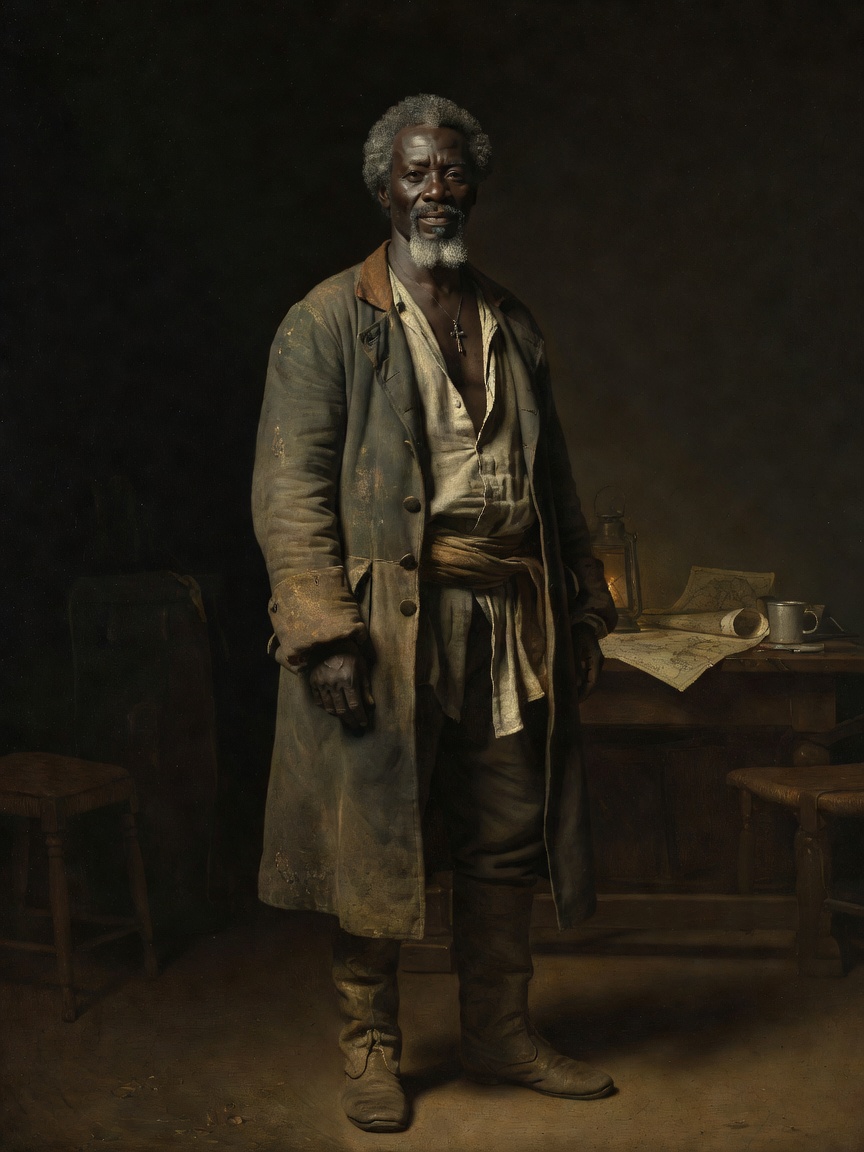
The face that emerges from the gallery is that of a man shaped by decades of precision work and deliberate stillness. Marius Holt’s head sits broad across the cheekbones — a Gold Coast geometry that no amount of time in the Caribbean could erase or soften.
His eyes are dark, nearly black in most light, set deep beneath a brow ridge that catches shadow and casts it downward, lending his gaze an almost predatory attentiveness. That attentiveness is the thing: even in repose, his eyes are working.
They move laterally across a room
They move laterally across a room the way a port inspector’s eyes move across a manifest — cataloguing, assessing, extracting value or rot from whatever surface they touch. The sclera shows no yellowing despite his age; the pupils track with the precision of a man who has trained himself to see detail in darkness.
His nose is broad and strong, set without deviation, the septum unbroken by any recorded violence. The bridge is distinct, the nostrils wide — a working nose, not a decorative one.
Below it, his mouth sits compressed into what might be mistaken for displeasure but is more accurately indifference. He does not smile often.
When he does, the expression occupies
When he does, the expression occupies only the mouth; the eyes remain engaged elsewhere, as though the smile is a courtesy his face extends while his attention pursues its own business.
His lips are full, almost African in their unflinching width, and he has never attempted to minimize them — a small defiance, perhaps, in a world that preferred men of his origin to apologize for their own proportions.
His jaw is square and prominent, extending forward from the face without apology. There is no softness there, no accumulation of age-fat. The skin beneath his chin remains taut, drawn tight across bone.
Age has written itself into his
Age has written itself into his face not through loosening but through deepening — the lines that radiate from the corners of his eyes have become crevasses, and the creases that frame his mouth run deep enough to cast their own shadow.
His forehead is high, the hairline receded to a point perhaps two fingers above the apex of his skull, and what remains of his hair is the same coal black it has always been, coiled tight against the scalp in the manner of his heritage, now shot through with threads of grey-white that catch the light like silver wire worked into iron.
The scars on his back — the nine lashes administered at Elmina when he was nineteen — do not appear in a headshot, but they inform his bearing. He sits upright always, chest open, shoulders set back in a posture that suggests he has made peace with exposure.
There is no protective slouch in
There is no protective slouch in Marius Holt. His neck is long and corded with muscle, the skin darkened by decades of sun, and he wears it with the unconscious authority of a man who has learned that occupying space is not a privilege but a practice.
His hands, where visible in the gallery, are remarkable for their precision. The fingers are long and tapered, capable of the fine motor control required to hold a brass caliper or parse a ship’s ledger by candlelight.
The palms are callused but not coarse — the calluses are the neat, professional calluses of a man who works with instruments rather than rope.
He favors dark wool, earth tones
He favors dark wool, earth tones when he can manage them: ochres, russets, the kind of brown that doesn’t show the grime of a colonial port. His clothing is clean beyond what necessity demands — a signal, perhaps, of a man restoring dignity through the simple act of keeping himself presentable.
The nickname “The Gentleman” emerges when you observe him in context. It is not irony.
Marius Holt carries himself with a formality that exceeds his circumstance, a precision of movement and speech that suggests he has trained himself to the standards of a world that was never meant to accommodate him. He does not rush.
He does not raise his voice
He does not raise his voice. When he moves through a ship’s hold, he does so with the careful, economical motion of a man who respects the space he occupies and expects others to do the same.
His voice, on the rare occasions it surfaces in accounts, is described as low and measured, with no trace of the Caribbean patois that marks most men of his years. He speaks as though every word has been weighed before utterance.
At somewhere past his fiftieth year, Marius Holt presents as a man who has not surrendered to age but has instead incorporated it into his operational repertoire.
The grey in his hair, the
The grey in his hair, the deepening of his face, the slight stiffening of his spine — all of these are simply data points, obstacles noted and worked around.
His coal-black skin, unmarked by sun damage beyond a generalized deepening, suggests either exceptional genetics or exceptional care, perhaps both.
The overall impression is of a man who has learned that survival is a form of resistance and that dignity is a skill that can be practiced, like ledger-keeping or the inspection of cargo.
Identity
- Gender
- Male
- Nationality
- West African
- Origin
- Gold Coast (Cape Coast / Elmina) — formerly enslaved, escaped to the Caribbean
- Ship · 1725
- Brass Promise
- Ship · 2025
- —
- Berth
- Quartermaster
- Bounty
- 11000
Frestagon Profile
Compiled by Dr. Frestagon from observation rather than testimony. Scores out of ten; the commentary is his own.
- Education (9) — at the ceiling. Assume premeditation.
- Strategy (8) — formidable; rarely caught improvising.
- Cunning (7) — serviceable, and aware of its limits.
- Intuition (7) — serviceable, and aware of its limits.
- Command (6) — serviceable, and aware of its limits.
- Lore (5) — middling; compensated for elsewhere.
- Charm (4) — middling; compensated for elsewhere.
- Navigation (4) — middling; compensated for elsewhere.
Filed under seal. The subject has not seen this assessment.
Saltwell Profile
Leadership, as the Admiral's office measures it.
Blackwater Profile
Intelligence and tradecraft, by Blackwater reckoning.
Tidecrest Profile
A woman's appraisal — of a woman as she is, or of a man as he believes himself to be.