Akoto Leclerc
- Ship
- Depth Maiden Boatswain
- Position
- Boatswain
- Faction
- Black Ribbon Society
- Territory
- Van Hoorn's Ship Stores
Backstory
THE CROW’S RECKONING
A Chronicle of Akoto Leclerc, Boatswain of the Brass Promise1
The man they call the Crow does not announce himself.
He arrives — at the rail
He arrives — at the rail of a merchantman at dawn, at the quarterdeck during a squall, at a tavern in Port Royal2 where the light pools thick as molasses — and within moments, the room has reorganized itself around him without anyone quite noticing the moment the shift occurred.
This is not magnetism. Akoto Leclerc possesses no flash. It is something older: the quiet authority of a man who has calculated every surface in a space before his eyes have finished crossing the threshold.
He was born in Loango in 1678, in a compound where three languages died in his father’s ledgers each time a trading agreement failed.
Nzinga — his father, a Kongo
Nzinga — his father, a Kongo merchant prince of minor standing — taught him early that knowledge is a commodity more durable than cloth or spice, that the direction of the wind matters less than the direction of profit, and that a man who appears weak survives longer than a man who appears strong.
The boy learned to count in Portuguese, Manding, and the coastal Kikongo his mother’s people had already half-forgotten.
He learned to read the quality of light on water, to distinguish between the smoke of cooking fires and the smoke of destruction, to mark the moment when a negotiation shifts from commerce to something that requires escape.
The escapes began when he was
The escapes began when he was ten.
In 1688, raiders came at dusk. The interior kingdoms were already fragmenting; the supply of captives the coastal traders depended upon had grown volatile.
His father’s careful neutrality — that hedge against catastrophe — had begun to look like weakness to men whose fortunes depended on his expertise.
Akoto does not speak of what
Akoto does not speak of what he saw that evening, though men who have served with him for twenty years know that something in his chest refuses to close when darkness falls on open water.
He made his way north along the slave-trading routes, hidden in the bilge of a Portuguese ship, then in a French prize taken in the Windward Passage3, then as a bargained labor hand — which is to say, enslaved again, in the eyes of law and paper — in the cane fields near Port Royal.
He was in those fields for seven years.
They broke many men in less
They broke many men in less time than that. They broke Akoto differently. He learned the pattern of the overseers’ rounds the way his father had learned the patterns of trade winds.
He learned that a man who appears docile, who does not meet eyes, who moves with the specific exhaustion of someone on the edge of collapse, can be placed in positions of trust precisely because he does not seem worth watching.
He learned every rope in the plantation’s rigging, every cart route to the coast, every corrupted factor and half-drunk ship’s carpenter who could be bribed with stolen coin or the promise of information.
And he learned — this took
And he learned — this took the full seven years, required the patience of someone who understood that revenge is a luxury — to read the habits of free men. The gestures they make without thinking. The way they hold their shoulders when they expect obedience.
The tone of voice they use when they believe their authority is unquestionable.
In 1701, at a dock in Port Royal where a coastal sloop called the Brass Promise was taking on water and crew, Akoto Leclerc presented himself to a captain named Cheikh Severin with the papers of a freed man — forged, purchased from a clerk in Spanish Town who had learned early that his wage was insufficient to his silence.
The papers were excellent work. More
The papers were excellent work. More importantly, Akoto’s posture was perfect: the slight hunch of a man accustomed to being smaller than required, the eye-line of someone trained not to presume. Severin needed a bosun.
The Brass Promise, though small, was building a reputation for knowing the coastal routes between Barbados4 and the Carolina shallows — routes that required not courage but precision, not aggression but the ability to read a tide the way a man reads a face.
Severin, who would later become the Sunflower Captain and sail under the name Cheikh Blacktide5, hired him within the hour.
What Severin could not have known
What Severin could not have known — and what Akoto never told him until they had been together for nearly a decade — was that the forged papers represented not an escape but an arrival.
On the plantation, Akoto had learned how the machinery of colonial authority worked. On the Brass Promise, in the years that followed, he learned how to dismantle it from within.
As bosun, he controlled the crew’s discipline and the ship’s rigging. He controlled the watch schedules, the cargo storage, the rotation of duties that determined who worked where and when.
He controlled the rope and the
He controlled the rope and the water and the knowledge of which men could be trusted and which men would break under pressure or under profit. This was power that did not advertise itself.
A bosun’s authority came from below — from the crew’s understanding that he kept them alive — rather than from above. This distinction would shape everything that came after.
Over the next two decades, the Brass Promise evolved from a coastal trader into something more: a vessel that moved between the legitimate commerce of the chartered ports and the shadow economy that flowed through the Caribbean’s ungoverned waters.
Akoto did not plan this transformation
Akoto did not plan this transformation. He simply responded to the tides when they came. When Cheikh Blacktide accepted a merchant’s proposition to take a prize off the shipping lanes, Akoto organized the crew.
When circumstances required the forging of manifest papers, Akoto knew which factors could be approached and in what sequence.
When the Black Ribbon Society6 began to coalesce — that loose confederation of men who had determined that the Atlantic’s violence could be directed toward their own purposes — Akoto was already positioned at its interstices, a man whose presence signaled not menace but competence.
His cunning manifests not as schemes
His cunning manifests not as schemes but as adjacencies. He stands near the conversations that matter. He remembers every debt, every indiscretion, every pattern in a man’s character that might be useful later.
His strategy — and his record shows a man who has rarely lost a calculated wager — consists of seeing three moves ahead while others are calculating two.
When a merchant vessel appears on the horizon, Akoto can estimate its draft, its likely cargo, its crew complement, and the probable response of its captain within the time it takes to light a pipe. This is not intuition.
This is the specific form of
This is the specific form of intelligence that emerges when a man has spent forty years learning how the world is organized and has internalized its logic so completely that the logic becomes invisible.
His education is remarkably thin — three languages, some arithmetic, the ability to read practical documents.
Everything else is learned from surfaces, from the behaviors of men, from the slow accumulation of understanding that comes from paying attention when other men are not. This has cost him in contexts where written knowledge carries authority.
In the world of the Brass
In the world of the Brass Promise, at the tables where the Brethren make their decisions, it has cost him nothing.
By 1725, when Akoto Leclerc is forty-seven years old, he is among the most trusted men in Cheikh Blacktide’s circle. He has never commanded a ship of his own, though he has turned down offers to do so. He has never sought rank higher than bosun.
What he has done is survive — through a period when most of his cohort have died, either violently or through the slow deterioration that comes from drinking away a man’s interior — and he has accumulated a form of power that does not diminish when the law presses in, does not evaporate when the winds turn, does not depend on youth or flash or the approval of distant authorities.
He is called the Crow because
He is called the Crow because of the way he watches — dark, attentive, present without seeming to be there. Because he appears at moments of decision. Because once he has seen something, he does not forget it.
Because, in the years when the Brethren were building their world, he was the man who calculated what that world would require, and built it in the spaces between the visible and the recorded, one piece of rope and one careful decision at a time.
THE CROW’S RECKONING: ORIGIN
A Chronicle of Akoto Leclerc’s Passage
A Chronicle of Akoto Leclerc’s Passage from Loango to the Sea
---
The compound in Loango smelled like pepper dust and wet palm-thatch. His father’s warehouse sat three days inland from the coast, positioned in that deliberate margin where the Kongo traders could still deny they were complicit in what happened at the beach.
Nzinga Leclerc kept his hands in
Nzinga Leclerc kept his hands in ledgers, not in chains. This distinction mattered to him the way a priest cares about the color of his vestments — it was the uniform of respectability, the costume that let him sleep.
Akoto was born in 1678 into a house of numbers.
His father moved through the compound with the precision of a man cataloguing inventory: three porters, two linguists, four factors whose loyalty rotated with the seasons, and a wife whose name appears only once in the surviving correspondence — Zara, mother-line of the southern merchants, excellent judgment on cloth grades.
The ledger captures more of her
The ledger captures more of her than any record of her face. Akoto learned to read from watching his father’s fingers move across those pages. Portuguese across the top margin. Manding in the vertical columns.
Kikongo in the annotations where the real negotiations lived — the erasures, the price corrections, the names of intermediaries who would later vanish or appear with new titles.
By age six, Akoto could distinguish Portuguese-house trading cloth from Augsburg damask by touch alone. His father tested him, pressing samples into his small palms while the dust from the warehouse settled in the afternoon heat.
A cloth that moves like water
A cloth that moves like water is a cloth that moves inventory, his father would say. A cloth that resists — that cloth is a cloth that sits. Nzinga Leclerc bought and sold the second type deliberately. He was teaching his son that knowledge compounds.
Every fact withheld from a buyer, every specification misremembered, every margin of confusion between what was promised and what arrived — these were deposits in an account that paid interest across years.
The boy’s mother added other educations in the compound’s interior. Zara taught him the songs for maize-planting, the words for sky-watching, the way to address his father’s mother without causing offense to the hierarchy of women.
She gave him languages the way
She gave him languages the way another woman might distribute cloth: careful, measured, with the understanding that he might need any one of them to survive a negotiation or an escape.
She never said the word escape, but Akoto understood — as children understand such things — that the accumulation of small competencies was armor.
His father’s neutrality was the compound’s philosophy.
Nzinga Leclerc cultivated relationships wi
Nzinga Leclerc cultivated relationships with Portuguese factors, French traders, and the Dutch merchants who operated out of São Tomé with the casual morality of men conducting business on an island everyone knew was a cemetery.
He cultivated equally careful relationships with the interior kingdoms whose merchant princes controlled the supply routes. He did not sell captives himself — not technically. He arranged introductions. He facilitated conversations.
He ensured that the goods moved downcoast at prices that satisfied everyone involved and implicated no one directly.
This arrangement worked for precisely as
This arrangement worked for precisely as long as the supply remained stable.
In 1688, the interior kingdoms began to fragment. The wars were not new; Akoto’s father had built his fortune partly on the chronic instability of the region. But instability that serves a merchant is not the same as instability that devours him.
When the supply of captives dried up — when the raids stopped reaching the coast with their former regularity — the men who depended on that pipeline began to look at merchants like Nzinga Leclerc with new mathematics.
A man who knew all the
A man who knew all the routes, who spoke all the languages, who could negotiate with kingdoms and Europeans alike, became a liability rather than an asset.
The evening before the attack, Akoto’s father changed the oil in the lamps himself, which he never did. His fingers smelled of tallow and something else — the salt-sweat of a man calculating odds.
The raiders came at dusk, ten men on horseback with muskets and machetes, moving through the compound with the efficiency of people who knew its layout. They were not after trade goods; the warehouse they left burning but untouched for plunder.
They were after Nzinga Leclerc. Akoto
They were after Nzinga Leclerc. Akoto watched from the roof-gap where he had hidden at his mother’s urging, watching her hands shake as she pushed him upward through the thatch.
He watched his father step into the courtyard with the same composure he used to greet factors. Watched the first blade catch light. Watched his mother stop moving mid-breath.
Akoto was ten. His memory of the violence is organized not by sequence but by sensory shard: the smell of pepper burning in the warehouse fire, the sound of his father’s ledgers crashing to the courtyard floor, the specific weight of silence after the horses rode out.
The raid was not a robbery
The raid was not a robbery. It was an erasure.
What happened in the compound after — the flight, the negotiations with his father’s remaining factors, the decision to move him north rather than let him become a bargaining piece — these details Akoto has never articulated, not even in the confessional style of drunken shipboard talk.
What matters is the architecture of his survival: he was hidden in the bilge of a Portuguese slaver bound for São Tomé, where the Portuguese captain traded him for cargo space to a French corsair operating out of Tortuga8, where the French captain sold him to a plantation labor merchant with connections to the cane fields of Jamaica7.
Seven years underground. That is how
Seven years underground. That is how Akoto learned to think in layers — the way a man who has been stripped of everything learns that the self is not a unified object but a stack of disposable masks, each one expendable, none of them the whole truth.
In the cane fields of Port Royal, the overseers worked the men in dawn-to-dark rotations, breaking perhaps half in the first two years through the combination of heat, dysentery, and the rhythmic precision of violence that does not need to rage because it is simple routine.
Akoto did not break. Not because he was stronger — several men were stronger — but because he understood, the way his father had understood ledgers, that the body is also a text, and the overseers could be taught to read what he wanted them to see.
A man who moves with the
A man who moves with the shuffle of collapse, who does not raise his eyes, who answers questions one beat too slowly — such a man becomes invisible. Not because no one is watching, but because no one is interested in what they are watching.
Akoto learned every rope in the plantation’s rigging. He learned the cart routes to the coast by ear and smell. He learned the corrupted factors and the half-drunk ship’s carpenters. He learned the names of free men and the specific authority in their voices.
And he waited.
In 1701, a coastal sloop called
In 1701, a coastal sloop called the Brass Promise came into Port Royal for water and repairs. Her boatswain had died of the flux. The plantation master, who occasionally hired out labor to ships desperate enough to ask, offered Akoto as a temporary hand.
The transaction took perhaps three minutes. Akoto walked up the gangway with his forged papers — purchased from a clerk with stolen coin and a whispered promise — and he did not look back at the cane fields.
The Brass Promise sailed with the evening tide. On his first night aboard, Akoto climbed the rigging in absolute darkness — a skill the plantation had never known he possessed — and felt the Caribbean wind clear the sugar-dust from his chest for the first time in seven years.
He was 23 years old. He
He was 23 years old. He had committed no crime yet. But the geometry of his entire life was now arranged so that crime was simply the next necessary motion, the obvious vector once you understood the angles.
Appearance
COMPOSITE HEADSHOT: AKOTO LECLERC (“THE CROW”)
A Portrait Assembled from Canonical Fact and Visual Register
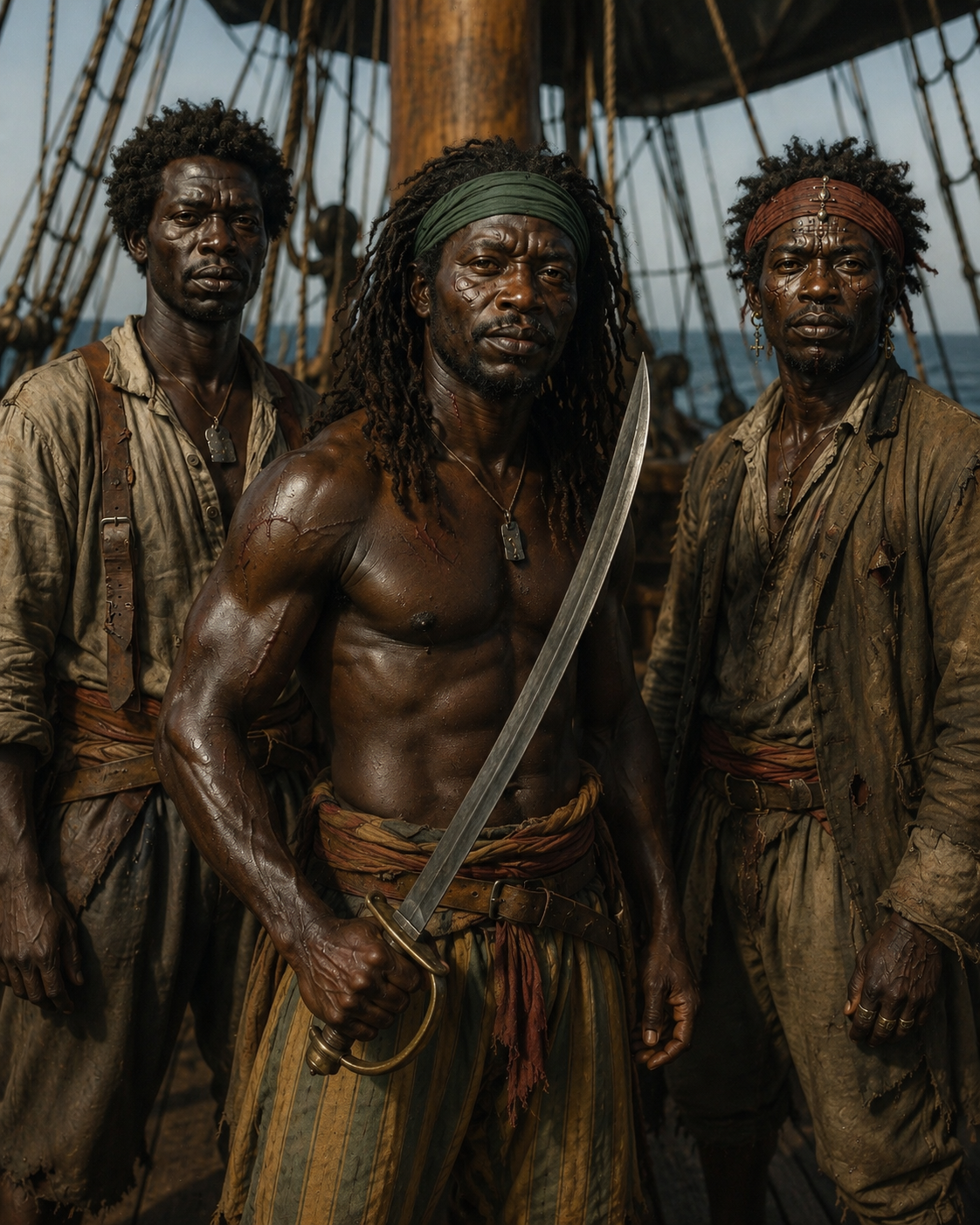
The man enters a room the way a crow lands on a branch — without apology, with the precision of something that has calculated the weight-bearing before the talons grip.
His face is the color of
His face is the color of tar left in the sun: deep, absorptive, nearly black, the kind of darkness that seems to swallow light rather than reflect it.
He is tall — not exceptionally so, but tall enough that his proportions read as slightly compressed when he stands among ordinary men, as though the space around him has been scaled for someone smaller.
His frame is lean and efficient, the build of a man who does not waste motion or breath; there is no slack in his shoulders, no excess at his middle, no pendulous softness anywhere that might suggest ease or leisure.
He is perhaps forty-seven years old
He is perhaps forty-seven years old as of 1725, though the mathematics of his face resist easy arithmetic.
There are weathered lines around his eyes — deep ones, the kind that come from squinting into salt spray across decades — but his skin retains an underlying firmness that suggests either exceptional physical discipline or the inheritance of cartilage and bone that ages slowly.
His face is angular: the cheekbones are pronounced and high, creating shadows beneath them even in bright light; his jaw is broad and squared at the angles, neither rounded nor softened by age.
His brow is prominent and relatively
His brow is prominent and relatively unlined across the crown, which gives his eyes a quality of being set slightly deeper than they might otherwise appear, watchful and slightly shaded.
His eyes are black. Not brown with flecks of amber or ochre — black, with whites so clear and white that the contrast reads as almost predatory. The irises seem to absorb rather than reflect; there is no easy warmth in them, no reflexive generosity.
When he looks at a man, that man experiences the sensation of being read — not judged, precisely, but inventoried, the way a merchant might examine a bolt of cloth for hidden flaws.
His gaze does not linger; it
His gaze does not linger; it moves with the efficiency of a master’s assessment, landing, extracting information, and releasing.
Men who have served under him for years report that they never quite become accustomed to the feeling of being looked at by Akoto Leclerc, because the looking never softens into familiarity.
He does not smile easily, and when he does, the expression appears to cost him something — a brief reorganization of the muscles around his mouth that reads as performance rather than genuine pleasure.
His nose is straight and moderately
His nose is straight and moderately broad, with nostrils that flare slightly, giving him the aspect of someone perpetually scenting the air for information the ordinary senses might miss.
There is a thin scar, perhaps two inches long, that runs from the left corner of his mouth toward the hinge of his jaw — old enough that it has faded to a slightly lighter brown, not quite blending with the surrounding skin.
The origin of the scar is not documented in the record, and Akoto does not volunteer explanations.
His hair is the most immediately
His hair is the most immediately striking feature. He wears it in long dreadlocks, woolly and black, the texture of rope that has been sea-soaked and dried in the sun hundreds of times.
The locks fall past his shoulders, some of them twisted with thin cord or wire, creating a texture that reads as both deliberate and menacing.
There is no grey in the dreadlocks — either he has inherited the tendency toward late greying, or he takes deliberate steps to maintain their uniform darkness.
The arrangement of the locks seems
The arrangement of the locks seems to serve a practical function: they keep his face framed in a way that makes expressions difficult for distant observers to read.
A man watching Akoto from across a deck or tavern finds his eye drawn to the movement of the locks, the way they sway or shift with his motion, and this draws attention away from the subtle micro-expressions of the face itself. Whether this is deliberate camouflage or fortunate accident is impossible to determine.
His bearing is the architecture of a man who has learned that visibility invites violence. He does not slouch — his posture is alert, spine generally vertical, shoulders held back but not rigidly so.
Yet there is nothing aggressive in
Yet there is nothing aggressive in the way he carries himself. Instead, he moves with a particular quality of quietness: his footfalls are nearly silent even on creaking wooden decks, his arms swing minimally, his head rotates rather than bounces.
When he speaks, his mouth moves less than the average man’s; the words seem to emerge from deeper in the chest, projected forward with minimal wasted effort. His hands are remarkable for their steadiness.
There is no tremor, no fidgeting, no unconscious movement. When he reaches for something, the motion is direct and economical.
His fingers are long and scarred
His fingers are long and scarred — the knuckles thickened from decades of rope work, the palms calloused and crosshatched with old cuts. There is a missing fingernail on his left hand, the index finger, the nail-bed healed into a smooth indentation.
Men who work cargo do not usually survive such injuries intact; that Akoto retained the finger despite the missing nail suggests either exceptional healing or exceptional care taken to prevent infection.
The hands themselves seem to move independent of his emotional state — even when anger or determination might be expected to manifest in tension, his hands remain loose and available.
In dress, he favors earth tones
In dress, he favors earth tones and practical cloth. Breeches of brown linen or worn wool, tucked into calf-high boots of dark leather, often salt-stained at the seams.
His shirts are linen, varying between tawny ochre and grey, worn loose enough for movement but not so loose as to tangle in rigging.
Over the shirt, he typically wears a waistcoat or sleeveless coat of dark brown or rust-colored wool, cut without ornament, with deep pockets and narrow seams.
He owns at least one coat
He owns at least one coat of finer cut — dark grey wool with subtle brocade at the cuffs — which he wears when business requires appearance in official contexts; this coat is worn with visible age and deliberate restraint, as though he has learned that ostentation draws the wrong kind of attention.
Around his neck, he sometimes wears a kerchief of faded indigo linen, knotted loosely, which he can pull up to cover the lower part of his face during salt spray or, historically, during the heat of boarding actions.
His hat is a broad felt tricorn of dark grey or black, often rain-stained, with the brim worn unevenly from years of salt-wind exposure. He does not wear jewelry — no rings, no chains, no earrings or badges of rank beyond the leather insignia of his bosun’s warrant, which he keeps in his cabin rather than on his body.
His voice matches the economy of
His voice matches the economy of his motion.
He speaks in a low register, without significant inflection, the accent a layered thing that suggests multiple linguistic childhoods — traces of Portuguese, hints of French, the clipped consonants of coastal Kikongo underlying the English he uses for command.
He rarely raises his voice; men who have served under him report that the most dangerous moment is not when the Crow shouts, but when he lowers his pitch further and speaks in something barely above a whisper.
The effect is that of a
The effect is that of a man drawing inward, concentrating his attention so completely that the air around him seems to compress. His speech is spare. He does not repeat himself or elaborate beyond necessity.
When he gives an order, it is phrased in terms of sequence and consequence, not persuasion — “The water casks are compromised; we furl the southerly jibs and make for Hispaniola” rather than “Gentlemen, I propose we furl the jibs.” Men interpret this precision as either callousness or the ultimate form of respect, depending on their own experience; what is constant is that no man who has heard an order from Akoto Leclerc has ever misunderstood its intent.
In photographs or formal crew records, Akoto presents as a composed figure: spine straight, eyes forward, expression neutral. The dreadlocks frame the darkness of the face in a way that creates optical weight despite his lean frame.
There is nothing soft in the
There is nothing soft in the resulting image. Instead, what emerges is the impression of controlled potential — a man not at rest, but at stillness, which is a different thing entirely.
A portrait artist would struggle with capturing the most essential feature of Akoto Leclerc, which is the quality of attention in the eyes: the sense that he is always reading, always calculating, always three layers ahead of the conversation or the crisis.
This is the signature of the Crow — not the dreadlocks or the scar, not the precise way he moves or the flatness of his affect, but the absolute certainty, visible in every interaction, that he has already determined the outcome before the action begins.
Career
CURRICULUM VITAE
AKOTO LECLERC Boatswain, Black Ribbon Society Brass Promise — rated vessel under full articles Known also as Milo Leclerc, called “the Crow” for his harsh laugh
ESTATE & ORIGIN
Born to Levantine trading stock in
Born to Levantine trading stock in the port-cities of Tunis, where my family conducted commerce in silk, spices, and bullion across the Mediterranean routes for three generations prior.
Learned the merchant’s reckoning from childhood, cataloging cargo values and port politics whilst my elder brothers managed the counting-house. Fled westward in my nineteenth year following a ruinous territorial war with Maltese competitors, my family’s warehouses consumed by fire and my brothers buried in salt earth.
COMMISSIONS
Passage to Port Royal aboard the
Passage to Port Royal aboard the Spanish merchant vessel Santa Eulalia, 1689-1690. Supercargo’s assistant. Relieved the vessel of her paymaster’s chest upon making harbor — a transaction never formally settled. Fled before Spanish justice could attach itself to my person.
La Sirena Negra, privateer bark operating from Tortuga and the Windward Passage, 1691-1694. Master-at-Arms and acting quartermaster.
Brought order to a mutinous crew and recovered three hidden caches aboard captured prizes that other officers had overlooked, thereby increasing the plantation’s [sic] share by nearly forty pounds in plate and jewelry.
The Defiant Mercy, brigantine under articl
The Defiant Mercy, brigantine under articles, 1695-1697. Boatswain’s Mate under Captain Henri Marchand.
Coordinated the taking of the merchant brig Providencia, whose hold contained colonial correspondence revealing the location of the governor’s private warehouse at Port au Prince — a discovery that led to our most profitable venture in those years.
The Brass Promise, full-rigged ship operating under Black Ribbon colors, 1698 to present. Boatswain and senior warrant officer.
Maintained vessel discipline and rigging s
Maintained vessel discipline and rigging standards whilst managing the boarding parties and prisoner details across seventeen recorded actions. No ship’s complement under my watch has suffered mutiny or significant discord.
COMPETENCIES
Boatswain — Conversant in all aspects of vessel maintenance, rigging, rope-work, and the discipline required to keep a pirate crew efficient and answerable to articles. Have supervised refitting in three Caribbean harbors.
Boarding — Experienced in coordinated assa
Boarding — Experienced in coordinated assault tactics, the securing of quarterdeck and hold, and the rapid assessment of crew resistance. Have led prize-taking actions across merchant vessels of varying tonnage and resistance.
Master-at-Arms — Skilled in the maintenance and distribution of small arms, the organization of fighting crews, and the enforcement of the code among men who respect only force and evidence of competence. Never tolerate shirking or cowardice.
Smuggler — Conversant in the hidden compartments, false manifests, and coastal routes that allow cargo to evade colonial customs and naval pursuit. Have located contraband aboard merchant vessels with uncommon accuracy.
Able Seaman — Capable in all
Able Seaman — Capable in all weather and all stations. Can hand, reef, and steer a ship under storm or becalmed condition. My first decade at sea was spent learning the honest trade before necessity drove me toward more profitable work.
NOTABLE ACTIONS
The capture of the merchant galleon Reina del Mar off the Morant Cays, 1696, wherein I alone descended into the hold and located the captain’s private bullion cache — recovered forty-eight ounces of coined gold that no other man would have found.
Service as boarding master during the
Service as boarding master during the taking of three colonial postal sloops, thereby acquiring government correspondence that proved invaluable to our faction’s political interests and navigation of the Bahama channels.
The disciplining of mutinous elements aboard La Sirena Negra in 1693, executed by summary flogging and strategic marooning, which restored order and prevented the seizure of ship and articles by malcontent elements.
REFERENCES & REPUTATION
Captain Henri Marchand and the officers
Captain Henri Marchand and the officers of the Black Ribbon Society stand witness to my competence and steady character.
I am regarded among the Brotherhood as a man of cold calculation and reliable judgment, though few claim intimate friendship with Akoto Leclerc.
Spanish colonial authorities and merchant factors view my name with particular disfavor, as I have cost them considerable sums and have shown merchants the same mercy they showed my family.
Identity
- Gender
- Male
- Nationality
- West African
- Origin
- Kingdom of Kongo (Loango coast)
- Ship · 1725
- Depth Maiden
- Berth
- Boatswain
- Bounty
- 97904
Frestagon Profile
Compiled by Dr. Frestagon from observation rather than testimony. Scores out of ten; the commentary is his own.
- Cunning (10) — at the ceiling. Assume premeditation.
- Strategy (10) — at the ceiling. Assume premeditation.
- Command (9) — at the ceiling. Assume premeditation.
- Intuition (8) — formidable; rarely caught improvising.
- Charm (7) — serviceable, and aware of its limits.
- Lore (7) — serviceable, and aware of its limits.
- Navigation (7) — serviceable, and aware of its limits.
- Education (3) — a documented weakness. Exploit with care.
Filed under seal. The subject has not seen this assessment.
Saltwell Profile
Leadership, as the Admiral's office measures it.
Blackwater Profile
Intelligence and tradecraft, by Blackwater reckoning.
Tidecrest Profile
A woman's appraisal — of a woman as she is, or of a man as he believes himself to be.