Milo Blackthorn
- Born
- 1700 · Norwich
- Faction
- Grave Keel Tenders
- Allegiance
- Unaffiliated
- Territory
- Tortuga
Backstory
MILO BLACKTHORN: FORGER, FENCE, AND THE ARCHITECTURE OF FALSE NAMES
The man who would become known as Milo Blackthorn was born into a world of careful deception in the year 1700, in Norwich — a port city where the boundary between legitimate ledger-work and criminal fabrication had long since dissolved into something far too murky for the Crown’s magistrates to untangle with confidence.
He did not come from merchant wealth.
Rather, he emerged from the stratum
Rather, he emerged from the stratum of clerks’ families, men whose fathers kept accounts for others and whose mothers knew, without ever saying so aloud, that the difference between prosperity and ruin often hinged on whether a figure in a column could be plausibly altered without detection.
By the time Blackthorn reached his fourteenth year, he had already begun to develop the particular sensory acuity that would distinguish him from the common forger — the hack with a stolen seal and ambitions beyond his reach.
He could feel the minute difference in weight between Genoa parchment and the inferior Flemish stock that attempted to imitate it.
He could read a merchant’s anxiety
He could read a merchant’s anxiety in the pressure his pen applied to paper during routine transactions; that telltale tremor spoke volumes about whether a sum had been recorded truthfully or under coercion.
He had learned to observe how officials’ hands moved when they were tired, when their signatures began to deteriorate, when the ego that governed their careful loops and flourishes started to flag.
This was not the ornamental counterfeiting of aristocratic dabblers. This was work born of necessity — the necessity of a boy who understood that survival in a port city meant becoming useful to people who preferred not to ask questions about origins.
He moved through counting-houses with the
He moved through counting-houses with the unremarkable presence of a ledger-boy, watching everything. The margins of accounts. The pressure-points where a document’s authenticity could be tested.
The slight discoloration where new ink had been applied over erasure. The pattern of oxidation that marked genuine age versus artificial aging with burnt umber and vinegar.
By twenty, Blackthorn could have produced a letter of credit that would have cleared three London1 banking houses before anyone thought to verify its origin. By twenty-two, he had almost certainly done so.
The Crown’s official reckoning of him
The Crown’s official reckoning of him arrived in the form of a warrant carrying a bounty of 10,517 doubloons — a sum that revealed far more than any magistrate’s proclamation could.
This was not the price on the head of some back-alley scrivener caught altering a modest promissory note for a desperate debtor.
The scale of the reward indicated that Blackthorn had fabricated documents of such consequence and scope that they had either unlocked merchant fortunes running into thousands of pounds, diverted cargo across seas, or rendered legitimate transactions void in ways that injured men of influence.
Perhaps he had produced manifests that
Perhaps he had produced manifests that allowed merchants to claim insurance on goods already sold elsewhere. Perhaps a perfectly executed letter of credit had drawn advances from a Levantine trading house against inventory that existed only in his own hand.
The authorities did not specify, and perhaps they did not wish to advertise the full measure of their humiliation. What mattered was that he had become, at twenty-two years old, expensive enough to hunt.
It was in the early 1720s — the precise year remains obscure, though the chronology suggests 1720 or 1721 — that Blackthorn made his first documented contact with the Grave Keel Tenders2.
The meeting likely occurred in a
The meeting likely occurred in a wine-house in a Mediterranean port, or in lodgings frequented by English merchants operating in the Levantine trade, men who had learned to do business in zones where official sovereignty was a negotiable fiction.
The Grave Keel Tenders did not hunt the deep Atlantic routes like their more celebrated cousins of the western piracy.
They were creatures of the inland sea — moving through the constricted harbors of the Mediterranean and the Levant, where the real profit lay not in seizing merchant vessels but in something far more subtle: intelligence, timing, and the ability to pass through zones of authority without leaving trace.
For such men, Blackthorn represented a
For such men, Blackthorn represented a tool of uncommon sophistication. A forged letter could unseal a counting-house door.
A fabricated manifest could redirect a shipment from one customs jurisdiction to another, rendering a cargo’s true provenance unknowable.
A falsified ledger could make profits appear where loss had been recorded, could vanish money from one merchant’s account and make it materialize, fully documented and legitimate, in another’s.
He became, in effect, the Tenders’
He became, in effect, the Tenders’ civilian liaison — the man who did not sail with them but who moved through the merchant houses and port offices of the Mediterranean under a constellation of assumed identities.
He was Venetian merchant Giovanni Moretti in one quarter, a Genoese factor in another, a Levantine trader named Salim in the narrow streets where Ottoman officials could be bribed to ignore paperwork inconsistencies.
Each identity had documentation to match — not merely a false name but an entire fabricated commercial history, letters of credit from banks that existed only on paper, ledgers showing years of hypothetical trading.
His worth to the Tenders rested
His worth to the Tenders rested on a single, terrible skill: the ability to make the false appear incontestably real.
This required not merely technical fluency with pen and seal, but a deeper understanding — almost intuitive — of how authority reads legitimacy.
He knew that a document bearing the careful errors of genuine correspondence would pass where a too-perfect script would fail.
He knew that officials inspecting cargo-ma
He knew that officials inspecting cargo-manifests looked not for perfect execution but for the particular wear-patterns and stains that marked papers that had passed through many hands.
He knew that a ledger’s credibility rested not on its presentation but on whether its internal logic — the way sums accumulated, the rhythm of entries — matched the expected rhythms of genuine commerce.
By 1725, Blackthorn existed in a peculiar legal and social space: formally a criminal with a Crown warrant against his name, materially invaluable to men operating across the borders of European sovereignty, physically absent from the maritime violence that characterized his associates’ work.
He was never a sailor. He
He was never a sailor. He never stood a deck under fire or participated in the seizure of merchant ships.
His warfare was conducted in the dim interiors of customs offices and merchant counting-houses, armed with nothing but paper, ink, and an intelligence bent entirely toward making the false coherent, the fabricated indistinguishable from the legitimate.
The bounty on his head — 10,517 doubloons — would pursue him through the following decades, a permanent marker of his crimes.
In the Mediterranean ports where he
In the Mediterranean ports where he operated, it functioned as a kind of strange credential, a sign that he had cost English authority enough to be considered genuinely dangerous.
It also meant that capture would result in something far worse than transportation. The Crown did not post sums of that magnitude for minor offenses.
It posted them for men who had wounded commerce itself, who had demonstrated that the entire apparatus of merchant legitimacy — the seals, the signatures, the ledgers, the documents — could be not merely copied but rendered indistinguishable from truth.
Milo Blackthorn had learned, before he
Milo Blackthorn had learned, before he was twenty-five years old, that this was the only form of power available to a man of no family, no wealth, and no legitimate standing: the power to make others trust the impossible, to inscribe falsehood so deeply into the architecture of commerce that even those who stood to lose everything could not detect where truth had ended and fabrication had begun.
THE PAPER ROUTE
Milo Blackthorn’s Origin, 1700–1720
Norwich in 1700 was a city
Norwich in 1700 was a city of wool and water — the Wensum River ran through it like a ledger’s margin, dividing the merchants’ quarter from the labourers’ warren.
The Blackthorn name carried modest weight: his father, Edward Blackthorn, was a wool-factor’s clerk, not the factor himself, a distinction that mattered in a port-town calculus where one rung separated respectability from the edge of the street.
His mother, Margaret, came from a family of dyers, people who understood the chemistry of transformation — how a vat of urine and oak-gall could turn cloth from its natural grey into the deep russets and blacks that commanded London prices. Milo was born into a household where the value of appearance was not abstract.
The Blackthorn residence sat on Pottergate
The Blackthorn residence sat on Pottergate Street, above a scrivener’s office whose proprietor, a man named George Fletcher, rented the ground floor from Edward. This proximity would shape the boy’s entire future.
Fletcher was not a gentleman-penman, the sort who drew up wills for the dying gentry.
He was a working scrivener — copying letters, drafting bills of sale, producing the endless paper by which Norwich’s merchants proved ownership of cloth, dye, tallow, dried fish, and the other commodities that moved through the Wensum warehouses.
The walls of his office were
The walls of his office were papered with specimens: merchant hands from Bruges, Amsterdam, London. Notarial forms. The seals of the Worshipful Company of Drapers, each one pressed from lead matrices that hung above Fletcher’s desk like talismans.
Young Milo — no more than eight years old — descended the narrow stairs to Fletcher’s office on a winter afternoon in 1708, ostensibly sent by his mother to retrieve a copied letter Edward had commissioned. What he found instead was the machinery of legitimacy laid bare.
Fletcher was away at a client’s counting-house. His apprentice, a sullen boy of sixteen named William3 Hughes, was copying a merchant’s hand into a ledger, pressing down hard with a steel nib, his tongue caught between his teeth in concentration.
The office smelled of iron-gall ink
The office smelled of iron-gall ink, sizing, and the particular mustiness of parchment stored in damp conditions.
Along the far wall, in a wooden case, lay the seals — forty or fifty of them, each one inscribed with a merchant’s mark, a city’s heraldry, or a guildmaster’s cipher. Some were new, the lead still bright. Others were worn smooth by years of pressing into red wax.
Milo did not steal anything that day. Instead, he watched.
For three hours, he sat on
For three hours, he sat on a stool in the corner while Hughes copied text, while Fletcher returned and corrected a bill of exchange with two sharp lines through an error and a rewritten sum in the margin, while a merchant came in to commission a copy of a trade license and Fletcher quoted him sixpence for a fair hand and ninepence for his best.
The merchant paid the ninepence without hesitation. The document would not be examined by an official for months, perhaps years. By then, its authority would be settled in reputation alone.
When Margaret finally found him and dragged him home, Milo carried something invisible: the understanding that a piece of paper, properly executed, was a tool of power more reliable than silver.
Over the next six years, he
Over the next six years, he cultivated Fletcher’s attention. He ran errands — fetching ink from the apothecary on Timber Hill, carrying letters to merchants’ offices, minding the office on afternoons when both Fletcher and Hughes were abroad.
He learned by observation and by being permitted, gradually, to hold the pens. At fourteen, he could produce a fair merchant’s hand. At sixteen, he could identify the ink-recipes of six different London scriveners by color and degradation.
By eighteen, he had learned the art that would define him: the recognition of pressure, the invisible signature written by the hand of a man under duress, in haste, or in the particular state of anxiety that came from signing away something he did not wish to lose.
The forgeries began small, because all
The forgeries began small, because all corruptions do.
A wool-merchant named Thomas Wilson came to Fletcher’s office with a problem in 1718.
He had purchased a shipment of cloth from a Bruges factor — quality goods, paid for in full — but the factor had since absconded, and the letter of credit that proved payment had been lost in a warehouse fire.
Wilson’s own creditors were pressing him
Wilson’s own creditors were pressing him, and unless he could produce proof of purchase within a fortnight, he would lose the goods to lien. The sum involved was modest by merchant standards — perhaps forty pounds — but it was ruin for Wilson, a man already thin from worry.
Fletcher, honest in his way, refused the commission. A forged letter of credit, he told Wilson, was a hanging matter, and he would not risk his apprentices for a man’s carelessness.
But Milo, listening from the back room where he was mending a quill, understood something that Fletcher did not: the risk could be distributed. A boy of eighteen, with no name yet, no reputation to protect, no masters to answer to except hunger — he could be expendable in ways that a licensed scrivener could not.
He approached Wilson three days later
He approached Wilson three days later, in the taproom of the Crown Inn near the market square. He did not introduce himself.
He simply placed before Wilson a document — not a letter of credit, which would have been too crude, but rather a merchant’s letter of acknowledgment from a Bruges factor whose hand Milo had studied in Fletcher’s specimen books.
The letter confirmed that Thomas Wilson had indeed settled his account and that the goods were consigned to his warehouse on the Wensum. It was dated eighteen months prior. The ink showed the proper degradation.
The seal — pressed from a
The seal — pressed from a lead matrix that Milo had borrowed from Fletcher’s office and duplicated in lead that he cast himself — bore the Bruges factor’s mark with such precision that Wilson himself would have doubted his own memory of seeing the original.
Wilson wept. He paid Milo three shillings — a sum that felt, in that moment, like the vindication of everything he had learned from watching Fletcher’s hands move across parchment.
He should have stopped there. The money was enough to rent a room of his own, to buy decent clothes, to eat meat three times a week instead of pottage. But the taste of it — the knowledge that he alone had remade a man’s fortune through the application of his own mind and hands — proved addictive.
Over the next eighteen months, he
Over the next eighteen months, he produced perhaps twenty documents. Most were for Norwich merchants in difficulties: disputed ledger entries, lost customs permits, letters of introduction for factors traveling to London or Harwich.
He charged what the traffic would bear, which was to say: whatever the merchant’s desperation would support. A disputed cargo claim might fetch twelve shillings. A fabricated deed to a piece of warehouse property went for two pounds.
By 1720, he had accumulated enough money to rent a proper office — not on Pottergate, but on a narrower street nearer the river, where the merchants were rougher and the questions fewer.
It was in that office, in
It was in that office, in late 1720, that a man calling himself Reynold came to him with a commission that carried the weight of history.
The document Reynold requested was not a simple forgery.
It was a bill of lading for a shipment of Moroccan leather and English tin intended for a trading post in Alexandria — a document that, when produced to the right merchants in the right Levantine port, would unlock credit against goods that Reynold and his associates had already sold elsewhere.
The fraud was elegant and large
The fraud was elegant and large: thousands of pounds in circulation, spanning six months, moving across three seas. When Reynold quoted the sum — fifty pounds, paid in two installments — Milo understood that he had crossed a threshold.
He produced the document. It was the finest work of his life: lead matrices cast from molds he burned in beeswax, inks compounded to match Levantine merchant standards, paper aged in saltwater and dried in a particular way that left the proper wear-marks.
When Reynold examined it under lamplight, he said nothing. He simply nodded and left a purse of sovereigns on the desk.
Three months later, soldiers came to
Three months later, soldiers came to Milo’s office. The bill of lading had been detected — not immediately, but eventually, through the careful work of a factor in Alexandria who recognized something false in the paper’s composition. The fraud had cascaded.
Credit had been advanced against phantom goods. Bills had been drawn on London banking houses. Merchants from Alexandria to Amsterdam had lost money.
Milo was arrested on a March morning, tried in a courtroom where the evidence against him was so clear that his own advocate did not bother with an elaborate defense, and convicted of forgery in the first degree.
The sentence was transportation to the
The sentence was transportation to the American colonies, which, everyone understood, was a slow form of hanging.
But the Crown, recognizing that a man with Milo’s particular skills might prove useful in future investigations, commuted the sentence to a fine of fifty pounds and exile from English soil.
The warrant for his arrest was issued simultaneously, with a bounty that would expire only when he did: ten thousand and five hundred seventeen doubloons, a sum that would have tempted angels.
By May of 1720, Milo Blackthorn
By May of 1720, Milo Blackthorn — or rather, what remained of that identity — was on a merchant vessel bound for the Mediterranean, carrying papers under the name Moretti and a skill set that made him, to certain men in certain ports, indispensable.
Appearance
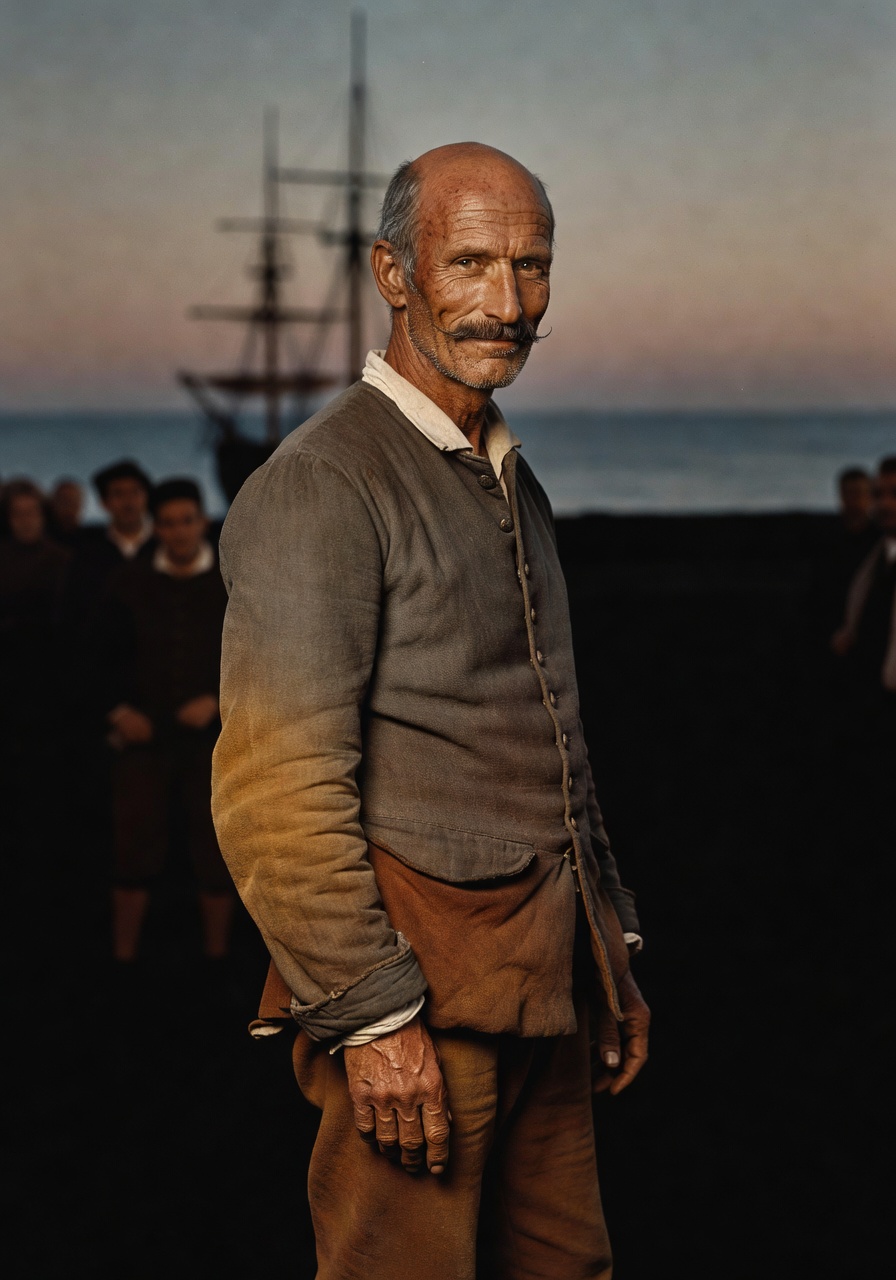
COMPOSITE HEADSHOT: MILO BLACKTHORN
Physical Canon from Gallery & Heritage
The man who moves through counting-houses under the name Moretti carries the build of someone who has never hauled rope or swung from a yard-arm — shoulders level but narrow, the frame of a scrivener rather than a laborer.
Height puts him at five foot
Height puts him at five foot ten, unremarkable in a crowded factor’s office, which is precisely the mathematics of his survival. His hands are the first betrayal: long-fingered, with the calluses of pen-work on the inside of his middle and ring fingers, the nails kept close and clean. A forger’s hands. A spy’s hands.
The face reads as English through and through — Norman stock, the kind that had sailed from Southampton six centuries prior and settled into East Anglian bone structure like ballast in a hull.
His cheekbones sit high and pronounced, creating a slight hollowing beneath them that deepens when he smiles, which he does rarely and only when calculation demands it.
The jaw is square but not
The jaw is square but not brutish; it tapers to a point that gives his profile a lean, almost predatory elegance — the face of a man who could pass as a Venetian merchant if he weighted the deception carefully enough.
Skin carries the ash-grey pallor of someone who works indoors by candlelight and lamplight, with only the mercenary’s minimum of sun-exposure. No weathering across the face. No salt-burn on the cheeks. The complexion of a man who has never stood watch on a quarterdeck or clawed his way up a rigging line.
His eyes are grey-hazel, set slightly close to the bridge of his nose, giving him a habit of focusing intently on the details of a document or a face with the concentration of a jeweler examining a stone for flaws.
These are the eyes that catch
These are the eyes that catch the weight-difference in parchment, the tremor in a merchant’s signature, the micro-hesitation before a lie.
The pupils are sharp and rarely blink — a trait that makes men uncomfortable in negotiation, as though he is reading something written across their foreheads that they themselves cannot see. Age has begun to etch crow’s feet at the outer corners, thin lines that suggest chronic squinting rather than laughter.
Hair is dark brown, turning grey at the temples and along the crown, worn short and practical, without vanity. In his twenties he likely wore it longer, as fashion demanded.
By the 1720s — the years
By the 1720s — the years of his operation with the Grave Keel Tenders — the shortness serves him better: it reads as clerical rather than fashionable, the grooming of a man too busy counting money to think about appearance.
It is always clean, always combed back from his forehead with a precise, repetitive motion that has worn a particular furrow into the hair-line.
There is a scar — thin, pale, no more than two inches long — that runs from his left temple down toward his cheekbone, stopping just short of his eye. The origin is unknown; it is old enough that the tissue has faded to white.
He does not hide it, which
He does not hide it, which suggests either that it came before his life in forgery (when disguise mattered less) or that it is useful as misdirection — a visible wound that makes men focus on it rather than the subtle alterations in his face when he lies.
Bearing and Gait
Blackthorn moves through a crowded counting-house the way water moves through a sieve: without friction, without noise, without leaving a trace.
His posture is upright but never
His posture is upright but never stiff, the carriage of a man trained to move through spaces where visibility could kill him.
His shoulders roll slightly when he walks — a habit that likely comes from years of moving between narrow stone passageways in Mediterranean ports, where space is rationed and economy of motion becomes habit. He does not stride; he glides.
The pace is measured, not hurried. A hurried man in a factor’s office draws eyes; a measured man becomes part of the furniture.
When he sits, he sits with
When he sits, he sits with his spine against the back of the chair, hands folded or resting on the table in front of him, never crossed across his chest.
It is the posture of a man who has learned that visible relaxation is a weapon: it makes merchants lower their guard, makes port officials underestimate him, makes guards at customs houses assume he is harmless. The habit of stillness is profound.
He does not fidget. He does not tap his fingers or shift his weight. His breathing seems deliberately shallow, as though he is practicing invisibility at all times, in all spaces.
When he speaks, his voice is
When he speaks, his voice is measured and quiet — not whispered, which would draw attention, but calibrated to require the listener to lean in slightly to hear him clearly.
This is another technique: it forces the listener into closer focus, makes the conversation seem more intimate than it is, creates the illusion of conspiracy even when he is simply discussing the price of Levantine linen.
His accent is educated English, with the careful precision of a man who has had to mimic other accents and therefore keeps his own locked down behind grammar and deliberation. He rarely uses contractions. “I will” instead of “I’ll.” “He does not” instead of “He doesn’t.” The formality is another disguise.
Habitual Dress
Habitual Dress
Milo Blackthorn dresses in the uniform of the merchant class — a grey wool coat, cut well but not expensively, with buttons of grey bone. Brown breeches, wool, fitted at the calf. Stockings of darker brown or grey.
Shoes are leather, polished, with plain buckles of tarnished silver.
The coat is always buttoned to
The coat is always buttoned to the throat, summer or winter, which serves multiple purposes: it conceals the collarbone and neck, which are telling in their boniness, and it maintains the sense of formal distance even in conversation.
A waistcoat of cream linen sits beneath, with small buttons that he tends to fasten and unfasten unconsciously when he is listening — a minor tell that a careful observer might note, though most will not.
Over the coat, in cooler weather, he wears a cloak of brown wool that falls to mid-calf, lined in ochre linen that never shows unless he is being searched or arrested.
The cloak has deep pockets, and
The cloak has deep pockets, and in those pockets he carries the tools of his trade: a small leather case containing the finest steel pens he can procure, three different inks that mimic aging and oxidation, a miniature copper seal that he claims to use for merchant marks but which is actually a blank waiting to be engraved with whatever family crest or official mark the moment demands, and a single sheet of foolscap that holds his current list of aliases — Moretti, Andreas Voss, John Pearce, Henry Weatherby — written in a cipher that only he can read.
He wears no rings, which is deliberate; rings catch the light and the eye. The only metal he allows himself is a small brass fob attached to a leather cord around his neck, concealed beneath the grey wool and cream linen.
No one has ever seen what hangs from that cord and lived to describe it with certainty; those who have glimpsed it in candlelight report that it is shaped like a key, or a seal, or possibly a talisman of some foreign god. He does not confirm or deny. The ambiguity is useful.
His hands, when visible, are always
His hands, when visible, are always either holding something — a quill, a document, a cup of wine — or folded beneath the table where they cannot betray him through unconscious gesture.
This is the discipline of a man who understands that the body speaks louder than words to those trained to listen. Every aspect of his presentation is calculated to render him unremarkable: forgettable, in fact.
An hour after he has left a counting-house, the merchant who negotiated with him cannot accurately recall the color of his eyes or the exact shape of his face, only that he seemed like someone who belonged there, someone official, someone to be trusted.
This is his true gift —
This is his true gift — not the technical mastery of ink and parchment, though that is formidable. It is the ability to dress the forgery not just on paper, but on himself, to present himself as such a perfect counterfeit of legitimacy that the document itself seems redundant. He is the proof, and the documents follow.
Identity
- Born
- 1700
- Died
- 1730
- Gender
- Male
- Nationality
- English
- Origin
- Norwich
- Bounty
- 10517
Frestagon Profile
Compiled by Dr. Frestagon from observation rather than testimony. Scores out of ten; the commentary is his own.
- Cunning (9) — at the ceiling. Assume premeditation.
- Strategy (5) — middling; compensated for elsewhere.
- Charm (3) — a documented weakness. Exploit with care.
- Lore (3) — a documented weakness. Exploit with care.
- Navigation (3) — a documented weakness. Exploit with care.
- Command (2) — a documented weakness. Exploit with care.
- Education (2) — a documented weakness. Exploit with care.
- Intuition (2) — a documented weakness. Exploit with care.
- Empathy (1) — a documented weakness. Exploit with care.
Filed under seal. The subject has not seen this assessment.
Saltwell Profile
Leadership, as the Admiral's office measures it.
Blackwater Profile
Intelligence and tradecraft, by Blackwater reckoning.
Tidecrest Profile
A woman's appraisal — of a woman as she is, or of a man as he believes himself to be.