Rodrigo Costa
- Ship
- Sandhill Captain
- Position
- storm lord
- Faction
- The Cathedral
- Territory
- Brine Gate Harbor
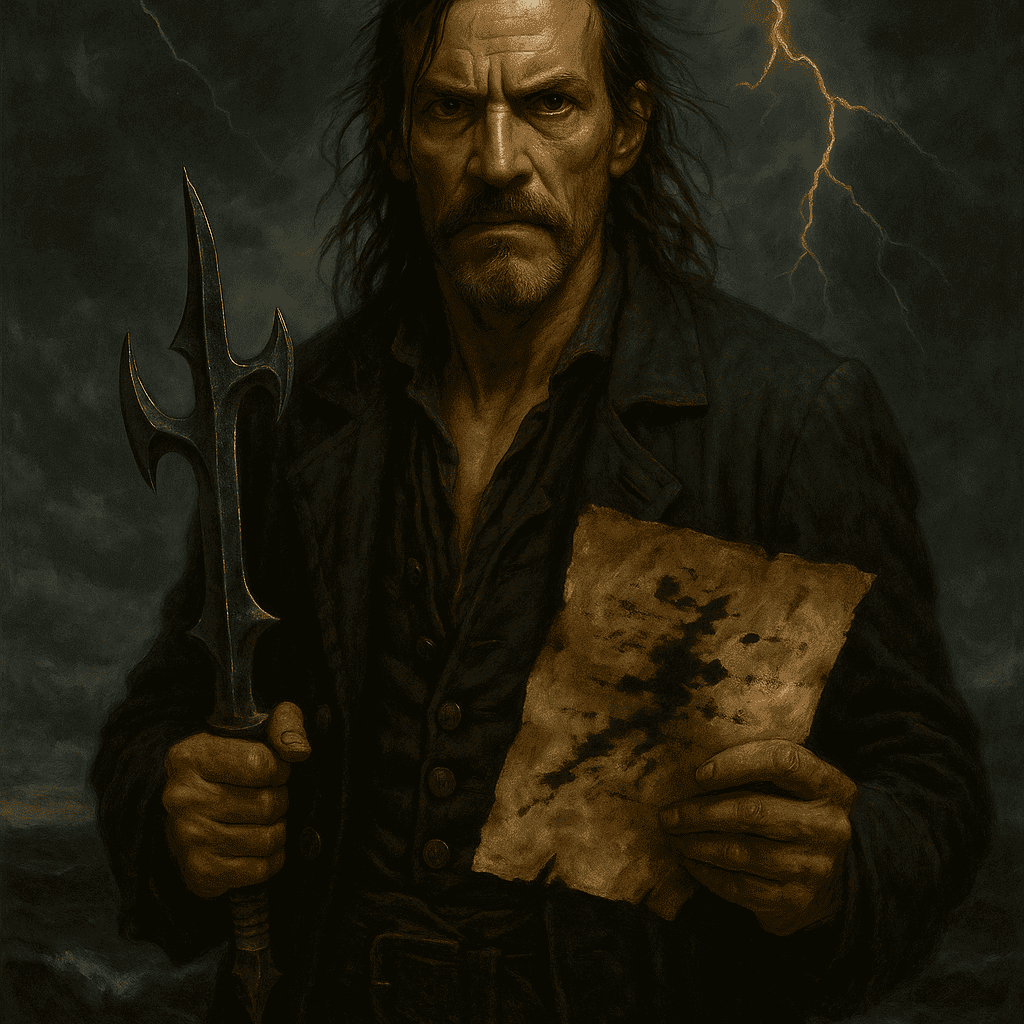
Backstory
Rodrigo Costa was born into the crackling aftermath of a life already split in half.
His father, a Spanish merchant captain, drowned off Havana1 in 1687 when Rodrigo was eight—a storm, they said, though storms were common enough that year that the word meant nothing.
What mattered was the void left behind: a widow who took in laundry, a boy with a merchant's bearing and a pauper's bread ration, and a debt to the sea that would spend the next decade collecting interest.
By sixteen, Rodrigo had shipped aboard
By sixteen, Rodrigo had shipped aboard three vessels as a powder monkey and cabin boy, learning the arithmetic of sail and survival. He was competent, unremarkable, hungry—the kind of boy navies and merchant houses chew through without noticing.
Everything pivoted in 1706 when the brigand captain Gerrit Brasiliano raided the merchant cog *Santa Isabella* off Campeche2.
The cog was outgunned and outmaneuvered; resistance lasted perhaps ten minutes before the crew began burning below deck rather than surrender.
During that brief chaos—the screaming, the
During that brief chaos—the screaming, the smoke, the electrical voltage of pure terror—lightning struck the *Santa Isabella's* mainmast.
The bolt descended through the wood, through rope and canvas and human bone, and when the powder magazine detonated a heartbeat later, Rodrigo Costa stood alone in the burning wreckage, clothes singed, hair standing wild from his scalp as if still conducting the storm itself.
He was alive. Everything else had char and screaming attached to it. Brasiliano, impressed by the boy's survival or simply amused by his bewildered stare, offered him a place. Rodrigo accepted. In that moment, Storm Fang was born—not named, not yet, but kindled.
For the next thirteen years, Rodrigo
For the next thirteen years, Rodrigo served Brasiliano and the Roc's floating confederation with the grim efficiency of a man who'd learned that sentiment was a luxury corpses couldn't afford. He rose from powder hand to bosun, from bosun to master-at-arms.
But the electric charge in his blood had never dissipated; it accumulated with every year, every storm weathered, every scar collected.
Around 1719, when the Gunwale Court3 began consolidating power across the Caribbean's fractured pirate kingdoms, Rodrigo caught the attention of Bastion Vire4 himself—the Judge, the Court's anchor point.
Vire recognized something in him: not
Vire recognized something in him: not just competence, but a kind of living weapon, a man who *was* the storm rather than merely sailing through it. The recruitment was done in an afternoon.
Rodrigo left Brasiliano's service and walked into the Cathedral's embrace. He became executioner, elemental enforcer, the Court's living lightning—Storm Fang, the name sealing itself into legend the moment he accepted it.
But executioners, even elemental ones, accumulate enemies faster than allies. By 1724, Rodrigo had delivered too many sentences, burned too many bridges—literal and metaphorical.
When the opportunity arose to command
When the opportunity arose to command the brigantine *Persistence5*, he seized it, breaking from the Cathedral's direct hierarchy while maintaining his alignment with their principles.
Now he captains independently, a privateer whose reputation precedes him like rolling thunder. The *Persistence* serves as both vessel and statement: Storm Fang answers to no master but the storm itself.
The Cathedral6 still considers him an asset; the Wolves still fear him. But the static in his hair crackles with a new frequency now—the charge of autonomy, of a man who has learned that power wielded for others eventually demands to be wielded for oneself.
**The Campeche Burning (1706)**: Brasilian
**The Campeche Burning (1706)**: Brasiliano's raid on the *Santa Isabella* should have ended Rodrigo's life—would have, for any other boy. Instead, lightning and circumstance conspired to remake him.
When the powder magazine detonated, Rodrigo stood in the center of the blast radius, clothes smoking, hair electrified into a permanent corona. He emerged from that wreckage walking.
Brasiliano watched him step over corpses and burning timber without flinching, and in that moment decided the boy was worth recruitment. The crew called it a miracle.
Rodrigo never spoke of it, but
Rodrigo never spoke of it, but the static in his blood dated from that day—as if the lightning had been absorbed into his very marrow, settling there like a permanent guest.
**The Name-Duel with Rafael Silva7 (circa 1715)**: Both men claimed the title "Storm Fang" in Roc's scattered fleet, and both had the weather-sense to back the claim.
They met during a squall off Jamaica8, swords in hand aboard the listing hulk of a captured merchant ship. The duel lasted perhaps three minutes—Silva was faster, meaner, a creature of pure violence. But Rodrigo understood electricity in ways Silva never would.
He discharged directly through the blade
He discharged directly through the blade, a focused arc that sent Silva sprawling, weaponless and smoking. Rodrigo could have killed him then. Instead, he let Silva live but took the name. Some said it was mercy. Rodrigo knew better: it was a message. *You are not the storm. Only I am.*
**Sigrid's Departure (1719–1720)**: Before the Court, Rodrigo had loved—or something close enough that the distinction no longer mattered. Sigrid Johansson9, the Shadow Apparent, moved through darkness with the same precision Rodrigo commanded lightning.
They were inseparable for nearly two years, two apex predators who had found their match. Then Vire offered Rodrigo the Cathedral's executioner role, and Rodrigo accepted without hesitation. Sigrid demanded he refuse. He didn't.
She left the same night, taking
She left the same night, taking a ship captaincy with the Wolves and swearing that if they met again, one of them would die. They have met, many times since. Neither has yet followed through. This restraint is its own form of violence.
**The Wrecker's Gambit (1722)**: A merchant fleet sheltered in Charleston harbor during a hurricane, and the Court wanted them broken before they scattered.
Rodrigo positioned himself on a coastal outcrop with a lightning rod of iron and copper, earthed into the sand.
As the storm peaked, he grounded
As the storm peaked, he grounded a series of electrical discharges directly into the harbor's waters, sending current through the anchorages and into the hulls of ships.
Fires erupted in five vessels at once—not the natural conflagrations of lightning, but the systematic destruction of a man who understood both weather and engineering. The fleet burned. Insurance adjusters would call it an act of God for the next century.
Rodrigo simply walked away as the storm passed, his hair still crackling.
**The *Persistence* Commission (1724)**: W
**The *Persistence* Commission (1724)**: When the Cathedral offered Rodrigo command of a newly acquired brigantine, he recognized it for what it was: a leash disguised as promotion.
He accepted the vessel but rejected the leash, declaring himself an independent privateer while maintaining Cathedral alignment.
The move was calculated—he had accumulated enough reputation that open rebellion would be wasteful, but enough autonomy that continued subordination had become intolerable.
Vire allowed it, perhaps recognizing that
Vire allowed it, perhaps recognizing that Storm Fang unleashed was more useful than Storm Fang constrained. The *Persistence* now prowls Caribbean waters as an independent operator, its captain a living reminder that some forces cannot be commanded, only directed.
**Encounters with Aidan Flynn10 (ongoing)**: Storm Fang and Frost Fang, once the Court's paired elemental enforcers, maintain their working relationship despite Rodrigo's independent status.
They have executed targets together—Rodrigo providing lightning to sever nerve clusters while Aidan uses cold-induction to stop hearts. Their coordination remains flawless and terrifying.
Some whisper that between the two
Some whisper that between the two of them, the fundamental forces of nature have been weaponized. Rodrigo doesn't correct this rumor.
**The Campeche Burning (1706)**: Brasiliano's raid on the *Santa Isabella* should have ended Rodrigo's life—would have, for any other boy. Instead, lightning and circumstance conspired to remake him.
When the powder magazine detonated, Rodrigo stood in the center of the blast radius, clothes smoking, hair electrified into a permanent corona. He emerged from that wreckage walking.
Brasiliano watched him step over corpses
Brasiliano watched him step over corpses and burning timber without flinching, and in that moment decided the boy was worth recruitment. The crew called it a miracle.
Rodrigo never spoke of it, but the static in his blood dated from that day—as if the lightning had been absorbed into his very marrow, settling there like a permanent guest.
**The Name-Duel with Rafael Silva (circa 1715)**: Both men claimed the title "Storm Fang" in Roc's scattered fleet, and both had the weather-sense to back the claim.
They met during a squall off
They met during a squall off Jamaica, swords in hand aboard the listing hulk of a captured merchant ship. The duel lasted perhaps three minutes—Silva was faster, meaner, a creature of pure violence. But Rodrigo understood electricity in ways Silva never would.
He discharged directly through the blade, a focused arc that sent Silva sprawling, weaponless and smoking. Rodrigo could have killed him then. Instead, he let Silva live but took the name. Some said it was mercy. Rodrigo knew better: it was a message. *You are not the storm. Only I am.*
**Sigrid's Departure (1719–1720)**: Before the Court, Rodrigo had loved—or something close enough that the distinction no longer mattered. Sigrid Johansson, the Shadow Apparent, moved through darkness with the same precision Rodrigo commanded lightning.
They were inseparable for nearly two
They were inseparable for nearly two years, two apex predators who had found their match. Then Vire offered Rodrigo the Cathedral's executioner role, and Rodrigo accepted without hesitation. Sigrid demanded he refuse. He didn't.
She left the same night, taking a ship captaincy with the Wolves and swearing that if they met again, one of them would die. They have met, many times since. Neither has yet followed through. This restraint is its own form of violence.
**The Wrecker's Gambit (1722)**: A merchant fleet sheltered in Charleston harbor during a hurricane, and the Court wanted them broken before they scattered.
Rodrigo positioned himself on a coastal
Rodrigo positioned himself on a coastal outcrop with a lightning rod of iron and copper, earthed into the sand.
As the storm peaked, he grounded a series of electrical discharges directly into the harbor's waters, sending current through the anchorages and into the hulls of ships.
Fires erupted in five vessels at once—not the natural conflagrations of lightning, but the systematic destruction of a man who understood both weather and engineering. The fleet burned. Insurance adjusters would call it an act of God for the next century.
Rodrigo simply walked away as the
Rodrigo simply walked away as the storm passed, his hair still crackling.
**The Gunwale Court Consolidation (1724–present)**: When Bastion Vire solidified control of the Cathedral faction, Rodrigo became the mechanism of that consolidation. Judge passes sentence; Storm Fang delivers it.
He has executed deserters, rivals, failed captains, and enemies with methodical precision. His methods vary—sometimes electrocution, sometimes the simpler blade. What matters is the reliability. The Wolves fear him.
Independent captains negotiate with him in
Independent11 captains negotiate with him instead of against him because the alternative is becoming cautionary tale. In a decade of service, he has never failed to deliver a sentence.
The static in his hair hums louder with each execution, as if something is accumulating, building charge in a reservoir that will someday need catastrophic discharge.
**Encounters with Aidan Flynn (ongoing)**: Storm Fang and Frost Fang, the Court's elemental enforcers, have developed a working rapport that verges on friendship or rivalry depending on the day.
They have executed targets together—Rodrig
They have executed targets together—Rodrigo providing lightning to sever nerve clusters while Aidan uses cold-induction to stop hearts. Their coordination is flawless and terrifying.
Some whisper that between the two of them, the Cathedral controls not just the seas but the fundamental forces that govern survival. Rodrigo doesn't correct this rumor.
The Lightning Boy
Havana in 1679 was a city
Havana in 1679 was a city that sweated. Not from heat alone — the heat was merely honest — but from the pressure of empires pressing down on a narrow spit of land, each one trying to wring gold and sugar from the same exhausted earth.
Rodrigo Costa’s father, Miguel, was a merchant captain who understood this pressure the way a man understands the weight of water: as something that would kill him if he relaxed his grip for a single breath.
Miguel had married late, at forty-three, a woman named Catalina whose dowry was modest but whose hands could mend canvas in the dark.
They lived in a narrow stone
They lived in a narrow stone house on Calle Obispo, three rooms and a kitchen that faced the street, where Catalina took in laundry from the merchant families who lived on the hill.
Rodrigo was born in 1679, during the yellow fever season, which meant his first months were spent as a bargaining chip between his mother’s prayers and the rot smell that drifted up from the harbour. He survived.
His father marked the event by buying three new lengths of Genoese silk for the San Demetrio, the merchant cog that would be his life’s work.
The boy grew up learning two
The boy grew up learning two languages: Spanish in the house, where his mother’s voice carried the Castilian vowels of her Córdoba childhood, and Portuguese in the street, where the sailors’ patois mixed Spanish, Dutch, English, and the click-soft tongues of the enslaved African workers who loaded sugar onto the docks.
By eight, Rodrigo could calculate cargo weight in his head and curse comprehensively in four languages. His father noticed this — not with praise, but with the quiet nod of a man who sees his own competence being replicated in smaller form.
Miguel Costa did not believe in coddling. He took his son to the docks and made him watch the loading process, the mathematics of ballast, the way a ship’s trim could mean the difference between profit and bankruptcy.
In September 1687, Miguel was preparing
In September 1687, Miguel was preparing the San Demetrio for a run to Caracas.
The port was full of captains making the same calculation: ride the tail end of the hurricane season for faster passage, or wait two weeks and lose the market advantage to the Flemish traders. Miguel chose speed. He’d chosen speed his entire life.
It was the muscle under his skin, the thing that made him different from the careful men who died in their beds.
The storm hit three days out
The storm hit three days out of Havana. Not a hurricane — that came later — but a nor’easter with enough teeth to tear the horizon into white noise.
Rodrigo’s mother heard about it on the fourth day, from a harbor master’s wife who’d seen the San Demetrio’s sister ship limping back toward port. She didn’t tell her son immediately.
She finished the laundry she was working on — a Spanish captain’s shirts, cream-colored linen — and folded them with the same precision she’d used for fifteen years. Only then did she find him in the courtyard, teaching himself to tie a bosun’s knot with hemp rope.
“Your father has been taken by
“Your father has been taken by the sea,” she said, in Spanish, which was how you said impossible things.
Rodrigo was eight. He didn’t cry. He finished the knot.
The widow’s pension was modest — Miguel had been cautious about one thing: insurance. But modest meant bread, not meat. It meant Rodrigo’s shoes were patched three times before they burst open completely.
It meant his mother’s hands developed
It meant his mother’s hands developed wounds from the lye she used, wounds that never fully healed because there was no rest in a widow’s calendar.
By fourteen, when Rodrigo stood five foot seven and had the corded wrists of a young man who’d already worked half his life, the mathematics of survival became obvious: the sea had taken his father, but the sea was also hiring.
He signed aboard the Flota Blanca as a powder monkey in 1693. The captain barely looked at him — one thin boy among fifty other workers, barely distinguishable from cargo.
The ship was a merchant vessel
The ship was a merchant vessel running sugar and indigo between Havana and Seville, the slowest, safest route in the Atlantic. But Rodrigo learned.
He learned the smell of different types of rope, learned which knots held under stress and which ones were theater. He learned the rhythm of a ship under sail, the way a brigantine talked to you through the deck beneath your feet if you knew how to listen.
He served three vessels this way, each one teaching him something: the Flota Blanca taught him obedience; the Reina Isabel taught him how to navigate by stars and by the behavior of water; the Santa Isabella taught him that competence meant nothing against surprise.
The Santa Isabella was a merchant
The Santa Isabella was a merchant cog, three months into a Caribbean circuit, when the brigand sails appeared on the horizon in August 1706. The captain was old, indecisive, a man who’d confused caution with wisdom.
The crew was merchant-grade: decent sailors, but men without hunger. Rodrigo was seventeen, bosun’s mate, and the moment he saw the black flag catch the wind, he knew.
The lightning came later.
The Storm That Bore Him
The Storm That Bore Him
The name Havana meant nothing to eight-year-old Rodrigo Costa except as the place his father left it and never came back.
The city itself was a sprawl of low white buildings and rust-bleached anchors, heat that pooled in the streets like spilled tar, and the perpetual smell of salt-rot and indigo.
His mother had taken him to
His mother had taken him to the quay once — he remembered her hand, callused from the laundry work that kept them fed, pointing at a merchant cog called San Cristóbal with such pride it made his small chest ache. That was his father’s vessel. That was where the money came from.
The San Cristóbal sank in ‘87, they said. A storm off the Yucatán Strait. A normal storm. A merchant captain drowned the way merchants drowned — no heroics, no last words, just water and weight and the slow dark.
His mother stopped pointing at ships after that.
The years that followed were not
The years that followed were not marked by hunger so much as by the permanent absence of fullness. Bread made of ground corn and something else, something that tasted like dust.
The laundry trade — she took in clothes from the Spanish garrison, scrubbed them raw on stone, hung them in the blast-furnace heat to dry. Rodrigo was expected to help by age nine, his small fingers wringing fabric until the skin split.
There was no money for schooling. There was barely money for the rent on the single room they shared behind the laundress’s workshop, the air so thick with steam it was like breathing through cloth.
By thirteen, he was taller than
By thirteen, he was taller than his mother. Thinner, too — all knuckled joints and shoulder blades that poked through his shirt. He began shipping out on merchant vessels, first as a powder monkey on a merchant brigantine called the Nuestra Señora del Carmen.
The captain barely glanced at him. The crew treated him like a stray dog — useful, disposable, easy to yell at. He learned to reef canvas without looking down. He learned that the horizon moved whether you watched it or not.
He learned that his father had not been unique in his drowning; the sea was an appetite that never closed.
Three vessels in four years. Each
Three vessels in four years. Each one left him more competent and more invisible.
Then came 1706.
The Santa Isabella was a merchantman out of Seville, fat with trade goods — indigo, chocolate, cochineal — headed for Cartagena. Rodrigo was sixteen, bosun’s mate in all but rank, which meant he took orders and got paid last.
The morning of the raid, he
The morning of the raid, he was below deck stacking cargo when the lookout’s scream cut through the wooden bones of the ship. By the time the cannon fire began, there was already blood in the bilge water.
A brigantine — sleek, low-slung, flying no colors — cut off their escape toward the harbor. Brasiliano’s ship, someone breathed. El Pirata Sangre. The name moved through the crew like a current.
The Santa Isabella’s captain tried to run into shallower water, but the brigantine was faster. The exchange of fire lasted perhaps ten minutes before the merchant captain understood what surrender meant out here.
He ordered the cargo set alight
He ordered the cargo set alight rather than see it taken. Better ruin than enrichment of pirates, he shouted. Honour, he called it.
Rodrigo was moving toward the companionway with the rest of the scrambling crew when the lightning struck.
It came through the mainmast like a lash, a white-silver bolt so bright it burned itself into the back of his eyes. The mast cracked from crown to keel, a sound like the world breaking.
The electrical charge ran through the
The electrical charge ran through the rigging, through the iron fittings, through the hemp rope he’d been coiling just moments before. Men screamed. The powder magazine, compromised by the fire already spreading below, detonated a heartbeat later.
The blast threw him against a bulkhead hard enough that stars bloomed in his vision.
When the roaring stopped, Rodrigo lay in the wreckage breathing smoke and burnt meat. His hair stood from his scalp as if still conducting the storm, and when he touched his fingers to his head, they came away singed. The Santa Isabella was coming apart around him like a carving. Everything was char and screaming.
He crawled onto the deck, gasping
He crawled onto the deck, gasping. Bodies. Splintered wood. The brigantine was pulling alongside, grappling hooks already flung. And there, standing in the smoke — a bearded man with eyes like flint, watching the wreckage burn.
Brasiliano.
The pirate captain was assessing him. Not with mercy. Simply as a phenomenon — a boy who’d survived a lightning strike and a magazine explosion in the same breath. A curiosity. A possibility.
“What’s your name, boy?” The Spanish
“What’s your name, boy?” The Spanish accent was heavy, Caribbean-worn.
Rodrigo couldn’t remember. His own name felt burned away.
“Storm Fang,” Brasiliano said, and the boy didn’t disagree.
Appearance
RODRIGO COSTA — COMPOSITE HEADSHOT
“Storm Fang” | Captain, Persistence | The Cathedral
---
The man who answers to Storm
The man who answers to Storm Fang carries himself like a weapon halfway through the draw. His build is compact, economical — a body that has learned to occupy less space than it deserves, muscle distributed for leverage rather than display.
He stands somewhere in his mid-forties now, though the Caribbean sun and twenty years of salt-work have compressed his timeline in ways that make him read older in certain lights, younger in others, depending on whether the damage or the hunger shows first.
His face arrests attention because it refuses to settle. The bone structure underneath is strong — a clean jaw with a Spanish sharpness to it, cheekbones cut at an angle that catches shadow in ways that make him look angular, almost predatory when he’s still.
But stillness is not his natural
But stillness is not his natural state. His expression moves constantly, flickering between focus and calculation, and this restlessness gives his features a kind of electric instability.
The scar tissue around his left eye — not extensive, but present, a thin white crescent running from temple to cheekbone like something tried to claw its way out — only compounds the effect.
That eye itself is darker than the right, storm-grey rather than brown, and he’s developed a habit of tilting his head slightly leftward in conversation, as if favoring the unmarred side while keeping the scarred profile ready.
The effect is simultaneously unguarded and
The effect is simultaneously unguarded and watchful, the way a man looks when he’s showing you one hand while keeping the other behind his back.
His hair is black still, with threads of silver beginning to network through at the temples.
He wears it pulled back in a sailor’s tail, revealing the full architecture of his skull, and this choice — deliberate or habitual, it amounts to the same thing — strips away any softness his face might claim.
There is an old scorch mark
There is an old scorch mark visible along the left side of his neck, running down toward his collarbone, the kind of burn that comes from a lightning strike or a powder flash. The skin there is darker, puckered in places, and he makes no attempt to hide it.
He dresses around it instead: earth-toned linen shirts with high collars, ochre or rust-brown, occasionally a grey wool coat with brass fastenings that have survived better than the men who polished them.
The clothes are expensive enough to announce intention, worn enough to promise he’ll ruin them without ceremony if the work demands it.
His hands tell a different story
His hands tell a different story than his face. They’re a working man’s hands — calloused across the palms, fingers that have been broken and reset, nails permanently darkened with salt and old blood underneath the keratin.
When he gestures, and he does gesture when the cunning takes hold of him, those hands move with surprising precision. He’s learned to make economy of motion into a kind of threat; every gesture says he knows exactly how far his reach extends and what damage it can deliver.
The voice is the final calibration. It’s pitched low, neither particularly warm nor cold, and it carries an accent that sits somewhere between Castilian Spanish and the flattened drawl of a man who’s spent more decades at sea than on land.
He speaks slowly, with pauses that
He speaks slowly, with pauses that seem calculated rather than natural — the kind of deliberate pacing that makes listeners lean in, that transforms silence into tension.
When he uses his voice, it’s usually to deliver instruction or threat, and the economy of his language matches the economy of his motion. He doesn’t waste words the way captains often do; instead, he lets silence do the work.
His bearing announces itself before he opens his mouth. He moves through a space as if he owns it by right of having survived it, which in his case is nearly true.
There’s no swagger to it —
There’s no swagger to it — that’s for men younger or more desperate — but there is an absolute absence of apology.
He holds himself with the posture of someone who has been burned by lightning and walked away to tell about it, which again, in his case, is literally true. His gait is measured, economical, the walk of a man who has learned to move aboard a pitching deck so thoroughly that he carries the rhythm even on land.
When the Cathedral recruited him, they didn’t merely hire a captain. They invested in a phenomenon.
The nickname Storm Fang was not
The nickname Storm Fang was not arbitrary invention; it emerged from the static electricity that seems to gather around him, the way men swear his hair stands on end before a squall breaks, the way disaster follows him with the inevitability of thunder.
Whether this is reputation calcifying into legend or whether there’s something genuinely elemental in his presence — the men of the Persistence have learned not to parse the difference. They’ve seen what he can do. What he has done. And they follow because following is cheaper than resistance.
At rest, Rodrigo Costa looks like a man still conducting the storm that nearly killed him. At motion, he looks like the storm itself.
Identity
- Gender
- Male
- Nationality
- Spanish
- Origin
- —
- Ship · 1725
- Sandhill
- Berth
- Captain
- Bounty
- 98000
Frestagon Profile
Compiled by Dr. Frestagon from observation rather than testimony. Scores out of ten; the commentary is his own.
- Cunning (10) — at the ceiling. Assume premeditation.
- Strategy (10) — at the ceiling. Assume premeditation.
- Command (9) — at the ceiling. Assume premeditation.
- Charm (8) — formidable; rarely caught improvising.
- Empathy (7) — serviceable, and aware of its limits.
- Navigation (6) — serviceable, and aware of its limits.
- Education (5) — middling; compensated for elsewhere.
- Intuition (4) — middling; compensated for elsewhere.
- Lore (3) — a documented weakness. Exploit with care.
Filed under seal. The subject has not seen this assessment, which is for the best.
Saltwell Profile
Leadership, as the Admiral's office measures it.
Blackwater Profile
Intelligence and tradecraft, by Blackwater reckoning.
Tidecrest Profile
A woman's appraisal — of a woman as she is, or of a man as he believes himself to be.