Crispin Blackthorn
- Born
- 1700 · Newcastle
- Faction
- Unaffiliated
- Territory
- The Crow's Nest
Backstory
# CRISPIN BLACKTHORN: THE ARCHITECTURE OF DELIBERATE RUIN ## A Biography of Emergence (1700–1725)
Newcastle, 1700–1718: The Forge
Newcastle sat on the Tyne like a merchant's fist—grey, callused, perpetually grasping.
The coal came up from the
The coal came up from the deep pits in the surrounding countryside, blackening the river and the very air, so that a child born there in 1700 learned the taste of soot before he learned the taste of bread.
Crispin Blackthorn's father was Thomas Blackthorn, a coal-master's clerk with thin hands and a ledger he guarded as if it contained the names of God.
His mother, Sarah Fletcher, came from the merchant class—her father had owned ships, though the fleet had dwindled to nothing by the time she married down into the Blackthorns' modest brick house on Bottle Bank.
There were three sons: Crispin first
There were three sons: Crispin first, then Edward after an interval of five years, then Milo, who arrived when Crispin was already eleven and whose cry, according to family legend, could be heard across three streets.
The boy was fair-haired from his mother's side, and his face—even in childhood—carried the kind of symmetry that made strangers speak to him first. He learned to use this. At market, he could talk fishwives into extra cod.
At school, he could deflect punishment with a glance and a quiet word that suggested he understood the schoolmaster's difficult position, his impossible task, his likely exhaustion.
By fourteen, Crispin had stolen his
By fourteen, Crispin had stolen his first sum—seven shillings from his father's desk, the theft disguised as bookkeeping error, the excuse delivered with such perfect contrition that Thomas Blackthorn had actually apologized to him. This was not crime yet.
This was simply the boy discovering that the world's rules were negotiable, that a face arranged correctly and a voice pitched to the register of wounded sincerity could open doors that locks were meant to keep closed.
The moral architecture that governed Newcastle's respectable classes—obligation, honesty, the accumulation of reputation—meant nothing to him because he had never believed it meant anything at all. It was simply the story they told themselves about why they obeyed.
Milo noticed. Milo was a different
Milo noticed. Milo was a different animal entirely—compact, dark-haired, unmoved by charm. Where Crispin read people like ledgers, calculating the value in each gesture, Milo read systems.
While Crispin was still at Newcastle Grammar learning Latin declensions, Milo was apprenticed to a printer named William1 Hughes on Collingwell Street, and within two years had mastered not only the trade but its vulnerabilities. Hughes kept poor records.
The apprentices worked unsupervised for hours. The ink suppliers were paid by estimate rather than by actual weight.
By the time Milo was eighteen
By the time Milo was eighteen, he had established a parallel ledger in his head—a map of every discrepancy, every margin where a clever boy could skim without drawing scrutiny.
The brothers did not yet work together, but they recognized in each other the same fundamental insight: that institutions were simply performances, and performances could be rewritten by anyone with the wit to see through them.
Thomas Blackthorn detected something in his eldest son in the autumn of 1717 that required intervention. Not criminality—something worse. A letter came from France.
Inside was word of the Irish
Inside was word of the Irish Brigade, and a request: an old friend of the family, a distant connection named Patrick O'Donnell who had taken the Continental shilling, had written to ask if Thomas had a son old enough for a soldier's commission.
The friend could arrange it. The pay was steady. The life was structured. It would remove the boy from Newcastle.
What Thomas had detected was not theft but drift—the gravitational pull of a beautiful liar toward the center of a city that could not contain him.
At seventeen, Crispin Blackthorn rode east
At seventeen, Crispin Blackthorn rode east toward the coast with a letter of introduction and twenty pounds in Commonwealth coin. He had never been more than ten miles from the Tyne. The world opened like a mouth.
The Low Countries and the Spanish Crucible: 1718–1722
The Irish Brigade was a ghost army—Irishmen and displaced English Catholics who had sold themselves to France because England had no use for them anymore.
The cavalry regiments were housed in
The cavalry regiments were housed in garrison towns across Picardy and Flanders, and the men who filled them were the residue of civil war, the sons of families that had backed the wrong king, younger sons without inheritance, and youths who had simply preferred the regularity of soldiering to the uncertainty of trade.
Blackthorn took to it with the completeness of a man discovering his native element.
The cavalry taught him that the body could be made into an instrument—that posture, breath, the angle of a glance, the readiness of the sword-arm, the seat of the horse, all these things signaled rank and will and the certainty of command.
In Newcastle, he had manipulated individua
In Newcastle, he had manipulated individuals. In the cavalry, he learned to manipulate crowds.
A well-timed order delivered from horseback, voice low and absolute, would move two dozen men with the same fluidity with which a single flick of the wrist could redirect a single mark.
He absorbed the precision of Continental soldiering—the flattened vowels of the drill-yard, the formal courtesy that masked absolute obedience, the understanding that an officer's body was not his own but a symbol of the state's authority.
Promotion came fast. By his mid-twenties
Promotion came fast. By his mid-twenties he was a sous-officier, respected but not beloved. The men recognized competence, but they also recognized the absence of brotherhood. Crispin did not get drunk with his comrades. He did not gamble.
He did not visit the same prostitutes. He was always somehow separate, observing, calculating, storing away the small economies and imbalances that might be useful later. During the Spanish campaigns in 1703, a skirmish near Basque country changed everything.
A Spanish cavalry unit caught Blackthorn's squadron in broken ground. He led a disciplined retreat—no panic—but the Spanish had him separated from the main body. Three men, a failing horse, six Spanish soldiers closing distance. He fought. He was good.
But a lucky saber stroke caught
But a lucky saber stroke caught him across the wrist, and the hand that had never trembled suddenly betrayed him. The sword fell.
He woke three days later in a Spanish presidio in Basque country, his wrist bandaged by an indifferent surgeon. The next six months were an education in suffering. The Spanish considered him a brigand and a heretic, and they treated him accordingly.
The scalping came in a fit of drunken cruelty by a guard—punishment for an escape attempt that had nearly succeeded.
The brand came from a priest
The brand came from a priest who believed that suffering would drive out the Protestant devils that surely inhabited such a beautiful devil of a man.
The brand was shaped like an iron key, deliberate, theological, meant to mark him as a prisoner in his own body.
When he was finally released—traded for Spanish prisoners under the terms of some diplomatic agreement he never fully understood—he was thirty-three years old, one-handed, partially scalped, and possessed of a precision-burned scar on his left shoulder that would never fully heal.
The Irish Brigade would not take
The Irish Brigade would not take him back. He was no longer useful. He was reclassified.
The Indies and the Architecture of Ruin: 1722–1725
He made his way south through France to the ports, and from there to the Indies. The bounty hunters and merchants and captains of privately-chartered vessels did not care about his missing hand or his scarred scalp.
They cared that he could still
They cared that he could still navigate, that he could still command obedience without the authority of rank, that his voice—when he pitched it correctly, in that register of controlled exhaustion that had been born in Spanish cells—could make men do what they believed was their own decision.
One captain, a Breton named Jean Collard who traded in salvage and occasionally in slaves, hired him first as a navigator, then as something closer to a guarantor.
Crispin would walk into port authorities' offices, his stump concealed, his face arranged in the expression of a man who had suffered but not been broken, and he would transact business. A missing hand was not a disability; it was a credential.
It marked him as a survivor
It marked him as a survivor. The colonial bourgeoisie could not help but read survival as legitimacy, as if the universe itself had tested him and found him sound.
His brother Milo was waiting in the Caribbean, having fled Newcastle himself on charges connected to a master forgery scheme that had nearly ruined William Hughes.
They found each other in Brinegate Harbor in late 1722, and the recognition between them was immediate and absolute. Milo had aged—he was now thirty, with the compact intensity of a man who had learned to move through the world with minimal margin.
Crispin's transformation was more obvious:
Crispin's transformation was more obvious: the missing hand, the irregular scalp, the way he carried his left arm with the slight inward curl of permanent scarring. They did not embrace. They sat in a taproom on Water Street and began to discuss what remained of their capacity.
What remained was this: Crispin could still perform legitimacy. Milo could still read systems. Together, they could construct the architecture of deliberate ruin.
They began with customs documentation—Milo had studied printers, and he had studied forgery; Crispin could walk into the collector's office and speak to him in that careful, exhausted voice about "certain irregularities in the previous ledgers" that "a man in my position learns to overlook." The collector would construct the entire proposition himself: that someone was being paid, that someone knew something, that the visitor could be trusted because he was clearly someone to whom trust had already been offered and refused.
Crispin's face—handsome still, but now bea
Crispin's face—handsome still, but now bearing the marks of Spanish cruelty—made the permission explicit. A scarred man was a man who had survived. The colonial bourgeoisie could not help but read survival as legitimacy.
They moved from forged permits to phantom companies—credit instruments that drained offshore accounts with the precision of a surgeon's blade. Milo was the architectural intelligence; Crispin was the presentation.
He would appear in the offices of merchants and factors, and the merchants would see a man who had already lost everything, who could therefore not be threatened with loss.
He would speak in the oblique
He would speak in the oblique register—never stating his intentions directly, but allowing the mark to assemble them from hints and inferences.
A merchant might hear him say, "A man in my position learns that certain investments sometimes require... protection," and the merchant would construct the entire scheme without Crispin having committed a word to actionable confession. This was strategy compressed
Appearance
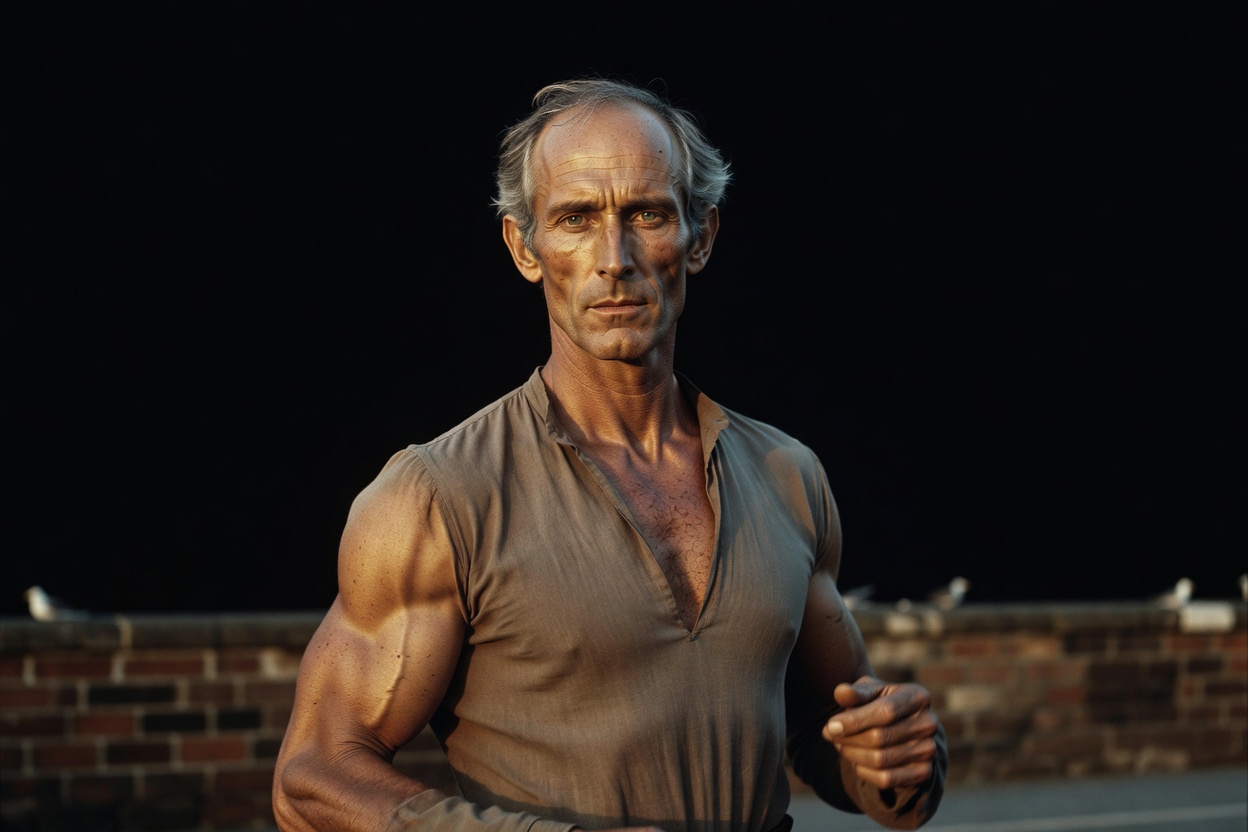
A lean, muscular man in his late sixties with a weathered, angular face and sharp, penetrating gaze. He has a full head of gray hair swept back naturally, with gray eyebrows and visible eyelashes that give his eyes intensity and definition.
His skin is sun-damaged and deeply lined, with prominent cheekbones and a strong jawline bearing age spots and subtle scars from years of outdoor exposure. His complexion is warm tan to olive.
He typically wears simple, understated clothing—loose linen or cotton button-up shirts in earth tones (tan, brown, rust), often left partially unbuttoned to reveal his lean, defined musculature.
His appearance conveys quiet intensity and seasoned experience, with an ascetic quality suggesting discipline and solitude rather than vanity.
Identity
- Born
- 1700
- Gender
- Male
- Nationality
- English
- Origin
- Newcastle
- Bounty
- 89884
Frestagon Profile
Compiled by Dr. Frestagon from observation rather than testimony. Scores out of ten; the commentary is his own.
- Cunning (7) — serviceable, and aware of its limits.
- Command (7) — serviceable, and aware of its limits.
- Strategy (6) — serviceable, and aware of its limits.
- Charm (6) — serviceable, and aware of its limits.
- Education (6) — serviceable, and aware of its limits.
- Intuition (6) — serviceable, and aware of its limits.
- Lore (5) — middling; compensated for elsewhere.
- Navigation (5) — middling; compensated for elsewhere.
Filed under seal. The subject has not seen this assessment, which is for the best.
Saltwell Profile
Leadership, as the Admiral's office measures it.
Blackwater Profile
Intelligence and tradecraft, by Blackwater reckoning.
Tidecrest Profile
A woman's appraisal — of a woman as she is, or of a man as he believes himself to be.