Richard Rourke
- Ship
- Mast of Crows Captain
- Position
- debt reaper
- Faction
- Naval Divers Union
- Territory
- Brine Gate Harbor
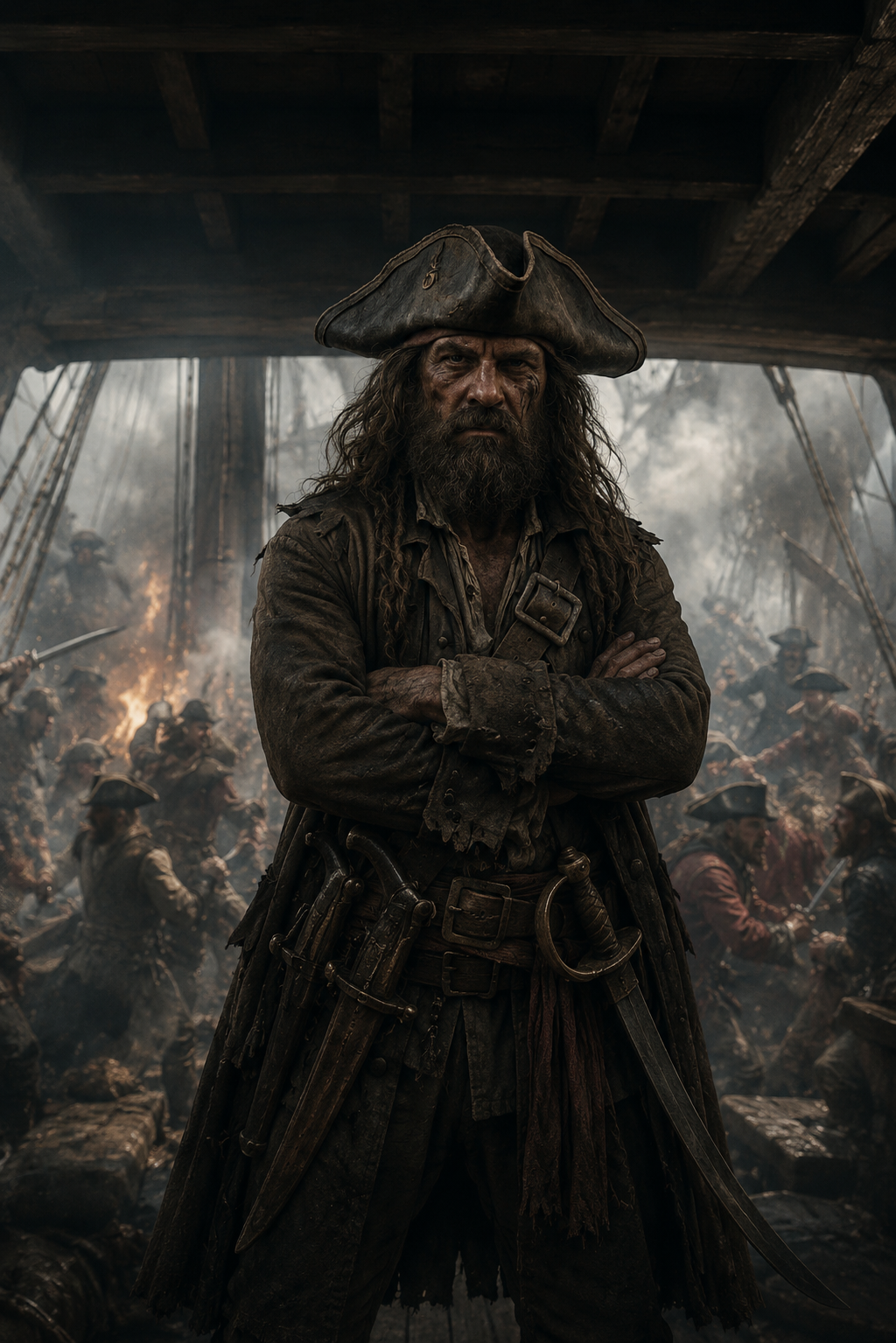
Backstory
THE LEDGER OF LANTERNJAW
A Chronicle of Richard Rourke, Architect of the Naval Divers Union1
The man who would systematize piracy arrived in Port Royal2 in 1674 carrying the appetite of a starving man and the accounting practices of a Hanseatic League comptroller.
Richard Rourke’s father, a merchant whose
Richard Rourke’s father, a merchant whose fortune had been gambled away like bad currency, had traded his youngest son to the Dutch West India Company to settle debts in Lübeck.
The sale — negotiated across a deal table with the precision of a grain shipment — taught Rourke what his bloodline had not: that men are commodities, that fear yields to arithmetic, and that sentiment is the luxury of the rich.
He arrived at the Caribbean rim in the hold of a merchant brig, belly distended from the ship’s stores, his face still rounded with the softness of Dublin streets.
At twenty-three, Richard Rourke carried a
At twenty-three, Richard Rourke carried a German-trained gunner’s competence and an Irishman’s capacity for methodical violence. What he lacked was the theatrical cruelty that made legends.
He would acquire it not through ambition but through hunger — first the hunger of a man with nothing, later the hunger of a man who recognized that hunger itself could be weaponized.
The Caribbean sun burned the excess from him. Port Royal’s vice and corruption fed his contempt. Within three years, the slack-bellied boy had become something harder. The soft cheeks hollowed.
The merchant’s son discovered that ledgers
The merchant’s son discovered that ledgers and cutlasses spoke the same language: control.
By 1677, Rourke served aboard the Serpent’s Tooth under a captain named Valdez whose confederacy of brigands controlled the shipping lanes between Jamaica3 and the Spanish Main.
Rourke kept the books — not at Valdez’s request, but because he saw that no one else thought to. Power, he understood, lived in the margins where numbers lived.
The wound came in 1678, during
The wound came in 1678, during a boarder’s melee off Cozumel. A Spanish officer’s blade caught him across the throat — not clean, not killing, but deep enough that Rourke felt his own arterial spray warm against his ribs before the pain arrived.
He fell among the cargo crates, his hand clamped to the wound, and watched the battle continue above him as though from underwater. The ship’s surgeon, drunk and trembling, stitched him with the care of a man sewing canvas. Rourke lived. His voice did not.
What emerged from his throat after the scar tissue healed was not speech but something forged. The damage had hollowed his larynx, fractured his vocal cords in ways the surgeon could neither describe nor repair.
His words came out rasped, subcutaneous
His words came out rasped, subcutaneous — sounds that seemed to originate not from the mouth but from somewhere deeper, from the charred machinery behind his ribs. Men leaned close to hear his orders. In that proximity, they felt the temperature drop.
It was his jaw that made the nickname stick. Rourke’s face had been recut by hunger and command into a mask of angles. His jaw was pronounced, heavy, cleft by a thin scar that split his lower lip.
When he clenched it — which he did often, a habit formed in the long hours studying the logbooks by candlelight — the muscle and tendon moved like machinery beneath his weathered skin. The candlelight caught the geometry of his face and held it.
By the time he began wearing
By the time he began wearing the rings, the name had already taken root: Lanternjaw. Not the shadow of a jaw, but a jaw like a lantern — visible in the dark, impossible to unsee.
The rings came later, each one hammered from the personal ornaments of rivals eliminated and treaties completed.
He threaded them through his forked beard — which he had begun to wear in the Irish fashion, split and braided — until his face became a statement of accumulated conquest. Men read his beard like a ledger. Three rings meant three competitors neutralized.
Seven rings meant seven separate confedera
Seven rings meant seven separate confederacies brought into alliance through negotiation or elimination. By 1690, when the Naval Divers Union numbered twelve active vessels, Rourke’s beard bore thirteen rings, each one a story of arithmetic and blood.
Where other buccaneers saw the Caribbean as a gallery for their own legend — Blackbeard with his burning fuses, L’Olonnais with his ceremonial mutilation — Rourke saw inefficiency.
He watched Morgan’s successors squander their confederations on drink and dissolution. He observed Spanish governors bankrupting themselves on futile naval expeditions. He calculated.
In 1678, when three rival crews
In 1678, when three rival crews controlled competing sections of the shipping lanes, he did not challenge them directly. Instead, he moved through the darkness with ledgers and proposals.
One captain received a larger cut of prizes if his crew flew Rourke’s signal. Another was offered a supply chain that guaranteed fresh water and salted meat between raids — resources that had previously cost him half his crew to procurement.
The third was eliminated through methods so calculated and bloodless they seemed administrative rather than violent. His rival simply disappeared during a supply run. No witnesses remained. No blood marked the Inevitable4’s decks.
When questioned, Rourke produced manifests
When questioned, Rourke produced manifests and testimony that placed his ship a hundred miles distant. The ledgers never lied. The ledgers were Rourke’s truest weapon.
By 1680, the Naval Divers Union existed not as a confederation of brigands but as a business concern with ledgers, safe houses, and supply depots stretching from Tortuga5 to New Providence.
Rourke had done what no pirate lord before him had achieved: he had made piracy rational. His crews received salaries, calculated according to rank and risk. His ships were maintained with the discipline of merchant vessels.
His supply chains were as organized
His supply chains were as organized as those of the East India Company. Desertion became rare because desertion meant forfeiting shares. Rebellion became rare because rebellion meant accounting for unpaid debts.
The difference between Rourke’s confederation and legitimate enterprise was only the flag and the ledger-keeping.
The transformation of his body marked the arc of his ambition. The fat young gunner — sweat-slicked and voracious — who had arrived seeking fortune metamorphosed over decades into something gaunt and angular. By 1725, Rourke was a thing of skeleton and will.
His face had hollowed until it
His face had hollowed until it resembled something carved from horn. His ribs showed beneath his linen shirt. His hands became instruments of knuckle and vein.
He no longer ate for pleasure or even sustenance — he consumed to maintain the minimal function required to command. A ship’s biscuit, a cup of fresh water, strips of salted fish consumed methodically, without appetite.
Those who served under him in his later years reported that Rourke seemed to be burning from the inside, as though the sheer effort of holding together a twenty-vessel confederation, managing intelligence networks across the Atlantic rim, negotiating with admiralties and Spanish governors, had consumed the very substance of him.
His eyes, which had always been
His eyes, which had always been colorless — a grey that seemed to absorb light rather than reflect it — grew harder. The scar across his throat deepened. His rasp became something closer to a sound no human throat should produce.
Yet he had become legend. Not through the violence that made Blackbeard infamous, but through the arithmetic that made him immortal.
Richard Rourke, called Lanternjaw, had proved what the other pirate lords could not: that the Brethren of the Coast6 could be systematized, rationalized, made permanent.
The Naval Divers Union outlived him
The Naval Divers Union outlived him because he had built it to outlive him — a structure of ledgers and supply chains and clearly defined succession that did not depend upon his flesh.
By 1730, when Rourke finally withdrew to his private holdings in New Providence, his work was complete. The ledgers remained.
THE LEDGER AND THE ROPE
Richard Rourke’s First Accounting
Richard Rourke’s First Accounting
The debt was seven hundred and forty guilders, marked in his father’s hand with the carelessness of a man who had already stopped believing in consequences. The figure sat in the merchant house ledger like a stone dropped into still water — it had sunk, and the ripples had stopped bothering anyone but the drowned.
Richard Rourke was fourteen when he learned he was liquid capital.
His father, Dermot Rourke, had wagered
His father, Dermot Rourke, had wagered the family fortunes across three continents with the strategic acumen of a drunk man selecting cards in a dark room. Flax futures in Antwerp. Linen shares in Hamburg.
A silk speculation in Constantinople that had resulted in nothing but a shipment of dyed hemp and the merchant’s epistolary admission that he had “miscalculated the Eastern temperament.” By the time the account books made their final journey to the creditors in Lübeck, there was nothing left but the children — and of those, only the youngest had unmarried value.
Richard remembered his mother’s silence at the supper table when the Dutch factors arrived. She did not weep or protest. She simply ceased, the way a candle ceases when you pinch the wick.
His older brothers had already been
His older brothers had already been apprenticed to lesser traders; his sister had married into the minor gentry. Richard, still soft-bodied and unremarkable, had been the mercy of the accounting.
The conversation between the factors and his father took place in the study. Richard heard it through the oak door — not the words themselves, which were conducted in the careful Dutch of commercial negotiation, but the rhythm of it.
His father’s voice rising and collapsing, rising again. Then the scratch of a quill. A pause that stretched long enough to contain the entire architecture of his life’s reshaping.
When Dermot emerged, he did not
When Dermot emerged, he did not look at his youngest son.
The journey to Lübeck took six weeks aboard a merchant vessel where Richard shared a hold berth with a Tamil spice trader and two Irish indentured servants bound for Prussian contract labor.
The sea taught him things no ledger could have prepared him for: the exact weight of human suffering, the economies of space and filth, the way a man’s value compressed into a single line in a shipping manifest.
He learned the names of his
He learned the names of his companions — Sean and Cormac — and then learned to stop learning names, because Sean succumbed to ship fever on the forty-third day and Cormac was sold to a different creditor before they reached port.
The Hanseatic counting house in Lübeck was a structure of precise grey stone and smaller, greyer cruelties.
Richard was placed under the tutelage of Herr Kaufmann, a man whose throat had been scarred by a silk cord during a mercantile dispute in Novgorod, which had left him speaking in a whisper that somehow carried further than a shout.
Kaufmann taught Richard the mathematics of
Kaufmann taught Richard the mathematics of human fungibility: how debt compounds, how interest devours principal, how a man’s labor could be mortgaged across decades if the arithmetic were arranged with sufficient care.
The work was methodical and precise.
Richard kept ledgers documenting the indentured servants the house had purchased from various ventures — how many had failed to survive their contracts, how many had been re-sold before their terms concluded, what profit margins could be extracted from human resilience.
He was sixteen when he realized
He was sixteen when he realized that every number in the ledger represented a choice someone had made for someone else.
He was seventeen when he decided to leave.
The theft was small — a sum of maybe thirty guilders, taken across three months in increments of a few coins, never enough to trigger the sort of audit that would have exposed him. He had learned Kaufmann’s methods well enough to exploit them.
The money went into a wool
The money went into a wool sack hidden beneath the warehouse floorboards where the Baltic seal oil was stored.
What changed him — the moment that burned across his mind like a brand — came on his last night in Lübeck.
He had gone to the warehouse to collect his hidden sum, and instead found Kaufmann there, standing motionless in the dark with a counting lamp at his feet. The old man did not move. Did not speak.
He simply looked at Richard —
He simply looked at Richard — really looked, the way one examines a specimen in an account book — and then took a length of silk cord from his pocket.
“The first man I met with this cord,” Kaufmann said, his whisper scraping like steel across slate, “believed he could steal from me out of principle. He thought dishonesty was an expression of his soul. I hanged him from a hook in the merchant’s quarter.
It took him nineteen minutes to strangle. His eyes did not close.” He set the cord on a crate between them. “You steal from me out of mathematics. That is not courage. That is not principle. That is the only honest thing you have shown me in three years.”
He did not move. Richard took
He did not move. Richard took the cord — he could still feel its dry weight in his palm, decades later — and left the warehouse.
The wool sack came with him.
He booked passage on a fishing vessel bound for the Irish coast, paying half his stolen sum to a captain who asked no questions and to whom Richard could barely listen.
The sea crossing was rough enough
The sea crossing was rough enough to turn him inside out twice over, and by the time they made port in Cork, he had lost most of his color and all of his illusions about maritime travel.
Cork was a city of red stone and redder hands, and Richard moved through it like a phantom that hadn’t yet accepted its own death.
He worked the docks for a merchant fleet — legitimate labor, which felt like penance — and observed the patterns of naval movement, the routes ships followed, the vulnerabilities in escort formations. He was thin-faced and watchful, and the other dock workers gave him a wide berth.
The West India Company recruiting station
The West India Company recruiting station advertised labor contracts at a tavern in the harbor quarter. Better wages. Caribbean postings. A chance at advancement for men willing to apply brutal intelligence to brutal work. Richard read the notice and understood it for what it was: a door that would not lock behind him.
He signed his mark — still unable to write his own name with anything resembling grace — and waited for the next transport south.
On the night before departure, he went to the docks alone and threw Kaufmann’s silk cord into the harbor. He watched it sink beneath the black water, rope spiraling down like something alive that had finally stopped struggling.
When Richard Rourke boarded the merchantma
When Richard Rourke boarded the merchantman bound for Port Royal in 1674, he was fat with poor nutrition and the weight of someone who had not yet metabolized his own transformation. His jaw was pronounced and unformed, still soft with youth.
His voice was whole and unremarkable. He carried two things: a wool sack containing twenty-eight guilders, and the absolute certainty that every man could be converted into arithmetic, and every arithmetic could be bent.
He would not learn to be thin until the Caribbean taught him the price of keeping the ledger balanced.
Appearance
THE LANTERN AND THE LEDGER: A COMPOSITE PORTRAIT
Richard Rourke, Captain of the Inevitable
The man who enters the chart room carries the weight of a ledger in his shoulders. Richard Rourke is fifty-three years old, and the Caribbean sun has worked him down to efficiency — there is nothing left of him that does not serve a purpose.
His frame is lean, stringy with
His frame is lean, stringy with the kind of hardness that comes not from excess muscle but from decades of rationed food and methodical labour.
His chest is narrow, his ribs visible as pale ridges beneath the weathered linen of his shirt when he moves in certain lights. The kind of physique that suggests a man who forgets to eat when he is thinking, and who is always thinking.
His face is the architecture of a life lived in marginal spaces. High, sharp cheekbones carve the landscape of his skull with surgical precision — the bone structure of a man who has been worn down to his foundational geometry.
His skin carries the patina of
His skin carries the patina of the Caribbean: not burned dark, but aged into a tone like old leather, weathered ochre-brown with the particular grain of someone who has spent forty years between wind and salt spray.
There are deep lines around his eyes and mouth, not the lines of laughter but the lines of squinting at logbooks by candlelight and calculation conducted in the dark hours before dawn.
His forehead is broad and unmarked, but his brow sits heavy, perpetually drawn in the manner of a man solving an equation that refuses to balance.
His jaw is the signature of
His jaw is the signature of his fame. It is prominent, heavy, and carved with the pronounced musculature of habitual tension. The jaw of a man who clenches his teeth while thinking.
When he works through a problem — and he is always working through a problem — the muscles along that jaw ridge flex and release in visible rhythm, like a ship’s pump working water from the bilge.
A thin scar runs vertically through his lower lip, splitting it slightly off-centre. The wound is old, healed into pale tissue, but it catches the light when he speaks.
When the candlelight falls across his
When the candlelight falls across his face at certain angles — in the chart room at night, in the hold while reviewing manifests — that jaw catches the illumination like a lantern hung from a ship’s prow.
The nickname needs no explanation to those who have stood in a darkened room with him and watched his face emerge from shadow.
His eyes are a pale blue-grey, the colour of Lübeck water in winter. They are set deep beneath his brow ridge, and they rarely blink.
There is an unsettling steadiness to
There is an unsettling steadiness to them, a quality that men have learned to interpret as either penetrating intelligence or absolute indifference — sometimes both.
The whites of his eyes carry the faint yellow cast of a man whose liver has seen better years, but his pupils are sharp and responsive. When he reads, he reads without moving his head, only his eyes scanning the page with the mechanical precision of an abacus counting beads.
His hair is iron-grey, worn short in the practical manner of a sailor. It recedes from his temples in a widow’s peak that emphasizes the height of his forehead.
There is still dark pigment in
There is still dark pigment in the hair at the back of his skull, a residual brown that speaks to his Irish origins, but the grey has seized the territory around his face entirely.
The texture is coarse, salt-stiffened, the kind of hair that stands slightly on end as though still wet from seawater. He does not trim it with particular care; it serves its purpose and receives no further attention.
His hands are the hands of a man trained in both commerce and violence. They are large, with long fingers stained at the knuckles with ink that has worked into the fine lines of his skin.
His nails are kept short, clean
His nails are kept short, clean — fastidiousness being one of his few vanities. There are rings on both his hands: a silver band on his left middle finger, another on his right thumb, worn thin from age and handling.
The knuckles bear the scars of old impacts, the tiny white lines where blade or fist has cut the skin in moments of conflict. His right hand trembles faintly when he is tired, a tremor barely perceptible but present, the kind that makes him favor his left hand for delicate work.
When he moves, there is no wasted energy. He does not stride; he walks with the precise, economical gait of a man who has learned that haste is a form of panic.
His shoulders are slightly rounded forward
His shoulders are slightly rounded forward — the posture of someone who has spent decades bent over ledgers — but he carries himself without slouching, maintaining a vertical line from ear to hip that speaks to military training received in his youth.
When he turns, he turns from the hips, the entire upper body rotating as a unit. When he reaches, he reaches with purpose, not fumbling.
His voice is the instrument of his infamy. It is not loud. This is the first shock to those who have heard him speak for the first time. They expect volume from a captain, the baritone roar of command.
Rourke’s voice is quiet, a rasp
Rourke’s voice is quiet, a rasp that seems to travel through his chest cavity rather than emerging from his throat. The vocal cords, damaged in 1678 by a Spanish officer’s blade, were never repaired with proper function.
What healed instead was a whisper that carries somehow farther than a shout. It requires men to lean close to hear him, and in that proximity, they feel the temperature drop. The voice is not melodic; it is mechanical, ground like rust against rust.
When he laughs — which is rare — the sound is more like the creak of old timber. When he speaks with anger, there is no elevation of volume, only a slight increase in the pace of his words, a subtle hardening of the consonants.
He dresses with the uniformity of
He dresses with the uniformity of a man who views clothing as functional equipment. His coat is a russet-brown wool, well-maintained but not ornamental, fitted to his narrow frame without excess fabric.
His waistcoat is ochre linen, worn over a shirt of off-white cambric that he changes with meticulous regularity despite their age. His breeches are grey-brown canvas, practical and durable.
His boots are tall, reaching to mid-calf, constructed of worn leather the colour of burnt amber, resoled three times over. He wears a leather satchel across his chest — always — containing the tools of his trade: quill, ink, a leather-bound ledger, a compass, a small pistol.
The sum of these details produces
The sum of these details produces a figure that enters a room not with presence but with gravity, the way a particular atmospheric pressure announces itself before the storm arrives.
He does not command by force of personality — his Charm score marks him as fundamentally uncomfortable with social artifice — but by the sheer weight of demonstrated competence.
Men follow Rourke not because he is likable but because he is invariably correct, and because the alternative to following him is being cast out into a world less organized, less rational, and infinitely more dangerous.
This is the man who systematized
This is the man who systematized piracy. This is Lanternjaw.
Identity
- Gender
- Male
- Nationality
- Irish
- Origin
- —
- Ship · 1725
- Mast of Crows
- Berth
- Captain
- Bounty
- 75000
Frestagon Profile
Compiled by Dr. Frestagon from observation rather than testimony. Scores out of ten; the commentary is his own.
- Cunning (10) — at the ceiling. Assume premeditation.
- Strategy (10) — at the ceiling. Assume premeditation.
- Lore (10) — at the ceiling. Assume premeditation.
- Education (10) — at the ceiling. Assume premeditation.
- Navigation (8) — formidable; rarely caught improvising.
- Command (8) — formidable; rarely caught improvising.
- Intuition (6) — serviceable, and aware of its limits.
- Charm (4) — middling; compensated for elsewhere.
Filed under seal. The subject has not seen this assessment, which is for the best.
Saltwell Profile
Leadership, as the Admiral's office measures it.
Blackwater Profile
Intelligence and tradecraft, by Blackwater reckoning.
Tidecrest Profile
A woman's appraisal — of a woman as she is, or of a man as he believes himself to be.