Adriaan Hoekstra
- Ship
- Dutchess Captain
- Position
- night broker
- Faction
- Harbor Wolves
- Territory
- Brine Gate Harbor
Backstory
THE NIGHT FANG: CHRONICLE OF ADRIAAN HOEKSTRA
The Blood Moon1 never leaves harbor in daylight. Those who have served aboard her know this as ritual law, written nowhere but observed with the rigidity of scripture.
Captain Adriaan Hoekstra — called Night Fang by men who've learned to fear precision over bluster — inverted his existence the way other men invert a ship's glass, and the Sand runs in his favor. He sleeps when the sun commands the sky. He walks when darkness swallows the harbor whole.
The first time a merchant's representative
The first time a merchant's representative encountered him was at quarter past midnight in a waterfront counting house. The man recalled afterward that Hoekstra had not lit a lamp.
The room held only the ambient phosphorescence of the moon through salt-fouled windows, a light that should have rendered any contract unsigned.
Yet Hoekstra had produced parchment and written with steady hand, the ink he used leaving a faint luminous trail as the nib crossed paper — a trail that faded as the ink dried, rendering the agreement invisible to any eye seeking it by day.
Only under specific conditions would the
Only under specific conditions would the writing bloom again into legibility. The merchant understood, without being told, that this was intentional architecture: the contract bound him in darkness, where Hoekstra's advantages multiplied.
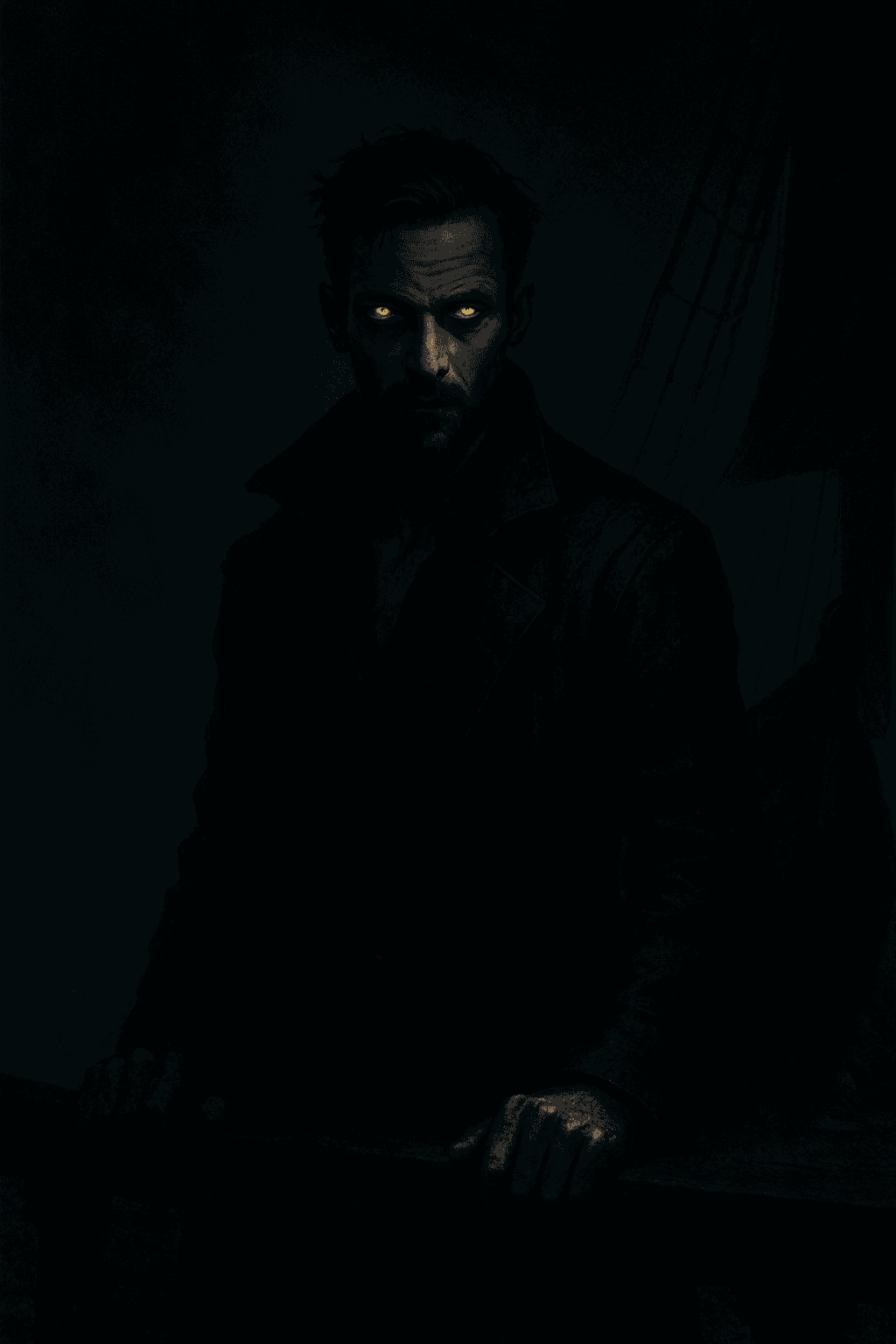
The man who commands the Blood Moon carries the bone-structure of the Low Countries in his face — sharp at the cheekbone, severe at the jaw, nothing yielding in the architecture.
His skin holds the colour of weathered oak that has weathered salt air without the bronze of daylight labor. There is a pallor beneath it, true enough, but not the pallor of illness.
Rather the genuine complexion of one
Rather the genuine complexion of one who has organized his entire existence in opposition to the sun's schedule. His small frame moves without wasted motion. The scar tissue around his left temple, visible without squinting if one catches him in specific light, suggests history — violence absorbed and survived.
But his eyes are what arrests every account worth reading.
In daylight, they offer nothing. A pale grey-blue, colourless as a fishmonger's stare, belonging to any number of unremarkable men moving through any port in Christendom.
Witnesses who encountered Hoekstra during
Witnesses who encountered Hoekstra during daylight hours often struggled to describe them afterward, remarking only that they had somehow failed to register, had slipped past observation like water through netting.
In darkness, transformation occurs.
The iris blooms with inner luminescence — not the simple shine of animal eyes catching lamplight, not the reflection common to cats or nocturnal creatures.
This is genuine radiance that appears
This is genuine radiance that appears to emanate from within the pupil itself, burning with the steady glow of a banked fire that someone has fed throughout the night.
Whether the source is medical anomaly (some whisper of a retinal disorder that permits bioluminescent bacteria to colonize the eye itself), or whether Hoekstra has applied his own preparation — crushed glow-worm larvae rendered with fat, or distilled extract from deep-water fish, or some compound altogether unknown — the mechanism matters less than the consequence.
In the black hours, his eyes track movement with predatory precision. Men who have faced him in true darkness report that he navigates without hesitation, that obstacles present no barrier, that his vision operates on a principle unavailable to ordinary men.
He schedules his contracts only at
He schedules his contracts only at midnight, claiming that the precise moment between days provides a binding force that other hours lack. He speaks of darkness with the reverence other men reserve for nationality, for God, for blood-obligation.
Night is his homeland. The hours between midnight and dawn are his territory. The moonless nights — when even adapted eyes struggle, when the harbor's activity reaches its minimum, when guards grow careless and witnesses sleep — those are his councils of war.
The Harbor Wolves2 command respect through direct violence. Gretel Boserupl Lange rules through intelligence and distributed authority.
But Adriaan Hoekstra operates through a
But Adriaan Hoekstra operates through a different calculus altogether: he makes himself indispensable to operations that require true invisibility, genuine darkness, the kind of work that cannot tolerate witnesses or daylight scrutiny.
He has sworn alliance with Cornelis De Boer3, binding them stronger together than either could be alone. He maintains commerce with Eilidh Fraser4 through arson contracts, riddle-work, midnight trades conducted in taverns that know better than to ask questions.
He carries debt to Vargo Knell5 — the nature of that debt whispered about but never stated directly by men who valued their silence.
And he remains, still, the man
And he remains, still, the man who sleeps while the world works and walks when the world dreams.
Those who have broken agreements with Night Fang learn their error in darkness, where his advantages are not merely practical but absolute.
They learn what happens when a predator operates in his native element, in an environment where contract law is written in inks only he can read, where witnesses cannot be summoned and daylight evidence crumbles to dust.
The Blood Moon waits in harbor
The Blood Moon waits in harbor. Her captain sleeps. In twelve hours, when the sun abandons the sky, the real work begins.
Appearance
Adriaan Hoekstra: The Man Who Wears Midnight
Flesh and Shadow
Adriaan Hoekstra carries the physical inheritance of the Low Countries — Dutch bone structure that speaks of Northern European stock, sharp at the cheekbone and jaw, nothing soft about the architecture of his face.
His skin holds the colour of
His skin holds the colour of weathered oak that has spent years exposed to salt air without the bronze of a man who works daylight hours.
There is a pallor beneath the surface, not sickness but the genuine complexion of one who has inverted his existence, who sleeps while the sun rules and walks when it abandons the sky.
The skin appears faintly luminescent in certain light — not the phosphorescence of his notorious eyes, but simply the consequence of minimal sun exposure, a transparency that makes the small scar tissue around his left temple visible without squinting.
His eyes are the feature that
His eyes are the feature that arrests attention and refuses release. In daylight they appear almost colourless — a pale grey-blue that seems to offer nothing, eyes that might belong to a fishmonger or a clerk. But in darkness, the transformation occurs.
The iris blooms with an inner light: not reflection, not the simple shine of animal eyes catching lamplight, but genuine luminescence that radiates from within the pupil itself.
Whether this results from a medical anomaly — some disorder of the retina that permits bioluminescent bacteria to colonize the eye — or from his own hand-applied preparation with phosphorescent compounds (crushed glow-worm larvae mixed with rendered fat, some whisper; distilled extract of deep-water fish, claim others), the effect remains unchanged.
In the black hours, his eyes
In the black hours, his eyes burn like the steady glow of a banked fire, and men who have faced him in darkness report that his gaze tracks movement with predatory precision, finding them even when they stand motionless.
His hair is dark to black, cut short and utilitarian, offering nothing for an opponent to grasp and revealing the clean lines of his skull.
Grey threads beginning at the temples — he is not a young man, perhaps forty winters or beyond — but the grey only adds to the impression of something forged rather than grown. There is no vanity in his grooming; every detail serves function.
His hair is kept so short
His hair is kept so short that sweat and salt cannot accumulate in the harbour nights. His beard, when he wears one, is kept to shadow rather than substance — just enough darkening to sharpen the angle of his jaw without the bulk that would impede movement or catch on ropes and rigging.
The Bearing of the Predator
His hands reveal labour and precision in equal measure. The fingers are long-boned, the nails kept trimmed hard and short, callused at the fingertips in patterns that speak of decades handling rope and steel.
There is a scar tissue across
There is a scar tissue across the back of his left hand — three parallel lines, old enough to have faded to white — that some speculate came from a creature's claws, though Adriaan himself has never confirmed or denied the origin.
His right hand moves with fractional economy; when he gestures, each motion accomplishes purpose rather than ornamentation.
When he signs contracts — those infamous midnight agreements in luminescent ink — his handwriting is precise to the point of obsession, each letter formed with geometric exactitude, each word spaced with mathematical regularity.
His gait is the walk of
His gait is the walk of a man at home in absolute darkness.
When moving through shadow, Adriaan proceeds without hesitation, stepping over obstacles with the confidence of one who sees them clearly, navigating the uneven surfaces of the harbor district with the smooth precision of a man crossing his own cabin.
In daylight hours, when he must occasionally move despite his inverted schedule, the gait becomes more careful — not caution but adjustment, a man compensating for senses dulled by unwanted illumination.
He moves quietly, the practised silence
He moves quietly, the practised silence of someone who has made stealth both profession and habit. Even on creaking dock-boards, his footfalls seem to absorb sound rather than produce it.
The Costume of Darkness
Adriaan dresses entirely in night tones: black breeches of wool or canvas, dark grey linen shirts that could pass for black in low light, a coat of charcoal grey wool that extends to mid-thigh. Everything functional, nothing decorative.
His buttons are darkened silver or
His buttons are darkened silver or slate rather than brass — bright metal would catch light and betray position.
Over this, in true working hours, he wears a cloak of heavy wool so dark it seems to absorb illumination, a garment that would belong to any prosperous Dutch captain but worn here as a working tool.
Around his neck, he keeps a length of dark silk — sometimes wound, sometimes loose — that serves variously as binding, signal cloth, or the material upon which he conducts his midnight contractual ceremonies.
The scent of Adriaan is salt
The scent of Adriaan is salt and something else: the mineral sharpness of brine combined with lamp oil and the acrid undertone of whatever phosphorescent compound he uses to maintain his eyes' luminescence.
No perfume, no spice — just the honest reek of a man who works in darkness and returns to darkness, whose life has no truck with the social ornaments of daylight commerce.
His voice, when he speaks, is low and measured — not the theatrical whisper of a stage villain, but the practical tone of a man conducting business in hostile conditions, each word calibrated for transmission through darkness without unnecessary volume.
Identity
- Gender
- Male
- Nationality
- Dutch
- Origin
- Amsterdam
- Ship · 1725
- Dutchess
- Berth
- Captain
- Bounty
- 63000
Saltwell Profile
Leadership, as the Admiral's office measures it.
Blackwater Profile
Intelligence and tradecraft, by Blackwater reckoning.
Tidecrest Profile
A woman's appraisal — of a woman as she is, or of a man as he believes himself to be.