Liam O'Donnell
- Ship
- Widow’s Laugh Quartermaster
- Position
- watch clerk
- Faction
- Ledger Syndicate
- Territory
- Brine Gate Harbor
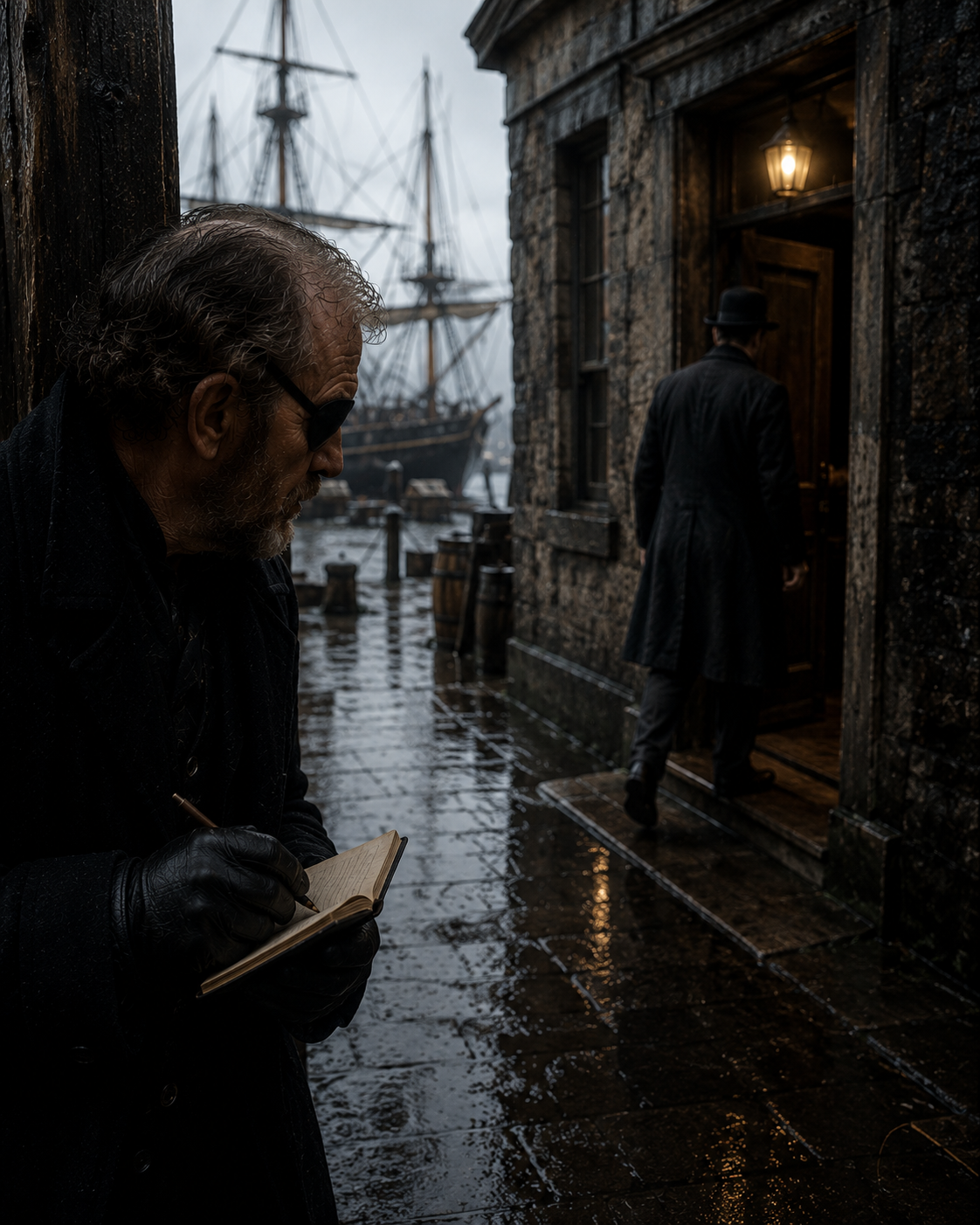
Backstory
The Deadeye Clerk’s Registry
The lamp in the Watchtower alcove burned blue-green through the winter of 1712, visible from the eastern quays if you knew which rooftop to stand upon and which minute to watch.
Liam O’Donnell did not light it himself anymore — that work fell to younger hands, steadier than his own.
Instead, he sat in the alcove’s
Instead, he sat in the alcove’s cramped rear chamber, his single eye moving across ledgers in the phosphorescent glow, reading margins the way another man might read faces. The black glass monocle over his left socket caught no light and threw none back.
It was deliberate cruelty, he’d once told Maren Glass1: let them wonder what darkness lived behind that lens, and they’ll think twice before lying in his presence.
He had not always been a man of one eye.
The story began in Ballykilmore, in
The story began in Ballykilmore, in a cottage that smelled of turf and his mother’s lye soap, where his father Seamus bent over books that never quite balanced in his favor.
Young Liam inherited the ledgers like some men inherited land — seeing in the columns a kind of truth that words could not touch. Numbers did not flatter. Numbers did not forgive.
A digit misplaced was a life destabilized, and by fourteen he’d grasped what his father had spent a lifetime avoiding: that information was currency, and currency was power.
The reckoning came at nineteen, during
The reckoning came at nineteen, during a merchant audit that should have been simple arithmetic. Liam had found the rot in Captain Mackenzie’s books — phantom shipments, accounts bled white through deliberate obscuring.
His cipher was flawless: a personal notation so intricate that only the man who’d written it could read the proofs. The work was honest. The mathematics were immaculate.
But the Dublin magistrate had interests in Mackenzie’s ventures, and connections in that corner of Ireland were bloodier than steel. Caleb Doyle, the merchant who’d hired him, suddenly remembered no such hire. The ledger was forgery, they said. The cipher was fabrication. A boy trying to cheat honest men.
The duel was called not with
The duel was called not with civility but malice. The man Doyle sent was scarred across his right cheek, left-handed, and utterly without mercy. They fought in a garden behind the merchant hall, dawn breaking cold across wet grass.
Liam’s eye — his good eye, his only eye then — caught every blade-shift, every measured footfall. He was fast. He was right. But he was not ruthless enough. When the opening came, his opponent did not execute a killing stroke.
Instead, he drove the point upward with a twist that was not meant to kill but to destroy. The blade went in beside the socket. The pain was a white fire that erased the world.
When Liam woke in his mother’s
When Liam woke in his mother’s house, Brigid’s face was set in the kind of stillness that spoke of prayers already said for the dead. His father brought him the ledger from the garden — the one the magistrate’s men had seized.
The pages were burned at the edges. The entries were illegible. Everything he’d proven was ash.
He left Ballykilmore that spring with scar tissue where sight had been and a new name the dockside men had given him: Deadeye Clerk. Not mockery, not quite. The epithet carried dark respect — a boy who’d been gutted and refused to stay ruined.
The Ledger Syndicate found him in
The Ledger Syndicate2 found him in Dublin six months later, through channels so obscure even he’s never entirely known the entry point.
What mattered was that Samuel Blackwater3’s people recognized something in that scarred boy hunched over figures in a merchant-house cellar: a man who could read beyond the page, who understood that every mark on vellum carried consequence.
They trained him to interrogate not just numbers but men — to see in the tremor of a hand or the lag in a spoken price where the deception lived. His single eye became an instrument of terrible precision.
By twenty-five, Liam O’Donnell was quarter
By twenty-five, Liam O’Donnell was quartermaster of the Ink & Vanish, managing the Syndicate’s shadow commerce from Port Royal4 to Nassau5.
He moved real estate like other men moved contraband — erasing identities, creating safe houses, building networks of observation that threaded through taverns and rooftops alike.
His alliance with the Lamplighters Guild and the Chimney Sweep Union6 meant that he saw what others could not: every room in a city, every rooftop perch, every passage that did not appear on any charter.
The Narrow Straits Massacre in 1717
The Narrow Straits Massacre in 1717 had broken something in him that even the blade could not reach. Twenty-three souls — merchants, traders, a child among them — executed on orders he’d given, on intelligence he’d verified. The ledger had been correct.
The mathematics had been immaculate. But correctness, he learned in that moment, was not the same as justice. The families of the dead did not care about his accounting. And in the dark hours when the blue-green lamp burned above the quays, neither did he.
Hero or villain — the duality no longer troubled him. He was what the numbers made him, nothing more. And the numbers, always, were honest.
Appearance
Liam O’Donnell: Physical Particulars
The eye — singular, functional, hazel-brown — is the first thing a man notices, and the second thing he learns to respect. It moves with the precision of a quartermaster’s sextant, taking in ledger-marks and human tells with the same unblinking mathematics.
The socket opposite it wears a shallow disc of black glass, perfectly opaque, fitted into a leather cup that has molded itself to the bone beneath after forty-odd years of continuous wear. No vanity in the choice.
The glass is deliberate darkness; it
The glass is deliberate darkness; it tells you nothing and promises less. When he turns his head, the false eye catches lamplight and throws it back cold, as if the socket contained not tissue but the interior of a well.
Men who have lied to him in enclosed rooms speak quietly about that glass afterward — how it seemed to absorb rather than reflect, as though it could read the margins of their deception the way his remaining eye reads columns of figures.
The face is long, bone-spare, pitched forward slightly from decades bent over foolscap. High sharp cheekbones, pocked faintly with old acne scars on the left side — visible from certain angles the way flaws in paper become apparent in strong light.
The skin itself carries the particular
The skin itself carries the particular pallor of a man who works by lamp and candle, with the thin-skinnedness that comes from having earned his living indoors since adolescence.
It has the texture of old vellum, slightly waxy with age, and across the left side of the jaw runs a silver scar tissue, thin as a blade-stroke, from socket down to the angle of the jaw.
The scar is pale and does not quite match the surrounding skin — it is a thing lived with so long it has become part of the face’s architecture rather than a wound.
His hair was once red, the
His hair was once red, the particular fox-red that marks certain Irish lines. Now it is mostly iron-grey with rusted undertones at the temples and along the closely trimmed beard.
The hair on his crown has retreated in a clean arc, leaving the scalp pale and slightly spotted with age-marks.
What remains he combs across with the small vanity of a man who has no other vanities to permit himself — a thin dark line drawn across pale bone, careful and almost apologetic.
The beard is short, kept close
The beard is short, kept close to the jaw, and shows the grey more plainly than the hair atop his head. There is something austere in the cut of it, something that speaks of regular maintenance but no ornamentation, no softness.
His hands are the hands of a clerk, which is to say they are narrow, long-fingered, marked with the particular damage that decades of small work inflict.
The knuckles bear permanent stains — ink that has soaked into the dermal layers through ten thousand dippings of steel nib into glass wells.
The nails are kept scrupulously clean
The nails are kept scrupulously clean and trimmed short, a habit born from a time when a clerk’s hands were inspected as evidence of his character.
The fingers themselves carry a tremor if you watch them closely — not pronounced, but present, the hand-shake of a man in his sixties who has spent forty-five years in lamplight. Despite this, his penmanship remains immaculate; the tremor, he has learned, is irrelevant to precision if the mind remains undamped.
His dress is the costume of his calling. A collarless linen shirt, white but aged to a faint cream at the cuff where candle-wax and iron-gall ink have settled into the fibers, worn over a dark wool waistcoat in a shade between charcoal and sepia.
Over this, when he moves outdoors
Over this, when he moves outdoors, falls a long black wool coat, the hem worn smooth at the bottom from years of dragging across stone floors and ship-deck planking.
The coat carries the faint smell of lamp-oil and the particular mustiness of enclosed spaces — cellars, ship’s holds, counting-houses where the air does not move freely.
Elastic sleeve-garters, thin black things, cinch the linen at his biceps; they are worn so long they have left faint indentations in the flesh beneath, marks that do not fade. No pocket-watch chain. No signet ring. No ornament of any kind except the leather cup that holds the false eye.
His gait is measured, careful, slightly
His gait is measured, careful, slightly favoring his right side — an old accommodation born from an old wound. He does not walk quickly unless necessity drives him.
When he sits, he settles into the chair with the precision of a man placing a ledger into a shelving-place, each movement deliberate and economical.
His voice, when he speaks, carries the soft burr of Dublin working-class mixed with the crisp diction of formal education — neither accent overwrites the other. It is a voice pitched low, meant to be listened to rather than overheard. He does not raise it.
He smells of ink, old paper
He smells of ink, old paper, lamp-oil, and underneath these, the particular mustiness of a body that spends its life in windowless rooms. There is nothing of sea about him, despite his rank — the salt has never sunk into his clothing or his pores.
What lives on him instead is the smell of the ledger, the archive, the place where secrets are written down and preserved.
Identity
- Gender
- Male
- Nationality
- Irish
- Origin
- —
- Ship · 1725
- Widow’s Laugh
- Berth
- Quartermaster
- Bounty
- 20000
Saltwell Profile
Leadership, as the Admiral's office measures it.
Blackwater Profile
Intelligence and tradecraft, by Blackwater reckoning.
Tidecrest Profile
A woman's appraisal — of a woman as she is, or of a man as he believes himself to be.