Celestine Beaumont
- Position
- Proprietor of the Widow's Walk; Intelligence broker
- Born
- 1635 · La Rochelle
- Faction
- Independent
- Territory
- Brine Gate Harbor

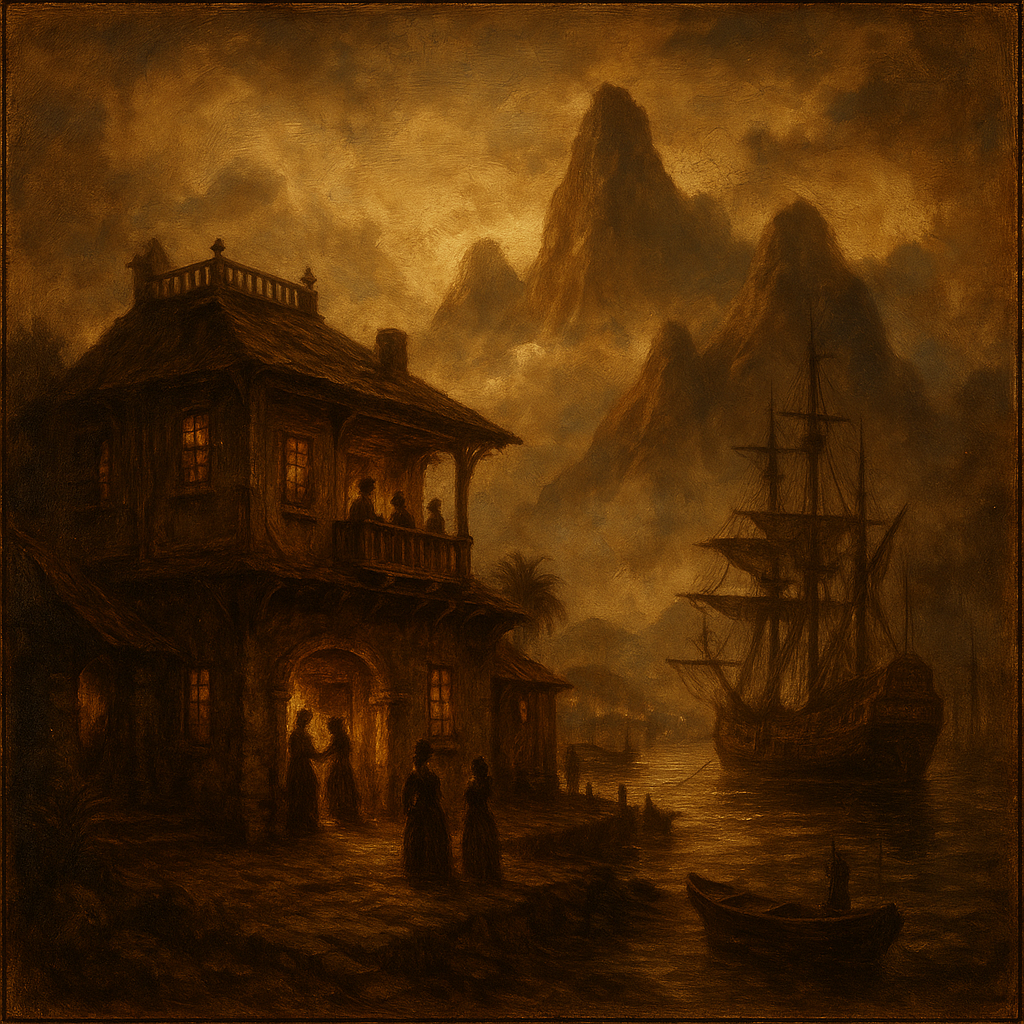
Backstory
Ma Celestine: The Woman Who Built Sanctuary in the Drowning Dark
I. The Rope Around Her Wrist
The merchant captain’s hands were soft — the kind of softness that comes from never loading your own cargo.
This detail matters, because it is
This detail matters, because it is the thing Celestine would remember, thirty years later, in the moment before she cut his throat with a rusted nail she’d bent into a point across six months in the hold. Soft hands. Negotiating hands. The hands of a man who believed softness was a persuasion.
She was ten years old when they took her from La Rochelle.
The tavern her mother kept at the Quay-du-Change had burned on a Wednesday evening in the autumn of 1645.
The fire moved with intention —
The fire moved with intention — upward through the kitchens, across the timber beams where the smoke would reach the street and broadcast what everyone already knew: that Henriette Beaumont had extended credit to the wrong man, or refused credit to another wrong man, and now the debt was being paid in ash.
The girl had been running to the well with a bucket when the roof let go, and she stood watching until a hand closed around her wrist — not her mother’s hand, which was already upstairs deciding whether to jump.
The merchantman Saint-Aignan was taking on crew in the harbor that same hour, and a stevedore with a rope-burned palm needed easy money. A child who didn’t scream too loud in the first week could be broken quietly. She brought maybe thirty livres to his pocket, depending on where she was sold.
The Mediterranean would teach her the
The Mediterranean would teach her the mathematics of that calculation.
She learned to speak Greek in the hold — not the philosopher’s Greek of Athens, but the throated, practical Greek of men who worked the galleys and the holds of the Levantine trade. Malaka. Sklavos. Thalassa.
The words came with the back of a hand, delivered by guards who found it arousing to correct her pronunciation while she was on her knees. She learned that beauty could be sealed away. She learned that the body could be inhabited by something that was not her.
She learned the weight of every
She learned the weight of every human being she shared that darkness with, and she learned which ones would not survive to the auction.
When the captain’s soft hands came for her in his cabin — when he began the elaborate negotiation of his appetites — something in her skull clicked into a different shape.
There was a nail. There had always been a nail.
There was darkness, and the sound
There was darkness, and the sound of wet breathing, and the sudden absence of pressure at her throat.
There was a ship that did not know its captain was dead, and a girl of fifteen who could now read the wind in canvas the way some people read a prayer book — not from piety, but from necessity. She did not think of this as murder. She thought of it as the restoration of property to its rightful owner.
She thought of it as freedom, though that word would not seem large enough for decades to come.
II. The Aegean Apprenticeship and the
II. The Aegean Apprenticeship and the Merchant’s Cunning
For six years — the chronology itself is a kind of calculated obscurity — Celestine moved through the pirate networks threading the inner Mediterranean like a rat through cargo holds.
She took work where work was available: as a rigger, her small frame useful in the crawl-spaces where larger men got wedged; as a cook’s assistant, which was how she learned the weight of every merchant captain’s paranoia about his food; as a guard on slave-holds, which was how she learned the economics of human suffering by the weight.
The men who sailed with her
The men who sailed with her then — if they survived to talk about it — remembered fragments. The way she could read the weight of wind in a canvas before it tore.
The strange precision with which she kept accounts, writing numbers in a cipher no one else could parse. The night she crept into a Portuguese slaver’s hold with a fire-pot and freed three hundred souls, then burned the vessel to the waterline with the crew still singing in the rigging.
They called her “the Glass Woman” in those years. Cold. Reflective. Impossible to read. The beauty was still there — it had not gone anywhere — but it had learned to live behind glass. It was a thing you could see but not touch, and any man who tried to touch it would find his hand bleeding.
But the thing that made her
But the thing that made her dangerous was not the knife skills, and it was not the navigational cunning — her mind did not work in charts and angles; she would never be a navigator in the mathematical sense.
What made her dangerous was something her cognitive architecture provided without her asking for it: the ability to see what another person wanted and reflect it back at them in perfect miniature. Her charm was not natural.
It was worn, like a coat stolen from a captain’s cabin, fitted precisely to the shape of whatever man stood in front of her.
And underneath it, her cunning moved
And underneath it, her cunning moved in a different register entirely.
A merchant captain’s books were an open letter to her. She could see, in the weight of a single entry, whether his crew was paid on time or whether he was nursing a shortfall.
She could taste the fear in a manifesto that claimed full cargo when the hold had three hands’-breadths of space. She could read a man’s desperation in the thickness of his handwriting.
These were not educated skills —
These were not educated skills — she had no formal schooling — but they were the skills of a woman who had spent her childhood in a tavern watching her mother listen her way into a merchant prince’s confidence.
By the time she sailed westward toward the Caribbean — aboard a sloop that was no longer quite a theft and not yet quite legitimate — she carried something more valuable than any navigational instrument.
She carried an absolute understanding that the real trade was never in goods. It was in information. It was in the spaces between what men said and what they feared. It was in the knowledge of what a man would trade to keep his name out of certain ledgers.
III. The Architecture of the Widow’s
III. The Architecture of the Widow’s Walk
Port Royal1, 1695, was a city that had already burned once and was busy burning itself again.
She arrived with Portuguese letters of introduction, a merchant’s credit note drawn on Amsterdam (forged, immaculately), and the kind of face that made harborside men forget they were married.
She rented rooms in a house
She rented rooms in a house whose previous proprietor had died badly — the yellow fever, they said, though the truth was messier and less visible.
She opened a tavern. Not in the grand tradition of her mother’s place, which had been theater and commerce in equal parts. This would be something else. Something safer. Something useful.
The Widow’s Walk was never meant to be large. Four rooms, a kitchen barely big enough for one cook, a bar that could hold twenty bodies if they stood close and pretended to like each other.
But the location was crucial —
But the location was crucial — too far from the governor’s house to attract his men looking for ceremony, too close to the docks to be invisible. The neutrality was the entire enterprise.
She did not own it through conquest. She bought it through credit, which meant she understood the merchant principle that everything is always for sale if the terms are right.
She bought it by knowing which dockmaster had money he couldn’t explain, which harbormaster needed to lose weight somehow, which merchant captain was carrying cargo that had no manifest.
The Widow’s Walk became sanctuary because
The Widow’s Walk became sanctuary because Ma Celestine made it so. Because the French buccaneers knew they would not be sold to the English, and the English knew they would find no French in her tavern plotting against them.
Because the information that moved through her rooms was always secured — not through force, but through her absolute refusal to ever speak what had been said inside her walls.
Her cunning was patient.
It was the cunning of a
It was the cunning of a woman who understood that the men drinking her rum today would be broken or wealthy or dead tomorrow, and that it was therefore senseless to choose a side before she knew which direction the wind was actually blowing.
Her charm was the charm of someone who had learned, over decades, exactly what each type of man wanted to believe about himself — and she gave it to them with such perfect calibration that they never noticed they were being used as instruments.
She was not a hero in the manner of the great captains. She took no ships. She commanded no fleet.
But by 1710, there was no
But by 1710, there was no strategic decision made by any captain in the Brethren of the Coast2 that had not, in some form, been shaped by information that had passed through her hands, or credit that she had extended, or a conversation she had overheard while her hands were busy polishing glass.
Her Navigation score was poor — she could not calculate her way out of a paper bag. Her Strategy was pedestrian — she did not think in grand arcs. But her Cunning was a nine, and her Intuition was a nine, and her Command over the space she had carved was absolute.
She built sanctuary in the drowning dark, and men called her “Ma” because she had learned, finally, that motherhood was not something you had to birth. It was something you could become by listening to the broken things that washed ashore and making sure they knew they would not drown on your watch.
The Tavern at Quay-du-Change: The Making
The Tavern at Quay-du-Change: The Making of Celestine
PART ONE: THE HOUSE
La Rochelle in 1645 was a city of Protestant refugees and merchant princes, where money flowed upward like tide and women like Henriette Beaumont learned to survive by pouring drinks and keeping counsel.
The tavern stood three stories above
The tavern stood three stories above the Quay-du-Change, wedged between a rope-maker’s loft and a Baltic factor’s counting house — a structure of dark timber and salt-stained plaster, with a painted sign that had faded to the color of old bone. The Ancre, it was called. The Anchor. It did not hold.
Celestine was born there in the winter of 1635, or so her mother said. No record existed; her mother never registered the birth with the cure. In those years, such omissions were either careless or calculated, and nothing about Henriette Beaumont was careless.
The girl grew up in the noise and salt-smell of the taproom, moving between the tables almost before she could walk with any steadiness, learning the names of drinks before she learned to read.
Her mother kept her small and
Her mother kept her small and quick, useful for reaching the high shelves, for slipping between the elbows of men who barely noticed her passing.
She learned the tavern’s true business early: not the sale of wine, though wine sold. The real trade was information. Men came to the Ancre because Henriette Beaumont never betrayed a confidence and because the wine was honest.
They came because a woman who listened without judgment was rarer than good brandy. The merchants told her about shipments delayed by magistrates. The sea-captains told her which ships were weakly crewed.
The Spanish agents told her things
The Spanish agents told her things they meant to keep secret, believing that a woman tending a bar could not possibly retain numbers, dates, names.
But Celestine’s mother retained everything.
By the time the girl was old enough to pour wine without spilling, she understood that her mother’s silence was not mere discretion — it was a weapon. Henriette wielded it the way a merchant wielded credit, carefully, always at a profit.
She had come to La Rochelle
She had come to La Rochelle with nothing but her accent (which was Breton) and her face (which was handsome enough to matter then, before the years aged it).
She had married a pilot named Beaumont who lasted three seasons before a storm off the Îles d’Yeu took him and his knowledge down. The widow was left with a daughter not yet born and a tavern lease signed in both their names.
She made it prosper through a simple transaction: she converted silence into obligation. The men who told her secrets owed her silence in return.
When a ship needed to disappear
When a ship needed to disappear — when a cargo needed to move from one hold to another without the knowledge of the crown’s inspectors — those men remembered that Henriette Beaumont could be trusted.
And when they paid her, she asked only for what was fair and for the understanding that her daughter would never lack for rent.
Celestine learned, watching her mother move through the taproom with the careful grace of a woman who has learned exactly how much of her body to display and how much to keep hidden. She learned that beauty was a loan, not a possession.
She learned that a woman’s voice
She learned that a woman’s voice was more powerful when used sparingly. She learned that men would tell you almost anything if you brought them wine and did not interrupt them.
What she did not know was that this lesson had a shelf-life measured in years.
PART TWO: THE FIRE
The night came in late April
The night came in late April when Celestine was ten years old.
She was asleep above the taproom in the small chamber she shared with her mother, the two of them in a bed that was never quite clean and never quite warm, even with the brazier burning low in the corner.
The smell of smoke woke her — not the familiar smoke of the hearth, but something acrid and spreading, the smell of pine tar and tar-cloth and something else beneath it, something oily.
Her mother was already moving, pulling
Her mother was already moving, pulling the girl from the bed, wrapping a wool cloak around her shoulders.
“Don’t scream,” Henriette said. Her voice was not panicked; it was steady in the way her voice became when she was most afraid. “We go down the back stairs. Quickly.”
The smoke was thicker on the landing. Celestine could see the orange light seeping under the taproom door, and then her mother pushed it open and the heat struck them like a fist. The bar was burning. The shelves where the bottles stood were burning.
The painted sign of the Anchor
The painted sign of the Anchor — faded, salt-stained — was burning somewhere below them now, and the ropes that held it must have rotted because it fell with a sound like a ship’s timber cracking.
The back stairs descended into the kitchen yard. Her mother half-carried her down them, one hand gripping Celestine’s wrist hard enough to leave marks that would last for weeks, her other hand holding the cloak around them both as if fabric could shield them from the heat at their backs.
They reached the quay with the fire climbing toward the roof. Other people were there — the rope-maker from upstairs, the Baltic factor whose counting house shared the wall. They stood in the darkness and watched the Ancre burn, and no one moved to fight it.
The fire burned well. It burned
The fire burned well. It burned too well, with the kind of thoroughness that came from planning.
Henriette Beaumont held her daughter’s hand and did not look away from the flames. The watch came eventually — three men with pikes, sent because the fire was spreading to the neighboring timber. They asked questions.
Henriette gave them answers that were true and complete and revealed nothing. The rope-maker had not seen anyone. The factor had been asleep. The fire was mysterious. These things happened.
What did not happen was any
What did not happen was any investigation that led anywhere.
The magistrate who came in the morning was a man who had sat at the Beaumont family’s table six months earlier and told Henriette about a shipment of silk that his superior wanted hidden from the crown’s inventory.
He looked at the burned tavern and he looked at Henriette Beaumont’s face, and he wrote his report and moved on.
The fire was ruled an accident
The fire was ruled an accident. A brazier left too close to the wooden wall. Carelessness. Regrettable. The lease on the Ancre passed to a merchant from Nantes who had no interest in opening a tavern there.
Henriette Beaumont owned nothing anymore, and she had no one who owed her anything.
PART THREE: THE TAKING
For three months, mother and daughter
For three months, mother and daughter lived in a rented room above a bakery. Henriette took work as a seamstress, mending the fine clothes of the merchant wives. Her fingers, which had learned grace by pouring wine, learned precision by sewing seams. She made barely enough for bread and candles.
Celestine, at ten years old, began to understand that her mother was no longer invulnerable.
On the first of August, a dockside merchant named Gérard hired her to help carry baskets of salted fish to a ship anchored in the outer harbor. The work was simple — heavy, but simple.
She was small and strong for
She was small and strong for her age, and the merchant said he would pay her a denier for the morning’s work. Her mother needed money for the rent on the room, which was due that day.
She went to the quay in the early morning.
The ship was a merchant vessel of perhaps eighty tons, with enough crew to suggest a long voyage. The captain was a Genoese named Salvatore Riva, a man with a scarred face and the precise manner of someone who kept detailed accounts.
He watched the baskets being loaded
He watched the baskets being loaded, and he watched the girl carrying them, and when the work was finished and the merchant paid her and sent her back toward the quay, the captain said something to his mate in a language Celestine did not recognize.
An hour later — she was in the bakery shop buying bread with her denier — two of the ship’s crew came ashore. They asked the baker if he had seen a small girl with dark hair. The baker, who was French and cautious, said he knew nothing about girls.
But they were already leaving, moving toward the street that led to the rented room.
Celestine understood, in the animal way
Celestine understood, in the animal way that children understand danger, that she should not follow them.
She walked instead toward the harbor, toward the forest of masts and rigging. Behind her, she did not hear screams or sounds of violence. That was almost worse.
It meant her mother had not fought them, which meant her mother had understood something that Celestine had not yet learned: that some debts were called in without warning, and some silences were only silence until they were betrayal.
The Genoese captain who had watched
The Genoese captain who had watched her carry fish was standing on the dock when she reached the mole. He seemed unsurprised to see her there. He did not speak to her.
He simply gestured, and when she did not move, his mate came and took her elbow, and she was led up the gangway onto a ship that was already casting off.
The Ancre had burned in April. The Genoese ship sailed in August. In between, her mother had made some arrangement — a debt, a sale, a transformation of her daughter into currency.
Henriette Beaumont died of fever seven
Henriette Beaumont died of fever seven months later, in the rented room above the bakery. She was never told that her daughter survived the voyage. No one had reason to tell her.
Celestine’s first crime was her survival. Everything that followed was interest on that debt.
The Tavern at Quay-du-Change: The Making of Celestine
PART ONE: THE HOUSE
PART ONE: THE HOUSE
La Rochelle in 1645 was a city of Protestant refugees and merchant princes, where money flowed upward like tide and women like Henriette Beaumont learned to survive by pouring drinks and keeping counsel.
The tavern stood three stories above the Quay-du-Change, wedged between a rope-maker’s loft and a Baltic factor’s counting house — a structure of dark timber and salt-stained plaster, with a painted sign that had faded to the color of old bone. The Ancre, it was called. The Anchor. It did not hold.
Celestine was born there in the
Celestine was born there in the winter of 1635, or so her mother said. No record existed; her mother never registered the birth with the cure. In those years, such omissions were either careless or calculated, and nothing about Henriette Beaumont was careless.
The girl grew up in the noise and salt-smell of the taproom, moving between the tables almost before she could walk with any steadiness, learning the names of drinks before she learned to read.
Her mother kept her small and quick, useful for reaching the high shelves, for slipping between the elbows of men who barely noticed her passing.
She learned the tavern’s true business
She learned the tavern’s true business early: not the sale of wine, though wine sold. The real trade was information. Men came to the Ancre because Henriette Beaumont never betrayed a confidence and because the wine was honest.
They came because a woman who listened without judgment was rarer than good brandy. The merchants told her about shipments delayed by magistrates. The sea-captains told her which ships were weakly crewed.
The Spanish agents told her things they meant to keep secret, believing that a woman tending a bar could not possibly retain numbers, dates, names.
But Celestine’s mother retained everything
But Celestine’s mother retained everything.
By the time the girl was old enough to pour wine without spilling, she understood that her mother’s silence was not mere discretion — it was a weapon. Henriette wielded it the way a merchant wielded credit, carefully, always at a profit.
She had come to La Rochelle with nothing but her accent (which was Breton) and her face (which was handsome enough to matter then, before the years aged it).
She had married a pilot named
She had married a pilot named Beaumont who lasted three seasons before a storm off the Îles d’Yeu took him and his knowledge down. The widow was left with a daughter not yet born and a tavern lease signed in both their names.
She made it prosper through a simple transaction: she converted silence into obligation. The men who told her secrets owed her silence in return.
When a ship needed to disappear — when a cargo needed to move from one hold to another without the knowledge of the crown’s inspectors — those men remembered that Henriette Beaumont could be trusted.
And when they paid her, she
And when they paid her, she asked only for what was fair and for the understanding that her daughter would never lack for rent.
Celestine learned, watching her mother move through the taproom with the careful grace of a woman who has learned exactly how much of her body to display and how much to keep hidden. She learned that beauty was a loan, not a possession.
She learned that a woman’s voice was more powerful when used sparingly. She learned that men would tell you almost anything if you brought them wine and did not interrupt them.
What she did not know was
What she did not know was that this lesson had a shelf-life measured in years.
PART TWO: THE FIRE
The night came in late April when Celestine was ten years old.
She was asleep above the taproom
She was asleep above the taproom in the small chamber she shared with her mother, the two of them in a bed that was never quite clean and never quite warm, even with the brazier burning low in the corner.
The smell of smoke woke her — not the familiar smoke of the hearth, but something acrid and spreading, the smell of pine tar and tar-cloth and something else beneath it, something oily.
Her mother was already moving, pulling the girl from the bed, wrapping a wool cloak around her shoulders.
“Don’t scream,” Henriette said. Her voice
“Don’t scream,” Henriette said. Her voice was not panicked; it was steady in the way her voice became when she was most afraid. “We go down the back stairs. Quickly.”
The smoke was thicker on the landing. Celestine could see the orange light seeping under the taproom door, and then her mother pushed it open and the heat struck them like a fist. The bar was burning. The shelves where the bottles stood were burning.
The painted sign of the Anchor — faded, salt-stained — was burning somewhere below them now, and the ropes that held it must have rotted because it fell with a sound like a ship’s timber cracking.
The back stairs descended into the
The back stairs descended into the kitchen yard. Her mother half-carried her down them, one hand gripping Celestine’s wrist hard enough to leave marks that would last for weeks, her other hand holding the cloak around them both as if fabric could shield them from the heat at their backs.
They reached the quay with the fire climbing toward the roof. Other people were there — the rope-maker from upstairs, the Baltic factor whose counting house shared the wall. They stood in the darkness and watched the Ancre burn, and no one moved to fight it.
The fire burned well. It burned too well, with the kind of thoroughness that came from planning.
Henriette Beaumont held her daughter’s han
Henriette Beaumont held her daughter’s hand and did not look away from the flames. The watch came eventually — three men with pikes, sent because the fire was spreading to the neighboring timber. They asked questions.
Henriette gave them answers that were true and complete and revealed nothing. The rope-maker had not seen anyone. The factor had been asleep. The fire was mysterious. These things happened.
What did not happen was any investigation that led anywhere.
The magistrate who came in the
The magistrate who came in the morning was a man who had sat at the Beaumont family’s table six months earlier and told Henriette about a shipment of silk that his superior wanted hidden from the crown’s inventory.
He looked at the burned tavern and he looked at Henriette Beaumont’s face, and he wrote his report and moved on.
The fire was ruled an accident. A brazier left too close to the wooden wall. Carelessness. Regrettable. The lease on the Ancre passed to a merchant from Nantes who had no interest in opening a tavern there.
Henriette Beaumont owned nothing anymore,
Henriette Beaumont owned nothing anymore, and she had no one who owed her anything.
PART THREE: THE TAKING
For three months, mother and daughter lived in a rented room above a bakery. Henriette took work as a seamstress, mending the fine clothes of the merchant wives. Her fingers, which had learned grace by pouring wine, learned precision by sewing seams. She made barely enough for bread and candles.
Celestine, at ten years old, began
Celestine, at ten years old, began to understand that her mother was no longer invulnerable.
On the first of August, a dockside merchant named Gérard hired her to help carry baskets of salted fish to a ship anchored in the outer harbor. The work was simple — heavy, but simple.
She was small and strong for her age, and the merchant said he would pay her a denier for the morning’s work. Her mother needed money for the rent on the room, which was due that day.
She went to the quay in
She went to the quay in the early morning.
The ship was a merchant vessel of perhaps eighty tons, with enough crew to suggest a long voyage. The captain was a Genoese named Salvatore Riva, a man with a scarred face and the precise manner of someone who kept detailed accounts.
He watched the baskets being loaded, and he watched the girl carrying them, and when the work was finished and the merchant paid her and sent her back toward the quay, the captain said something to his mate in a language Celestine did not recognize.
An hour later — she was
An hour later — she was in the bakery shop buying bread with her denier — two of the ship’s crew came ashore. They asked the baker if he had seen a small girl with dark hair. The baker, who was French and cautious, said he knew nothing about girls.
But they were already leaving, moving toward the street that led to the rented room.
Celestine understood, in the animal way that children understand danger, that she should not follow them.
She walked instead toward the harbor
She walked instead toward the harbor, toward the forest of masts and rigging. Behind her, she did not hear screams or sounds of violence. That was almost worse.
It meant her mother had not fought them, which meant her mother had understood something that Celestine had not yet learned: that some debts were called in without warning, and some silences were only silence until they were betrayal.
The Genoese captain who had watched her carry fish was standing on the dock when she reached the mole. He seemed unsurprised to see her there. He did not speak to her.
He simply gestured, and when she
He simply gestured, and when she did not move, his mate came and took her elbow, and she was led up the gangway onto a ship that was already casting off.
The Ancre had burned in April. The Genoese ship sailed in August. In between, her mother had made some arrangement — a debt, a sale, a transformation of her daughter into currency.
Henriette Beaumont died of fever seven months later, in the rented room above the bakery. She was never told that her daughter survived the voyage. No one had reason to tell her.
Celestine’s first crime was her survival
Celestine’s first crime was her survival. Everything that followed was interest on that debt.
The Tavern at Quay-du-Change: The Making of Celestine
PART ONE: THE HOUSE
La Rochelle in 1645 was a
La Rochelle in 1645 was a city of Protestant refugees and merchant princes, where money flowed upward like tide and women like Henriette Beaumont learned to survive by pouring drinks and keeping counsel.
The tavern stood three stories above the Quay-du-Change, wedged between a rope-maker’s loft and a Baltic factor’s counting house — a structure of dark timber and salt-stained plaster, with a painted sign that had faded to the color of old bone. The Ancre, it was called. The Anchor. It did not hold.
Celestine was born there in the winter of 1635, or so her mother said. No record existed; her mother never registered the birth with the cure. In those years, such omissions were either careless or calculated, and nothing about Henriette Beaumont was careless.
The girl grew up in the
The girl grew up in the noise and salt-smell of the taproom, moving between the tables almost before she could walk with any steadiness, learning the names of drinks before she learned to read.
Her mother kept her small and quick, useful for reaching the high shelves, for slipping between the elbows of men who barely noticed her passing.
She learned the tavern’s true business early: not the sale of wine, though wine sold. The real trade was information. Men came to the Ancre because Henriette Beaumont never betrayed a confidence and because the wine was honest.
They came because a woman who
They came because a woman who listened without judgment was rarer than good brandy. The merchants told her about shipments delayed by magistrates. The sea-captains told her which ships were weakly crewed.
The Spanish agents told her things they meant to keep secret, believing that a woman tending a bar could not possibly retain numbers, dates, names.
But Celestine’s mother retained everything.
By the time the girl was
By the time the girl was old enough to pour wine without spilling, she understood that her mother’s silence was not mere discretion — it was a weapon. Henriette wielded it the way a merchant wielded credit, carefully, always at a profit.
She had come to La Rochelle with nothing but her accent (which was Breton) and her face (which was handsome enough to matter then, before the years aged it).
She had married a pilot named Beaumont who lasted three seasons before a storm off the Îles d’Yeu took him and his knowledge down. The widow was left with a daughter not yet born and a tavern lease signed in both their names.
She made it prosper through a
She made it prosper through a simple transaction: she converted silence into obligation. The men who told her secrets owed her silence in return.
When a ship needed to disappear — when a cargo needed to move from one hold to another without the knowledge of the crown’s inspectors — those men remembered that Henriette Beaumont could be trusted.
And when they paid her, she asked only for what was fair and for the understanding that her daughter would never lack for rent.
Celestine learned, watching her mother mov
Celestine learned, watching her mother move through the taproom with the careful grace of a woman who has learned exactly how much of her body to display and how much to keep hidden. She learned that beauty was a loan, not a possession.
She learned that a woman’s voice was more powerful when used sparingly. She learned that men would tell you almost anything if you brought them wine and did not interrupt them.
What she did not know was that this lesson had a shelf-life measured in years.
PART TWO: THE FIRE
PART TWO: THE FIRE
The night came in late April when Celestine was ten years old.
She was asleep above the taproom in the small chamber she shared with her mother, the two of them in a bed that was never quite clean and never quite warm, even with the brazier burning low in the corner.
The smell of smoke woke her
The smell of smoke woke her — not the familiar smoke of the hearth, but something acrid and spreading, the smell of pine tar and tar-cloth and something else beneath it, something oily.
Her mother was already moving, pulling the girl from the bed, wrapping a wool cloak around her shoulders.
“Don’t scream,” Henriette said. Her voice was not panicked; it was steady in the way her voice became when she was most afraid. “We go down the back stairs. Quickly.”
The smoke was thicker on the
The smoke was thicker on the landing. Celestine could see the orange light seeping under the taproom door, and then her mother pushed it open and the heat struck them like a fist. The bar was burning. The shelves where the bottles stood were burning.
The painted sign of the Anchor — faded, salt-stained — was burning somewhere below them now, and the ropes that held it must have rotted because it fell with a sound like a ship’s timber cracking.
The back stairs descended into the kitchen yard. Her mother half-carried her down them, one hand gripping Celestine’s wrist hard enough to leave marks that would last for weeks, her other hand holding the cloak around them both as if fabric could shield them from the heat at their backs.
They reached the quay with the
They reached the quay with the fire climbing toward the roof. Other people were there — the rope-maker from upstairs, the Baltic factor whose counting house shared the wall. They stood in the darkness and watched the Ancre burn, and no one moved to fight it.
The fire burned well. It burned too well, with the kind of thoroughness that came from planning.
Henriette Beaumont held her daughter’s hand and did not look away from the flames. The watch came eventually — three men with pikes, sent because the fire was spreading to the neighboring timber. They asked questions.
Henriette gave them answers that were
Henriette gave them answers that were true and complete and revealed nothing. The rope-maker had not seen anyone. The factor had been asleep. The fire was mysterious. These things happened.
What did not happen was any investigation that led anywhere.
The magistrate who came in the morning was a man who had sat at the Beaumont family’s table six months earlier and told Henriette about a shipment of silk that his superior wanted hidden from the crown’s inventory.
He looked at the burned tavern
He looked at the burned tavern and he looked at Henriette Beaumont’s face, and he wrote his report and moved on.
The fire was ruled an accident. A brazier left too close to the wooden wall. Carelessness. Regrettable. The lease on the Ancre passed to a merchant from Nantes who had no interest in opening a tavern there.
Henriette Beaumont owned nothing anymore, and she had no one who owed her anything.
PART THREE: THE TAKING
PART THREE: THE TAKING
For three months, mother and daughter lived in a rented room above a bakery. Henriette took work as a seamstress, mending the fine clothes of the merchant wives. Her fingers, which had learned grace by pouring wine, learned precision by sewing seams. She made barely enough for bread and candles.
Celestine, at ten years old, began to understand that her mother was no longer invulnerable.
On the first of August, a
On the first of August, a dockside merchant named Gérard hired her to help carry baskets of salted fish to a ship anchored in the outer harbor. The work was simple — heavy, but simple.
She was small and strong for her age, and the merchant said he would pay her a denier for the morning’s work. Her mother needed money for the rent on the room, which was due that day.
She went to the quay in the early morning.
The ship was a merchant vessel
The ship was a merchant vessel of perhaps eighty tons, with enough crew to suggest a long voyage. The captain was a Genoese named Salvatore Riva, a man with a scarred face and the precise manner of someone who kept detailed accounts.
He watched the baskets being loaded, and he watched the girl carrying them, and when the work was finished and the merchant paid her and sent her back toward the quay, the captain said something to his mate in a language Celestine did not recognize.
An hour later — she was in the bakery shop buying bread with her denier — two of the ship’s crew came ashore. They asked the baker if he had seen a small girl with dark hair. The baker, who was French and cautious, said he knew nothing about girls.
But they were already leaving, moving
But they were already leaving, moving toward the street that led to the rented room.
Celestine understood, in the animal way that children understand danger, that she should not follow them.
She walked instead toward the harbor, toward the forest of masts and rigging. Behind her, she did not hear screams or sounds of violence. That was almost worse.
It meant her mother had not
It meant her mother had not fought them, which meant her mother had understood something that Celestine had not yet learned: that some debts were called in without warning, and some silences were only silence until they were betrayal.
The Genoese captain who had watched her carry fish was standing on the dock when she reached the mole. He seemed unsurprised to see her there. He did not speak to her.
He simply gestured, and when she did not move, his mate came and took her elbow, and she was led up the gangway onto a ship that was already casting off.
The Ancre had burned in April
The Ancre had burned in April. The Genoese ship sailed in August. In between, her mother had made some arrangement — a debt, a sale, a transformation of her daughter into currency.
Henriette Beaumont died of fever seven months later, in the rented room above the bakery. She was never told that her daughter survived the voyage. No one had reason to tell her.
Celestine’s first crime was her survival. Everything that followed was interest on that debt.
Appearance
Ma Celestine: A Composite Headshot
The woman who answers to Ma Celestine sits for the portrait with the stillness of someone who has learned that motion invites scrutiny.
Her face is a study in the mathematics of survival — all planes and angles, the kind of bone structure that reads differently depending on the light and who is doing the reading.
She is somewhere in her late
She is somewhere in her late fifties or early sixties (the records say 1635, which would make her pushing ninety, but the records lie, or she has learned to make them lie), and her face carries the precision of a woman who has counted every year and spent most of them usefully.
Her head sits level on shoulders that remain straight despite the decades of salt spray and ship’s work.
The build beneath the dress is lean, almost austere — the body of someone who has never carried weight she did not need, who moves with economy because waste has always been a luxury she could not afford.
Her frame is small by the
Her frame is small by the standard of the men she has sailed with, but there is nothing fragile in the way she holds it. When she stands, she stands as if the deck beneath her feet has asked permission before shifting.
The face itself is a composition of contradictions.
Her cheekbones are high and prominent, casting shadows beneath them even in daylight — the kind of architecture that suggests hunger was once a familiar condition and the body remembers it in the structure of bone.
Her jawline is defined, slightly squared
Her jawline is defined, slightly squared, the chin neither receding nor prominent but positioned with the kind of careful balance that speaks to stubborn will.
The nose is straight and narrow, slightly long, the nostrils flared just enough to suggest she breathes deeply and seldom panics.
There is a small scar — perhaps three inches long — running from just below her right cheekbone toward the hinge of her jaw, pale against her weathered skin, the kind of mark that came from something sharp moving quickly and someone turning away at the last possible moment.
She does not hide it. She
She does not hide it. She does not call attention to it either.
Her eyes are the feature that stops observation. They are a pale grey-green, the colour of shallow water over stone, the whites shot through with the faint amber discoloration that comes from decades of salt wind and relentless sun.
The gaze itself is the instrument — focused, present, and entirely without apology. She looks at people as if she is taking inventory, noting the tremor in a hand, the moisture at the corner of an eye, the way a breath catches on a lie.
Men who have sat across from
Men who have sat across from her in negotiation report afterward that they felt seen — not admired, not judged, simply seen — and the experience leaves most of them unsettled.
Her brows are grey now, darker than her hair, and they sit low and level over those unsettling eyes, the arch slight and practical rather than expressive.
Her hair is the other element that draws notice. It is long, still thick, and predominantly silver now, though the copper-brown of her younger years shows through in patches, especially near the roots where the sun has not yet bleached it entirely white.
She wears it pulled back with
She wears it pulled back with discipline — usually knotted at the base of her skull and bound with a ribbon, the colour of which varies (she favours deep reds and blacks, rarely anything bright), but never loose.
The grey is not an accident of age she tolerates; it is part of the uniform she has constructed. A woman with that hair, tied that way, with that expression, signals something in the harbor that words would take paragraphs to explain.
Her skin is light olive in its base tone, the kind that speaks to La Rochelle and generations of Mediterranean trade, but the sun has weathered it into something closer to mahogany in places — her forearms, the bridge of her nose, the outer rims of her ears.
The weathering is not even. There
The weathering is not even. There are places where the skin shows the pale marks of old sun damage, small spots of uneven pigmentation that would horrify a woman who had never been at sea.
Her mouth is wide, the lips thin and pale, pressed into a line that is neutral by habit rather than anger. When she smiles, which is rarely and always to purpose, the smile involves the eyes first and the mouth last — a reversal of how most people smile, and infinitely more convincing for its calculation.
The hands that rest in her lap in the portrait are weathered and capable. The fingers are long and tapered, the nails kept short and clean, the palms marked with the kinds of calluses that come from years of rope work and sail handling.
There is a ring on her
There is a ring on her left hand — silver, not gold, a simple band with something engraved on the inner surface that is never visible to anyone but herself. She does not wear jewellery beyond this, though the records show she has access to considerable wealth.
The hands move rarely when she speaks, and when they do move, the motion is minimal and precise. She does not gesture. She points, or she holds still.
Her voice, when she speaks, carries the shape of her accent — French at its root, but weathered by decades of harbor pidgin, Mediterranean Greek, Spanish, and the particular inflection of the Golden Age Caribbean where three languages collide on every dock.
She speaks slowly, choosing words with
She speaks slowly, choosing words with visible care, as if each one is being selected from inventory and she is responsible for the accounting.
The voice itself is not particularly deep or particularly light, but it carries a kind of authority that has nothing to do with volume. Men lower their own voices to match hers.
In the tavern — in the Widow’s Walk, which is hers — the noise levels drop when she moves through the room, not because anyone has ordered the silence, but because the air itself seems to listen when Ma Celestine is nearby.
The dress in the portrait is
The dress in the portrait is serviceable. Not elaborate, not poor, but chosen with the same precision she brings to everything else.
It is a dark rust-brown, the colour of old blood or old earth, a fabric that does not show salt stains easily and that moves in a way that permits work.
The cuffs are rolled up past the wrist — a habit, not an affectation — and the bodice sits close to the lean frame without attempting to suggest anything that is not there. There is no attempt at ornamentation.
No lace, no ribbons beyond the
No lace, no ribbons beyond the one in her hair, no embroidery. A woman dressed like this, in a harbor where wealth announces itself loudly, announces something else entirely: that her authority does not require advertisement, and that she has learned the difference between costume and appearance.
The posture is what a painter would notice last. She sits without touching the back of the chair, her spine straight but not rigid, her shoulders level, her hands folded but not clenched.
It is the posture of someone at a ship’s helm who has learned to distribute her weight in a way that keeps the vessel balanced.
There is no tension in it
There is no tension in it, but there is no relaxation either — she is simply present, occupying space without apology, waiting for the next thing to happen with the patience of someone who has learned that most things eventually do.
This is Ma Celestine at the moment the portrait is taken: a woman of sixty-some years, weathered and capable, her beauty neither soft nor hard but architectural, the kind that does not fade because it was never based on the flesh in the first place.
She is the woman who pours the drinks and hears everything. She is the woman who built sanctuary in a harbor that has no room for mercy.
She is the woman who survived
She is the woman who survived slavery, the Mediterranean, piracy, and the Golden Age itself — not by being beautiful, though she is; not by being lucky, though she has been; but by being precisely, relentlessly, intelligently herself, in whatever form the moment required.
Identity
- Born
- 1635
- Gender
- Female
- Nationality
- French
- Origin
- La Rochelle
- Berth
- Proprietor / Intelligence Broker (land-based)
Frestagon Profile
Compiled by Dr. Frestagon from observation rather than testimony. Scores out of ten; the commentary is his own.
- Cunning (9) — at the ceiling. Assume premeditation.
- Intuition (9) — at the ceiling. Assume premeditation.
- Charm (8) — formidable; rarely caught improvising.
- Lore (8) — formidable; rarely caught improvising.
- Command (8) — formidable; rarely caught improvising.
- Strategy (6) — serviceable, and aware of its limits.
- Education (6) — serviceable, and aware of its limits.
- Navigation (3) — a documented weakness. Exploit with care.
- Empathy (3) — a documented weakness. Exploit with care.
Filed under seal. The subject has not seen this assessment, which is for the best.
Saltwell Profile
Leadership, as the Admiral's office measures it.
Blackwater Profile
Intelligence and tradecraft, by Blackwater reckoning.
Tidecrest Profile
A woman's appraisal — of a woman as she is, or of a man as he believes himself to be.