Brannigan
- Ship
- Tortue Able Seaman
- Position
- ledger captain
- Allegiance
- Blackout Guild
- Territory
- Brine Gate Harbor
Backstory
Brannigan has a real name that nobody remembers, including possibly Brannigan himself.
The Weasel earned his moniker through physical resemblance and professional aptitude — he is small, quick, able to squeeze through spaces larger men cannot, and possessed of a survival instinct that makes him useful to everyone and loyal to no one.
He works Nassau1’s back alleys gathering intelligence for whichever crew pays best this week, his information reliable precisely because he has no stake in its interpretation.
He was pulled half-dead from the
He was pulled half-dead from the harbor four years ago, speaking no language anyone recognized, and has since learned enough pidgin to conduct business without revealing origins he may not remember.
His clothes are always slightly too large, acquired secondhand, and his eyes never stop moving — calculating angles, exits, the locations of weapons and threats. Those who underestimate him based on size rarely make the mistake twice.
The nickname stuck for reasons Brannigan himself has never publicly addressed. His build certainly contributes — narrow shoulders, a frame that seems constructed for slipping between things rather than standing against them.
But the real weasel lives in
But the real weasel lives in his face: pinched features, a pointed nose that twitches when he smells opportunity or danger, lips so thin they barely register as present. His eyes are the worst part, the part crews remember after they’ve crossed him.
They dart constantly, never settling, never showing a flicker of sentiment or alliance. Brown hair receding despite his relative youth, slicked back with an excess of product that suggests vanity or perhaps a compulsion to remain forgettable.
Everything about him — the grey suit acquired from a dead man’s widow, the neutral ties, the shoes worn at the heels from constant readiness — speaks to a philosophy of invisibility. He is the man your eye slides past in a crowd.
He is the voice you forget
He is the voice you forget mid-conversation. He is the ghost in the room who was never there at all.
No one knows where Brannigan came from before the harbor pulled him under. The languages he spoke when they fished him out have been lost to time and deliberate forgetting.
Whether he was a refugee, a deserter, a man running from something worse than poverty, he has never said. He learned the pidgin of Nassau’s docks methodically, the way a scholar learns Latin — not for love of the language but for function.
Enough to negotiate a price. Enough
Enough to negotiate a price. Enough to ask where the next job waits. Enough to disappear into a conversation and be gone before anyone remembers his face.
His value to crews like those captained by John Saltwell3 and Old Copper Finn2 lies in his absolute deniability. Brannigan never writes anything down. Never.
He has been offered money — good money — to document what he knows, and he refuses with a consistency that borders on religious conviction. Information that exists only in memory cannot be traced back to its source.
It cannot be subpoenaed by harbor
It cannot be subpoenaed by harbor authorities. It cannot be stolen from a messenger or used as evidence in a tribunal.
Everything Brannigan knows stays locked in that calculating skull until the moment he speaks it aloud, and by then the intelligence is already being acted upon, the window for denial already closing. He trades in verbal ghosts, in ephemeral truths that vanish the moment they’re heard.
The dead drop method he favors is older than most sailors — scratches inside water barrels, messages written in code only he and the recipient understand, everything erased with a wet thumb before the barrel is filled again. No trace. No proof.
Just the efficient transfer of knowledge
Just the efficient transfer of knowledge between people who will never speak directly, who may never share a drink or acknowledge mutual purpose. It is the work of a man who understands that in Nassau, survival depends on having no permanent allegiances.
Four years of this have made him something between a ghost and a weapon.
Samuel Blackwater5 and Isabella Tidecrest4 have learned to trust him in the way one trusts a sharp tool — careful handling, clear purpose, knowledge that it will cut you if you’re not precise.
His enmity with Gallows Tom runs
His enmity with Gallows Tom runs deeper, the product of a crossed operation and money that never arrived. Mirella Quay6 is something more complicated, an alliance conditional upon circumstances neither party discusses.
He serves under Saltwell and Finn because they pay reliably and ask nothing of him but results. He belongs to no faction because belonging would make him predictable, and a predictable weasel is a dead one.
His bearing is always calculated escape. He positions himself near exits, traces routes through crowds before entering spaces, knows which rooftops connect to which alleyways. His clothes, always slightly too large, give him room to move.
His eyes, never still, catalog threats
His eyes, never still, catalog threats and opportunities with equal indifference. He is a man constructed entirely for survival, for slipping through gaps that should be too narrow, for vanishing into Nassau’s shadow and emerging somewhere unexpected with intelligence worth far more than the small frame carrying it.
Brannigan has a real name that nobody remembers, including possibly Brannigan himself.
The Weasel earned his moniker through physical resemblance and professional aptitude — he is small, quick, able to squeeze through spaces larger men cannot, and possessed of a survival instinct that makes him useful to everyone and loyal to no one.
He works Nassau’s back alleys gathering
He works Nassau’s back alleys gathering intelligence for whichever crew pays best this week, his information reliable precisely because he has no stake in its interpretation.
He was pulled half-dead from the harbor four years ago, speaking no language anyone recognized, and has since learned enough pidgin to conduct business without revealing origins he may not remember.
The story of how he came to be drowning remains contested. Some of the older hands at the docks say he jumped from a merchant vessel that was listing toward the bottom. Others claim he was thrown from a crew boat after a disagreement about payment.
A third group insists he simply
A third group insists he simply walked into the water one winter morning and forgot the way back out. Brannigan himself has never bothered correcting any version. In Nassau, a man’s past is negotiable currency, and he learned early to let other people spend theirs while he spent nothing.
His clothes are always slightly too large, acquired secondhand from sources he never discusses. The grey suit came from a dead man’s widow three years back — she didn’t ask questions when Brannigan offered fair coin, and he didn’t offer explanations.
The shoes are worn at the heels from constant readiness, from the habit of standing in doorways and on street corners where the light is bad and the exits are numerous.
His ties are neutral to the
His ties are neutral to the point of invisibility, purchased in bulk from a sales clerk at one of the harbor warehouses who learned not to make conversation. Everything about Brannigan speaks to a philosophy of being forgettable.
He is the man your eye slides past in a crowd. He is the voice you forget mid-conversation. He is the ghost in the room who was never there at all.
The nickname itself — the one that stuck like tar to canvas — derives partly from his build. Narrow shoulders. A frame constructed for slipping between things rather than standing against them.
A man who can compress himself
A man who can compress himself into the space beneath a ship’s hold or through the gap between two buildings where ordinary men would wedge and fail. But the real weasel lives in his face. Pinched features.
A nose that twitches when he smells opportunity or danger — a tell he’s learned to minimize but never entirely suppress. Lips so thin they barely register as present. His eyes are the worst part, the part crews remember after they’ve crossed him.
They dart constantly, never settling, never showing a flicker of sentiment or stake. Brown hair receding despite his relative youth, slicked back with an excess of product that suggests either vanity or compulsion. Brannigan himself would never say which.
No one knows where he came
No one knows where he came from before the harbor pulled him under. The languages he spoke when they fished him out have been deliberately forgotten — whether by Nassau’s collective will or by Brannigan’s own erasure of his previous self remains unclear.
A refugee, perhaps. A deserter. A man running from something worse than poverty or shame. He has never said, and four years of silence has made the question irrelevant. What matters is what he knows now, and how carefully he has learned to keep it.
His value to crews like those captained by John Saltwell and Old Copper Finn lies in his absolute deniability. Brannigan never writes anything down. Never.
He has been offered money —
He has been offered money — good money — to document what he knows, and he refuses with a consistency that borders on religious conviction. Information that exists only in memory cannot be traced. It cannot be subpoenaed by harbor authorities.
It cannot be stolen from a messenger or used as evidence in a tribunal. It cannot be burned or lost or discovered in a midnight raid.
Everything Brannigan knows stays locked in that calculating skull until the moment he speaks it aloud, and by then the intelligence is already being acted upon, the window for denial already closing.
He trades in verbal ghosts, in
He trades in verbal ghosts, in ephemeral truths that vanish the moment they’re heard.
The dead drop method he favors is older than most sailors — scratches inside water barrels, messages written in code only he and the recipient understand, everything erased with a wet thumb before the barrel is filled again. No trace. No proof.
Just the efficient transfer of knowledge between people who will never speak directly, who may never share a drink or acknowledge mutual purpose.
Four years of this have made
Four years of this have made him something between a ghost and a weapon. In Nassau, survival depends on having no permanent allegiances, and Brannigan has become the perfect embodiment of that principle. He serves. He disappears.
He returns when needed, paid or unpaid, because in his calculation, everyone owes him something eventually, and debts are the only currency that never devalues.
The Weasel’s First Drowning
Dublin, 1708. The Liberties stank of
Dublin, 1708. The Liberties stank of tannery runoff and the particular rot that comes when too many bodies crowd into too little space.
Brannigan’s ma was a name he would later forget — not because time erased it, but because she’d stopped existing as a person somewhere between his third year and his fifth.
The narrative he carried, if you could call it that, was skeletal: a woman with red hands, work-worn from laundry, who’d coughed blood into a basin one winter and never stopped.
The basin itself he remembered better
The basin itself he remembered better than her face — cheap tin, dented along one rim, the sort of thing a man sells for copper when he needs drink.
His father was equally abstract. A chandler’s assistant, or a dock worker, or possibly a soldier who’d deserted — the stories changed depending on which neighbor was talking, which meant none of them were true. What was concrete was the absence.
The small room in Dirty Lane where his ma had died, and then afterward, the absence of that room.
He’d been seven, or possibly six
He’d been seven, or possibly six. Numbers meant nothing in the Liberties. Age was marked by your ability to work, not by birthdays no one tracked.
The Mercy House took him, and the Mercy House was where the weasel truly began to form. Not the name — that came later, earned through smaller, sharper skills — but the thing itself.
The way of moving through the world like you were always sliding between the cracks of someone else’s attention. The House had forty orphans and three old women to feed them, which meant the arithmetic was catastrophic.
Boys learned quickly that the loudest
Boys learned quickly that the loudest voice got nothing, because the loudest voice drew the staff woman’s cane. The smart ones learned to be invisible, to move to the kitchen when the porridge was being ladled, to take their portion and slip away before anyone could count.
Brannigan learned something finer: he learned to anticipate the movement of other boys’ hands toward the bread basket, and to slide his own in at the moment of their distraction.
He learned which staff woman’s knees ached on damp days, and therefore which afternoons the workshop supervision went slack. He learned to palm a spinning coin in his left hand while his right hand reached for something else entirely.
By ten, he could move through
By ten, he could move through a crowded market and return with enough tucked into the waistband of his breeches to trade for information, which he then traded for money, which he then traded for advantage.
The weasel name hadn’t stuck yet. The other boys called him Snitch, which was crueler because it carried the threat of enforcement.
But a man named Corrigan, who worked the docks and occasionally hired small boys for jobs that required getting into spaces larger men couldn’t manage, called him something different. “There’s a weasel in you,” Corrigan said once, watching him disappear into a shipping container to retrieve a package that had been wedged past the reach of ordinary hands. “The way you move.
The way you measure before you
The way you measure before you commit. Like something that survives by being quick and knowing exactly where it’s going.”
Brannigan was fourteen when he left the House for Corrigan’s employ. The work was marginal — retrieve, scout, carry, hide — and the pay was just enough to make him dangerous. Dangerous to himself, mainly.
Dangerous because he now had the smallest taste of what agency felt like, what it meant to choose between options instead of simply enduring the only option available.
The first theft was inevitable. A
The first theft was inevitable. A purse from a merchant’s agent, taken during the chaos of the morning tide at the docks, slipped from a coat hung over a crate while the man was distracted by the sight of his shipment being loaded.
Seventeen shillings and tuppence. It might as well have been a kingdom. It meant he didn’t have to sleep in the dormitory that night. It meant he could pay for a room in a house where no one asked questions and no children cried in the dark.
It also meant the end, though he didn’t know that yet.
The merchant’s agent had connections to
The merchant’s agent had connections to the Harbor Master, which meant the Harbor Master’s men came asking questions, which meant Corrigan cut him loose to avoid the complications.
For a week, Brannigan lived in the spaces between buildings, in the gaps where the city’s official eye couldn’t quite focus. And then, on a night so dark the river looked like it had no bottom, he made the mistake that would remake him entirely.
He was running from a constable.
The paths he chose had always
The paths he chose had always worked before — narrow alleys, sudden turns, the knowledge of the city’s secret passages — but the constable was younger and hungrier, and the route that should have led to safety led instead to the river wall. A miscalculation.
A single error in what had been, until that moment, a perfect system of avoidance.
He went over backward, striking water that was colder than he’d imagined anything could be, and then struck bottom almost immediately. The river at that point was shallow, filthy, and swift.
His lungs filled with something that
His lungs filled with something that was not quite water and not quite breath. He drowning-gasped and thrashed, and a hand caught his collar.
What he became, when the fishermen pulled him out, was someone else. Something else. A man who didn’t remember his name, or chose not to. A creature rebuilt in the image of its own survival.
The Weasel’s First Drowning
Dublin, 1708. The Liberties stank of
Dublin, 1708. The Liberties stank of tannery runoff and the particular rot that comes when too many bodies crowd into too little space.
Brannigan’s ma was a name he would later forget — not because time erased it, but because she’d stopped existing as a person somewhere between his third year and his fifth.
The narrative he carried, if you could call it that, was skeletal: a woman with red hands, work-worn from laundry, who’d coughed blood into a basin one winter and never stopped.
The basin itself he remembered better
The basin itself he remembered better than her face — cheap tin, dented along one rim, the sort of thing a man sells for copper when he needs drink.
His father was equally abstract. A chandler’s assistant, or a dock worker, or possibly a soldier who’d deserted — the stories changed depending on which neighbor was talking, which meant none of them were true. What was concrete was the absence.
The small room in Dirty Lane where his ma had died, and then afterward, the absence of that room.
He’d been seven, or possibly six
He’d been seven, or possibly six. Numbers meant nothing in the Liberties. Age was marked by your ability to work, not by birthdays no one tracked.
The Mercy House took him, and the Mercy House was where the weasel truly began to form. Not the name — that came later, earned through smaller, sharper skills — but the thing itself.
The way of moving through the world like you were always sliding between the cracks of someone else’s attention. The House had forty orphans and three old women to feed them, which meant the arithmetic was catastrophic.
Boys learned quickly that the loudest
Boys learned quickly that the loudest voice got nothing, because the loudest voice drew the staff woman’s cane. The smart ones learned to be invisible, to move to the kitchen when the porridge was being ladled, to take their portion and slip away before anyone could count.
Brannigan learned something finer: he learned to anticipate the movement of other boys’ hands toward the bread basket, and to slide his own in at the moment of their distraction.
He learned which staff woman’s knees ached on damp days, and therefore which afternoons the workshop supervision went slack. He learned to palm a spinning coin in his left hand while his right hand reached for something else entirely.
By ten, he could move through
By ten, he could move through a crowded market and return with enough tucked into the waistband of his breeches to trade for information, which he then traded for money, which he then traded for advantage.
The weasel name hadn’t stuck yet. The other boys called him Snitch, which was crueler because it carried the threat of enforcement.
But a man named Corrigan, who worked the docks and occasionally hired small boys for jobs that required getting into spaces larger men couldn’t manage, called him something different. “There’s a weasel in you,” Corrigan said once, watching him disappear into a shipping container to retrieve a package that had been wedged past the reach of ordinary hands. “The way you move.
The way you measure before you
The way you measure before you commit. Like something that survives by being quick and knowing exactly where it’s going.”
Brannigan was fourteen when he left the House for Corrigan’s employ. The work was marginal — retrieve, scout, carry, hide — and the pay was just enough to make him dangerous. Dangerous to himself, mainly.
Dangerous because he now had the smallest taste of what agency felt like, what it meant to choose between options instead of simply enduring the only option available.
The first theft was inevitable. A
The first theft was inevitable. A purse from a merchant’s agent, taken during the chaos of the morning tide at the docks, slipped from a coat hung over a crate while the man was distracted by the sight of his shipment being loaded.
Seventeen shillings and tuppence. It might as well have been a kingdom. It meant he didn’t have to sleep in the dormitory that night. It meant he could pay for a room in a house where no one asked questions and no children cried in the dark.
It also meant the end, though he didn’t know that yet.
The merchant’s agent had connections to
The merchant’s agent had connections to the Harbor Master, which meant the Harbor Master’s men came asking questions, which meant Corrigan cut him loose to avoid the complications.
For a week, Brannigan lived in the spaces between buildings, in the gaps where the city’s official eye couldn’t quite focus. And then, on a night so dark the river looked like it had no bottom, he made the mistake that would remake him entirely.
He was running from a constable.
The paths he chose had always
The paths he chose had always worked before — narrow alleys, sudden turns, the knowledge of the city’s secret passages — but the constable was younger and hungrier, and the route that should have led to safety led instead to the river wall. A miscalculation.
A single error in what had been, until that moment, a perfect system of avoidance.
He went over backward, striking water that was colder than he’d imagined anything could be, and then struck bottom almost immediately. The river at that point was shallow, filthy, and swift.
His lungs filled with something that
His lungs filled with something that was not quite water and not quite breath. He drowning-gasped and thrashed, and a hand caught his collar.
What he became, when the fishermen pulled him out, was someone else. Something else. A man who didn’t remember his name, or chose not to. A creature rebuilt in the image of its own survival.
Appearance
BRANNIGAN: A COMPOSITE HEADSHOT
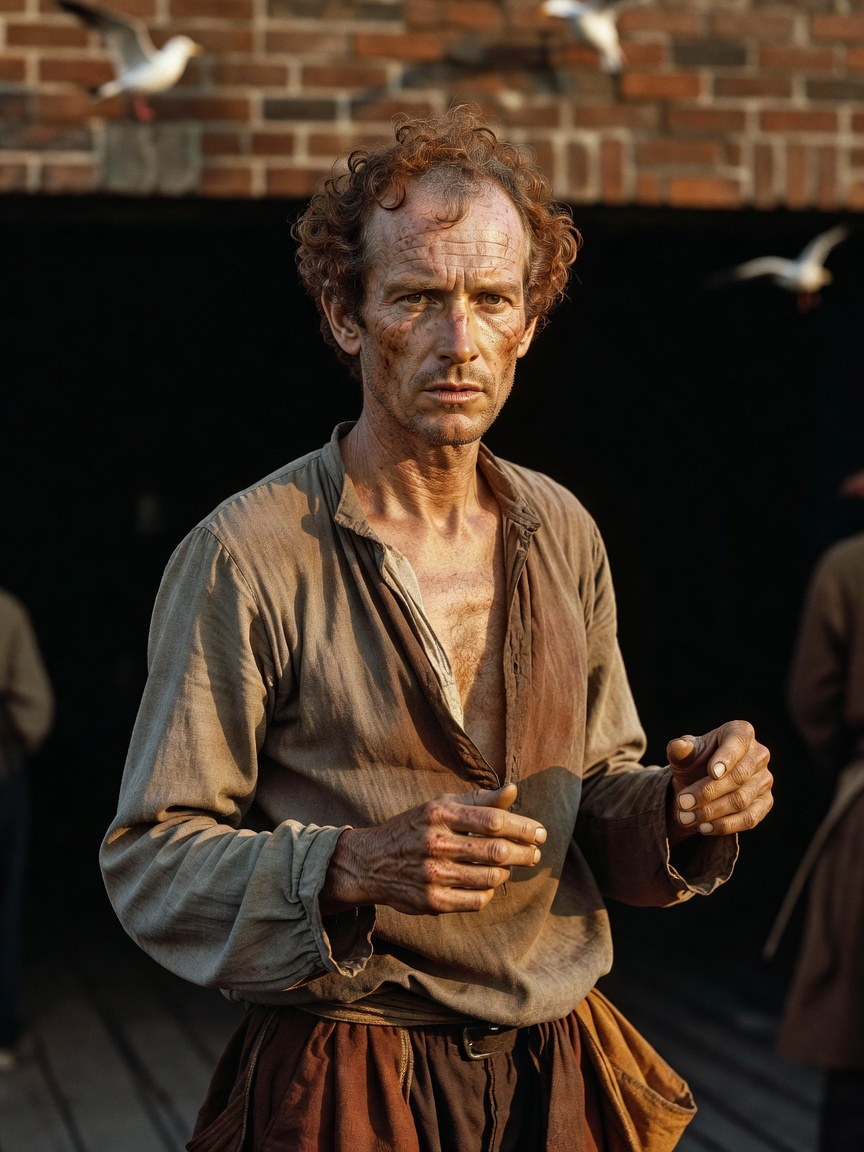
The first thing you notice about Brannigan is that there is almost nothing to notice.
He has engineered invisibility into his very face — a feat of either nature or deliberate cultivation so complete that your eye, having passed over him, struggles to reconstruct what it saw.
Ask three men who stood beside
Ask three men who stood beside him what he looked like, and you will receive three different answers, each one partly true and collectively useless.
But the photographs tell a steadier story.
He is small — not dwarfish, but genuinely compact, as though his frame were assembled from pieces intended for a slightly younger man.
His shoulders are narrow and slightly
His shoulders are narrow and slightly hunched, a posture that might indicate either poor nutrition in his growing years or a long habit of making himself smaller than the spaces he inhabits.
The weight he carries sits without bulk; there is no softness in him, only a kind of functional thinness that speaks to a metabolism that burns what it needs and stores nothing.
At thirty-something, he has the physical carriage of someone for whom food has always been optional and sleep a luxury negotiated against necessity.
His face is the face of
His face is the face of the nickname made flesh. It is pinched — truly pinched, as though someone took the skull and pressed it slightly too hard from the temples inward.
The nose is pointed and slightly too prominent for the rest of his features, a predator’s nose that twitches visibly in the portraits when he is calculating something.
His cheekbones are high and sharp, creating hollows beneath them that photograph almost as shadows. There is no roundness anywhere in the architecture of his skull; every angle is acute, every line a vector pointing outward or downward.
His jaw is narrow to the
His jaw is narrow to the point of seeming fragile, though the set of it suggests nothing breakable.
The eyes are what men remember, and what the photographs capture most reliably. They are brown — a dark, unremarkable brown that should blend into his face entirely but doesn’t. Instead, they dart.
Even in a still photograph, there is a quality of movement to them, as though the image has caught him mid-calculation, mid-assessment, mid-departure. They do not rest on the camera. They do not rest on anything.
They move laterally, checking angles, meas
They move laterally, checking angles, measuring distances, cataloguing exits. There is no warmth in them and no cruelty either — only an absolute, unsentimental evaluation.
This is a man who has looked at every person he has ever met and calculated their utility and their threat in the same moment, and found both measurements wanting.
His hair is auburn, curly in the way that suggests Irish ancestry, and cropped close enough to suggest either military discipline or a refusal to waste time on grooming.
It is unkempt in the photographs
It is unkempt in the photographs — not dirty, but distinctly uncared-for, the way hair looks when the man wearing it has simply stopped thinking about it.
His hairline is receding despite his relative youth, the loss concentrated at the temples, which only sharpens the already angular quality of his skull.
He sometimes slicks what remains back with an excessive amount of product — the photographs vary on this — which suggests vanity, or perhaps a compulsion toward consistency, or perhaps simply a recognition that a visible scalp draws more attention than slicked hair.
Every choice, however small, seems to
Every choice, however small, seems to be motivated by the goal of remaining peripheral to any observer’s vision.
His skin is pale — genuinely pale, the kind that suggests either Irish heritage, or German inheritance, or simply a life conducted away from sunlight.
The paleness is marked across his face and visible forearms with a constellation of faded scars, small and various, the kind accumulated not through dramatic violence but through the ten thousand minor injuries of a life conducted in tight spaces and against sharp edges.
Most are whitened to near-invisibility, th
Most are whitened to near-invisibility, thin lines that only register when the light catches them at a particular angle. They are old — years old, most of them. They are the map of his survival before he arrived at the harbor.
His habitual dress is almost aggressive in its obscurity. The suits are always slightly too large — acquired secondhand, clearly — and in neutral tones: greys, muted browns, colors designed to be forgotten.
His ties are inexpensive and geometrically impersonal. His shoes are worn at the heels from constant readiness, from years of standing in positions that allow for immediate movement in any direction.
Everything about his appearance is calcula
Everything about his appearance is calculated to move through a room without registering, to be present without being remembered, to occupy space without demanding acknowledgment.
When he moves, he moves like something small that has learned to survive by never calling attention to itself. His gait is quick and precise. His hands are small and deft, with fingers that seem too long for the hands they are attached to.
He speaks rarely, and when he does, his voice is quiet enough to require attention, which ensures that the person hearing him leans in slightly, closing the distance between himself and the Weasel — which places him exactly where the Weasel has already calculated he should be.
He is, in every measurable way
He is, in every measurable way, the man designed to be invisible. And yet, once you have truly seen him, you cannot unsee him.
Identity
- Gender
- Male
- Nationality
- Dutch
- Origin
- Hoorn
- Ship · 1725
- Tortue
- Berth
- Able Seaman
Saltwell Profile
Leadership, as the Admiral's office measures it.
Blackwater Profile
Intelligence and tradecraft, by Blackwater reckoning.
Tidecrest Profile
A woman's appraisal — of a woman as she is, or of a man as he believes himself to be.