Miguel Cortez
- Ship
- Oxford
- Position
- ledger captain
- Born
- 1674 · Seville
- Faction
- Ledger Syndicate
- Territory
- Brine Gate Harbor
Backstory
Glass-Eye: A Ledger of Miguel Cortez
The Bell and the Ledger (Seville, 1674–1693)
The Cathedral1 bell of Seville struck the morning into quarters, and the boy Miguel Cortez learned that time was a commodity you could trade.
Not from priests or philosophers —
Not from priests or philosophers — from his uncle Diego’s fingers moving across the counting-house pages, each strike of the bell marking a new column, a new debt, a new reason to move faster.
The Calle Santa María smelled of salt lime and the slow rot of paper that had absorbed thirty years of Guadalquivir damp. Three blocks from the river, in a room where the light came through wavy glass and made everything liquid, Diego kept his ledgers stacked like stone blocks — a fortress built from accounts.
Miguel’s father trafficked in spices. Saffron from Valencia in quantities that made the merchants whisper. Pepper that arrived in casks sealed with wax pressed by factors whose names nobody spoke aloud. Cinnamon that cost more to transport than to buy.
The spice trade was respectable: contracts
The spice trade was respectable: contracts, royal licenses, violence dressed in a merchant’s coat and carrying a ledger instead of steel. His mother’s name appeared nowhere in the accounts. This was the second lesson — erasure was a form of mathematics.
The boy was thin, olive-skinned, with watchful eyes that had learned early not to blink unless the figures required it. Diego was fifteen years older than his father and had chosen a different path.
Not caravans and corruption, but something closer to the bone: he was a contable, a keeper of secrets written in decimal form. He understood that a ledger was not merely a record. It was a language.
Words could lie with elegance, but
Words could lie with elegance, but a man who could read both the surface of the page and the buyer’s face as he submitted it had moved beyond belief into something nearer to sight.
Diego taught the boy the craft of looking — not with sentiment or curiosity (luxuries for merchants’ wives), but with the precise attention of a man reading a map to a shipwreck.
He would place Miguel at a small desk in the northern corner where the light fell without mercy, and set before him a bill of lading. Where did the weight not match the declaration? Where had the ink been applied with a hesitant hand?
Where did the port fees suggest
Where did the port fees suggest a route nobody had announced? The brown eye was sharp then, quick and turning. His uncle would tap the page with a single finger. “Look,” he would say. Not read. Look. The distinction was everything.
During Miguel’s fourteenth year, Diego commissioned a lens from a Portuguese cartographer’s workshop — a small telescope meant for examining the heavens, an indulgence Diego maintained without irony while surrounded by the machinery of earthly trade.
The grinding shop near the cathedral was run by an old craftsman named Tomás, whose family had been grinding glass for three generations. The boy asked to watch. Tomás permitted it with indifference.
The stone wheel rotated at a
The stone wheel rotated at a speed that made the air shimmer. The lens blank, mounted on a brass pivot, turned and turned.
Miguel’s attention fractured like the glass itself.
He had been standing too close, drawn by the mesmerizing rotation, when the wheel’s angle shifted — a dislodgement so small that only physics noticed. The stone caught the lens fragment and flung it like ice.
It entered the left socket with
It entered the left socket with the casual intimacy of a thief who had been let in by negligence. There was no dramatic pain, only the sensation of something essential leaving, like water pouring from a cup. He fell forward. Tomás caught him with surprising gentleness.
The physician in Seville wanted to sew the eyelid closed — leave it a collapsed purse of flesh, the mark of a maiming. The boy would wear it as a badge of clumsiness, the kind of injury that made a man less than whole.
For three weeks Miguel moved through fever dreams and darkened rooms, his right eye still searching while the left one wept lymph and blood into bandages that never stayed clean.
It was in that half-submerged time
It was in that half-submerged time that he remembered his uncle’s optical collection — the small room where Diego kept mirrors of polished silver, lenses of varying thickness, and a prism that threw rainbows across the wall when the morning light found it.
These were not luxuries. They were tools. A man who could manipulate light could manipulate what people saw.
When the fever broke, Miguel made a demand of his uncle: not a closed eyelid, but a glass eye. Not compensation. An accusation.
The Blue Marble (Cádiz, 1693)
The Blue Marble (Cádiz, 1693)
Diego took him to Cádiz, to a craftsman named Rafael whose fingers bore the scars of forty years grinding optical glass.
The workshop smelled of metal polish and something sharp — the dust of ground quartz, perhaps, or the particular air of a room where creation and precision lived in the same breath.
Rafael examined the socket with the
Rafael examined the socket with the dispassion of a man who had fitted glass eyes to a hundred ruined faces. He held up several blanks: jet black, milky white, a grey that seemed to contain all the sky. Then he brought out something else.
The blue marble came from Bohemia. It cost as much as a good horse. The workshop that had ground it no longer existed, a trade secret lost the way all secrets eventually are lost — to time, to death, to the indifference of history.
But Rafael had bought three blanks, decades ago, as insurance against the kind of request that only came once in a lifetime. The blue was not uniform. It held depth.
If you turned it in the
If you turned it in the light, you could almost see a landscape inside it — mountains, perhaps, or the curve of water. An iris had been painted in something that might have been gold leaf, though Rafael would not specify. The iris did not move.
The pupil would not dilate or contract with the light. It would stare with the flat accusation of a mirror that reflected nothing back.
“It will not blink,” Rafael said. He was not warning. He was describing.
“Good,” Miguel said
“Good,” Miguel said.
The fitting took two hours. Rafael used a compound that smelled of eggs and ammonia. The eye socket, still tender, still aching, received the marble with a sensation somewhere between insertion and violation.
Then Rafael fit a thin metal ring — the prosthetic cup — and Miguel felt the weight settle against the bone. His right eye, the brown one, watered from proximity and shock.
When Rafael led him to the
When Rafael led him to the mirror, Miguel saw: a boy with one eye of burning brown, quick and desperate with the burden of seeing for two. And one eye of blue marble, fixed and accusatory, reflecting the workshop light like a stone at the bottom of a well.
“You will learn to move your real eye twice as fast,” Rafael said. “The brain will compensate. The glass will keep watch.”
He was correct.
The Ledger and the River (Seville
The Ledger and the River (Seville, 1693–1725)
Miguel returned to Seville changed in a way that had nothing to do with his appearance. His uncle Diego saw it immediately — not in the eye itself, but in the way the remaining flesh eye worked.
It moved with obsessive precision, cataloging every detail it encountered, as if determined never to miss anything again. As if shame had been ground into him alongside the glass shard.
Diego used this hunger. By Miguel’s
Diego used this hunger. By Miguel’s sixteenth year, the boy was forging bills of lading with the attention that only a one-eyed man could muster. Every stroke deliberate. Every letter an act of will.
He learned to fence contraband by making it invisible in the ledger under false categories — shifting goods through the columns the way a river moves through channels, somewhere the custom official’s eye passed without catching. Knowledge and forgery were not opposites. They were siblings.
He learned that the spice trade was merely the visible surface of something deeper. Beneath it moved money that had no name on any bill. Money that came from the Caribbean — from sugar, from indigo, from the bodies that made both possible.
Diego’s counting house was a node
Diego’s counting house was a node in a network that extended from Seville to Cádiz to the smaller ports of Andalucía, and from there across the Atlantic to a place the boy had never seen but could visualize perfectly: the Caribbean, where the real ledgers were written in blood and ash.
When Miguel was nineteen, a ship came to Cádiz — a merchant vessel with deep holds and a crew that looked like men who had learned to sleep in the dark.
The captain needed someone who could forge documents, handle the ledger-work, move goods from one column to another without the column itself being traced. Someone with the precision of a man who had nothing left to lose but his remaining eye.
Miguel walked aboard the Oxford on
Miguel walked aboard the Oxford2 on a morning in 1693 when the tide was high and the Guadalquivir seemed to flow backward into the sea. His uncle watched from the dock. His one good eye — the brown one — looked forward. The blue marble never moved.
He carried with him a leather journal, a set of fine pens, and the absolute certainty that he had been remade not into something less than whole, but into something capable of seeing in ways that the two-eyed men could never comprehend.
The ledger had taught him that the world was a series of rearrangements. Now he would become an artist of rearrangement.
The bell of the Cathedral struck
The bell of the Cathedral struck the hour. Time moved forward. And Glass-Eye did not look back.
The Blue Marble of Seville: Glass-Eye’s Origin
Part One: The Ledger House
The Cathedral bell of Seville struck
The Cathedral bell of Seville struck the morning into quarters, and time became a commodity you could trade.
The boy Miguel Cortez learned this fact before he learned his letters — not from books, but from the way his uncle Diego Navarro3’s fingers moved across the counting-house pages, each strike of the bell marking a new column, a new debit, a new reason to hurry.
The Calle Santa María smelled of salt lime and the slow rot of paper that had absorbed thirty years of Guadalquivir damp.
Three blocks from the river, in
Three blocks from the river, in a room where the light came through wavy glass and made everything liquid, Diego kept his ledgers stacked like stone blocks. A man could build a fortress out of accounts.
Miguel’s father — whose name the boy learned to spell before understanding he was supposed to love him — trafficked in spices. Saffron from Valencia in quantities that made the merchants whisper.
Pepper that came up from Malabar in casks sealed with wax and the pressed seal of factors whose names nobody spoke aloud. Cinnamon that cost more in wax than in weight. The spice trade was respectable.
It involved contracts and royal licenses
It involved contracts and royal licenses and a kind of violence that wore a merchant’s coat and carried a ledger instead of a blade. His mother’s name appeared nowhere in the accounts. This was the second lesson: erasure was a form of mathematics.
The boy was thin, olive-skinned, with the watchful eyes of a child raised in a house of men who did not speak unless the numbers required it.
His uncle Diego was fifteen years older than his father — a gap that had made them rivals from birth — and he had chosen a different path: not the spice trade with its caravans and its corruption, but something closer to the bone.
He was a contable, a keeper
He was a contable, a keeper of secrets written in decimal form. He understood that a ledger was not merely a record. It was a language. Words could lie. Numbers could be arranged to lie more elegantly.
But a man who could read both the surface of the ledger and the man’s face as he submitted it could move beyond belief into something nearer to sight.
Diego taught Miguel the craft of looking. Not with sentiment or curiosity — those were luxuries for merchants’ wives — but with the precise attention of a man reading a map to a shipwreck.
He would place the boy at
He would place the boy at a small desk in the corner, where the light fell from a northern window, and set before him a bill of lading: where did the weight not match the declaration? Where had the ink been applied with a hesitant hand?
Where did the port fees suggest a route nobody had announced? The boy’s left eye was sharp then, the brown one quick and turning. His uncle would tap the page with a single finger. “Look,” he would say. Not “read.” Look. The distinction was everything.
It was in this room, during Miguel’s fourteenth year, that his uncle commissioned a lens from a Portuguese cartographer’s workshop.
The lens was meant for a
The lens was meant for a telescope — a small instrument for examining the heavens, which Diego maintained without irony while surrounded by the machinery of earthly commerce.
The grinding stone in the workshop near the cathedral was turned by an old craftsman named Tomás, whose family had been grinding glass for three generations. The boy asked to watch. Tomás permitted it, indifferent.
The stone wheel rotated at a speed that made the air shimmer. The lens blank, mounted on a brass pivot, turned and turned.
Miguel’s attention fractured like the glas
Miguel’s attention fractured like the glass itself.
He had been standing too close, his left eye drawn by the mesmerizing rotation, when the wheel’s angle shifted — a dislodgement so small that only physics noticed it. The stone caught the lens fragment and flung it like a shard of ice.
It entered the left socket with the casual intimacy of a thief who has been let in by negligence. There was no dramatic pain, only the sensation of something essential leaving, like water pouring from a cup. He fell forward. Tomás caught him with surprising gentleness.
The physician in Seville wanted to
The physician in Seville wanted to sew the eyelid closed — leave it a collapsed purse of flesh, the mark of a maiming. The boy would wear it as a badge of clumsiness, the kind of injury that made a man less than whole.
For three weeks Miguel moved through fever dreams and darkened rooms, his right eye still searching while the left one wept lymph and blood into bandages that never stayed clean.
It was in that half-submerged time that he remembered his uncle’s optical collection — the small room where Diego kept mirrors of polished silver, lenses of varying thickness, and a prism that threw rainbows across the wall when the morning light found it.
These were not luxuries. They were
These were not luxuries. They were tools. A man who could manipulate light could manipulate what people saw.
When the fever broke, Miguel made a demand of his uncle: not a closed eyelid, but a glass eye. Not compensation. An accusation.
Part Two: The Blue Marble
Diego took him to Cádiz, to
Diego took him to Cádiz, to a craftsman named Rafael whose fingers bore the scars of forty years grinding optical glass.
The workshop smelled of metal polish and something sharp — the dust of ground quartz, perhaps, or the particular air of a room where creation and precision lived in the same breath.
Rafael examined the socket with the dispassion of a man who had fitted glass eyes to a hundred ruined faces. He held up several blanks: jet black, milky white, a grey that seemed to contain all the sky. Then he brought out something else.
The blue marble came from Bohemia
The blue marble came from Bohemia, he said. It cost as much as a good horse. It had been ground by a workshop that no longer existed, a trade secret lost the way all secrets eventually are lost — to time, to death, to the indifference of history.
But Rafael had bought three blanks, decades ago, as insurance against the kind of request that only came once in a lifetime. The blue was not uniform. It held depth.
If you turned it in the light, you could almost see a landscape inside it — mountains, perhaps, or the curve of water. It had an iris painted in something that might have been gold leaf, though Rafael would not specify. The iris did not move.
The pupil would not dilate or
The pupil would not dilate or contract with the light. It would stare with the flat accusation of a mirror that reflected nothing back.
“It will not blink,” Rafael said. He was not warning. He was describing.
“Good,” Miguel said.
The fitting took two hours. Rafael
The fitting took two hours. Rafael used a compound that smelled of eggs and ammonia. The eye socket, still tender, still aching, received the marble with a sensation somewhere between insertion and violation.
Then Rafael fit a thin metal ring — the prosthetic cup — and Miguel felt the weight settle against the bone. His right eye, the brown one, watered from proximity and shock.
When Rafael led him to the mirror, Miguel saw: a boy with one eye of burning brown, quick and desperate with the burden of seeing for two. And one eye of blue marble, fixed and accusatory, reflecting the workshop light like a stone at the bottom of a well.
“You will learn to move your
“You will learn to move your real eye twice as fast,” Rafael said. “The brain will compensate. The glass will keep watch.”
He was correct.
Part Three: The Ledger and the River
Miguel returned to Seville changed in
Miguel returned to Seville changed in a way that had nothing to do with his appearance. His uncle Diego saw it immediately — not in the eye itself, but in the way the boy’s remaining flesh eye worked.
It moved with obsessive precision, cataloging every detail it encountered, as if determined never to miss anything again. As if shame had been ground into him alongside the glass shard.
Diego used this hunger. By Miguel’s sixteenth year, the boy was forging bills of lading with the attention that only a one-eyed man could muster. Every stroke deliberate. Every letter an act of will.
He learned to fence contraband by
He learned to fence contraband by making it invisible in the ledger under false categories — shifting goods through the columns the way a river moves through channels, somewhere the custom official’s eye passes without catching. He learned that knowledge and forgery were not opposites. They were siblings.
He learned that the spice trade was merely the visible surface of something deeper. Beneath it moved money that had no name on any bill. Money that came from the Caribbean — from sugar, from indigo, from the bodies that made both possible.
Diego’s counting house was a node in a network that extended from Seville to Cádiz to the smaller ports of Andalucía, and from there across the Atlantic to a place the boy had never seen but could visualize perfectly: the Caribbean, where the real ledgers were written in blood and ash.
When Miguel was nineteen, a ship
When Miguel was nineteen, a ship came to Cádiz — a merchant vessel with deep holds and a crew that looked like men who had learned to sleep in the dark.
The captain needed someone who could forge documents, handle the ledger-work, move goods from one column to another without the column itself being traced. Someone with the precision of a man who had nothing left to lose but his remaining eye.
Miguel walked aboard the Oxford on a morning in 1693 when the tide was high and the Guadalquivir seemed to flow backward into the sea. His uncle watched from the dock. His one good eye — the brown one — looked forward. The blue marble never moved.
He carried with him a leather
He carried with him a leather journal, a set of fine pens, and the absolute certainty that he had been remade not into something less than whole, but into something capable of seeing in ways that the two-eyed men could never comprehend.
The ledger had taught him that the world was a series of rearrangements. Now he would become an artist of rearrangement.
The bell of the Cathedral struck the hour. Time moved forward. And Glass-Eye did not look back.
The Blue Marble of Seville: Glass-Eye’s
The Blue Marble of Seville: Glass-Eye’s Origin
Part One: The Ledger House
The Cathedral bell of Seville struck the morning into quarters, and time became a commodity you could trade.
The boy Miguel Cortez learned this
The boy Miguel Cortez learned this fact before he learned his letters — not from books, but from the way his uncle Diego Navarro’s fingers moved across the counting-house pages, each strike of the bell marking a new column, a new debit, a new reason to hurry.
The Calle Santa María smelled of salt lime and the slow rot of paper that had absorbed thirty years of Guadalquivir damp.
Three blocks from the river, in a room where the light came through wavy glass and made everything liquid, Diego kept his ledgers stacked like stone blocks. A man could build a fortress out of accounts.
Miguel’s father — whose name the
Miguel’s father — whose name the boy learned to spell before understanding he was supposed to love him — trafficked in spices. Saffron from Valencia in quantities that made the merchants whisper.
Pepper that came up from Malabar in casks sealed with wax and the pressed seal of factors whose names nobody spoke aloud. Cinnamon that cost more in wax than in weight. The spice trade was respectable.
It involved contracts and royal licenses and a kind of violence that wore a merchant’s coat and carried a ledger instead of a blade. His mother’s name appeared nowhere in the accounts. This was the second lesson: erasure was a form of mathematics.
The boy was thin, olive-skinned, with
The boy was thin, olive-skinned, with the watchful eyes of a child raised in a house of men who did not speak unless the numbers required it.
His uncle Diego was fifteen years older than his father — a gap that had made them rivals from birth — and he had chosen a different path: not the spice trade with its caravans and its corruption, but something closer to the bone.
He was a contable, a keeper of secrets written in decimal form. He understood that a ledger was not merely a record. It was a language. Words could lie. Numbers could be arranged to lie more elegantly.
But a man who could read
But a man who could read both the surface of the ledger and the man’s face as he submitted it could move beyond belief into something nearer to sight.
Diego taught Miguel the craft of looking. Not with sentiment or curiosity — those were luxuries for merchants’ wives — but with the precise attention of a man reading a map to a shipwreck.
He would place the boy at a small desk in the corner, where the light fell from a northern window, and set before him a bill of lading: where did the weight not match the declaration? Where had the ink been applied with a hesitant hand?
Where did the port fees suggest
Where did the port fees suggest a route nobody had announced? The boy’s left eye was sharp then, the brown one quick and turning. His uncle would tap the page with a single finger. “Look,” he would say. Not “read.” Look. The distinction was everything.
It was in this room, during Miguel’s fourteenth year, that his uncle commissioned a lens from a Portuguese cartographer’s workshop.
The lens was meant for a telescope — a small instrument for examining the heavens, which Diego maintained without irony while surrounded by the machinery of earthly commerce.
The grinding stone in the workshop
The grinding stone in the workshop near the cathedral was turned by an old craftsman named Tomás, whose family had been grinding glass for three generations. The boy asked to watch. Tomás permitted it, indifferent.
The stone wheel rotated at a speed that made the air shimmer. The lens blank, mounted on a brass pivot, turned and turned.
Miguel’s attention fractured like the glass itself.
He had been standing too close
He had been standing too close, his left eye drawn by the mesmerizing rotation, when the wheel’s angle shifted — a dislodgement so small that only physics noticed it. The stone caught the lens fragment and flung it like a shard of ice.
It entered the left socket with the casual intimacy of a thief who has been let in by negligence. There was no dramatic pain, only the sensation of something essential leaving, like water pouring from a cup. He fell forward. Tomás caught him with surprising gentleness.
The physician in Seville wanted to sew the eyelid closed — leave it a collapsed purse of flesh, the mark of a maiming. The boy would wear it as a badge of clumsiness, the kind of injury that made a man less than whole.
For three weeks Miguel moved through
For three weeks Miguel moved through fever dreams and darkened rooms, his right eye still searching while the left one wept lymph and blood into bandages that never stayed clean.
It was in that half-submerged time that he remembered his uncle’s optical collection — the small room where Diego kept mirrors of polished silver, lenses of varying thickness, and a prism that threw rainbows across the wall when the morning light found it.
These were not luxuries. They were tools. A man who could manipulate light could manipulate what people saw.
When the fever broke, Miguel made
When the fever broke, Miguel made a demand of his uncle: not a closed eyelid, but a glass eye. Not compensation. An accusation.
Part Two: The Blue Marble
Diego took him to Cádiz, to a craftsman named Rafael whose fingers bore the scars of forty years grinding optical glass.
The workshop smelled of metal polish
The workshop smelled of metal polish and something sharp — the dust of ground quartz, perhaps, or the particular air of a room where creation and precision lived in the same breath.
Rafael examined the socket with the dispassion of a man who had fitted glass eyes to a hundred ruined faces. He held up several blanks: jet black, milky white, a grey that seemed to contain all the sky. Then he brought out something else.
The blue marble came from Bohemia, he said. It cost as much as a good horse. It had been ground by a workshop that no longer existed, a trade secret lost the way all secrets eventually are lost — to time, to death, to the indifference of history.
But Rafael had bought three blanks
But Rafael had bought three blanks, decades ago, as insurance against the kind of request that only came once in a lifetime. The blue was not uniform. It held depth.
If you turned it in the light, you could almost see a landscape inside it — mountains, perhaps, or the curve of water. It had an iris painted in something that might have been gold leaf, though Rafael would not specify. The iris did not move.
The pupil would not dilate or contract with the light. It would stare with the flat accusation of a mirror that reflected nothing back.
“It will not blink,” Rafael said
“It will not blink,” Rafael said. He was not warning. He was describing.
“Good,” Miguel said.
The fitting took two hours. Rafael used a compound that smelled of eggs and ammonia. The eye socket, still tender, still aching, received the marble with a sensation somewhere between insertion and violation.
Then Rafael fit a thin metal
Then Rafael fit a thin metal ring — the prosthetic cup — and Miguel felt the weight settle against the bone. His right eye, the brown one, watered from proximity and shock.
When Rafael led him to the mirror, Miguel saw: a boy with one eye of burning brown, quick and desperate with the burden of seeing for two. And one eye of blue marble, fixed and accusatory, reflecting the workshop light like a stone at the bottom of a well.
“You will learn to move your real eye twice as fast,” Rafael said. “The brain will compensate. The glass will keep watch.”
He was correct
He was correct.
Part Three: The Ledger and the River
Miguel returned to Seville changed in a way that had nothing to do with his appearance. His uncle Diego saw it immediately — not in the eye itself, but in the way the boy’s remaining flesh eye worked.
It moved with obsessive precision, catalog
It moved with obsessive precision, cataloging every detail it encountered, as if determined never to miss anything again. As if shame had been ground into him alongside the glass shard.
Diego used this hunger. By Miguel’s sixteenth year, the boy was forging bills of lading with the attention that only a one-eyed man could muster. Every stroke deliberate. Every letter an act of will.
He learned to fence contraband by making it invisible in the ledger under false categories — shifting goods through the columns the way a river moves through channels, somewhere the custom official’s eye passes without catching. He learned that knowledge and forgery were not opposites. They were siblings.
He learned that the spice trade
He learned that the spice trade was merely the visible surface of something deeper. Beneath it moved money that had no name on any bill. Money that came from the Caribbean — from sugar, from indigo, from the bodies that made both possible.
Diego’s counting house was a node in a network that extended from Seville to Cádiz to the smaller ports of Andalucía, and from there across the Atlantic to a place the boy had never seen but could visualize perfectly: the Caribbean, where the real ledgers were written in blood and ash.
When Miguel was nineteen, a ship came to Cádiz — a merchant vessel with deep holds and a crew that looked like men who had learned to sleep in the dark.
The captain needed someone who could
The captain needed someone who could forge documents, handle the ledger-work, move goods from one column to another without the column itself being traced. Someone with the precision of a man who had nothing left to lose but his remaining eye.
Miguel walked aboard the Oxford on a morning in 1693 when the tide was high and the Guadalquivir seemed to flow backward into the sea. His uncle watched from the dock. His one good eye — the brown one — looked forward. The blue marble never moved.
He carried with him a leather journal, a set of fine pens, and the absolute certainty that he had been remade not into something less than whole, but into something capable of seeing in ways that the two-eyed men could never comprehend.
The ledger had taught him that
The ledger had taught him that the world was a series of rearrangements. Now he would become an artist of rearrangement.
The bell of the Cathedral struck the hour. Time moved forward. And Glass-Eye did not look back.
Appearance
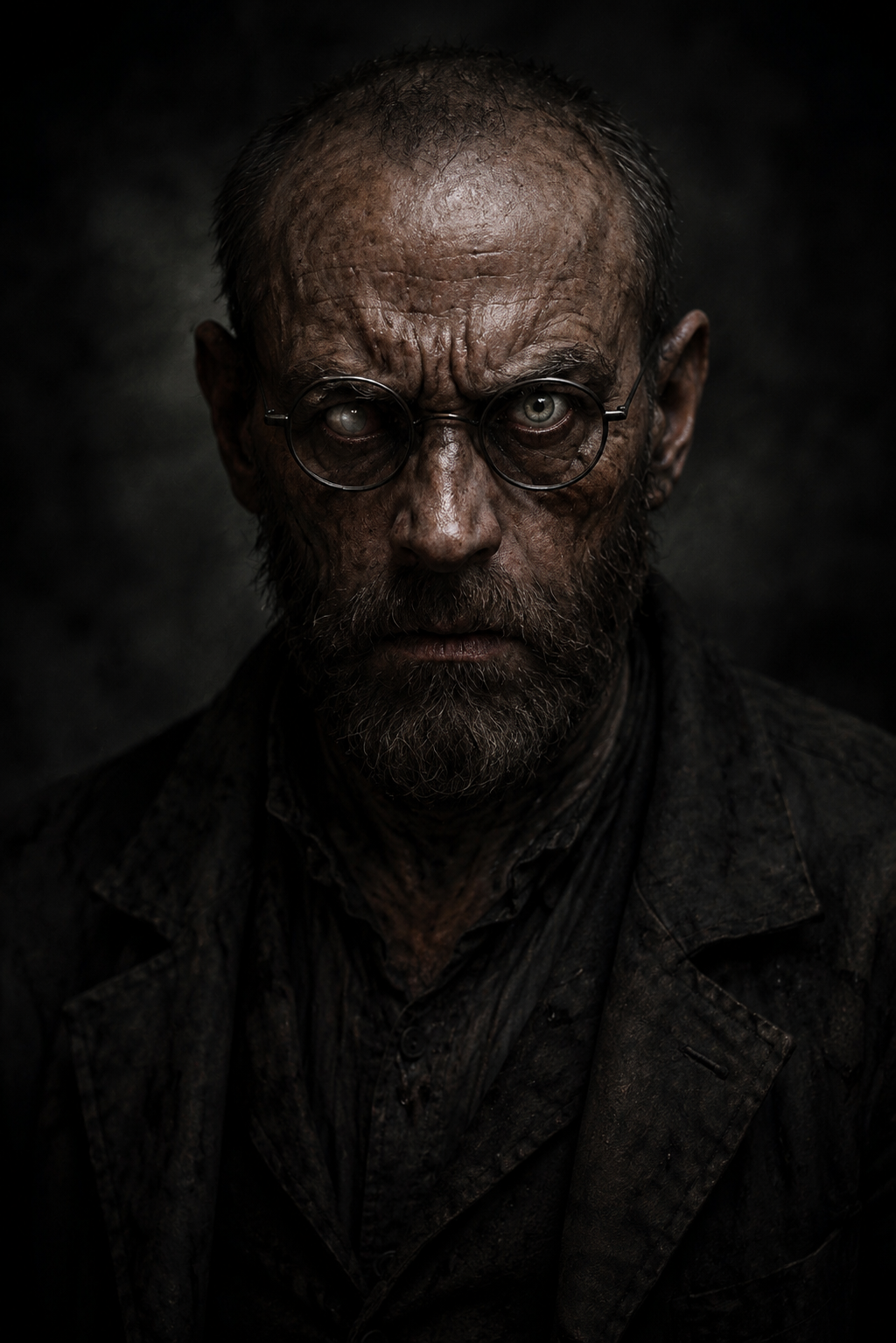
COMPOSITE HEADSHOT: Miguel Cortez, “Glass-Eye”
THE FACE AT FORTY-SEVEN
Miguel Cortez carries his years the way a ship carries ballast — distributed, settled, unavoidable. His head sits atop a frame that has thinned with age but retained its angle; there is no slack in the neck, no forward slouch of desk work or defeat.
The skull itself is narrow, almost
The skull itself is narrow, almost austere, with a prominent ridge of bone running from temple to temple across the brow.
His cheekbones sit high and distinct, casting small shadows even in midday light — the legacy of Seville bloodlines, that lean Iberian geometry that looks wrong in a fat man and becomes almost brutal in a thin one. He is thin.
Not the wasting-sickness thin of the starved, but the careful, intentional thinness of a man who learned young that excess is visible and visibility is risk.
His jaw is squared, slightly undershot
His jaw is squared, slightly undershot, with a small scar tissue beneath the left mandible — not recent, not dramatic, simply the mark of an old decision made under poor light.
The skin tells the real story. It is weathered to the colour of aged olive wood, burnished at the cheekbones and temples with the deep tan that no amount of indoor work erases once the Atlantic has marked it.
The brown is not uniform; it deepens along the jawline and beneath the chin where the collar rides, and fades to a paler bronze along the hairline — evidence of decades spent with his head covered and uncovered by turns.
At forty-seven, his face has begun
At forty-seven, his face has begun to settle into its final creases.
There are lines around the mouth — not laugh lines, these are too severe for that — but the parallel marks of a man who has spent half his life reducing his expression to a minimum, speaking only when calculation required it.
Two deeper lines bracket his nose, running from nostril to the corner of his mouth on both sides, which gives his face a quality of permanent suspicion even in repose.
The hair is silver-grey, still thick
The hair is silver-grey, still thick and swept back from the forehead in a style that may once have been fashionable but is now simply his habit.
It is the grey of a man who turned at forty and never looked back; there is no residual brown, no salt-and-pepper mingling.
It is entirely silver, the colour of old coins or burnished lead, and he keeps it short enough that the scalp shows through at the temples.
In certain light — the kind
In certain light — the kind of slanting Atlantic light that comes off the water in the hour before dusk — it catches and seems to hold the light itself, giving him the momentary appearance of something hammered out rather than grown.
But the eyes. The eyes are where the story concentrates.
His right eye — the genuine one — is brown, a deep tobacco-brown that sits slightly deeper in the socket than seems natural. It is smaller than it should be, or appears smaller, because it works constantly. That eye moves in ways that eyes should not.
It does not rest. It scans
It does not rest. It scans. In conversation, it does not meet yours in the way that honest men are taught to meet eyes; instead, it examines you sideways, pulling in detail while your attention is elsewhere.
It catches light and reflection and calculates distance. When he is thinking — truly thinking, running a problem through the machinery of his cunning — that eye narrows to a slit, and the surrounding musculature tightens as though the eye itself is pulling the entire face into focus.
The left socket is the work of a Cádiz craftsman who understood that a false eye need not apologize for being false. The glass is blue — a deep, almost purple blue, the colour of water so deep it has forgotten sunlight. It does not move. It does not blink.
It does not track with its
It does not track with its partner, and this asymmetry is the thing that stops a man mid-sentence when he first realizes it. The blue eye stares straight ahead with the calm malevolence of something that has seen too much and forgiven nothing.
It is perfectly fitted, bordered by a thin line of scar tissue that has faded to the colour of old parchment, and the eyelid above it closes and opens with the same mechanical perfection as the real one.
Most men who lose an eye to injury choose glass that approximates the colour of the eye they keep. Cortez chose something else entirely — something that announces the loss rather than hiding it. It is a choice that says: I do not require your comfort with my damage.
Together, the two eyes create an
Together, the two eyes create an effect of deliberate discord. Where the brown eye interrogates, the blue eye impassses. Where the brown eye searches for advantage, the blue eye sees only the fact of things as they are, stripped of sentiment. Men remember the blue eye long after they forget the man.
BEARING AND CARRIAGE
His posture is that of a man who has spent forty years not trusting a chair. He sits as though at any moment he might need to stand; his back does not rest against anything.
His hands are small, with long
His hands are small, with long fingers and nails kept scrupulously clean — the hands of a forger or a cartographer, which is precisely what he is.
When he writes, the pen becomes an extension of something older than language; the letters flow from the point with a precision that seems almost calligraphic until you realize there is nothing decorative about it. Every stroke serves function.
The hands are marked with the small white scars of a man who has worked with glass, blades, and paper for most of his life. There is one peculiar mark: a thin vertical line across the inside of his left wrist, barely visible unless he turns his hand in certain light, old enough to be pale as bone.
When he moves, there is no
When he moves, there is no excess motion. He does not gesture. He does not pace. When he walks, he walks with the flat, economical stride of a man moving through a ship in heavy weather — each step placed to conserve balance and momentum.
His gait is slightly favoured toward his right; his left leg carries something of the drag of old injury or calculation, though men who have sailed with him cannot quite remember when the injury happened. He may have been born that way.
His voice, when he uses it, is soft. This is not the softness of a quiet man, but the softness of a man who knows that whoever listens hardest hears best.
He speaks Spanish when he chooses
He speaks Spanish when he chooses to speak it — the Castilian of Seville, clipped and precise — and English when he must, with an accent that sits somewhere between Spain and the Indies and never quite resolves into either.
There is no lilt to his speech, no color, no embellishment. He sounds the way a ledger reads: accurate, impersonal, complete.
DRESS AND HABIT
His clothing is the uniform of
His clothing is the uniform of a man who has learned that visibility is a liability. He favors earth tones: ochre, grey, russet, the dull brown of old canvas. Nothing bright. Nothing new. Nothing that catches the eye from more than six feet away.
His coat, when he wears one, is a long merchant’s coat of the kind that was fashionable thirty years ago and remains functional — pockets deep enough to carry documents, fabric thick enough to wear well.
His shirt, when visible, is linen or linen-cotton, dyed to the colour of old bone, worn open at the collar. He wears no jewelry, no rings, nothing that would make him memorable in the way that ornament makes men memorable.
Even his shoes — worn leather
Even his shoes — worn leather, the colour of dried blood or autumn mud — seem chosen to be forgotten the moment he steps out of them.
But there is always, in every version, something that catches light. Usually it is glass. Sometimes it is the edge of a lens, visible in an upper pocket. Sometimes it is the frame of spectacles, folded carefully inside his coat.
Once or twice, men have caught the gleam of small mirrors sewn into the inner pockets of his jacket — mirrors polished to reflect exactly the angle of a man’s vision without requiring him to turn his head. The glass is not decoration. The glass is method.
At forty-seven, with no ship under
At forty-seven, with no ship under him and no captain calling him crew, Miguel Cortez is still a man who looks as though he is waiting to be called away. His posture says: I am ready. His eye — the blue one, especially — says: I am already gone.
Identity
- Born
- 1674
- Gender
- Male
- Nationality
- Spanish
- Origin
- Seville
- Ship · 1725
- Oxford
Frestagon Profile
Compiled by Dr. Frestagon from observation rather than testimony. Scores out of ten; the commentary is his own.
- Cunning (9) — at the ceiling. Assume premeditation.
- Strategy (7) — serviceable, and aware of its limits.
- Navigation (7) — serviceable, and aware of its limits.
- Lore (5) — middling; compensated for elsewhere.
- Education (5) — middling; compensated for elsewhere.
- Charm (4) — middling; compensated for elsewhere.
- Command (2) — a documented weakness. Exploit with care.
- Intuition (2) — a documented weakness. Exploit with care.
- Empathy (1) — a documented weakness. Exploit with care.
Filed under seal. The subject has not seen this assessment, which is for the best.
Saltwell Profile
Leadership, as the Admiral's office measures it.
Blackwater Profile
Intelligence and tradecraft, by Blackwater reckoning.
Tidecrest Profile
A woman's appraisal — of a woman as she is, or of a man as he believes himself to be.