Isabella Tidecrest
- Ship
- Saltwell Flagship
- Position
- Admiral, Brine Gate Harbor. Commander of the Convoy Lanes (escort squadron, heavy-weather school, harbor convoy accounting). Senior signatory of the Convoy Wreath agreement (1858). Member of the Admiralty's three-person standing committee on Lent-Hand counter-operations (with Saltwell and Blackwater).
- Faction
- Ledger Syndicate
- Territory
- Brine Gate Harbor
Backstory
## Bio
Admiral of the Brine Gate flotilla, commander of the harbor's Convoy Lanes — the largest standing command in the modern fleet.
Her squadron escorts the salt, grain, and powder trains up the coast and back, fights the autumn pursuits when Carleton comes hunting, and runs the heavy-weather school out of the Salt Tower in winter.
Under her command in the last
Under her command in the last decade the harbor's convoy losses have fallen by two-thirds. She reports directly to Fleet Admiral Saltwell, takes her standing orders without comment, and is the only Admiral besides Torrens whom the Lent-Hand Brotherhood marks by name on their broadsides.
## Backstory
Born in the harbor's pilot district to a family that had read tide charts for three generations.
Entered the harbor's naval academy at
Entered the harbor's naval academy at sixteen — older than most, having spent the prior years piloting freight tenders through the Tarbridge shoals to support her mother and younger brother. Commissioned in 1834, the year of the Great Fire.
Made her name in the Salt Coast actions of the early 1840s and again in the Tarbridge Blockade, where she captained the cutter NORTH SLEW under the senior Vice-Admirals — including the man then called Sir Richard Carleton1, whom she remembered as a poor commander to weatherward and a fastidious one to leeward.
She was the first ship-of-the-line captain Saltwell brought into his confidence after the Tarbridge ledger surfaced in 1843; she sat at the second desk in the Salt Tower the morning Carleton's warrant was signed, and she signed beneath Saltwell as the second witness.
She has never spoken publicly of
She has never spoken publicly of that morning, but she has not refused a Carleton interdiction since.
Her daughter Helene was taken from the family quay at Bone Cay in 1856 by Lent-Hand cell agents.
Torrens recovered the girl forty-one days later and returned her without ceremony; Tidecrest has been godmother to Torrens's affairs in the harbor ever since, and her intelligence network — pilots, harbor-mistresses, hawkers — funnels everything she has on Carleton's movements to Torrens's hand.
## Personality
## Personality
Quiet, exact, and unsurprisable. The harbor's captains rotate through her command and come out the other side either much better officers or quietly reassigned to land posts where they will do less harm.
She is known to drink one cup of Salt Quarter rum at the New Year's mess and otherwise to take only tea.
She writes in a small, precise
She writes in a small, precise hand — her convoy after-actions are kept in the Admiralty file as exemplars — and reads more histories than her staff can quite account for. She is fiercely private about Helene, who is now seventeen and a chart-cadet at the Salt Tower under her own name.
## Signature Acts
• The Black Channel running-fight (1854) — three days of close-quarters work against Carleton's escort; took two prizes, put a musket-ball through Carleton's left thigh, brought the convoy home with eleven of thirteen merchantmen intact.
• The Convoy Wreath agreement (1858
• The Convoy Wreath agreement (1858, jointly with Torrens) — formalized the working parley with three independent privateer captains; her squadron carries the wreath emblem on its quarter-rails.
• The 1860 Saltwater Ledger — a complete reform of harbor convoy accounting, written in her hand over the winter watch; saved the Admiralty roughly £14,000 in its first year and is still the standing doctrine.
• The Tarbridge gale of 1861 — sailed THE NORTH SLEW into a force-nine to pull a stranded grain convoy off the lee shore; lost two topmen and one boatswain; came home with seven ships' worth of seed wheat.
• Standing order on Wrecker's Tribunal
• Standing order on Wrecker's Tribunal2 sightings: any of her ships that spots a Tribunal vessel near a harbor convoy is to alter course and shadow at half a mile until the convoy clears.
Appearance
ISABELLA TIDECREST: COMPOSITE HEADSHOT
Physiognomy & Build
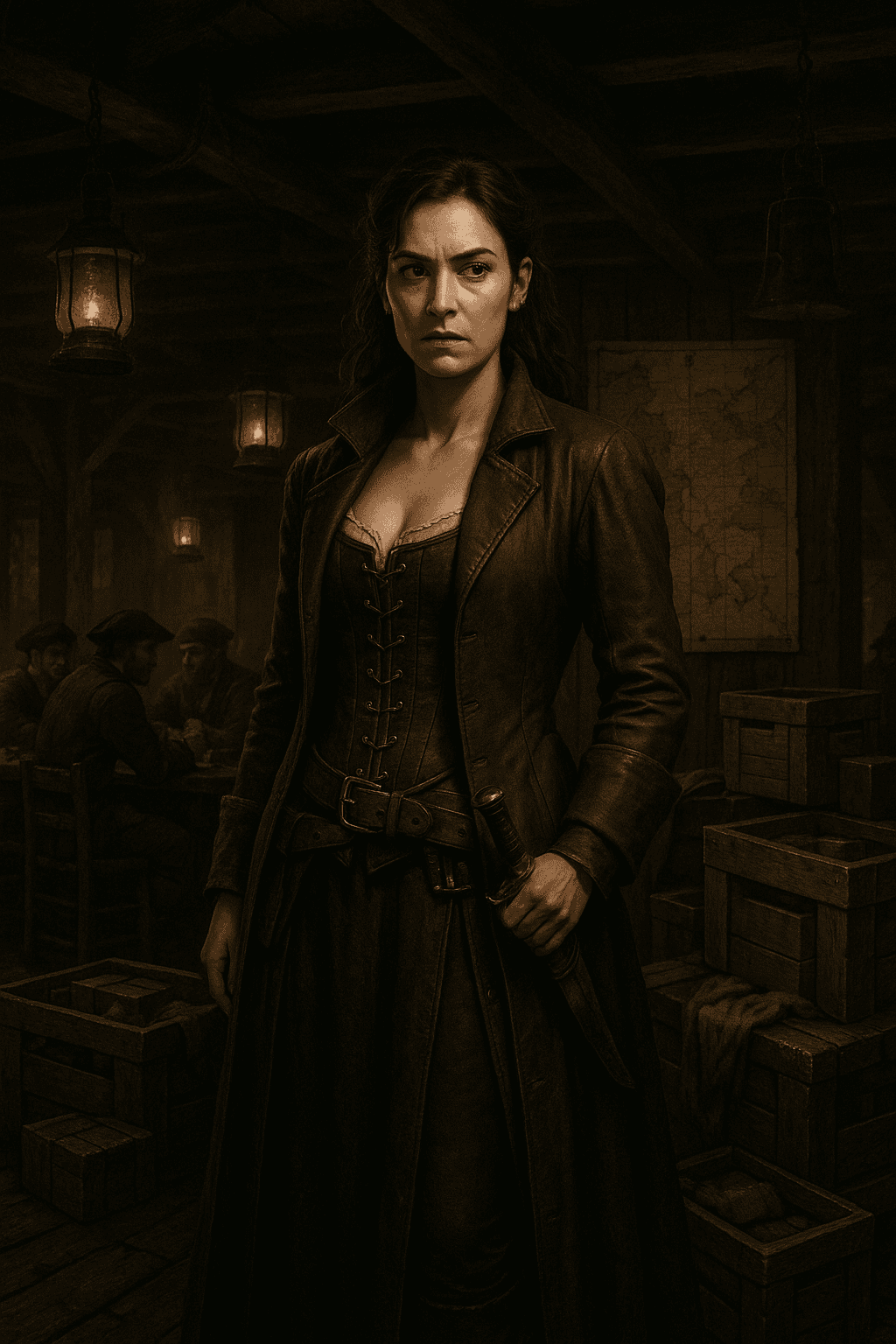
Isabella Tidecrest carries the structured, angular architecture of her Portsmouth lineage — a face built on sharp planes rather than softness, the kind that photographs well in hard light and reads as formidable even in repose.
Her cheekbones sit high and pronounced
Her cheekbones sit high and pronounced, creating a subtle hollow beneath them that deepens when she’s thinking — which is often — and gives her resting expression an edge of skepticism.
Her jaw is square, set forward slightly, neither delicate nor brutish, the bone of someone whose family has worked the water for three generations.
At fifty-three, her skin holds the weathered bronze of someone who has spent decades on exposed decks, with the kind of fine creasing around the eyes and mouth that comes not from smiling but from squinting into salt spray and poor light. The creases run deep; they’re honest work written in her face.
Her eyes are her most arresting
Her eyes are her most arresting feature: a pale grey-green, somewhere between slate and seafoam, with the peculiar intensity of someone who reads navigation charts by lamplight and misses nothing.
They’re set level, slightly wide-spaced, with a gaze that holds its focus without apparent effort — the look of a woman accustomed to making instantaneous judgments about wind, water, and the men and women who sail both.
Her pupils contract and expand with surgical precision; there’s no blankness in them, no drift. When she looks at you, she is fully present, and you know it. She blinks less often than most people.
Her hair was once dark auburn
Her hair was once dark auburn, the kind that catches copper in afternoon light, but it has surrendered steadily to grey over the last decade. She does not dye it or hide it.
She wears it pinned or braided, always off her face, in styles that read as utilitarian rather than decorative — a pilot’s pragmatism, no hair loose to catch in rigging or obscure her vision.
The grey now runs through it in wide, distinct streaks, particularly at the temples and along the crown, giving her an appearance of austere authority. Her hair is thick and has retained its wave; when she unbraids it on rare private occasions, it falls to her mid-back.
Her nose is straight, proportionate, with
Her nose is straight, proportionate, with a slight flare at the nostrils that suggests breath capacity — a swimmer’s or runner’s nose.
There’s a hairline scar along the left side of it, thin as a spider silk, barely visible unless you’re standing close in good light. She does not account for it when asked, so the story remains opaque.
Her mouth is her most mobile feature: thin-lipped, wide, with a habit of pressing into a flat line when she’s concentrating.
When she smiles — which she
When she smiles — which she does rarely and only when the situation warrants — it transforms her face entirely, creates lines that weren’t visible a moment before, softens the severity around her eyes.
Crew who have seen her smile a genuine smile report it as the sort of thing that changes their willingness to follow her into weather.
Her hands are distinctive: long-fingered, callused across the palms and at the base of the fingers in patterns that speak to rope work and navigation instruments.
Her nails are clipped short and
Her nails are clipped short and kept scrupulously clean — not manicured, but tended with the care of someone who handles charts and precision instruments.
She wears a single gold band on her left hand, worn thin from decades of wear, and a compass ring on her right forefinger, the face set with a tiny mother-of-pearl indicator. Both are functional objects that serve as jewelry only incidentally.
Her grip is firm without being aggressive; she shakes hands with the same exact pressure regardless of rank or gender.
Bearing & Posture
Bearing & Posture
Isabella moves with the economical grace of someone who has learned to keep her center of gravity low and her limbs efficient. She does not sprawl or take up unnecessary space.
When she stands, her weight is even across both feet, shoulders squared, spine neither rigid nor slouched but aligned — the posture of someone who has spent lifelong hours on tilting decks and learned to trust her body’s balance implicitly.
She walks with a measured stride
She walks with a measured stride, neither hurried nor lingering, the pace of someone who has somewhere to be and the certainty that she will arrive on time.
Her hands at rest fall to her sides or rest on a tabletop, palms down. She does not gesture expansively when she speaks.
Instead, her communication reads as concentrated — a pointed finger to emphasize a detail on a chart, a slight turn of the head to direct attention, a measured opening of the palm when she’s making an offer.
She sits upright in chairs, feet
She sits upright in chairs, feet flat on the deck, and frequently interlaces her fingers across the table in front of her, a posture that reads as patient containment. In unguarded moments, her jaw works slightly, as though she’s chewing over words she’s chosen not to speak aloud.
Her face at rest carries a mild expression of attentiveness, the baseline of someone for whom vigilance is not an affect but a permanent condition. Surprise moves through her features visibly but briefly, like a cloud crossing water.
Anger, when it surfaces, manifests as a narrowing of the eyes and a sharpening of the already-angular planes of her face — she does not raise her voice when angry; the loss of warmth in her tone is sufficient. Her crew has learned that the most dangerous moments come not when she is shouting but when she stops.
Dress & Habitual Expression
Dress & Habitual Expression
Isabella maintains a consistent aesthetic across all contexts: practical earth-tones and rigorous tailoring.
She favors wool waistcoats in charcoal or slate grey, worn over linen shirts in off-white or pale grey that she changes daily despite her austerity in other matters.
Her coat jackets are tailored wool
Her coat jackets are tailored wool or heavy canvas in brown, grey, or ochre — colors that absorb rather than reflect light — with reinforced seams and functional pocket placement.
Her trousers are always darker than her coat, usually brown or charcoal, and fitted close enough to move without binding but loose enough to allow the full stride required for deck work.
She wears good boots, always. They’re practical, weathered, kept in meticulous repair — never scuffed, never broken down at the heel. The leather is aged amber or deep brown, the soles worn but not thin.
She has the boots resoled twice
She has the boots resoled twice yearly and regards them as a ship’s supply rather than personal vanity: good boots keep you aboard, bad boots kill you.
Over this, depending on weather, she wears a coat or a heavy canvas duster in that same palette of russet and brown, often with a narrow leather belt at the waist that holds a small knife and a leather-cased compass.
In rain, she wears oilskin in dark brown or slate, the fabric worn soft from use. She owns one piece of visible jewelry aside from her rings: a silver watch chain attached to a brass compass, which she checks by habit rather than need — she always knows what time it is.
Her voice is her most distinctive
Her voice is her most distinctive vocal signature. It is neither high nor low, but rather precise and measured, with the flattened vowels of Portsmouth and an accent that has been partly weathered by decades at sea. She speaks in complete sentences.
She does not mumble or trail off. There is a slight rasp to it, as though from decades of issuing orders into salt wind, but it is not weak — it carries with almost no apparent effort.
She rarely raises it, and crew members note that her most cutting remarks are delivered in conversational tones that somehow land harder than shouting. She pauses between thoughts, a conscious gap that creates space rather than filling it. This makes her listening seem active and complete.
Her smile, when it appears, creates
Her smile, when it appears, creates lines around her eyes that make her look momentarily younger, and her laugh — rare, genuine — is a low, brief sound that suggests she finds amusement in the same pragmatic realities that govern her command style.
In close conversation, she leans neither forward nor back, maintains a steady distance, and meets the eyes of whoever is speaking as though their words are charts she is reading for hidden currents and shoals.
She is, in total: a woman whose exterior has been so thoroughly aligned with her interior that the two are indistinguishable. What you see is what there is. No artifice. No performance. Only the Channel Cutter, reading the water.
Identity
- Gender
- Female
- Nationality
- English
- Origin
- Portsmouth
- Ship · 1725
- Saltwell Flagship
Frestagon Profile
Compiled by Dr. Frestagon from observation rather than testimony. Scores out of ten; the commentary is his own.
- Cunning (10) — at the ceiling. Assume premeditation.
- Strategy (10) — at the ceiling. Assume premeditation.
- Charm (10) — at the ceiling. Assume premeditation.
- Lore (10) — at the ceiling. Assume premeditation.
- Navigation (10) — at the ceiling. Assume premeditation.
- Command (10) — at the ceiling. Assume premeditation.
- Education (10) — at the ceiling. Assume premeditation.
- Intuition (10) — at the ceiling. Assume premeditation.
- Empathy (10) — at the ceiling. Assume premeditation.
Filed under seal. The subject has not seen this assessment.
Saltwell Profile
Leadership, as the Admiral's office measures it.
Blackwater Profile
Intelligence and tradecraft, by Blackwater reckoning.
Tidecrest Profile
A woman's appraisal — of a woman as she is, or of a man as he believes himself to be.