Jonas Marr
- Position
- strangler
- Faction
- Jamaica Privateers
- Territory
- Brine Gate Harbor
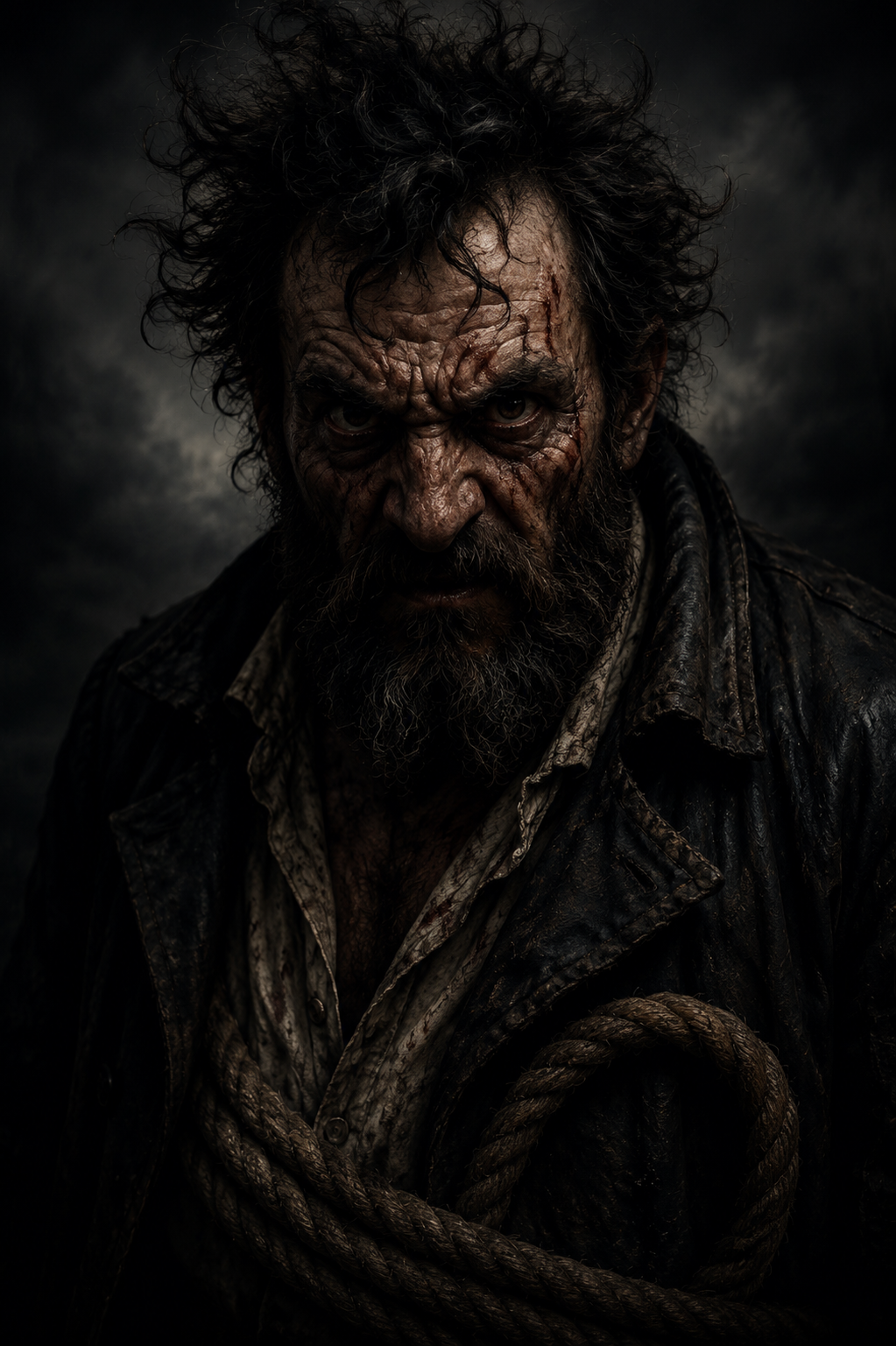
Backstory
THE ROPE: A NARRATIVE BIOGRAPHY OF JONAS MARR
Part I: The Apprenticeship of Silence (1695–1711)
Kingston1 in 1695 smelled of tar, rot, and the sharp mineral stench of men who had nowhere else to go.
Jonas Marr was born above a
Jonas Marr was born above a rope-maker’s shop in Brine Gate Harbor2, where the floorboards transmitted the thump and creak of the work below like a second heartbeat to the rented room where his mother coughed herself to death before he learned to read.
Edward Marr, his father, was the type of dockhand who understood that grief was a luxury, and so he worked longer shifts and came home with calloused hands and the smell of pitch embedded in his skin — a smell his youngest son would never forget, nor ever escape.
The rope-maker’s name was Thomas Pearce. He was missing two fingers on his right hand, and no one who worked for him was foolish enough to ask how.
What mattered was that he could
What mattered was that he could still tie a knot tighter than any man in the harbor, could still judge the weight of cordage by feel alone, and could somehow see something in a nine-year-old boy standing silent in the shop window — something worth teaching.
Jonas spent six years learning that rope was not mere material. In Pearce’s careful hands, it was mathematics, physics, and confession.
The old man taught him tension and weight distribution, how a single strand could hold a falling man, how pressure applied correctly could choke the life from resistance without a whisper.
He would place a length of
He would place a length of hemp in the boy’s small fists and guide them through the motions until Jonas’s hands remembered what his mind had not yet understood: that control lives in the space between too much and too little, that true mastery requires the willingness to break things to understand their breaking point.
By fifteen, Jonas could tie a running bowline in darkness, could splice a line under tension, could read a rope’s history in its fraying — the story written in abraded fibers and weathered knots.
More importantly, he understood something Pearce never spoke aloud but showed through every methodical movement: rope was control. Rope was the difference between hanging and staying, between a ship held fast and a ship lost to chaos.
When Edward Marr was crushed between
When Edward Marr was crushed between cargo bundles in 1710 — the lifting mechanism failing as it had failed countless times before — no inquiry followed. The harbor took what it wanted, and what it wanted was expendable men.
Jonas inherited his father’s worn wool cap, yellowed from years, and the absolute certainty that sentiment was a commodity the living could not afford.
Part II: The Price of Ambition (1711–1725)
That winter, he began shipping out
That winter, he began shipping out. By twenty, Jonas had moved beyond the mathematics of cordage.
He had learned to read a chart by studying the captains who purchased his services, and he had learned to read men by studying how they held themselves when they thought no one was watching. A man’s fear lives in his shoulders. His lies live in his eyes.
His breaking point lives in the small muscles around his mouth — and Jonas had developed a gift for finding it.
His first contract came in spring
His first contract came in spring of 1711. William3 Hughes, a merchant’s agent, had been skimming from the collective take for months. The mathematics were simple. The governance, though loose, was not forgiving.
Jonas went to Hughes’s lodgings at dawn, when the man was alone, and what happened in that room took less than five minutes.
Hughes was strong and struggled, but struggle was something Jonas had learned to understand as a form of language — the body’s confession of its own limits. The rope around the man’s neck was thin and supple, the kind Pearce had kept locked away, and Jonas’s hands remembered every lesson about tension and leverage.
Afterward, he took the rope with
Afterward, he took the rope with him. Not from sentiment, not from trophy hunger, but from practicality — it had been well-made cord, and waste was a habit the poor could not afford.
From that moment forward, Jonas Marr was known as The Rope. The nickname followed him like his own shadow, because it was accurate. He held things together — transactions, discipline, the invisible bonds that kept violence organized enough to have value.
When disputes arose between crews, when debts festered and threatened to crack the fragile collective order, when a man needed to disappear and leave no trace except a message, The Rope’s name circulated in whispers. Other men carried cutlasses and pistols.
Jonas carried lengths of cord coiled
Jonas carried lengths of cord coiled at his waist like a merchant carries ledgers, because a man who understood rope understood the difference between chaos and architecture.
He rose through the ranks not by command — his education was sparse, his intuition unreliable — but by cunning and lore. He could read a contract well enough to spot the thief’s clause hidden in its folds.
He could navigate the politics of divided crews better than most captains, understanding which men would break first, which would hold, which were already broken and simply didn’t know it yet.
In 1712, he made his first
In 1712, he made his first deep-water crossing to Tortuga4, and the voyage marked him as something more than a specialist — he was becoming a necessary man, the kind ships needed when the stakes were measured in blood.
The 1716 keeling off Nassau5 Roads nearly ended him. Mutinous crewmen lashed him to the mainmast and dragged him beneath the hull, a punishment designed to drown slowly or be torn apart by barnacles.
He survived because he had learned, long before, that the body holds more secrets than the mind cares to admit — he held his breath in a way most men cannot, made himself light in the water by going utterly still, and when they hauled him up, his first action was not to gasp but to observe which men had laughed loudest.
He took his time with three
He took his time with three of them. The others understood.
By 1720, when he strangled Captain Voss and seized the Mirabel, Jonas had become indispensable. Voss had been skimming again — the infection recurring like a disease — and the crew looked to Jonas to make it stop.
He took the captain’s cabin without resistance, not because he wanted command but because someone had to. He held the Mirabel for fourteen months, kept her crew fed and her violence directed outward rather than inward, then passed the captaincy to a man with more political gift and better instincts for grand gesture.
By 1725, Jonas Marr was in
By 1725, Jonas Marr was in his thirtieth year, medium-brown skin weathered the color of old oak from sun and salt, his short coiled hair hidden beneath the same yellowed wool cap his father had worn.
He carried rope always — loops of it, thin and strong, wrapped around his torso beneath his shirt so it never showed until it needed to. Men who worked with him understood that The Rope was not a nickname born of humor. It was a description. It was a warning.
It was a promise of what would happen if you tried to break the compact between yourself and the crew, if you tried to take what had not been given, if you chose to be the kind of man the harbor would eventually crush.
He had learned, early and completely
He had learned, early and completely, that the harbor takes what it wants only if you let it. And Jonas Marr had spent his entire life making sure he would not be taken.
Appearance
COMPOSITE HEADSHOT: JONAS MARR (“THE ROPE”)
A Portrait in Repose and Readiness
---
The first thing you notice about
The first thing you notice about Jonas Marr is the economy of his presence. He does not fill a room; he occupies a corner of it with the deliberation of a man who has learned that visibility is often a liability.
In the crew photographs taken aboard Viktor Petrov6’s vessels — grainy as they are, salt-stained and foxed at the margins — he appears always slightly removed from the cluster, his body angled as though calculating distance to an exit. This is not accident.
It is the posture of a man for whom trust is a operational fiction and departure a standing option.
His head is broad across the
His head is broad across the temples, tapering to a jaw that carries the weight of his Kingston origins — medium brown skin, weathered across the cheekbones and bridge of nose to a burnt-umber patina that speaks of decades exposed to Caribbean sun without reprieve.
The weathering is not uniform.
His forehead and the soft skin beneath his eyes retain a slightly darker, less damaged tone, suggesting he spent years with a cap pulled low — a habit that persists into his modern age, where he is more often seen in worn baseball caps or wide-brimmed fishing hats than bareheaded.
The sun damage clusters heaviest across
The sun damage clusters heaviest across his nose and the outer thirds of his face, creating a geography of exposure that reads like a working man’s résumé.
His eyes are set deep, slightly hooded by the accumulation of crow’s feet and the natural downward descent of skin that comes with age and illness.
The irises are a dark brown that absorbs light rather than reflects it — a feature visible even in poor photographic conditions, where his gaze appears almost lightless, almost mineral.
There is no warmth in them
There is no warmth in them, but neither is there the animal vacancy of a sociopath. Instead, they suggest the cold precision of an accountant tallying debits and living flesh in the same ledger. When he meets your gaze, the sensation is akin to being weighed on a scale whose true calibration you will never know.
His hair, when visible beneath his inevitable headwear, is short and tightly coiled, iron-grey now in the 2025 era, but in the earlier photographs (1995–2010) it held darker tones — a charcoal black with threads of silver beginning at the temples around his fifth or sixth decade.
He does not appear to be a man who combs his hair for vanity; the coils sit close to his scalp in a manner suggesting either personal indifference or deliberate maintenance for practicality. The tightness of the curl means debris does not catch easily.
The shortness means no one can
The shortness means no one can grab it in a struggle. These are the choices of a man whose grooming habits encode survival logic.
His nose is broad at the bridge, slightly flattened, bearing a hairline scar along the left septum — visible in close-quarters photographs from the early 2010s — that suggests a break set poorly or left to heal without intervention.
It has not been corrected, which implies either that he wore the disfigurement as deliberate camouflage in his earlier working years, or that vanity has never been a relevant category in his self-assessment.
The nostrils flare slightly, a feature
The nostrils flare slightly, a feature more apparent in profile, giving his face a quality of perpetual inhalation — as though he is always catching a scent in the air, always testing the atmosphere for signals others miss.
His mouth is thin-lipped, and in every photograph spanning three decades, it is closed. He does not smile for the camera.
This is not shyness or hostility; it is the expression of a man whose charm (rated at 7/10, well above baseline) operates through controlled speech and selective disclosure rather than the false bonhomie of the practiced grin.
When he does speak, according to
When he does speak, according to crew accounts across multiple decades, his voice is low-pitched and even, with no inflection that signals doubt or enthusiasm.
He modulates volume downward in social situations, forcing listeners to move closer, to focus harder, to lean in as though eavesdropping on a secret being shared only with them.
It is a confidence trick, executed with the precision he learned from Thomas Pearce sixty years ago: create the appearance of intimacy, and people will believe what they are told.
His hands are the most eloquent
His hands are the most eloquent feature of his physical presence.
In the photographs where they are visible — primarily the maritime archives from 1998–2012 — they appear scarred across the knuckles and palms, with calluses visible even in black-and-white reproduction.
The fingers are long and slightly bowed, not from disease but from decades of tension work, from holding rope under load and pressure. His thumbnails are oddly broad and flat, a characteristic of men who have spent their lives working with cordage and fiber.
In his modern era, particularly in
In his modern era, particularly in the Trust & Safety documentation photographs from 2015–2020, those hands remain visible and unchanged in their essential character: capable, precise, unmarked by age in the way that hands of working men often are — the calluses actually deepening with time, the scars becoming more prominent as surrounding skin loses elasticity.
His build is lean, almost sparse — the body of a man who has never accumulated fat in any decade of his life. This is partly genetic inheritance from his English and Kingston roots, partly the byproduct of a life lived without luxury or ease.
In the early photographs, circa 1995, he appears almost wiry, with minimal mass above or below the collarbone.
By 2013, when the STEMI event
By 2013, when the STEMI event forced medical intervention and documentation, the loss was apparent: the heart attack and subsequent bypass surgery stripped remaining bulk from his frame, leaving him skeletal in the hospital admission photographs.
The recovery photographs from 2014–2015 show a slow reconstitution, but never a return to the lean-muscled appearance of earlier decades. He exists now as a man hollowed by his own survival, carrying less weight with each passing year, as though his body is slowly resigning its membership in the physical world.
His bearing reflects this diminishment, but not in the way illness typically manifests in photographs. He does not slump.
His posture in recent Trust &amp
His posture in recent Trust & Safety board photos (2020–2023) remains upright, his shoulders squared back, his neck extended as though perpetually listening for sounds at the edge of human hearing.
But the effort is visible now in a way it was not before 2013. There is a brittleness to his erectness, a sense that holding himself together requires active management, constant expenditure of will.
This lends him a quality of coiled tension even in repose — the appearance of a man sitting still only through rigorous self-discipline, ready to move at the cost of considerable pain.
His dress has remained consistent across
His dress has remained consistent across five decades: earth tones and layers designed for function rather than presentation. He favors canvas, wool, and linen over synthetic fabrics — materials that age visibly, whose wear patterns tell stories.
His jackets are often brown or charcoal grey, worn soft at the elbows and cuffs.
His shirts, visible in crew photographs, tend toward ochre, rust, and muted amber — colors that do not show blood easily, a practical consideration for a man whose modern role as Investigator and Trust & Safety Officer masks a far older skillset.
The rope — the actual length
The rope — the actual length of cord that earned him his epithet — is no longer visible in recent photographs, but the garrote he carries in the modern era serves the same purpose it always has: it is kept within reach, wrapped around his waist or coiled in an inside pocket, a tool of control that has seen more use than his official resume acknowledges.
In all photographs spanning 1995 to 2025, there is an absence of softness. This is a face that has never betrayed uncertainty to the camera, never allowed the photographer to capture anything resembling vulnerability or humor.
He is a man photographed as he truly exists: functional, precise, dangerous — the kind of individual you would not want to encounter in a locked space with a door you could not reach, because his cunning (9/10) is so thoroughly embedded in his movements that you would not recognize the threat until the moment of contact, and by then, his knowledge of pressure and leverage, inherited from Pearce and refined across three centuries of violence, would already be closing the distance that might have allowed your escape.
Identity
- Gender
- Male
- Nationality
- English
- Origin
- England
- Bounty
- 17000
Frestagon Profile
Compiled by Dr. Frestagon from observation rather than testimony. Scores out of ten; the commentary is his own.
- Cunning (9) — at the ceiling. Assume premeditation.
- Lore (8) — formidable; rarely caught improvising.
- Charm (7) — serviceable, and aware of its limits.
- Strategy (6) — serviceable, and aware of its limits.
- Navigation (5) — middling; compensated for elsewhere.
- Command (4) — middling; compensated for elsewhere.
- Education (2) — a documented weakness. Exploit with care.
- Intuition (1) — a documented weakness. Exploit with care.
- Empathy (1) — a documented weakness. Exploit with care.
Filed under seal. The subject has not seen this assessment.
Saltwell Profile
Leadership, as the Admiral's office measures it.
Blackwater Profile
Intelligence and tradecraft, by Blackwater reckoning.
Tidecrest Profile
A woman's appraisal — of a woman as she is, or of a man as he believes himself to be.