Lucia Moretti
- Ship
- Cloud Dancer Captain
- Position
- feather mistress
- Born
- 1632 · Napoli
- Faction
- Gunwale Court
- Territory
- Brine Gate Harbor
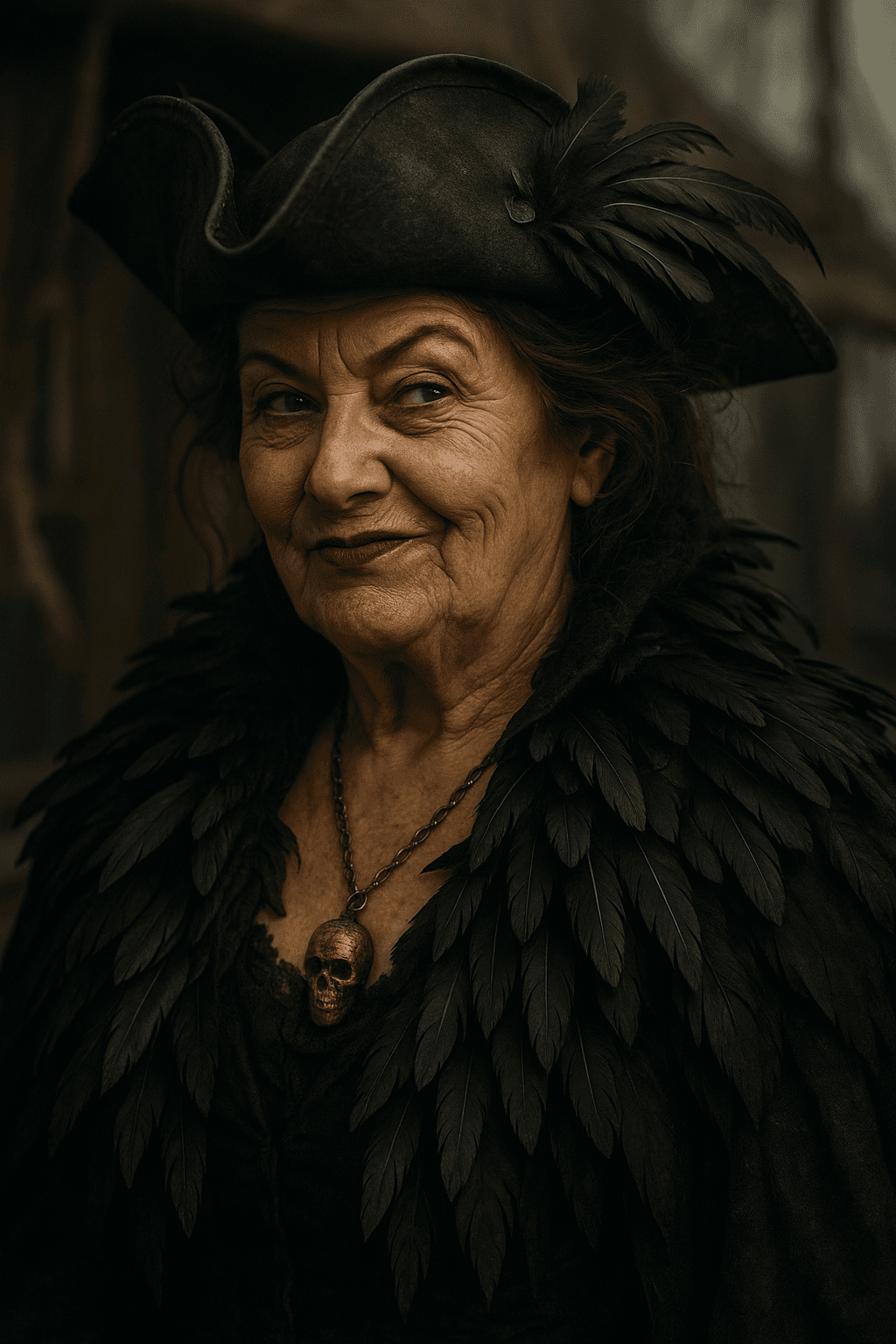
Backstory
LUCIA MORETTI: THE WIDOW’S LEDGER
A Chronicle of the Gunwale Court1
There is a widow in Naples who outlived three husbands and a dozen men foolish enough to cross her.
The townspeople call her Widow Feather
The townspeople call her Widow Feather — not for any softness in her nature, but for the way she collected plumage from the hats of the dead, threading them into the lace of her mourning cap like a magpie builds its nest from glitter and bone.
Each feather marked a conquest, a deal closed, a man removed from the equation. She wore them without vanity, the way a ledger wears its entries: factual, accumulated, damning.
Lucia Moretti came into the world olive-skinned and hungry, daughter of a Neapolitan merchant with more ambition than capital.
By sixteen, she had married the
By sixteen, she had married the first husband — a customs official twice her age whose connections proved more valuable than his company. When he died conveniently of apoplexy, she inherited his ledgers and his enemies’ fear of her competence.
That hat — a captain’s tricorn with a egret feather still crisp from the markets — went into the widow’s cap.
The second marriage came by necessity rather than choice. A Portuguese trader with sugar contracts in the Caribbean and debts that threatened to swallow both.
Lucia bore him no children, but
Lucia bore him no children, but she bore his entire network of contacts across the Atlantic — and when he drank himself into the grave within four years, she kept what he had failed to protect. The feather she took was from a ship’s great helm, tawny and resilient. It held its shape longest.
It was Marco Conti2 who saw what she truly was. An old corsair-turned-vintner, he recognized in Lucia the same hunger that had driven him across the Barbary Coast in his youth.
He was not a lover, though she took him as one for three seasons while she learned the language of the brethren, the mathematics of prize-distribution, the art of reading men’s fears like charts.
Marco taught her that the sea
Marco taught her that the sea was not a place of adventure but of accounts — every ship a debit, every crew a liability, every coastline a margin where fortunes were calculated and seized.
When he finally drowned off Corsica (drunk, she suspected, though she mourned him genuinely), no feather came from that loss. Some debts were paid in grief.
The third husband was a mistake she made in her thirties — a Scottish merchant-raider with genuine affection for her and terrible judgment about everything else.
She loved him more than the
She loved him more than the others, which is precisely why his death during a fever in Port Royal3 felt like punishment. That feather — glossy black, almost blue in the light, from a raven he kept aboard — she added to the cap with trembling fingers. The townspeople noticed. They began to whisper.
By then, Lucia had already begun her real work. The Velvet Coffin4 came to her through a combination of salvage rights, blackmail, and a loan from Vargo Knell5 that was paid back precisely on time in Portuguese gold.
She captained her first voyage at forty-two, her face already creased like old parchment, her hands already scarred from the actual work. She did not stay in her cabin while men risked their lives.
She helped hauld rope, read the
She helped hauld rope, read the compass herself, understood ballast and water-spoilage and the peculiar arithmetic of who could be trusted with a cutlass and who would panic when blood ran actual-warm on the deck.
Maeve Campbell6 recognized a sister when they met in Tortuga7 in 1708. The Irish widow-captain saw past the mourning black to the iron underneath.
From that meeting came Lucia’s rise through the Gunwale Court — not through seduction or inheritance, but through proving herself capable of managing the logistics of piracy itself.
She became their Managing Editor, the
She became their Managing Editor, the woman who kept the accounts straight, who knew which captains were drinking too much, which crews were restless, which ships needed careening before they became tombs.
The witch-marks came later, whispered by superstitious crews. She never lost a ship to storm in her first twelve years captaining. She never miscalculated a tide.
When crews fell sick, she administered remedies from her cabin — dried herbs, calcined bone, the lore Marco had taught her — and most of them lived. There was nothing supernatural in it, only observation, discipline, and the luck that always follows the competent.
Obadiah Crumm learned this last lesson
Obadiah Crumm8 learned this last lesson poorly.
Lucia Moretti is neither villain nor hero, though she wears both reputations like the feathers in her cap — useful fictions that keep lesser men at a useful distance.
What she is, simply, is a woman who understood that the Caribbean could be read like a ledger if you had the nerve to stand at the helm and tally the costs yourself.
Her former lover Varro Kane learned
Her former lover Varro Kane9 learned that truth when she ended their arrangement without passion or explanation, simply because continuing it would have been inefficient.
The Velvet Coffin still sails. The widow’s cap still gathers feathers. And in the Gunwale Court, when a matter requires accounting, they send for Lucia Moretti.
Appearance
Cordelia Marsh wears a widow's cap of black lace, perpetually mourning the three husbands whose deaths funded her empire. Her face is weathered beauty: strong bones beneath wrinkled skin, eyes the grey-green of marsh water.
White hair pinned up under the cap with whalebone pins, not a strand out of place. She maintains the grooming of a proper widow: scrubbed clean, powder carefully applied, black dress immaculate.
But her hands betray her: scarred, strong, the hands of a woman who's hauled salvage from wrecks herself. Her bearing is matriarchal authority, the presence of someone whose word drowns dissent.
Identity
- Born
- 1632
- Gender
- Female
- Nationality
- Italian
- Origin
- Napoli
- Ship · 1725
- Cloud Dancer
- Berth
- Captain
- Bounty
- 59000
Frestagon Profile
Compiled by Dr. Frestagon from observation rather than testimony. Scores out of ten; the commentary is his own.
- Cunning (10) — at the ceiling. Assume premeditation.
- Strategy (10) — at the ceiling. Assume premeditation.
- Command (10) — at the ceiling. Assume premeditation.
- Lore (9) — at the ceiling. Assume premeditation.
- Navigation (9) — at the ceiling. Assume premeditation.
- Intuition (8) — formidable; rarely caught improvising.
- Charm (7) — serviceable, and aware of its limits.
- Education (6) — serviceable, and aware of its limits.
Filed under seal. The subject has not seen this assessment, which is for the best.
Saltwell Profile
Leadership, as the Admiral's office measures it.
Blackwater Profile
Intelligence and tradecraft, by Blackwater reckoning.
Tidecrest Profile
A woman's appraisal — of a woman as she is, or of a man as he believes himself to be.