Jiro Tamaki
- Ship
- Smoke & Mirror Captain
- Position
- Captain
- Born
- 1689 · Bideford
- Faction
- Harbor Wolves
Backstory
Jiro Tamaki emerged from the tide-marked streets of Boston Harbor as a young man carrying nothing but a translator's credential and three years of meticulous apprenticeship burned into his bones.
What distinguished him from the transient dockworkers and ambitious merchants who churned through those wharves was not physical prowess or cunning deceit, but rather something far more dangerous: the capacity to perceive the actual machinery beneath surface chaos.
Where English customs brokers conducted their business in willful incomprehension—measuring cargo in conflicting standards, allowing precision to hemorrhage through redundant notation—Jiro began his quiet work of translation. Not of languages, but of systems.
His journal filled with equivalencies, wit
His journal filled with equivalencies, with the notation of which measurements aligned across which ports, with the patient mapping of inefficiency.
Within three years, harbor masters consulted him to dissolve disputes that official procedure could not resolve. He had made himself indispensable not through force or charisma, but through rendering legible what others preferred to leave opaque.
The Harbor Wolves1 recognized his utility when a supply broker died intestate, leaving their provisioning network to collapse into desperate improvisation. Jiro was approached with functional directness, and he accepted without performance or negotiation.
What followed was not dramatic restructuri
What followed was not dramatic restructuring but systematic reconstruction—the patient identification of which dockworkers possessed access to which resources at which hours, the tracing of actual supply bottlenecks rather than theoretical ones, the deliberate installation of redundancies into an architecture designed not for conquest but for continuance.
He claimed no captaincy, demanded no rank, and continued his other work unchanged. This refusal to perform ambition proved more consolidating than any officer's bluster.
He had made himself not the face of the organization but its nervous system—the mechanism through which survival actually occurred. The Crown's warrant, when it arrived at Boston in the spring of 1792, bore no romantic accusation of piracy or sedition.
It documented instead what Jiro had
It documented instead what Jiro had accomplished with surgical precision: the construction of a provisioning network that sustained operations explicitly antagonistic to English commercial monopolies, functioning through no flag and no captain's name, but through the unglamorous architecture of systematic supply.
He read the parchment with the same absence of ceremony he applied to all things, noted the accuracy of their particulars, and acknowledged the necessary consequence: he could move openly through English ports no longer.
The warrant had rendered him optical, had given him the one thing he had carefully avoided—visibility. Yet even in this, his response remained characteristically systemized.
He had already begun transferring his
He had already begun transferring his essential documentation to trusted contacts, already begun reconstructing the network's architecture to function independently of any single location.
Survival, he had learned years ago, was itself a system that could be rendered legible to those patient enough to study its actual mechanics.
Appearance
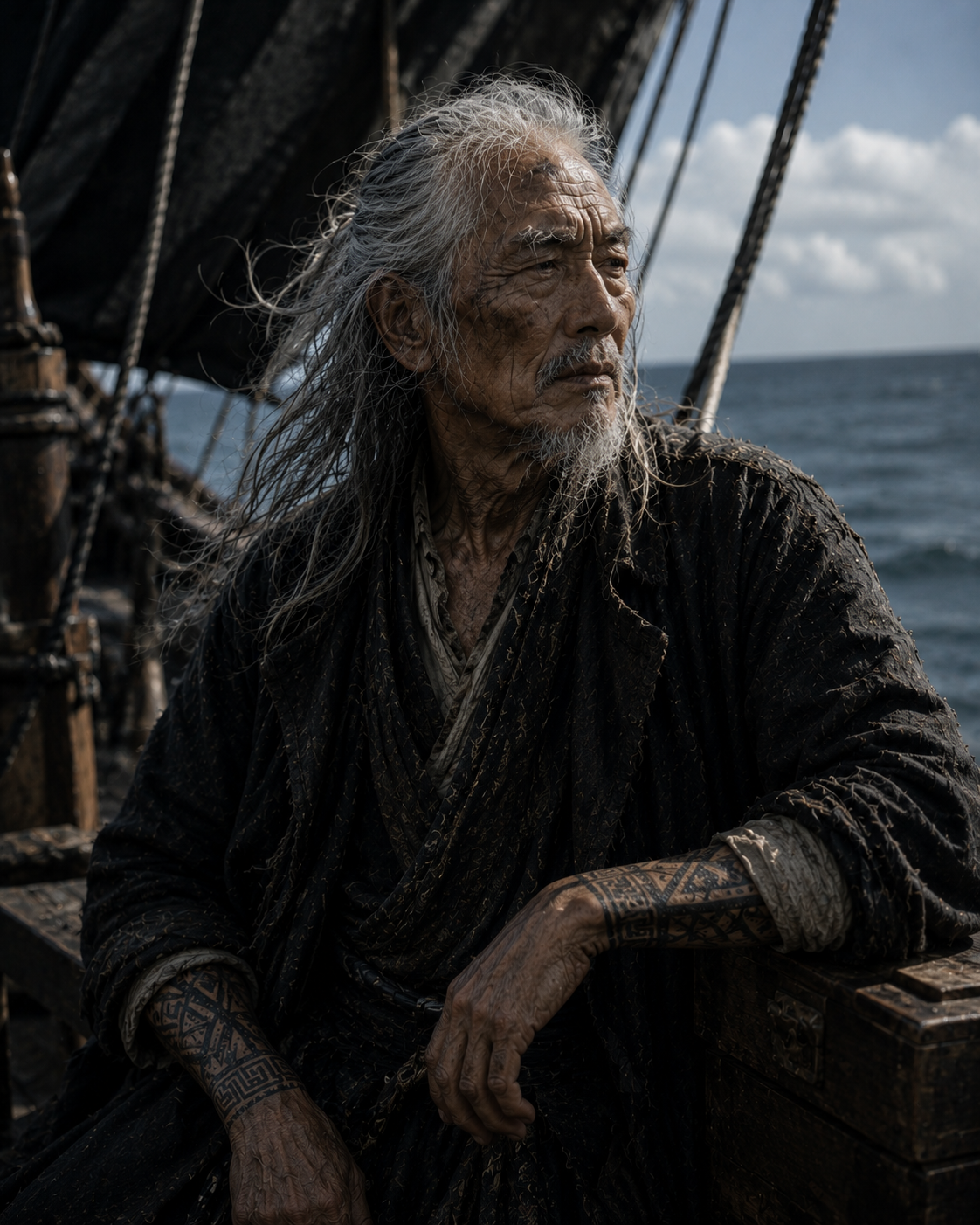
Jiro Tamaki is lean to the point of austerity: narrow shoulders beneath layered dark indigo garments, weathered travel coat hanging straight from a wiry frame built through repetition rather than deliberate conditioning.
His posture is economical and precisely balanced, every movement measured to avoid announcing intention.
His raven-black hair hangs past his collar in uneven strands tied loosely with frayed linen cord rather than ornament, and his face is carved in sharp planes—high cheekbones, narrow jaw, pale olive skin weathered by salt air and sleepless travel.
His dark eyes move constantly, absorbing
His dark eyes move constantly, absorbing information with an almost mathematical attentiveness that never quite announces itself as surveillance.
The missing third finger on his left hand is immediately visible—not dramatized, simply fact—and his compensated grip suggests years of unconscious adaptation.
His forearms carry intricate merchant-house tattoos: dense black geometric linework wrapping the arms in layered angular patterns resembling coded trade marks, navigational abstractions, and port sigils that disappear beneath fabric, hinting at a larger hidden system extending across shoulders and chest.
Identity
- Born
- 1689
- Nationality
- English
- Origin
- Bideford
- Ship · 1725
- Smoke & Mirror
- Berth
- Captain
Saltwell Profile
Leadership, as the Admiral's office measures it.
Blackwater Profile
Intelligence and tradecraft, by Blackwater reckoning.
Tidecrest Profile
A woman's appraisal — of a woman as she is, or of a man as he believes himself to be.