Audra Croft
- Ship
- Oxford Crew
- Position
- Crew
- Faction
- Chimney Sweep Union
- Territory
- Thieves' Market
Backstory
THE LEDGER OF AUDRA CROFT A Narrative Biography
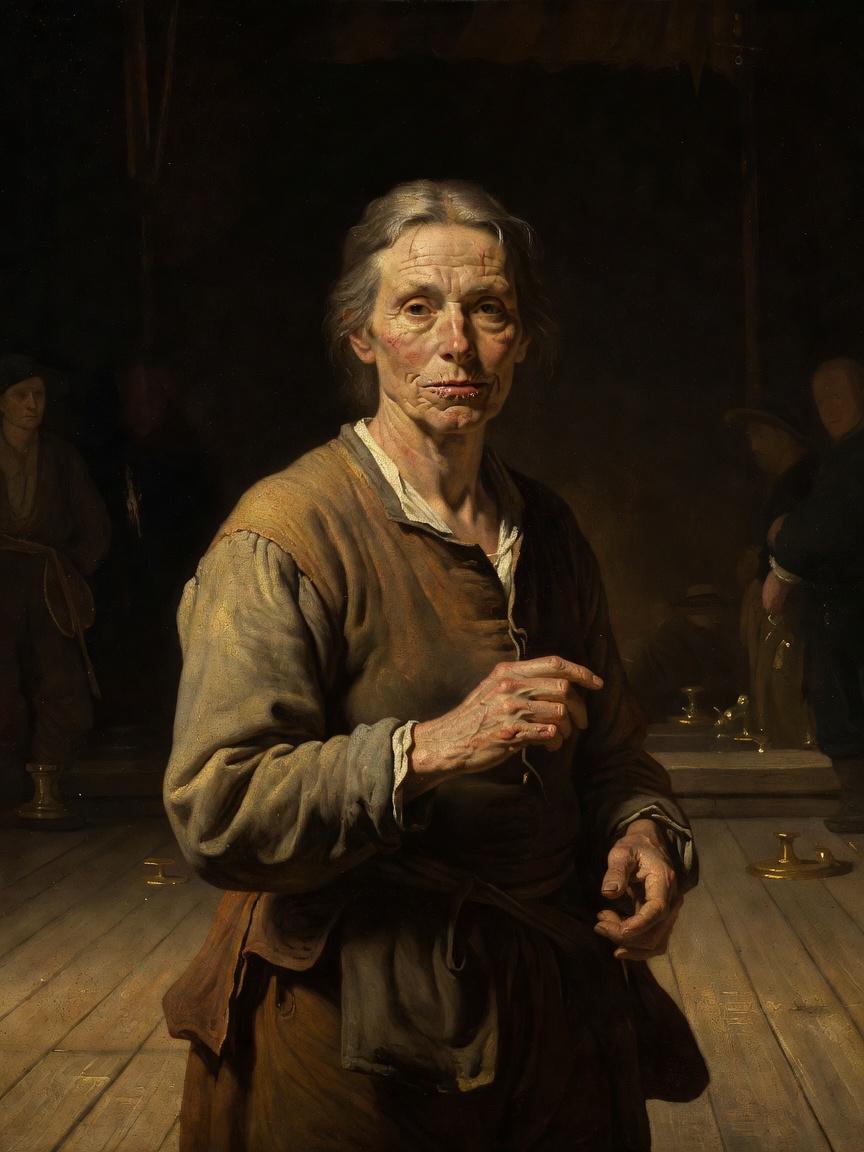
The woman the Oxford1’s crew calls Bramble kept her father’s merchant scales for thirty years after his death.
They hung in her cabin aboard the Spanish sloop María Concepción2, wrapped in oilcloth, their brass pans still bearing the ghost-weight of Genoese silks and Portuguese wine.
Audra had learned their language as
Audra had learned their language as a girl in Galicia — not from books, but from her father’s calloused hands as he taught her the grammar of profit and loss. The scales never lied. Men lied constantly. Gold lied. Promises lied.
But a proper balance beam, weighted and hung true, rendered judgment that a magistrate could only envy.
She was born in 1675, the only child of a merchant named Rodrigo Croft who had married into the English trading houses through his mother’s bloodline and made himself useful enough to the Spanish port authorities that they permitted his ships to dock at Cádiz without excessive scrutiny.
Audra grew up in the smell
Audra grew up in the smell of tar and cinnamon, learning to read the water’s color at dawn, to recognize a ship by the cut of her sails at three miles’ distance, to calculate the profit margin on a hogshead of Canary wine against the risk of piracy in the Strait.
Her father treated her as he might have treated a son — which is to say he taught her nothing by rote, but instead placed her at the ledger desk at age ten and let her watch, year after year, until the arithmetic of trade became as natural to her breathing as the rise and fall of her own ribs.
When Rodrigo Croft drowned in 1697 — a gangrenous wound from a fish-hook gone septic, a week of fever in a Genoa warehouse — his daughter was twenty-two and already more merchant than woman in the eyes of the Genoese counting houses.
She inherited his connections, his reputat
She inherited his connections, his reputation for fair dealing, and precisely enough capital to establish herself as a factor in her own right.
For five years, Audra moved goods between Genoa and the New World colonies with such practiced efficiency that merchants from Bristol to Barcelona requested her services by name. She accepted only cargoes she could inspect with her own hands.
She kept her own accounts. She never extended credit beyond what her reserve could absorb if the debtor defaulted. The scales balanced. Always, the scales balanced.
But profit built slowly when one
But profit built slowly when one obeyed the customs houses and respected the crown’s tariffs.
She was thirty years old and had accumulated enough to maintain her independence but not enough to accumulate power — the distinction that separates the comfortable merchant from the merchant who commands other men’s labor.
She began to ask herself, during the long watch-nights aboard chartered vessels, why honest commerce should yield only honest margins when the Spanish plate fleets, laden with silver from the American mines, moved along predictable routes guarded by aging galleons and elderly captains.
The transition, when it came, arrived
The transition, when it came, arrived not as a moral rupture but as a simple business decision. In 1705, off the coast of Hispaniola, she chartered a sloop and hired a crew of twelve men who had grown surplus to legitimate employment.
They took a Spanish merchantman carrying contraband sugar — sugar that bore no registration because the shipper had already bribed the Cadiz authorities and pocketed the tariff.
Audra sold the sugar in Boston at a profit of forty percent and realized, with the clarity of a woman watching numbers arrange themselves into new patterns, that the risk had been negligible and the reward immediate.
The scales had simply tilted toward
The scales had simply tilted toward a different kind of honesty: honesty to herself about what she wanted, and what the world would permit her to take.
By 1710, Audra Croft commanded her own vessel.
By 1715, she had taken enough Spanish prizes to establish credit in Port Royal3 and New Providence, where the lines between merchant and pirate had worn so thin they were barely visible except to magistrates whose palms remained un-greased.
She did not, in those years
She did not, in those years, kill men for their resistance. She killed men who forced her to — who reached for swords, who chose honor over arithmetic.
The others she released to carry word of Bramble’s reputation: a captain who paid fairly, who did not rut her female captives, whose crew did not die of scurvy or starvation, and whose prices for captured goods were calculated with the precision of a woman who still thought in terms of ledgers and fair exchange.
The nickname came later, bestowed by her crew without her knowledge or consent.
She learned it one morning in
She learned it one morning in New Providence when she heard a cabin boy spit the word at another urchin — Bramble, aye, thorny as a bramble thicket and just as quick to catch ye if ye brush her wrong. She did not correct them. Bramble was accurate.
She was indeed thorned, difficult to approach without drawing blood, quick to strike back when her boundaries were crossed.
And like a bramble thicket, she was also useful — her crew prospered in her shadow, grew fat on her prizes, gained the kind of practical confidence that comes from serving a captain who did not waste lives on vanity.
Richard Carleton recruited her in 1718
Richard Carleton4 recruited her in 1718.
The Black Admiral was assembling his flotilla against the merchant convoys of the West Indian trade, and he recognized in Audra Croft a mind that could map logistics without descending into the theatrical posturing that so often accompanied command among his peers.
She served him as she had served her father’s scales — not from affection, but from the practical knowledge that a rising tide lifted the best vessels, and the Black Admiral’s ambitions were grand enough to accommodate both of them.
Under his colors, she took prizes
Under his colors, she took prizes worth more than she had accumulated in all her previous years of independent predation. The profit was extraordinary. The moral cost, by then, had ceased to be measurable in anything but blood and blown-out powder smoke.
She remained with Carleton’s crew aboard the Oxford until the end of the golden age, that brief season when the brethren of the coast seemed poised to dismantle the Atlantic trade itself. She was too cunning to believe it would last.
Men like Carleton believed they were invincible; Audra had always understood that invincibility was a currency that inflated until it became worthless. She had begun, by 1720, to move her accumulated silver into London5 banks through intermediaries she trusted.
If the age would not endure
If the age would not endure — and she knew with the certainty of a woman who had always read the water correctly that it would not — then she would endure beyond it.
The scales had taught her that much, at least. Always keep the weight properly distributed. Always know the true price of every thing. And above all, understand that the ledger that mattered most was not the one that recorded profit and loss, but the one that counted the days remaining before the tide turned.
She was fifty-three years old when the courts finally closed around her world.
The law’s amnesty, when it came
The law’s amnesty, when it came, found her already vanished into the spaces where pirates become invisible — names retired, faces forgotten, fortunes carefully distributed through hands unlikely to betray her. Bramble had learned to disappear the way she had learned to balance scales: young, methodically, and well.
Identity
- Gender
- Female
- Nationality
- English
- Origin
- England
- Ship · 1725
- Oxford
- Berth
- Crew
- Bounty
- 18690
Frestagon Profile
Compiled by Dr. Frestagon from observation rather than testimony. Scores out of ten; the commentary is his own.
- Cunning (8) — formidable; rarely caught improvising.
- Strategy (8) — formidable; rarely caught improvising.
- Command (7) — serviceable, and aware of its limits.
- Lore (6) — serviceable, and aware of its limits.
- Charm (4) — middling; compensated for elsewhere.
- Education (4) — middling; compensated for elsewhere.
- Intuition (4) — middling; compensated for elsewhere.
- Navigation (3) — a documented weakness. Exploit with care.
- Empathy (3) — a documented weakness. Exploit with care.
Filed under seal. The subject has not seen this assessment, which is for the best.
Saltwell Profile
Leadership, as the Admiral's office measures it.
Blackwater Profile
Intelligence and tradecraft, by Blackwater reckoning.
Tidecrest Profile
A woman's appraisal — of a woman as she is, or of a man as he believes himself to be.