Richard Carleton
- Ship
- HMS Royal James Captain
- Position
- Admiral at Large (independent commission; the harbor's standing warrant names him an outlaw, but he sails on the title he stripped from his own discharge papers). Founder and leader of the Lent-Hand Brotherhood. Architect of the Tarbridge skim (1840-1843). Standing enemy of Brine Gate Harbor.
- Born
- 1600 · Memel (Klaipėda)
- Faction
- Tribunal
- Territory
- Brine Gate Harbor

 Portrait
Silhouette portrait of Richard Carleton, a figure associated
Portrait
Silhouette portrait of Richard Carleton, a figure associated
 Portrait
 of Richard Carleton, a pirate captain of the Caribb
Portrait
Portrait of Richard Carleton, a pirate captain of the Caribb
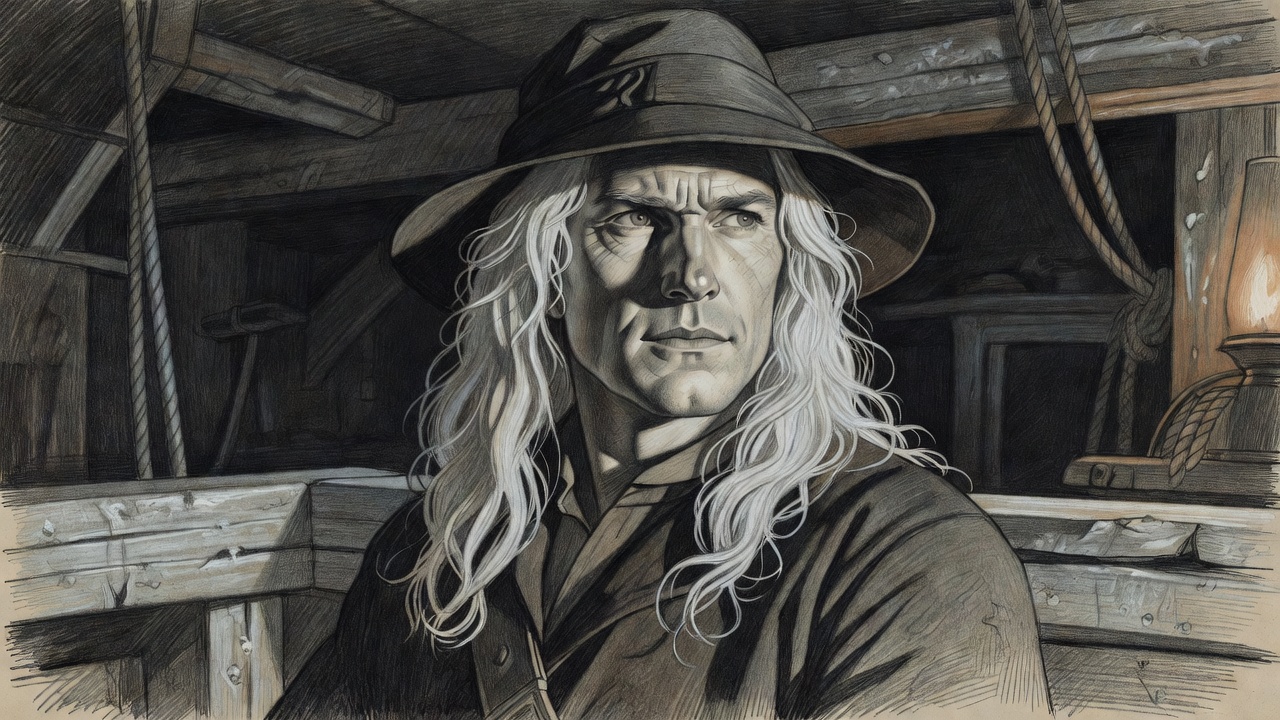 Portrait
 of Richard Carleton, a figure from the Golden Age o
Portrait
Portrait of Richard Carleton, a figure from the Golden Age o
 Portrait
Fictional portrait of Richard Carleton, a figure from Brine
Portrait
Fictional portrait of Richard Carleton, a figure from Brine
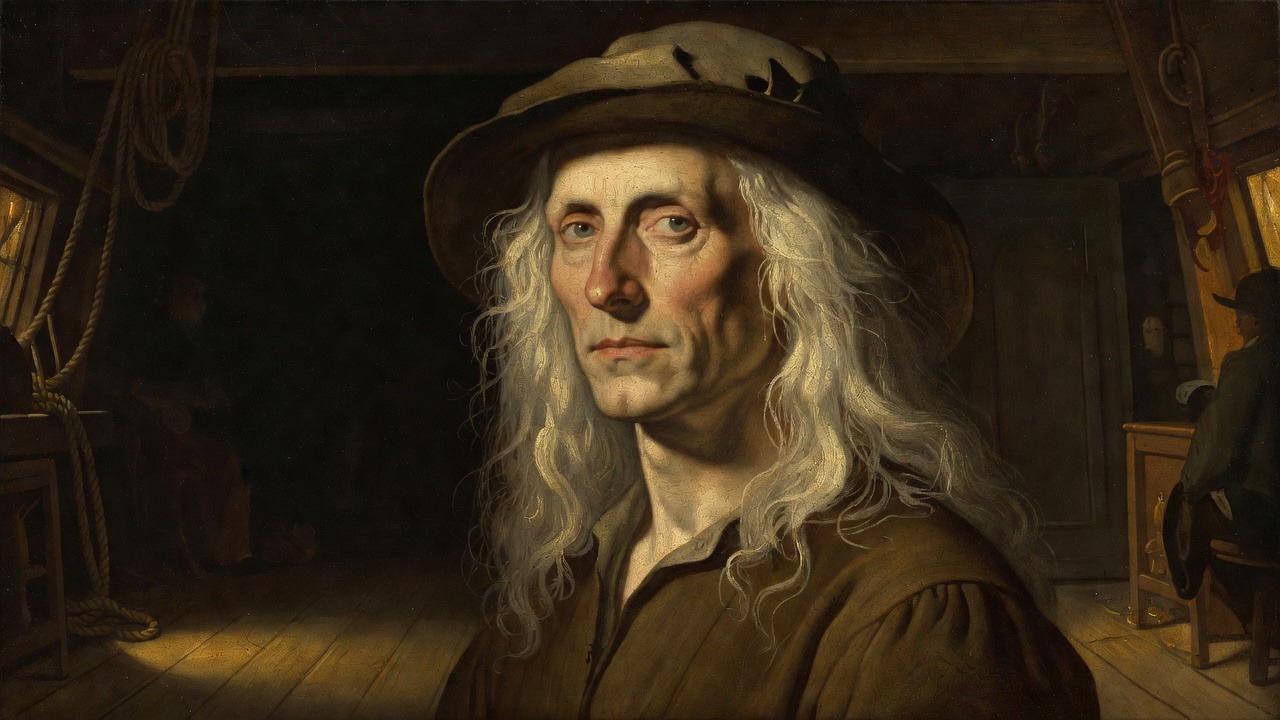 Portrait
 of Richard Carleton, a figure associated with Carib
Portrait
Portrait of Richard Carleton, a figure associated with Carib
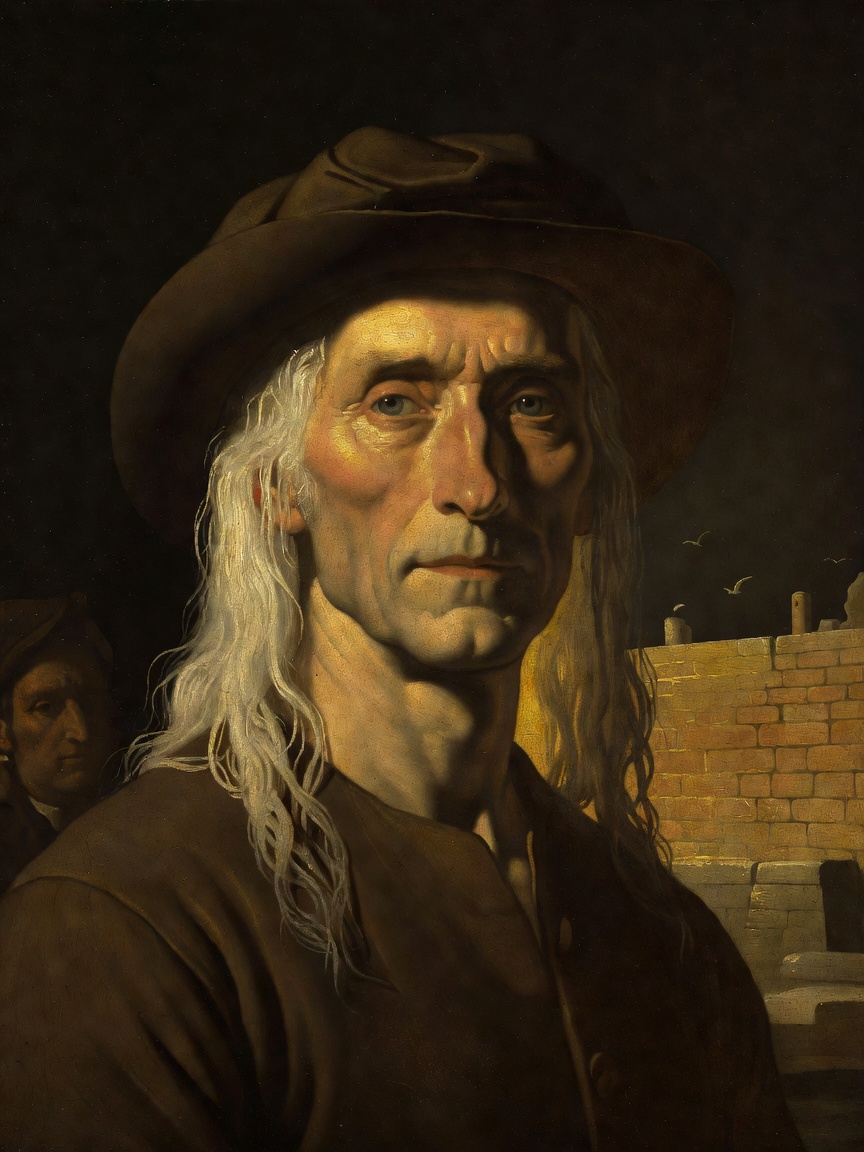 Portrait
 of Richard Carleton, an early 18th-century pirate l
Portrait
Portrait of Richard Carleton, an early 18th-century pirate l
Backstory
THE BLACK ADMIRAL: A CHRONICLE OF CALCULATION AND RECKONING
Part One: The Ledger’s Son
Memel in the winter of 1600 was a town that understood the mathematics of survival. The Curonian Lagoon froze thick enough to carry ox-carts, and the forests beyond the city walls held the kind of hunger that made men careful with their arithmetic.
Richard Carleton’s mother, Katarzyna Szpon
Richard Carleton’s mother, Katarzyna Szpon, came from those forests — from the pine-dark country where people measured wealth not in coin but in rendered fat and preserved meat and the number of winters a child could survive without the bloody flux.
His father, Thomas Carleton, was English — a Bristol merchant’s son who had drifted east into the Baltic trade and discovered, in the bone-rendering yards of Memel, a clarity that English commerce lacked. There was no pretense here.
Men were priced to their function. The tallow-workers knew the exact worth of their hands. The dock supervisors calculated their silence in shillings. The magistrate’s blind eye had a fixed cost, paid monthly, without sentiment or negotiation.
Thomas took this lesson into his
Thomas took this lesson into his counting house and raised his son within it like a child raised in a temple learns the liturgy without thinking. By the time Richard was seven, he could read a ledger entry the way other children read nursery rhymes.
By eleven, he understood that the world operated according to a single, unforgiving principle: a man’s value was determined by what he knew that others did not, and what he could conceal about what he knew.
The boy was pale — ashen, as if the Baltic winter had leached the warmth from his blood before birth. His hair, which would eventually silver into that distinctive white tangled mass, held then only the faint blonde of driftwood.
But his eyes — his eyes
But his eyes — his eyes were the colour of slate in storm, and they missed nothing.
When his father’s second wife, Maria Kowalski, was negotiating her bride-price, young Richard had already calculated that she would cost forty pounds annually and that this sum represented precisely the amount required to keep her complaint-silent and precisely insufficient to permit her escape.
He was not wrong.
The years between his thirteenth and
The years between his thirteenth and twenty-second were the years of his education in the true ledger — not the one his father kept for the guild, but the one that existed in the architecture of memory and mathematics.
He learned that the dock supervisor at Memel’s main quay was taking a percentage from every ship’s cordage order; that this was known to the harbor master; that the harbor master was paid, in turn, not to notice; and that the entire arrangement netted approximately eight percent more profit than it would have cost to prevent the theft.
This was not corruption. It was efficiency. It was the way the world actually worked when you looked at it without sentiment.
When Thomas Carleton died in 1622
When Thomas Carleton died in 1622 — the pox, swift and final — Richard inherited not just the counting house but the understanding that underpinned it. For two years he operated it with his father’s austere precision.
Then, in 1624, at the age of twenty-four, he made a calculation that changed the architecture of his life.
Part Two: The Theft and the Breaking
The Royal Navy was recruiting. Not
The Royal Navy was recruiting. Not press-gangs — voluntary commissions for men with education and connections. Richard possessed both. He also possessed something rarer: the capacity to read mathematics the way most men read maps.
He entered the Navy in 1625 as a master’s mate and rose with the precision of a man climbing a ladder he had already measured and counted.
By 1665, he held the rank of Captain. His innovations in harbor fortification had saved the Navy Board thousands in unnecessary construction. His calculations for supply routes had eliminated wastage across three stations.
He kept three ledgers, as his
He kept three ledgers, as his father had: the official record, the private accounting, and the memory-ledger where the true prices lived.
Then came Captain Thomas Merridew.
Merridew commanded Portsmouth station — a man of sixty years, red-faced, whose rank had been purchased with family connections rather than earned through merit.
When Richard presented his masterwork —
When Richard presented his masterwork — eighteen months of night calculations on the geometry of gun placements, field angles cross-referenced with tide tables and supply routes — Merridew listened with the expression of a man watching cards he did not understand.
At the end, he poured two glasses of port and smiled with great deliberation.
“Thorough work, Carleton. Most thorough. I shall present this to the Board.”
Six weeks later, the Navy Board
Six weeks later, the Navy Board awarded Captain Merridew a substantial patent and fifty pounds for innovations in harbor fortification.
Richard learned of it from a clerk not yet eighteen, apologetic, believing he was delivering welcome news.
The rage that came was immediate and total — a white-hot sensation that lived for precisely forty-eight hours before calcifying into something far more useful. The rage died. What remained was an entry in the iron ledger: seven names, written in invisible ink.
Merridew. Three Board members. Two others
Merridew. Three Board members. Two others who had smiled while his work was consumed. And one more — the dock supervisor who had facilitated the theft of Crown supply lists to the French.
The debt needed collecting. Not in coin. The Navy understood that language, and it had already spoken its answer to him.
The debt needed collecting in the only currency that would purchase what he required: leverage, anonymity, and the knowledge that every man he appointed to his reckoning would understand, at the moment of understanding, exactly why.
On the night of March 10th
On the night of March 10th, 1667, Richard Carleton walked away from the Navy, away from the geometry of promotion that had been designed to reward every man except him. He went to Plymouth.
He withdrew thirty pieces of silver from the family account — his inheritance, his half-brother Edmund not bothering to question the transaction. He found the Silent Pursuit at anchor, a brigantine with adequate armament and a crew too drunk to notice the addition of a precise, white-haired man in a grey-brown coat.
The dock supervisor, Hartley, took the bribe without meeting his eyes. Mathematics required no conversation.
By dawn, Richard Carleton and seven
By dawn, Richard Carleton and seven men were beyond sight of land, flying no colors.
Part Three: The Witch’s Arithmetic
What followed was not piracy in the theatrical sense. The Black Admiral — as the crew would come to call him, not from any theatrical darkness but from the particular absence of mercy in his face — did not raid vessels for ransom or spectacle.
He collected debts. Each man named
He collected debts. Each man named in the ledger received, in turn, a visit that was precisely calculated to teach him the cost of theft. Merridew’s ship was taken.
The Board members’ warehouses burned — not with the chaos of fire, but with the cold precision of calculated arson that destroyed records but spared lives. The dock supervisors and the others found themselves marked, hunted, their names whispered in quarters where such names meant ruin.
The violence, when it came, was never theatrical. It was the violence of a man who understood that cruelty without purpose was waste, but cruelty as instruction — as the settling of an account — possessed a terrible clarity.
Richard Carleton broke men the way
Richard Carleton broke men the way his father had priced them: according to their precise utility and their understanding of what they were worth.
By 1670, the Black Admiral was no longer a name whispered in fear. He was a fact, written into the ledgers of the Brethren of the Coast1.
His crew grew not through press or promise but through the recognition that here was a captain who understood the mathematics of command — who knew that loyalty had a price, and paid it; that violence had a purpose, and executed it without waste.
The ancient witch from Memel, spell-binder
The ancient witch from Memel, spell-binder and accountant, had opened the iron ledger. And for the next fifty-eight years, until his death in 1725, he would keep careful account of every man who believed himself outside the arithmetic of consequence.
The ledger, once opened, was never closed.
THE BLACK ADMIRAL: MEMEL, 1600
The Sealing
The Sealing
The Baltic wind that came off the Curonian Lagoon in winter carried the smell of rendered bone and old blood — the price of Memel’s prosperity.
Richard Carleton’s mother, Katarzyna Szpon, had come from inland, from the pine forests where the air held only the resin-dark smell of living things.
The smell of the town’s tanneries
The smell of the town’s tanneries and whalebone works had made her sick for three years, until sickness became simply the texture of her days, no more remarkable than hunger or cold.
She died giving birth to Richard in the winter of 1600, when the lagoon froze solid enough to walk upon, and the town’s fishermen abandoned their boats to hunt seal beneath the ice.
His father, Thomas Carleton — English, for all his years in the Baltic trade — had come to Memel not from patriotic service but from the simple truth that the town’s accounting was as loose as its moral fiber.
A man with the right ledgers
A man with the right ledgers and the right bribes could become wealthy in a place where the Polish crown was distant, the Teutonic Knights were memories, and the merchants’ guild had more interest in cargo than in conscience.
Thomas had not mourned. The boy was healthy, fair-haired, clear-eyed — a commercial asset. The mother had served her biological purpose and expired on schedule. Thomas engaged a Baltic woman named Marija to wet-nurse the child and returned to his ledgers, where the real work of building a fortune was accomplished.
Richard’s earliest memories were not of a mother’s face but of the ledger room — a chamber above his father’s warehouse where the Baltic winter light came thin and blue through the casement, and the smell of whale oil and ink competed with the sharper reek of the lagoon at low tide.
He was perhaps four years old
He was perhaps four years old when Thomas first set him upon a stool beside the great oak desk and placed a stylus in his hand.
“Numbers are the only honest language,” Thomas said, and these words would echo through every decision the boy would make, every calculation he would perform, every accounting of human worth he would commit to the iron architecture of his mind. “They do not lie.
They do not forgive. They do not change according to the mood of men. A man who understands numbers understands the true nature of the world.”
The boy had nodded, though he
The boy had nodded, though he understood nothing but the weight of the stylus and the vastness of the figures before him, marks that seemed to float on the vellum like ships on water.
By age seven, Richard had begun to truly see. The warehouse below the ledger room was not, as he had initially believed, a place of honest trade. It was a sorting mechanism.
Goods came in bearing one price — a price established by the merchants who sold them to Thomas, men who did not know the Danzig market, who did not know that Russian furs were becoming scarce, who did not know that the demand in London2 had shifted toward Baltic amber and away from simple timber.
Those men were priced according to
Those men were priced according to their ignorance.
The goods left bearing a different price — a price established by what the final merchant would pay, the wealthy Amsterdam merchant or the English factor who needed the goods and could afford to purchase without the painful education of the market.
Between those two prices lay Thomas Carleton’s profit, and in that space Richard learned the first true lesson of his life: that the difference between ignorance and knowledge could be measured in shillings, and that a man with access to information that others did not possess held dominion over them, absolute and permanent.
His father did not beat him
His father did not beat him. Violence was a tool for men with insufficient imagination.
Instead, Thomas simply observed his son with the dispassionate regard he directed toward inventory, noting the boy’s capacity for calculation, his absence of what Thomas called “sentimental weakness,” his ability to look at a man in the warehouse and see not the man but the price the man represented.
“You will inherit this,” Thomas said once, when Richard was perhaps ten years old.
They were in the ledger room
They were in the ledger room during a winter storm, snow coming sideways past the windows, and the boy was calculating the variance between the cost of a shipment of Russian goods and their eventual sale price in Amsterdam. “Not because it is rightfully yours by blood, though that is convenient.
You will inherit it because you understand it. The others — your half-siblings, if there are any — they will see the gold and the fine clothes and believe those are the real treasure. They will be useless and poor within a generation.
You understand that the gold is merely a shadow cast by the ledger. You will not be poor.”
It was not quite a compliment
It was not quite a compliment, but it was close enough that Richard, at ten years old, felt something crystallize in his chest — not warmth exactly, but a kind of purposeful cold, a clarity that would never quite leave him.
The Shattering
But the shattering came in the form of a plague ship, December of 1614, when Richard was fourteen and had begun to understand not just the arithmetic of trade but the geometry of the town itself — where power flowed, how it moved, which merchants controlled which routes, which officials could be priced at what cost.
The ship arrived with most of
The ship arrived with most of its crew dead.
Memel’s merchants, looking at the cargo of spices and fine cloth, saw profit. The plague they saw as a misfortune that would occur elsewhere, in the homes of the ignorant, not in the sealed and orderly warehouses where proper precautions were maintained.
Thomas Carleton, calculating the prices the goods would fetch in a market starved of such luxuries during the winter months, instructed his son to take the inventory and begin the careful accounting of what had come ashore.
Richard did not question. The authority
Richard did not question. The authority of the ledger had become the authority of God in his young mind — absolute, unarguing, a voice that spoke only in numbers and therefore could not lie.
He was in the warehouse on the third day of the plague, running his stylus across the vellum, when the first of the warehouse hands fell. A man named Janusz, perhaps forty years old, a careful worker who had been employed by Thomas for eight years.
He simply sat down among the bales of spice, his face gone grey as driftwood, and began to bleed from places where men should not bleed.
The second was Marija, the woman
The second was Marija, the woman who had nursed Richard as an infant. She had come into the warehouse looking for work, following the promise of extra wages during the busy season.
Richard watched from the shadows above as she moved among the crates, and then watched as her hands began to shake, as she pressed her palms against her face, as the fever came on so fast that she seemed to collapse inward, as if her bones were being unmade from the inside.
He did not flee. He remained in the ledger room, watching the warehouse fill with the dying like the tide coming in, a slow inevitable swelling of bodies and groans and the particular stink of mortality that no ledger could adequately account for.
By the time the town’s magistrates
By the time the town’s magistrates arrived to burn the warehouse and seal the quarter, thirty-seven people had died. Thirty-seven entries that had to be subtracted from the town’s able population. Thirty-seven prices that would never be paid.
Thomas Carleton did not mourn them. He calculated the loss: the cost of the workers, the cost of the goods destroyed, the cost of the quarter being sealed off from trade for six months while the plague burned itself out.
He instructed Richard to open a new ledger column, headed “Plague Loss,” and to enter the figures with the same dispassionate precision he applied to every other accounting.
But something had broken in Richard
But something had broken in Richard, though not in the way his father might have hoped.
He had spent fourteen years learning that men were prices, that calculation was the truest form of love, that the ledger was the only honest reflection of value in a world of liars.
And then he had watched as the ledger had proven itself completely insufficient.
Numbers could account for death, but
Numbers could account for death, but they could not account for the particular way Marija’s hands had shaken, the specific curve of Janusz’s collapse, the mathematics of his own small guilt at remaining alive when thirty-seven others had not.
The ledger had lied, or at least it had failed to tell the whole truth.
And if the ledger had failed, then everything Thomas Carleton had built his philosophy upon — the notion that numbers alone could define value — was revealed as a beautiful and elaborate fiction, a seduction that masked the messiness of actual suffering.
That night, Richard Carleton burned his
That night, Richard Carleton burned his personal notes — not the ledger entries his father required, but the careful calculations he had been beginning to develop, the careful accounting of who owed what to whom in the town of Memel.
He watched the ink curl and blacken, watched the vellum crumble into ash, and felt the heat of the fire on his face.
When the flames died down, what remained was not the boy who had been content to sit in a counting house for the rest of his life.
What remained was something harder, colder
What remained was something harder, colder, and far more dangerous: a man who had learned that the only price worth calculating was the price of justice, and that justice could not be purchased or sold.
That justice would have to be taken.
THE BLACK ADMIRAL: MEMEL, 1600
The Sealing
The Sealing
The Baltic wind that came off the Curonian Lagoon in winter carried the smell of rendered bone and old blood — the price of Memel’s prosperity.
Richard Carleton’s mother, Katarzyna Szpon, had come from inland, from the pine forests where the air held only the resin-dark smell of living things.
The smell of the town’s tanneries
The smell of the town’s tanneries and whalebone works had made her sick for three years, until sickness became simply the texture of her days, no more remarkable than hunger or cold.
She died giving birth to Richard in the winter of 1600, when the lagoon froze solid enough to walk upon, and the town’s fishermen abandoned their boats to hunt seal beneath the ice.
His father, Thomas Carleton — English, for all his years in the Baltic trade — had come to Memel not from patriotic service but from the simple truth that the town’s accounting was as loose as its moral fiber.
A man with the right ledgers
A man with the right ledgers and the right bribes could become wealthy in a place where the Polish crown was distant, the Teutonic Knights were memories, and the merchants’ guild had more interest in cargo than in conscience.
Thomas had not mourned. The boy was healthy, fair-haired, clear-eyed — a commercial asset. The mother had served her biological purpose and expired on schedule. Thomas engaged a Baltic woman named Marija to wet-nurse the child and returned to his ledgers, where the real work of building a fortune was accomplished.
Richard’s earliest memories were not of a mother’s face but of the ledger room — a chamber above his father’s warehouse where the Baltic winter light came thin and blue through the casement, and the smell of whale oil and ink competed with the sharper reek of the lagoon at low tide.
He was perhaps four years old
He was perhaps four years old when Thomas first set him upon a stool beside the great oak desk and placed a stylus in his hand.
“Numbers are the only honest language,” Thomas said, and these words would echo through every decision the boy would make, every calculation he would perform, every accounting of human worth he would commit to the iron architecture of his mind. “They do not lie.
They do not forgive. They do not change according to the mood of men. A man who understands numbers understands the true nature of the world.”
The boy had nodded, though he
The boy had nodded, though he understood nothing but the weight of the stylus and the vastness of the figures before him, marks that seemed to float on the vellum like ships on water.
By age seven, Richard had begun to truly see. The warehouse below the ledger room was not, as he had initially believed, a place of honest trade. It was a sorting mechanism.
Goods came in bearing one price — a price established by the merchants who sold them to Thomas, men who did not know the Danzig market, who did not know that Russian furs were becoming scarce, who did not know that the demand in London had shifted toward Baltic amber and away from simple timber.
Those men were priced according to
Those men were priced according to their ignorance.
The goods left bearing a different price — a price established by what the final merchant would pay, the wealthy Amsterdam merchant or the English factor who needed the goods and could afford to purchase without the painful education of the market.
Between those two prices lay Thomas Carleton’s profit, and in that space Richard learned the first true lesson of his life: that the difference between ignorance and knowledge could be measured in shillings, and that a man with access to information that others did not possess held dominion over them, absolute and permanent.
His father did not beat him
His father did not beat him. Violence was a tool for men with insufficient imagination.
Instead, Thomas simply observed his son with the dispassionate regard he directed toward inventory, noting the boy’s capacity for calculation, his absence of what Thomas called “sentimental weakness,” his ability to look at a man in the warehouse and see not the man but the price the man represented.
“You will inherit this,” Thomas said once, when Richard was perhaps ten years old.
They were in the ledger room
They were in the ledger room during a winter storm, snow coming sideways past the windows, and the boy was calculating the variance between the cost of a shipment of Russian goods and their eventual sale price in Amsterdam. “Not because it is rightfully yours by blood, though that is convenient.
You will inherit it because you understand it. The others — your half-siblings, if there are any — they will see the gold and the fine clothes and believe those are the real treasure. They will be useless and poor within a generation.
You understand that the gold is merely a shadow cast by the ledger. You will not be poor.”
It was not quite a compliment
It was not quite a compliment, but it was close enough that Richard, at ten years old, felt something crystallize in his chest — not warmth exactly, but a kind of purposeful cold, a clarity that would never quite leave him.
The Shattering
But the shattering came in the form of a plague ship, December of 1614, when Richard was fourteen and had begun to understand not just the arithmetic of trade but the geometry of the town itself — where power flowed, how it moved, which merchants controlled which routes, which officials could be priced at what cost.
The ship arrived with most of
The ship arrived with most of its crew dead.
Memel’s merchants, looking at the cargo of spices and fine cloth, saw profit. The plague they saw as a misfortune that would occur elsewhere, in the homes of the ignorant, not in the sealed and orderly warehouses where proper precautions were maintained.
Thomas Carleton, calculating the prices the goods would fetch in a market starved of such luxuries during the winter months, instructed his son to take the inventory and begin the careful accounting of what had come ashore.
Richard did not question. The authority
Richard did not question. The authority of the ledger had become the authority of God in his young mind — absolute, unarguing, a voice that spoke only in numbers and therefore could not lie.
He was in the warehouse on the third day of the plague, running his stylus across the vellum, when the first of the warehouse hands fell. A man named Janusz, perhaps forty years old, a careful worker who had been employed by Thomas for eight years.
He simply sat down among the bales of spice, his face gone grey as driftwood, and began to bleed from places where men should not bleed.
The second was Marija, the woman
The second was Marija, the woman who had nursed Richard as an infant. She had come into the warehouse looking for work, following the promise of extra wages during the busy season.
Richard watched from the shadows above as she moved among the crates, and then watched as her hands began to shake, as she pressed her palms against her face, as the fever came on so fast that she seemed to collapse inward, as if her bones were being unmade from the inside.
He did not flee. He remained in the ledger room, watching the warehouse fill with the dying like the tide coming in, a slow inevitable swelling of bodies and groans and the particular stink of mortality that no ledger could adequately account for.
By the time the town’s magistrates
By the time the town’s magistrates arrived to burn the warehouse and seal the quarter, thirty-seven people had died. Thirty-seven entries that had to be subtracted from the town’s able population. Thirty-seven prices that would never be paid.
Thomas Carleton did not mourn them. He calculated the loss: the cost of the workers, the cost of the goods destroyed, the cost of the quarter being sealed off from trade for six months while the plague burned itself out.
He instructed Richard to open a new ledger column, headed “Plague Loss,” and to enter the figures with the same dispassionate precision he applied to every other accounting.
But something had broken in Richard
But something had broken in Richard, though not in the way his father might have hoped.
He had spent fourteen years learning that men were prices, that calculation was the truest form of love, that the ledger was the only honest reflection of value in a world of liars.
And then he had watched as the ledger had proven itself completely insufficient.
Numbers could account for death, but
Numbers could account for death, but they could not account for the particular way Marija’s hands had shaken, the specific curve of Janusz’s collapse, the mathematics of his own small guilt at remaining alive when thirty-seven others had not.
The ledger had lied, or at least it had failed to tell the whole truth.
And if the ledger had failed, then everything Thomas Carleton had built his philosophy upon — the notion that numbers alone could define value — was revealed as a beautiful and elaborate fiction, a seduction that masked the messiness of actual suffering.
That night, Richard Carleton burned his
That night, Richard Carleton burned his personal notes — not the ledger entries his father required, but the careful calculations he had been beginning to develop, the careful accounting of who owed what to whom in the town of Memel.
He watched the ink curl and blacken, watched the vellum crumble into ash, and felt the heat of the fire on his face.
When the flames died down, what remained was not the boy who had been content to sit in a counting house for the rest of his life.
What remained was something harder, colder
What remained was something harder, colder, and far more dangerous: a man who had learned that the only price worth calculating was the price of justice, and that justice could not be purchased or sold.
That justice would have to be taken.
Appearance
COMPOSITE HEADSHOT: THE BLACK ADMIRAL AT SEVENTY-FIVE
The Face of Calculation
Richard Carleton at three-quarters of a century carries his age the way a ship carries ballast — with the authority of weight deliberately distributed.
His face is a study in
His face is a study in the mathematics of survival: bone structure that suggests Prussian severity married to Baltic endurance, the cheekbones pronounced enough to cast shadows in candlelight, the jawline still defined despite the softening that decades permit.
His skin holds the peculiar ashen quality of a man who spent his first quarter-century in Memel’s grey winters and his second quarter-century beneath equatorial sun — not the gold or copper of a typical sailor, but something closer to driftwood left on a beach too long, bleached of colour until it becomes almost luminescent in certain light.
The pallor is not sickness. It is the sediment of two centuries of calculation.
His eyes remain the most arresting
His eyes remain the most arresting feature: slate-grey, shot through with thin nets of capillaries that suggest either profound attention to detail or the habit of squinting into ledgers by inadequate light.
They possess that peculiar intensity of a man who has learned to read human commerce the way other men read weather — recognizing the shift before the sky changes. There is no warmth in them, and nothing in his bearing suggests he traffics in warmth.
When he looks at a crew member or an adversary, the gaze settles with the precision of a balance-scale finding its equilibrium. Whatever calculation occurs happens behind those eyes; the result emerges as decision, delivered without apology.
The hair is perhaps the only
The hair is perhaps the only romantic element in his appearance — white, long, deliberately tangled beneath a wide-brimmed hat of weathered felted wool.
It is not neglect; the disorder appears intentional, the way a man might arrange chaos to signal that he no longer requires society’s permission to present himself. The hat itself is Prussian in cut, though faded to the colour of old ash.
It sits at an angle suggesting habit rather than fashion. Beneath it, the hair catches light with a kind of luminescence that reads almost spectral in certain conditions — the white so complete that it seems to contain all colours at once, then none.
A thin scar, barely visible now
A thin scar, barely visible now, runs from his left temple toward the angle of his jaw — old enough that the tissue has healed to near-invisibility, but present enough that an observant man would note it. It does not distort his expression.
Nothing appears to distort his expression. His face at rest resembles a ledger waiting to be read: present, available, but revealing nothing until the proper question is asked.
The Bearing of Authority
Carleton’s posture carries the stiffness o
Carleton’s posture carries the stiffness of a man who learned command very young and never permitted himself to relax the posture that command requires. His spine maintains the vertical precision of a compass needle pointing north.
When he sits, he does not slouch into furniture but rather settles with the deliberation of a ship anchoring — choosing the position, securing it, and remaining unmoved until another calculation demands movement.
His hands, when visible, show the weathering of age but not the gnarled severity of manual labor; these are the hands of a man who wrote more than he hauled, though the fingers themselves are capable and strong. The fingernails are kept precisely trimmed.
His left hand occasionally tremors slightl
His left hand occasionally tremors slightly — barely perceptible, the kind of fine shaking that suggests either advancing age or the suppression of profound rage so complete it manifests as a motor tic.
When he walks, the gait remains steady and direct, a man who knows the destination and the calculation required to arrive there. There is no wandering in his movement. No doubling back.
The stride covers ground efficiently, as if the body itself is an extension of the ledger-mathematics that animated his childhood — every step accounts for itself, no wasted motion, no deviation that cannot be justified by arithmetic.
His hands when speaking — and
His hands when speaking — and he speaks infrequently, in careful measured sentences — remain relatively still. He does not gesture for emphasis.
Emphasis emerges from the temperature of silence around his words, from the precise grammatical architecture he assembles before speaking.
When others interrupt him, his eyes contract almost imperceptibly, and he waits for them to finish with the patience of a man who has learned that the correction will be more devastating if delivered only after the interrupter has completed their error.
The Costume of Self
The Costume of Self
His dress is disciplined and austere. In the 2025 contexts where he appears as clerk or judge, he favours suits in earth tones — charcoal, rust, ochre — cut conservatively and maintained with obsessive precision.
There is never a thread loose, never a collar that has begun to fray. The shoes are always polished. But the polish is not for presentation; it is maintenance, the same maintenance he would apply to a ship’s brass or a ledger’s binding.
His tie — invariably brown or
His tie — invariably brown or grey, sometimes a rust-brown that echoes Memel’s tallow-yards — is knotted with geometric precision. The knot never loosens throughout a working day; when he removes it, the gesture carries the finality of a ship hauling down its ensign.
In the earlier contexts, when he commands the Assurance3 or the Royal James, his dress maintains the same austere architecture: a coat of dark brown wool, felted and heavy enough to shed spray; breeches in matching grey; boots polished to a dull gleam that suggests utility rather than vanity.
No ornamentation. No rings beyond a single band on his left hand — iron, not silver, with a calculation or insignia too worn to read. His hat, the wide-brimmed felt, sits at that deliberate angle that seems to announce: I have aged beyond the requirement to conform to fashion.
His voice, in the accounts of
His voice, in the accounts of those who have heard it, is described with remarkable consistency: moderate in volume, pitched slightly lower than average, with an accent that traces back to the Baltic without settling into any single national register.
He speaks English fluently but with a precision that suggests it was learned from ledgers rather than nurseries. His German emerges occasionally — sharp, declarative sentences that slice through ambient noise.
When he speaks Polish or Lithuanian, the few who have heard him report that the rhythm changes, becomes almost musical, before he returns to English as if the detour into his mother-language was a momentary lapse in discipline.
The Habitual Signature
The Habitual Signature
What the photographs most consistently capture is a quality of absolute stillness. Other men fidget. Other men adjust themselves, seek comfort, unconsciously perform the small restlessnesses of the living.
Carleton in crew photographs appears frozen — not paralyzed, but settled into a kind of temporal suspension. His eyes are always aware; the pupils track slightly. But the body seems to have consented to arrest.
He sits for portraiture the way
He sits for portraiture the way a merchant ship sits at anchor: present, secure, waiting for either the tide or the order to move.
There is about him, in every captured image, the sense that he is simultaneously the most present and the most remote person in any gathering. Men stand beside him in crew photos and appear, by contrast, temporary — shadows cast by a more substantial reality.
This is not a matter of size; he is lean, almost spare, without the bulk that usually commands a room. It is instead the effect of absolute certainty radiating outward from a man who has never permit himself the luxury of doubt.
In photographs, even the youngest images
In photographs, even the youngest images — those claiming to be from the Golden Age, when he served under Torrens Netwright4 — that certainty is already in place, already calcified into the posture, the eyes, the held mouth.
Whatever shaped Richard Carleton into the man called the Black Admiral, it shaped him thoroughly, and early.
The photographs, taken together, reveal a man in the act of becoming stone. Not dead stone — aware, watchful, capable of motion.
But the kind of stone that
But the kind of stone that will not be worn by weather or negotiation, that will abrade any tool used against it, and that will remain in fundamentally the same condition whether a century passes or a day. At seventy-five, the process appears complete.
Identity
- Born
- 1600
- Gender
- Male
- Nationality
- Prussian Lithuanian
- Origin
- Memel (Klaipėda)
- Ship · 1725
- HMS Royal James
- Ship · 2025
- —
- Berth
- Captain
- Bounty
- 120000
Frestagon Profile
Compiled by Dr. Frestagon from observation rather than testimony. Scores out of ten; the commentary is his own.
- Cunning (10) — at the ceiling. Assume premeditation.
- Strategy (10) — at the ceiling. Assume premeditation.
- Charm (10) — at the ceiling. Assume premeditation.
- Lore (10) — at the ceiling. Assume premeditation.
- Navigation (10) — at the ceiling. Assume premeditation.
- Command (10) — at the ceiling. Assume premeditation.
- Education (10) — at the ceiling. Assume premeditation.
- Intuition (1) — a documented weakness. Exploit with care.
Filed under seal. The subject has not seen this assessment, which is for the best.
Saltwell Profile
Leadership, as the Admiral's office measures it.
Blackwater Profile
Intelligence and tradecraft, by Blackwater reckoning.
Tidecrest Profile
A woman's appraisal — of a woman as she is, or of a man as he believes himself to be.