Ifeoma Calloway
- Ship
- Creditor's Due
- Faction
- Black Ribbon Society
- Territory
- Cay of Whispers
Backstory
THE KEPT WOMAN OF BRENDAN McCARTHY: A BIOGRAPHY OF IFEOMA CALLOWAY, CALLED HELENA
PART I: THE ARITHMETIC OF FREEDOM
The woman who would become known as Helena first learned the price of her own existence in a Bridgetown1 countinghouse, aged seven, watching her mother’s hands as they sorted sugar receipts by candlelight.
Her mother did not speak while
Her mother did not speak while the work proceeded — this was a rule her mother had made, not a rule imposed — and the silence carried its own instruction: that a woman’s survival depended upon the careful arrangement of other men’s wealth before those men had finished their evening rum.
Ifeoma’s father, Thomas Calloway, was a merchant of moderate pretension and declining fortune.
He kept accounts with the same precision he kept his daughter’s mixed blood — carefully segregated from public view, yet omnipresent in the household’s cautious arrangements.
He had never married Ifeoma’s mother
He had never married Ifeoma’s mother, though he had never pretended she did not exist.
The law of Barbados2 permitted him to leave his daughter free-born, and he had done so with what might have been called generosity, or might have been called calculation to avoid the moral complications of having sired a slave.
Ifeoma learned later — learned it from the tight-lipped way her mother received certain visitors, learned it from the way certain planters’ wives turned their shoulders when they passed on Broad Street — that her freedom was a courtesy extended, not a right secured.
By her sixteenth year, she could
By her sixteenth year, she could keep accounts in three languages and had been taught to move through colonial society with the invisibility of a woman whose presence was necessary but whose observations were meant to remain unrecorded.
She learned to watch how magistrates looked at ships’ manifests, which merchants traded in goods no port master would formally acknowledge, how currency moved through the island’s shadowed channels.
Most importantly, she learned that her mixed ancestry was not a burden to be carried but a tool to be wielded — she could move between worlds because neither world wholly claimed her.
When her father’s fortunes collapsed with
When her father’s fortunes collapsed with the predictability of a rotted mast, the household dissolved. She was portionless, unmarriageable in any respectable sense, and possessed of skills that marked her as an anomaly.
She took passage to Jamaica3 aboard the Constant Venture, a merchant brig, engaging herself as clerk and supercargo to a captain named Whitmore who cared nothing for the social impossibility of her employment.
PART II: THE LANGUAGE OF THE ATLANTIC
Whitmore taught her the deeper arithmetic
Whitmore taught her the deeper arithmetic — not the neat columns of legitimate trade, but the fluid choreography of ships that served multiple masters.
She learned which Caribbean harbors maintained sympathetic magistrates, which ports could be relied upon when a cargo required discretion, how the line between merchant service and something far more profitable could be crossed by men with the necessary nerve and the necessary connections.
She was twenty-one when Whitmore’s brig sheltered in Willemstad harbor, and she saw for the first time a city where the rules governing her existence seemed to hold less absolute dominion. In Curaçao, women of color managed trading houses.
Men of no formal rank commanded
Men of no formal rank commanded respect through competence alone. The law remained harsh, but it seemed negotiable in a way English colonial law never would be.
When Whitmore died — not dramatically, but of the slow consumption that claimed men who spent too long in Caribbean trade — she was offered a choice by his widow: a modest pension and a return to obscurity, or a recommendation to a Portuguese captain who sought a woman fluent in cant, commerce, and the survival languages of the Atlantic trade.
She chose the Portuguese captain. She chose his ship, the Conceição, which trafficked in goods the Spanish considered contraband.
She became his supercargo, his intermediar
She became his supercargo, his intermediary with port authorities, his translator of the languages that moved cargo when official channels remained closed. And for three years, she remained his supercargo, until the day a English privateer with black ribbon colors stopped the Conceição in open water.
The privateer was Brendan McCarthy4, and he was not primarily interested in cargo.
PART III: THE KEPT WOMAN
McCarthy was the sort of man
McCarthy was the sort of man colonial law created: intelligent enough to recognize value where convention would not, ruthless enough to act upon his recognitions without the paralyzing weight of respectability.
When the Conceição struck colors, he came aboard with perhaps a dozen men and moved through the ship with the unsentimental authority of someone accustomed to command. He found Ifeoma in the captain’s cabin, completing the manifest of a cargo no one would ever officially acknowledge.
What passed between them in that moment was not seduction. It was recognition.
McCarthy saw a woman of perhaps
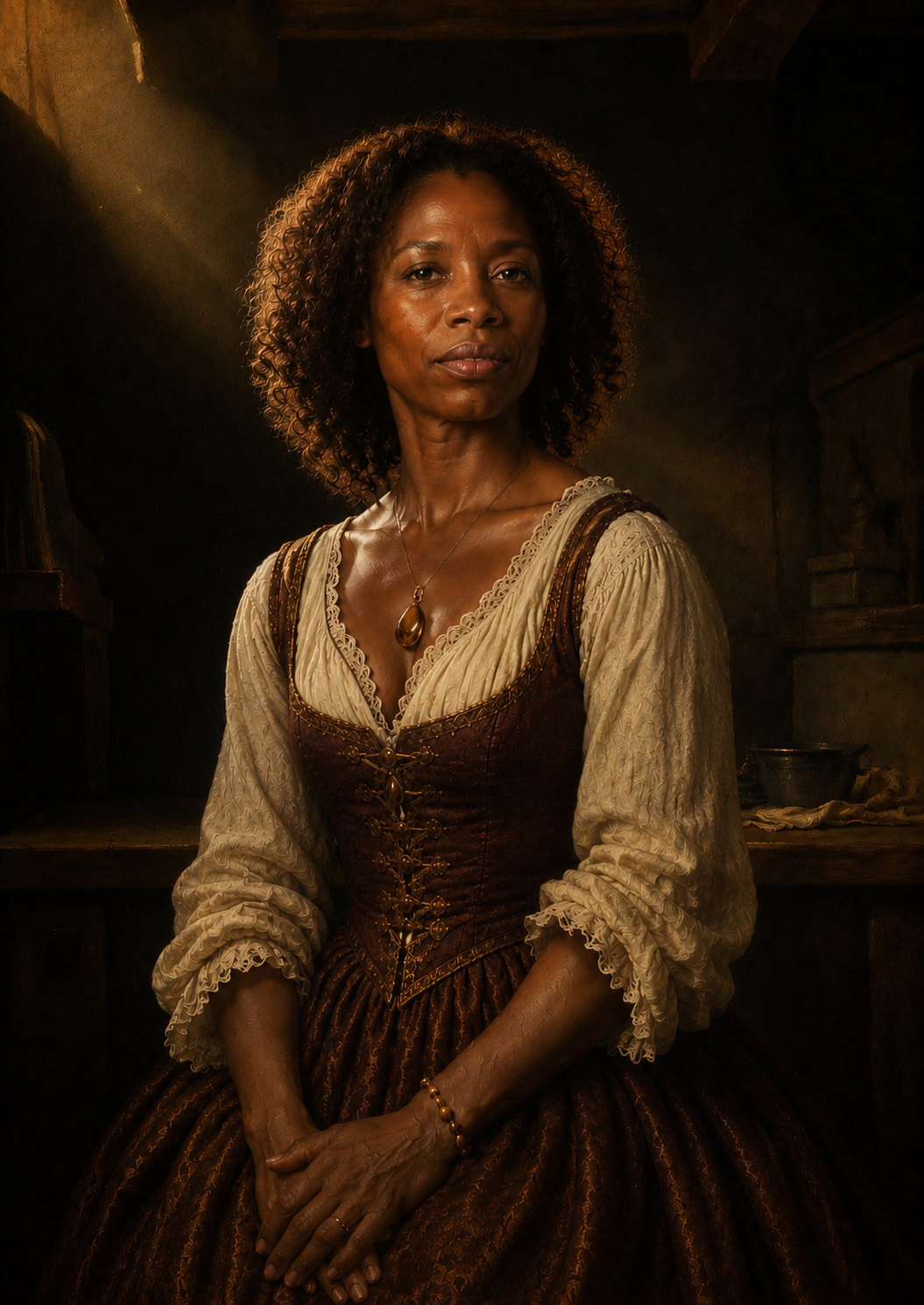
McCarthy saw a woman of perhaps thirty years, with tawny copper skin and springy coils of mid-brown hair bound practically against her head, dressed in merchant’s grey linen and calfskin — a woman whose competence was visible in the way she held the ledger, in the absence of performance in her posture.
Ifeoma saw a man in his early forties with the kind of scarred hands and weighted presence that suggested neither mercy nor waste.
“You keep his books,” McCarthy said. It was not a question.
“I keep his books. His counsel
“I keep his books. His counsel. His routes. His contacts.” She did not lower her eyes. “I kept his competence.”
“What’s your name?”
“Ifeoma Calloway.”
McCarthy smiled without warmth. “That’s no
McCarthy smiled without warmth. “That’s not what your crew will call you. You’ll need something sharper. Something that sticks in the throat.”
Within the week, she had been christened Helena — though whether the name referenced the face that launched ships or the voice that arrested attention, no one had ever quite clarified. The nickname carried layers.
Some of the crew used it with mockery, because no woman should have earned such authority. Some used it with something approaching deference, because she had. McCarthy used it the way he used all language: functionally, without sentiment, as a tool for accurate communication.
She became his kept woman in
She became his kept woman in the way that phrase was understood in pirate communities — which is to say, she was not kept at all, but rather retained for competence, valued for judgment, and permitted a form of autonomy that no respectable society would have tolerated.
She managed his accounts, negotiated with port merchants and corrupt officials, determined which cargos were worth the risk and which vessels were worth pursuing. She lay with him when he required it and did not require it when her work demanded her attention.
She was neither wife nor concubine nor servant, but rather an arrangement entirely contingent upon her usefulness and their mutual understanding that the arrangement would persist only so long as it benefited them both.
When McCarthy rose to prominence in
When McCarthy rose to prominence in the Black Ribbon Society5, Helena rose with him, her mid-brown curls bound beneath a merchant’s cap, her tawny copper hands directing the Shekhinah’s complex commerce.
The men called her by her nickname when they wanted her attention, and by her formal name in the ledgers — that careful preservation of distinction between her public authority and her private circumstance.
She kept his books. She kept his counsel. She kept the mathematics that allowed him and his fractious crew to move between legitimacy and predation without losing coherence.
And she kept, most carefully of
And she kept, most carefully of all, her own counsel regarding whether this arrangement constituted freedom or merely a more sophisticated version of the bondage her mother had navigated in Bridgetown countinghouses, where a woman’s survival depended upon arranging other people’s wealth with precision and silence.
Perhaps the distinction had never mattered much in the Atlantic trade.
Appearance
IFEOMA CALLOWAY: A PHYSICAL ACCOUNTING
The first thing a man notices about her is not her face, but her hands.
Ifeoma’s hands are the hands of someone who has never stopped working, even when the work shifted from ledgers to cargo manifests to the coiling of rope.
They are broad across the palm
They are broad across the palm, with fingers that taper to blunt, capable nails kept trimmed short — not filed or manicured in any colonial lady’s fashion, but pared down with a practical blade.
The knuckles are prominent, the webbing between thumb and forefinger slightly calloused from years of holding pens, gripping rigging, and the occasional knife hilt.
Her wrists are narrow compared to her hands, bound sometimes with a leather strap when she works the ship’s deck, and her forearms carry the lean muscle of someone who does not posture but acts.
In certain lights — particularly the
In certain lights — particularly the copper glow of Caribbean dusk — the fine hairs on her arms catch and hold the color of burnished metal.
Her skin tone is tawny copper, the kind that seems to shift between gold and rust depending on the angle of light and the intensity of sun exposure. It bears the deep patina of someone born in the tropics and never far from salt air.
There are no blemishes of consequence, though her shoulders and the bridge of her nose carry the permanent deepening of repeated burning and healing — the cost of working exposed decks. Her complexion is even, unadorned by cosmetics or pretense.
She does not wear face paint
She does not wear face paint, does not powder herself pale in the manner of colonial fashion. What you see is what the sun and wind have made and what she has chosen to keep.
Her features are striking without being beautiful in any orthodox sense. Her face is broad across the cheekbones, her jaw firm and squared, her nose slightly broad at the bridge with nostrils that flare when she breathes.
Her eyes are dark — not black, but deep brown with a particular quality of regard: they do not settle on you so much as calibrate you, taking in the cut of your coat, the wear on your boots, the sweat stains at your collar, the lie in your voice before you speak it.
Her eyebrows are dark and expressive
Her eyebrows are dark and expressive, natural in their arch, and they move when she thinks. People have learned to read her moods in those eyebrows the way sailors read weather in cloud formations.
There is something about the set of her eyes — they sit deep enough to cast small shadows in their sockets — that gives her a permanent air of concentration, as though part of her attention is always elsewhere, calculating an advantage or an escape route.
Her mouth is her most mobile feature. It is wide, with a fuller lower lip that gives her an appearance of greater youth than her years justify — she is in her early thirties now, though the sun has added fine lines around her eyes and the corners of her mouth.
When she smiles, it is brief
When she smiles, it is brief and purposeful, and it does not reach those calibrating eyes. When she speaks, her mouth moves economically; she does not waste words and does not waste the motions required to shape them.
Her hair is her singular concession to ornamentation, though “concession” grants it more intention than she would likely claim.
It grows in springy coils of mid-brown — darker at the roots, lighter at the tips where the sun has caught it — and she keeps it long enough to bind at the nape of her neck with a strip of linen or leather, depending on the day’s work.
The coils assert themselves despite the
The coils assert themselves despite the binding; there is always a small rebellion of curls at her temples and along her hairline. She does not smooth them. She wears no cap or bonnet except when weather demands it, and even then reluctantly.
Her hair moves when she moves, and there is something about this — the way it responds to her motion rather than constraining it — that speaks to her refusal of the rigid postures colonial feminine dress demands.
Her dress is uniformly practical. In port, she favors loose breeches of grey linen or weathered brown wool, tucked into boots that have been resoled more than once, fitted with buckles that no longer shine.
Her shirts are of undyed linen
Her shirts are of undyed linen or pale ochre, worn loose enough to allow freedom of movement, with sleeves that roll to the elbow when she works. Over these, she wears a russet wool coat, three-quarter length, with deep pockets worn from constant use.
The coat is neither fine nor poor; it is exactly what it appears to be — a garment chosen for function.
It bears the small scars of shipboard life: a frayed seam at the left shoulder where rope has caught it, a faint stain at the hem that did not entirely wash out. She wears no jewelry save a single ring of dark iron on her left hand, a simple band with no ornamentation. Its origin is never discussed.
Her gait is distinctive — not
Her gait is distinctive — not the constrained step of women trained in colonial drawing rooms, but the rolling, balanced stride of someone who has spent years moving across the pitching deck of a ship.
Her feet are placed with precision; she does not shuffle or glide but walks as though always bracing for the next swell. There is an economy to her movement that reads as either ease or coiled readiness, depending on the observer’s perception.
She does not take up space unnecessarily, does not gesture broadly, does not move in ways designed to draw the eye. And yet, somehow, she commands attention through the sheer absence of wasted effort — it is the opposite of display, and therefore all the more visible.
Her scent, when you are close
Her scent, when you are close enough to register it, is salt, cordage, and something underneath — something dry and slightly bitter that might be the oil she uses on her hands, or might simply be the accumulated smell of a woman who works in the open air and sees no reason to mask herself with perfume.
It is not unpleasant, but it is distinctly not the scent of a domestic interior.
Her voice is low and even, pitched from the chest rather than the throat. She does not raise it when she speaks, which means that those who wish to hear her must pay attention.
This habit — this quiet command
This habit — this quiet command of acoustic space — is perhaps what has earned her the nickname by which many know her. Helena.
They whisper it sometimes, with a sneer or a laugh, thinking themselves clever: the face that launched a thousand ships, the woman whose silence is its own gravitational pull. She does not correct them.
She understands that a reputation for dangerous attention is more useful than a reputation for beauty, and she has spent her life transforming liabilities into assets.
Her invisibility — that peculiar freedom
Her invisibility — that peculiar freedom her mixed blood and free birth afforded her in colonial spaces — has become something else entirely: a kind of studied opacity that reveals nothing unless she chooses to reveal it.
This is the woman who stands on the deck of The Creditor’s Due, watching the horizon.
Identity
- Gender
- Female
- Nationality
- English
- Origin
- Plymouth
- Ship · 1725
- Creditor's Due
- Bounty
- 32391
Saltwell Profile
Leadership, as the Admiral's office measures it.
Blackwater Profile
Intelligence and tradecraft, by Blackwater reckoning.
Tidecrest Profile
A woman's appraisal — of a woman as she is, or of a man as he believes himself to be.