Cheikh Blacktide
- Ship
- Reedwhisper Captain
- Position
- Captain
- Faction
- Bilge Communion
- Territory
- The In-Between Wharf
Backstory
THE SUNFLOWER CAPTAIN: A CHRONICLE OF CHEIKH BLACKTIDE Part Three: The Long Redistribution (1718–1725)
The ledger Cheikh kept in his cabin aboard the Brass Promise1 was written in a cipher no one else aboard could read, which was precisely the point.
His education had been bought with salvage and instinct rather than schooling — he could cipher accounts but not grammar, could navigate a merchant vessel’s manifest but not a printed book — yet his memory for numbers remained what his father’s leather tablets had taught him to value: exact, patient, cumulative.
The cipher was simple enough: a
The cipher was simple enough: a numerical substitution keyed to the latitude of Tortuga2, shifted monthly. Inside, he tracked not the prizes taken but the dispersals made.
By 1720, the column marked Maroon Relief (rendered in his cipher as MR-7) had grown to entries that would have made the Royal Africa Company weep, had they known to look.
Three hogsheads of salt pork to the settlement near Savannah, March 1719. Two casks of Birmingham flintlocks, powder, and bar lead to the Georgia interior, October 1719.
Fourteen head of livestock — horses
Fourteen head of livestock — horses and cattle — driven overland from a plantation near Charleston to a creek junction in what men were beginning to call the contested lands. Bolt-cloth, linen, iron nails, fishing nets, Spanish silver coin by the handful.
A surgeon’s kit, stolen from a merchant brig off the Carolinas and delivered in person to a Maroon healer named Asantewaa who had once bled his infected eye.
He did not think of it as charity. Charity was what plantation mistresses performed for their favored house servants, a performance that cost them nothing but the performance itself. This was accounting.
This was settlement of a debt
This was settlement of a debt that began in the hold of the Nossa Senhora da Graça and had not concluded when Kwesi found him drowning in sand.
His crew on the Brass Promise knew him as economical with speech and without mercy toward sloppiness. They did not know the full particulars of his intentions until after the taking.
Cheikh’s strategic weakness — and his cognition profile bore the mark — was that he did not plan campaigns far ahead; he could not.
Strategy required the kind of patient
Strategy required the kind of patient, methodical forethought that felt to him like the mindset of a factor, and factors were men who enslaved people for wages.
Instead, he cultivated opportunity, and he trusted his intuition to recognize which merchantman’s hold carried goods that could be diverted rather than sold, which crewman in a prize could be turned or reasoned with, where in the colonial interior the maroon settlements had begun to build something that resembled permanence.
Ewan Staves3 understood this about him, which was why the two men had remained allied across seven years of privateering. Staves kept the Promise pointed at merchant vessels; Cheikh made sure they took the right ones.
“You’ve a knack for the ships
“You’ve a knack for the ships that bleed easy,” Staves had said once, over rum in a Tortuga tavern, his Lowlands accent cutting through the creole like a knife through rope. “Not the armed merchantmen. Never the fast runners. Always the slow sugar-sloops heading to feed the plantations.”
“The slow ones carry food and cloth,” Cheikh had replied flatly. “Not trade goods for gentlemen. Trade goods for men.”
It was all the explanation Staves required. The Scotsman had his own history — indentured labor in Virginia, escape, revenge practiced quietly — and recognized the pattern in Cheikh’s selections.
By 1722, Ewan Staves did not
By 1722, Ewan Staves did not ask questions when Cheikh insisted on taking a particular course. He simply ordered the sails trimmed and let the Sunflower Captain work his mathematics on the horizon.
The nickname had attached itself without anyone precisely deciding it should.
Joren Pike4, the quartermaster who kept the Promise’s hold and had a sense for what the crew would swallow, had first said it aloud after watching Cheikh stand at the bow during a dawn raid off the Carolinas, his head tilted toward the rising sun as if he were something rooted and required the light.
Pike was not a thoughtful man
Pike was not a thoughtful man — his navigation scores were worse than Cheikh’s, and his command sense was functional at best — but he had noticed that Cheikh always turned toward the east in the hour before taking a ship, as if consulting some interior compass that pointed toward home and toward reckoning.
“Look at him. The Sunflower,” Pike had said, and the crew had laughed because it was a good name, better than Blacktide, which had been given in anger and adopted in irony. Sunflower held truth differently — it suggested growth toward light, turning always toward the source, an orientation rather than a judgment.
By 1723, the name had replaced Blacktide in the crew’s speech, though they used it with the kind of deference usually reserved for men whose decisions had killed rivals and whose vengeance was not theoretical. They were right to use that register.
Cheikh had killed four men —
Cheikh had killed four men — three in direct combat, one by poison in a drink offered in apparent friendship. None of these had been personal affronts. All four had been obstacles to the dispersal column.
A slaver captain out of Bristol named Hatford had threatened to denounce Cheikh’s hiding stations to the colonial authorities for coin. Cheikh had found him in a Kingston5 tavern three weeks later and had a conversation that lasted exactly six minutes.
The body was disposed of in a way that suggested accident — a fall from a gallery, a skull meeting stone. The colonial magistrate ruled it misadventure.
A French privateer named Levault had
A French privateer named Levault had begun selling information about maroon settlement positions to the plantation militias near Mobile.
Cheikh could not reach him directly — Levault kept to fortified ports — but Cheikh knew a woman who served in Levault’s household, and he knew how to frame a request that would not be refused.
The poison was slow enough that Levault died of what appeared to be a common Caribbean fever, attended by physicians who found nothing amiss.
This was what his low Command
This was what his low Command score meant in practice: he could not inspire men to die for him through charisma or by the force of his presence. But he could organize small, discrete cruelties. He could wait.
He could see the shape of a problem and solve it through accumulation rather than declaration. His cunning had teeth, and the crew knew it. They obeyed not because they loved him but because disobeying carried risks that accumulated silently, the way blood accumulated in a wound that would not close.
The settlements themselves he visited only rarely. It would have drawn notice — a ship’s captain visiting inland, distributing goods, taking on refugees. Instead, he worked through intermediaries.
Kwesi, now old and living in
Kwesi, now old and living in a semi-permanent camp near the Savannah interior, served as coordinator for the Georgia networks. A woman named Ama, who had escaped a rice plantation in the low country, managed the receiving stations in the Carolinas.
A Maroon captain named Osei, whose mother had been Asante and whose father had been a Portuguese trader turned rebel, ran the operations that reached as far west as the contested lands — the space between colonial authority and open country that stretched from Georgia toward the lands the French called Texarkana, where the maps dissolved into rumor and indigenous alliance.
The goods flowed like water finding cracks in stone.
By 1725, when Cheikh was thirty-nine
By 1725, when Cheikh was thirty-nine years old and his intuition had begun to whisper warnings about the coast’s changing temperament — the naval patrols increasing, the colonial governments coordinating, the Age of Piracy entering its final, cornered phase — the maroon settlements from Savannah inland were better armed, better provisioned, and more densely populated than any official estimate would have suggested.
The plantation militias knew something was happening in the interior, but they could not quite locate the shape of it.
They saw escaped slaves disappearing into the forest in ones and twos; they did not see the coordinated receiving stations, the caches of food and weapons, the structured communities beginning to build institutions that would persist long after Cheikh was dust.
His wealth, by 1725, was not
His wealth, by 1725, was not considerable. He had spent most of what the Brass Promise had earned. His education remained thin. His command of men remained functional but not exceptional. But his cunning had accrued, and his intuition had calcified into something like prophecy.
He knew, with the clarity of a man reading his own ledger, that piracy as an institution was dying. The long redistribution would need to survive without him.
He had perhaps three years left before the noose or the exile.
He intended to make them count
He intended to make them count.
Appearance
COMPOSITE HEADSHOT: CHEIKH BLACKTIDE (“THE SUNFLOWER CAPTAIN”)
The Face and Frame
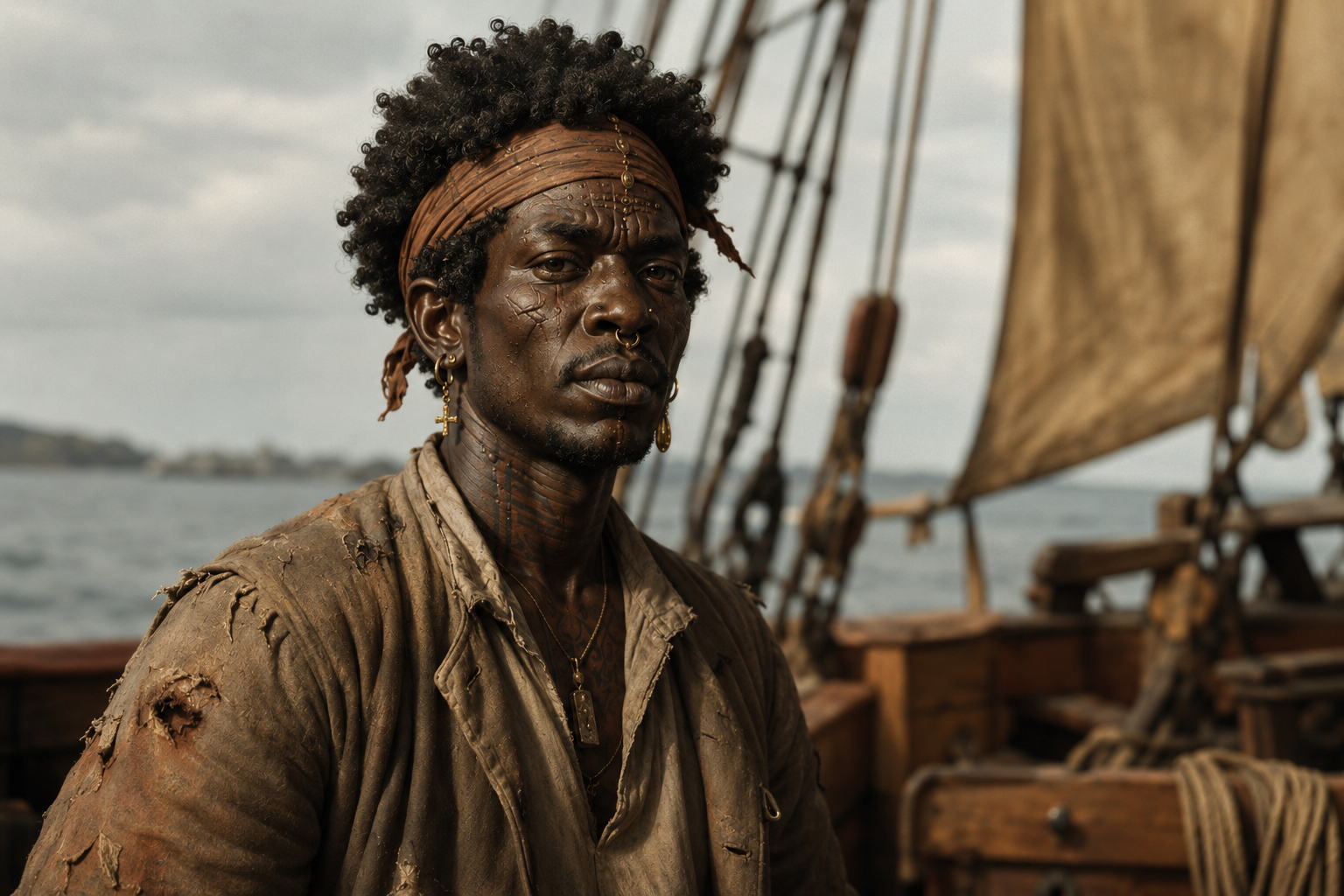
Cheikh Blacktide sits in the stern light like a man who has learned to be still.
His face is built on geometry
His face is built on geometry — high, prominent cheekbones that catch shadow unevenly, a jaw that angles down to a point rather than rounds, a brow ridge that sits heavy and forward over deep-set eyes.
The skull underneath is large, the shape of it visible through skin that offers no excess.
His skin is onyx, near-black, with the particular depth that holds light rather than reflects it; in certain angles the face reads as matte, almost absorptive, until he moves and the planes reorganize. The overhead sun finds the geometry and makes it clinical.
His eyes are the architectural exception
His eyes are the architectural exception. They are large, very dark, with a quality of deliberate focus that suggests he is not looking at something so much as through it to whatever lies behind.
The left eye carries a faint whitish film across the pupil — a scar from the infection acquired in the St. Jago’s hold, forty years ago, which never fully cleared. Most men would have gone blind in that eye.
Cheikh’s vision in it is imperfect, a haze at the edges, but functional. He compensates by tilting his head very slightly when taking in fine detail, a habit so ingrained it reads as natural to his bearing.
The iris itself is a brown
The iris itself is a brown so dark it merges with the pupil until light catches it dead-on; then it separates into a ring the color of rust on old iron.
His hair is tightly curled jet black, cut short and close to the scalp, with no grey to it despite his age — either the pigment holds or he dyes it, and neither fact would surprise the men who know him. It grows upward and outward in a dense matrix, ungreased, unornamented, strictly practical.
The face bears no scars below the eyes. This is remarkable for a man his age and profession.
The absence reads as intentional —
The absence reads as intentional — either he has learned to take damage on the body rather than the face, or something in his movement and timing keeps his face out of the knife-work.
His mouth is wide, the lips thin and angled downward at the corners even when he smiles, which gives every expression a faint cast of irony. He has all his teeth, which is itself a form of wealth; they are slightly yellowed from tobacco and coffee and salt.
His hands are notable.
They are large, with long fingers
They are large, with long fingers and prominent knuckles, the palms scarred in organized patterns — not random violence but the accumulated micro-damage of precision work, rope, counting, writing, the endless calibration of a man who uses his hands as tools of intelligence rather than force.
The nails are kept clean and trimmed short. There is a scar that runs from the base of his left thumb up the inside of his wrist, thin and white, dating from something that required stitching decades ago. He does not hide it; it sits in plain view like an old document.
Build and Posture
He is lean in the way
He is lean in the way of men who have lived on shipboard rations and in climates where food is intermittent. His shoulders are broad but not heavily muscled; the strength in him reads as functional rather than displayed.
He stands or sits with a particular economy — no wasted gesture, no lounging sprawl, no restless adjustment. When he moves, the motion comes from the hips and core rather than the arms and shoulders, a gait learned on a rolling deck and never fully abandoned.
He walks with a slight list to starboard, almost imperceptible, the kind of asymmetry that sets in after decades of bracing against the same direction of pitch. His age shows in the lines around his eyes and mouth, but not in his posture — he does not bend or hunch.
His hands, when he is idle
His hands, when he is idle, rest on the table or on his lap with the fingers slightly curved as though they were holding something. When he speaks or listens, there is minimal gesture. He uses his eyes and his voice rather than his arms.
This reserve reads to strangers as coldness; to men who know him well, it reads as a kind of respect — he does not move unless movement will clarify rather than confuse.
Habitual Dress
In the 1725 ledger period, he
In the 1725 ledger period, he wears a linen shirt, usually ochre or rust-brown, with the sleeves rolled past the elbow in warm weather. The shirt is often stained with salt rings at the collar from evaporated sweat and spray.
Over this he wears a wool coat, undyed grey or mottled brown, with deep pockets and worn cuffs where his wrists have rubbed the fabric pale. The coat is buttoned only at the chest, left open below, and sits long enough to reach past his hips.
His breeches are tan or grey linen, practical and patched at the knees. His feet are usually in leather boots, soft grey or dark brown, broken in past the point of stiffness, the heels worn unevenly.
He does not wear jewelry except
He does not wear jewelry except for a single brass ring on his left middle finger, broad and tarnished, unmarked except for a maker’s mark so worn it is nearly illegible.
The ring predates his arrival in the Caribbean by at least ten years, possibly longer; no man alive knows its origin or significance, and he has never offered to explain it.
His hair is never covered unless weather demands it. He owns two hats — a broad-brimmed felt in dark grey, creased down the center, and a knit wool cap of rust-red that he uses in spray or rain. He rarely wears either.
In the 2025 period, the habitual
In the 2025 period, the habitual dress has shifted toward institutional camouflage. He wears button-down shirts in muted earth tones — taupe, grey-brown, soft ochre — with the sleeves sometimes rolled, sometimes buttoned at the wrist.
These are worn under unstructured blazers in charcoal or navy wool, the cut loose enough not to strain across the chest. His trousers are tailored wool, dark grey or tan, with a flat front and minimal ornamentation.
His shoes are leather loafers or oxfords, polished but not gleaming, the kind that signal “respectable” without demanding attention.
The brass ring remains. The hat
The brass ring remains. The hat is gone, replaced by the understanding that bare-headed is safer in boardrooms.
Voice and Characteristic Expression
His voice is quiet and low, with a register that carries farther than its volume suggests.
The accent is a palimpsest —
The accent is a palimpsest — Portuguese from the holds, Maroon Spanish from the interior settlements, English from Port Royal6, the pidgin of the inter-island trade — none of them dominant, all present in subtle shifts depending on context and whom he addresses.
He uses formal English when precision matters, which is often. When he is among West African crew, sometimes Yoruba syllables rise up, half-forgotten and corrected, the mother tongue made intermittent by forty years of distance.
He speaks in short declarative sentences when the stakes are high. When he is calm and certain, he allows himself longer constructions, a kind of measured elaboration that suggests a man thinking through the problem as he articulates it.
He does not repeat himself. If
He does not repeat himself. If a man has not understood, he finds a different path to clarity rather than louder volume.
His characteristic expression is neutral — not cold, but empty of performance. His face does not telegraph what he is thinking.
When he smiles, it is often in response to something private, a thought internal rather than shared, which gives the expression a faint quality of mockery even when he intends none.
His eyes, however, are always working
His eyes, however, are always working, always tracking, always absorbing the small details — the set of a man’s shoulders, the hesitation before a lie, the spill of rum that signals haste or carelessness, the way light moves across water to tell him what the wind is doing three miles distant.
The nickname, “The Sunflower Captain,” has never been satisfactorily explained even by those who gave it. Some say it refers to a habit of facing into the sun, as though he were drinking it directly.
Others claim it came from a yellow silk jacket he wore in his early privateering years, now long lost or rotted. Still others suggest it marks some Maroon ritual, a reference to an African flower he would not explain.
The truth — if it exists
The truth — if it exists in any single form — is that it stuck because it contained some kernel of recognition that everyone understood but no one could articulate. He does not correct the attribution. He does not comment on it.
When it is used in his presence, he acknowledges it the same way he acknowledges any other name, with the slight nod of a man hearing his watch chime.
Identity
- Gender
- Male
- Nationality
- West African
- Origin
- Whydah / Ouidah (Slave Coast)
- Ship · 1725
- Reedwhisper
- Berth
- Captain
- Bounty
- 15000
Frestagon Profile
Compiled by Dr. Frestagon from observation rather than testimony. Scores out of ten; the commentary is his own.
- Cunning (10) — at the ceiling. Assume premeditation.
- Intuition (9) — at the ceiling. Assume premeditation.
- Lore (8) — formidable; rarely caught improvising.
- Strategy (5) — middling; compensated for elsewhere.
- Charm (4) — middling; compensated for elsewhere.
- Command (4) — middling; compensated for elsewhere.
- Education (3) — a documented weakness. Exploit with care.
- Navigation (1) — a documented weakness. Exploit with care.
Filed under seal. The subject has not seen this assessment.
Saltwell Profile
Leadership, as the Admiral's office measures it.
Blackwater Profile
Intelligence and tradecraft, by Blackwater reckoning.
Tidecrest Profile
A woman's appraisal — of a woman as she is, or of a man as he believes himself to be.