Peter Boilsack
- Ship
- Kingston Crew
- Position
- Crew
- Born
- 1679 · Tortuga - mixed
- Faction
- Independent (Grey Market)
Backstory
PETER BOILSACK: THE CARPENTER’S RECKONING
He arrived at Brine Gate in autumn of 1702, the twenty-third year of a life that had extracted every ounce of softness and left behind something harder than the granite he’d spent his earlier years breaking.
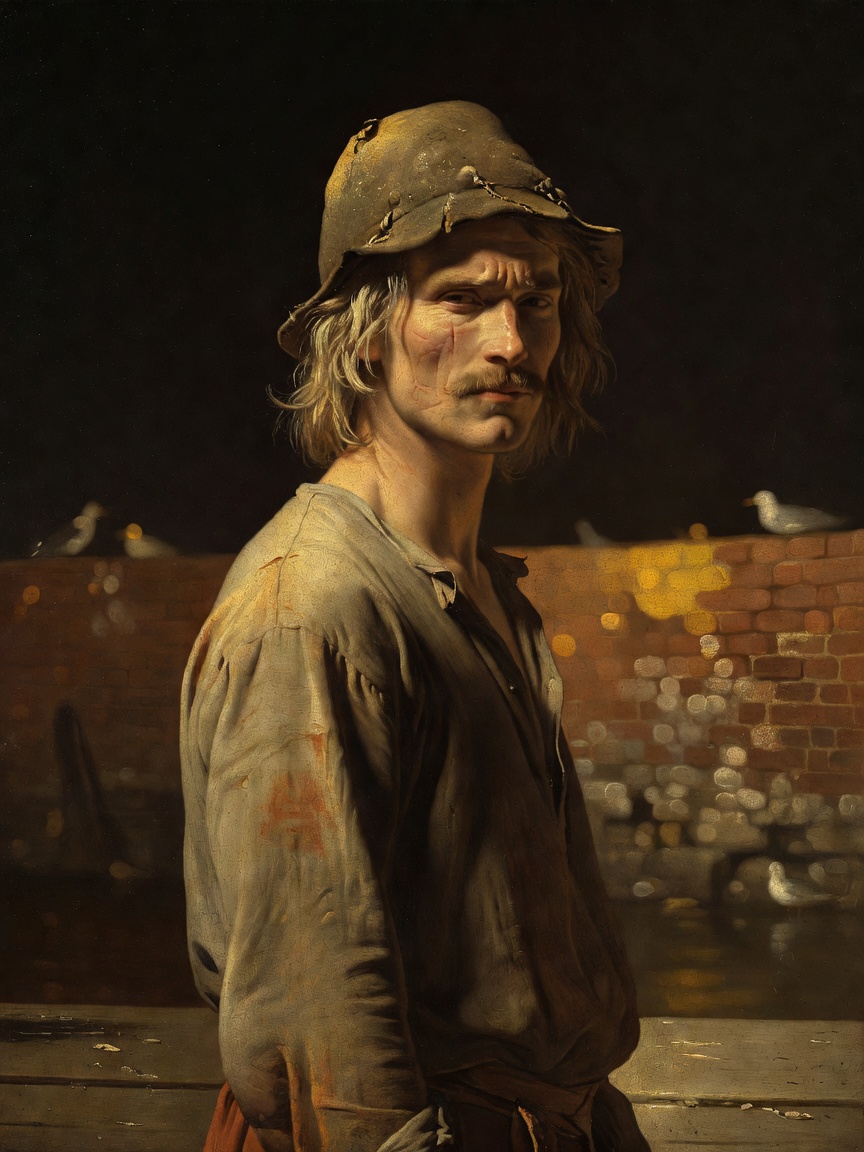
The tattered hat was Norse wool, salt-stained and darkened at the brim where sweat and spray had worked it into the colour of old rope.
His left hand bore three fingers
His left hand bore three fingers scored with white frostbite scars that never quite warmed again — not symbolic marks but functional ones, the hand still serviceable, still strong, simply diminished in the way the sea diminishes everything it touches.
The silence around him was not the silence of a quiet man. It was the silence of someone who had learned that words were a luxury, and reputation purchased cheaper through what you refused to say than through any amount of talk.
Men who ordinarily would have pressed for story and origin found themselves content to let him drink alone, watching the way his eyes tracked the door, the windows, the bartender’s hands. This attention was not paranoia.
It was the practical vigilance of
It was the practical vigilance of someone already expelled from one life, who understood the mechanics of expulsion well enough to recognize the first tremors.
The name came within a fortnight, scattered across different mouths in different versions.
Some said it referred to boiling ash — a warehouse in Liverpool, a ship’s hold, the convenient accident of a magistrate’s negligence, depending on the drinker’s inclination toward drama.
Others, with the confidence of men
Others, with the confidence of men who knew nothing, suggested it referred to a particular darkening that crossed his face when rage moved through him, a peculiar suffusion along the jaw and cheekbones that made him look as though something was cooking beneath the skin.
Peter himself never confirmed or corrected. The nickname had the weight of usefulness, and he understood that in places like this, a man’s reputation was scaffolding.
If he had burned something, or someone, or if the burning was only rumour — that distinction was precisely the uncertainty that kept other men at a careful distance.
He took work as a carpenter
He took work as a carpenter, which meant work with his hands, which meant no one expected conversation.
The hands themselves told their own history: deep calluses predating his arrival on the English coast, scored from the labour that stone demands when you are seventeen and your family’s lease is converting itself into a sentence.
The palms bore the marks of rope-work and rigging, the scarred white crescents of a life hauling things aboard ships. When he worked timber, the economy was absolute. No stroke wasted.
No cut placed without understanding exactl
No cut placed without understanding exactly where strain would gather once the joint was loaded. He built without sketches, measuring only what his eye required, and the work held — squared angles, joinery that would not betray itself under pressure.
The same principle he applied to wood was the principle he applied to violence.
The Oxford1 needed repair. The ship was a working vessel, not a glory-boat, and her frame carried evidence of hard use: twisted planking where the sea had hammered her, a mast stepped in haste, the compromises of a crew that kept moving rather than kept still.
Peter understood the logic of that
Peter understood the logic of that work. The Oxford’s carpenter before him had abandoned the post — dead, drunk, or departed; the crew did not specify — and the ship’s master knew better than to ask questions of a man who could splice a frame and hold his silence.
What distinguished Peter from the ordinary run of carpenter was not skill, though skill he possessed. It was the combination of cunning sharp enough to cut glass and the patience to let other men believe they were making the decisions.
He observed where men gathered, who spoke to whom, what cargo moved in which seasons. A man might notice that he tracked these patterns. A man might fail to notice that Peter remembered every detail, every name, every slight variation in routine.
This was not ambition in any
This was not ambition in any romantic sense. It was the hunger of someone who had learned early that control was the only commodity worth acquiring, and that control began with knowing precisely what was breakable and what would hold.
By December, he had assessed the Oxford’s vulnerabilities and possibilities with the same precision he applied to timber joinery — where the crew’s loyalty fractured, where the master’s authority was strongest, what trade routes ran through waters where authority itself grew thin.
He was not yet a pirate. He was still a carpenter. But the carpenter’s hands were already counting exits.
REYKJAVÍK WINTER: PETER BOILSACK’S BEGINNI
REYKJAVÍK WINTER: PETER BOILSACK’S BEGINNING
The house at Laugavegur Street stood three storeys, which marked it as belonging to a merchant family — not wealthy enough for the grandness that the trade could purchase, but elevated enough that the stairs creaked under the weight of expectation.
Peter’s father, Eiríkur Jónsson, dealt in dried fish and sulphur brought down from the hot springs that steamed like wounds in the earth north of the city.
His mother, Rósa Guðmundsdóttir, had come
His mother, Rósa Guðmundsdóttir, had come from the west coast with a dowry in silver and a habit of silence that suggested she had seen things the capital preferred not to name. Peter was the third of five children, born in 1679 on a night when the northern lights turned the snow the colour of bone-ash.
The house was orderly in the way that merchant households must be — accounts kept in ledgers, goods inventoried, the kitchen’s rhythm synchronized to the rhythm of trade. But orderliness can be another form of cruelty.
Eiríkur measured his children the way he measured his stock: by utility, by growth rate, by whether they would increase or decrease the household’s standing. Peter’s older brothers, Jón and Magnús, were groomed for the counting-house and the merchant’s chair.
Peter was left to the servants
Peter was left to the servants, who taught him to read accounts and calculate loss, but with the understanding that these skills were tools a younger son might use to make himself valuable in the gaps between other men’s ambitions.
At twelve, Peter was apprenticed to a master carpenter named Þórður, a man whose hands trembled from palsy and whose eye for joinery was nonetheless absolute. The apprenticeship was not a gift.
It was a placement — a way to offload a son who had shown early what Rósa called a “capaciousness for anger,” which meant that when other boys laughed, Peter’s response involved fists and a precision of violence that alarmed even the hired men. Þórður’s workshop stood on the dock, where the smell of fresh-cut timber mixed with the smell of the sea and the smell of fish-oil used to preserve the boats.
The work opened something in him
The work opened something in him. Not gentleness — nothing about stone-carving or timber-shaping could soften a boy whose earliest memory was his father’s hand across his face for miscounting a ledger. But focus.
The way a piece of wood wanted to split along its grain, and that wanting was not rebellion but simply truth about how the wood was assembled. If you worked with it, things held. If you fought it, everything fractured.
By sixteen, Peter was no longer an apprentice. He was a carpenter in fact, and Þórður — whose trembling had worsened into something that made fine work impossible — had begun to rely on him for the detailed joinery that paid the best. The pay was modest. The work was steady. Neither was enough.
In the autumn of 1697, a
In the autumn of 1697, a ship came into the harbour bearing news: the Danish Crown had instituted a new tax on household goods, a re-assessment that would fall heaviest on merchant families.
Eiríkur’s face, when Peter saw him that evening at the family table, carried the expression of a man watching something he had built being slowly dismantled by invisible hands. The account-books would not balance. The apprenticeships for the younger children could not be purchased. Something had to move.
Three months later, Peter stood on the dock with a canvas bag containing two changes of wool, a knife, and thirty rigsdaler that represented half of what Þórður had paid him for two years of work. A merchant ketch was taking on hands for Bergen. No questions.
The captain — a Dane named
The captain — a Dane named Sørensen who smelled of tar and indifference — looked at Peter’s hands, nodded, and said: “You work or you starve. No third option here.”
Peter stepped aboard. The hard country had already made him. Now the harder country would unmake whatever remained.
REYKJAVÍK WINTER: PETER BOILSACK’S BEGINNING
The house at Laugavegur Street stood
The house at Laugavegur Street stood three storeys, which marked it as belonging to a merchant family — not wealthy enough for the grandness that the trade could purchase, but elevated enough that the stairs creaked under the weight of expectation.
Peter’s father, Eiríkur Jónsson, dealt in dried fish and sulphur brought down from the hot springs that steamed like wounds in the earth north of the city.
His mother, Rósa Guðmundsdóttir, had come from the west coast with a dowry in silver and a habit of silence that suggested she had seen things the capital preferred not to name. Peter was the third of five children, born in 1679 on a night when the northern lights turned the snow the colour of bone-ash.
The house was orderly in the
The house was orderly in the way that merchant households must be — accounts kept in ledgers, goods inventoried, the kitchen’s rhythm synchronized to the rhythm of trade. But orderliness can be another form of cruelty.
Eiríkur measured his children the way he measured his stock: by utility, by growth rate, by whether they would increase or decrease the household’s standing. Peter’s older brothers, Jón and Magnús, were groomed for the counting-house and the merchant’s chair.
Peter was left to the servants, who taught him to read accounts and calculate loss, but with the understanding that these skills were tools a younger son might use to make himself valuable in the gaps between other men’s ambitions.
At twelve, Peter was apprenticed to
At twelve, Peter was apprenticed to a master carpenter named Þórður, a man whose hands trembled from palsy and whose eye for joinery was nonetheless absolute. The apprenticeship was not a gift.
It was a placement — a way to offload a son who had shown early what Rósa called a “capaciousness for anger,” which meant that when other boys laughed, Peter’s response involved fists and a precision of violence that alarmed even the hired men. Þórður’s workshop stood on the dock, where the smell of fresh-cut timber mixed with the smell of the sea and the smell of fish-oil used to preserve the boats.
The work opened something in him. Not gentleness — nothing about stone-carving or timber-shaping could soften a boy whose earliest memory was his father’s hand across his face for miscounting a ledger. But focus.
The way a piece of wood
The way a piece of wood wanted to split along its grain, and that wanting was not rebellion but simply truth about how the wood was assembled. If you worked with it, things held. If you fought it, everything fractured.
By sixteen, Peter was no longer an apprentice. He was a carpenter in fact, and Þórður — whose trembling had worsened into something that made fine work impossible — had begun to rely on him for the detailed joinery that paid the best. The pay was modest. The work was steady. Neither was enough.
In the autumn of 1697, a ship came into the harbour bearing news: the Danish Crown had instituted a new tax on household goods, a re-assessment that would fall heaviest on merchant families.
Eiríkur’s face, when Peter saw him
Eiríkur’s face, when Peter saw him that evening at the family table, carried the expression of a man watching something he had built being slowly dismantled by invisible hands. The account-books would not balance. The apprenticeships for the younger children could not be purchased. Something had to move.
Three months later, Peter stood on the dock with a canvas bag containing two changes of wool, a knife, and thirty rigsdaler that represented half of what Þórður had paid him for two years of work. A merchant ketch was taking on hands for Bergen. No questions.
The captain — a Dane named Sørensen who smelled of tar and indifference — looked at Peter’s hands, nodded, and said: “You work or you starve. No third option here.”
Peter stepped aboard. The hard country
Peter stepped aboard. The hard country had already made him. Now the harder country would unmake whatever remained.
REYKJAVÍK WINTER: PETER BOILSACK’S BEGINNING
The house at Laugavegur Street stood three storeys, which marked it as belonging to a merchant family — not wealthy enough for the grandness that the trade could purchase, but elevated enough that the stairs creaked under the weight of expectation.
Peter’s father, Eiríkur Jónsson, dealt in
Peter’s father, Eiríkur Jónsson, dealt in dried fish and sulphur brought down from the hot springs that steamed like wounds in the earth north of the city.
His mother, Rósa Guðmundsdóttir, had come from the west coast with a dowry in silver and a habit of silence that suggested she had seen things the capital preferred not to name. Peter was the third of five children, born in 1679 on a night when the northern lights turned the snow the colour of bone-ash.
The house was orderly in the way that merchant households must be — accounts kept in ledgers, goods inventoried, the kitchen’s rhythm synchronized to the rhythm of trade. But orderliness can be another form of cruelty.
Eiríkur measured his children the way
Eiríkur measured his children the way he measured his stock: by utility, by growth rate, by whether they would increase or decrease the household’s standing. Peter’s older brothers, Jón and Magnús, were groomed for the counting-house and the merchant’s chair.
Peter was left to the servants, who taught him to read accounts and calculate loss, but with the understanding that these skills were tools a younger son might use to make himself valuable in the gaps between other men’s ambitions.
At twelve, Peter was apprenticed to a master carpenter named Þórður, a man whose hands trembled from palsy and whose eye for joinery was nonetheless absolute. The apprenticeship was not a gift.
It was a placement — a
It was a placement — a way to offload a son who had shown early what Rósa called a “capaciousness for anger,” which meant that when other boys laughed, Peter’s response involved fists and a precision of violence that alarmed even the hired men. Þórður’s workshop stood on the dock, where the smell of fresh-cut timber mixed with the smell of the sea and the smell of fish-oil used to preserve the boats.
The work opened something in him. Not gentleness — nothing about stone-carving or timber-shaping could soften a boy whose earliest memory was his father’s hand across his face for miscounting a ledger. But focus.
The way a piece of wood wanted to split along its grain, and that wanting was not rebellion but simply truth about how the wood was assembled. If you worked with it, things held. If you fought it, everything fractured.
By sixteen, Peter was no longer
By sixteen, Peter was no longer an apprentice. He was a carpenter in fact, and Þórður — whose trembling had worsened into something that made fine work impossible — had begun to rely on him for the detailed joinery that paid the best. The pay was modest. The work was steady. Neither was enough.
In the autumn of 1697, a ship came into the harbour bearing news: the Danish Crown had instituted a new tax on household goods, a re-assessment that would fall heaviest on merchant families.
Eiríkur’s face, when Peter saw him that evening at the family table, carried the expression of a man watching something he had built being slowly dismantled by invisible hands. The account-books would not balance. The apprenticeships for the younger children could not be purchased. Something had to move.
Three months later, Peter stood on
Three months later, Peter stood on the dock with a canvas bag containing two changes of wool, a knife, and thirty rigsdaler that represented half of what Þórður had paid him for two years of work. A merchant ketch was taking on hands for Bergen. No questions.
The captain — a Dane named Sørensen who smelled of tar and indifference — looked at Peter’s hands, nodded, and said: “You work or you starve. No third option here.”
Peter stepped aboard. The hard country had already made him. Now the harder country would unmake whatever remained.
REYKJAVÍK WINTER: PETER BOILSACK’S BEGINNI
REYKJAVÍK WINTER: PETER BOILSACK’S BEGINNING
The house at Laugavegur Street stood three storeys, which marked it as belonging to a merchant family — not wealthy enough for the grandness that the trade could purchase, but elevated enough that the stairs creaked under the weight of expectation.
Peter’s father, Eiríkur Jónsson, dealt in dried fish and sulphur brought down from the hot springs that steamed like wounds in the earth north of the city.
His mother, Rósa Guðmundsdóttir, had come
His mother, Rósa Guðmundsdóttir, had come from the west coast with a dowry in silver and a habit of silence that suggested she had seen things the capital preferred not to name. Peter was the third of five children, born in 1679 on a night when the northern lights turned the snow the colour of bone-ash.
The house was orderly in the way that merchant households must be — accounts kept in ledgers, goods inventoried, the kitchen’s rhythm synchronized to the rhythm of trade. But orderliness can be another form of cruelty.
Eiríkur measured his children the way he measured his stock: by utility, by growth rate, by whether they would increase or decrease the household’s standing. Peter’s older brothers, Jón and Magnús, were groomed for the counting-house and the merchant’s chair.
Peter was left to the servants
Peter was left to the servants, who taught him to read accounts and calculate loss, but with the understanding that these skills were tools a younger son might use to make himself valuable in the gaps between other men’s ambitions.
At twelve, Peter was apprenticed to a master carpenter named Þórður, a man whose hands trembled from palsy and whose eye for joinery was nonetheless absolute. The apprenticeship was not a gift.
It was a placement — a way to offload a son who had shown early what Rósa called a “capaciousness for anger,” which meant that when other boys laughed, Peter’s response involved fists and a precision of violence that alarmed even the hired men. Þórður’s workshop stood on the dock, where the smell of fresh-cut timber mixed with the smell of the sea and the smell of fish-oil used to preserve the boats.
The work opened something in him
The work opened something in him. Not gentleness — nothing about stone-carving or timber-shaping could soften a boy whose earliest memory was his father’s hand across his face for miscounting a ledger. But focus.
The way a piece of wood wanted to split along its grain, and that wanting was not rebellion but simply truth about how the wood was assembled. If you worked with it, things held. If you fought it, everything fractured.
By sixteen, Peter was no longer an apprentice. He was a carpenter in fact, and Þórður — whose trembling had worsened into something that made fine work impossible — had begun to rely on him for the detailed joinery that paid the best. The pay was modest. The work was steady. Neither was enough.
In the autumn of 1697, a
In the autumn of 1697, a ship came into the harbour bearing news: the Danish Crown had instituted a new tax on household goods, a re-assessment that would fall heaviest on merchant families.
Eiríkur’s face, when Peter saw him that evening at the family table, carried the expression of a man watching something he had built being slowly dismantled by invisible hands. The account-books would not balance. The apprenticeships for the younger children could not be purchased. Something had to move.
Three months later, Peter stood on the dock with a canvas bag containing two changes of wool, a knife, and thirty rigsdaler that represented half of what Þórður had paid him for two years of work. A merchant ketch was taking on hands for Bergen. No questions.
The captain — a Dane named
The captain — a Dane named Sørensen who smelled of tar and indifference — looked at Peter’s hands, nodded, and said: “You work or you starve. No third option here.”
Peter stepped aboard. The hard country had already made him. Now the harder country would unmake whatever remained.
REYKJAVÍK WINTER: PETER BOILSACK’S BEGINNING
The house at Laugavegur Street stood
The house at Laugavegur Street stood three storeys, which marked it as belonging to a merchant family — not wealthy enough for the grandness that the trade could purchase, but elevated enough that the stairs creaked under the weight of expectation.
Peter’s father, Eiríkur Jónsson, dealt in dried fish and sulphur brought down from the hot springs that steamed like wounds in the earth north of the city.
His mother, Rósa Guðmundsdóttir, had come from the west coast with a dowry in silver and a habit of silence that suggested she had seen things the capital preferred not to name. Peter was the third of five children, born in 1679 on a night when the northern lights turned the snow the colour of bone-ash.
The house was orderly in the
The house was orderly in the way that merchant households must be — accounts kept in ledgers, goods inventoried, the kitchen’s rhythm synchronized to the rhythm of trade. But orderliness can be another form of cruelty.
Eiríkur measured his children the way he measured his stock: by utility, by growth rate, by whether they would increase or decrease the household’s standing. Peter’s older brothers, Jón and Magnús, were groomed for the counting-house and the merchant’s chair.
Peter was left to the servants, who taught him to read accounts and calculate loss, but with the understanding that these skills were tools a younger son might use to make himself valuable in the gaps between other men’s ambitions.
At twelve, Peter was apprenticed to
At twelve, Peter was apprenticed to a master carpenter named Þórður, a man whose hands trembled from palsy and whose eye for joinery was nonetheless absolute. The apprenticeship was not a gift.
It was a placement — a way to offload a son who had shown early what Rósa called a “capaciousness for anger,” which meant that when other boys laughed, Peter’s response involved fists and a precision of violence that alarmed even the hired men. Þórður’s workshop stood on the dock, where the smell of fresh-cut timber mixed with the smell of the sea and the smell of fish-oil used to preserve the boats.
The work opened something in him. Not gentleness — nothing about stone-carving or timber-shaping could soften a boy whose earliest memory was his father’s hand across his face for miscounting a ledger. But focus.
The way a piece of wood
The way a piece of wood wanted to split along its grain, and that wanting was not rebellion but simply truth about how the wood was assembled. If you worked with it, things held. If you fought it, everything fractured.
By sixteen, Peter was no longer an apprentice. He was a carpenter in fact, and Þórður — whose trembling had worsened into something that made fine work impossible — had begun to rely on him for the detailed joinery that paid the best. The pay was modest. The work was steady. Neither was enough.
In the autumn of 1697, a ship came into the harbour bearing news: the Danish Crown had instituted a new tax on household goods, a re-assessment that would fall heaviest on merchant families.
Eiríkur’s face, when Peter saw him
Eiríkur’s face, when Peter saw him that evening at the family table, carried the expression of a man watching something he had built being slowly dismantled by invisible hands. The account-books would not balance. The apprenticeships for the younger children could not be purchased. Something had to move.
Three months later, Peter stood on the dock with a canvas bag containing two changes of wool, a knife, and thirty rigsdaler that represented half of what Þórður had paid him for two years of work. A merchant ketch was taking on hands for Bergen. No questions.
The captain — a Dane named Sørensen who smelled of tar and indifference — looked at Peter’s hands, nodded, and said: “You work or you starve. No third option here.”
Peter stepped aboard. The hard country
Peter stepped aboard. The hard country had already made him. Now the harder country would unmake whatever remained.
Appearance
# Composite Character Description
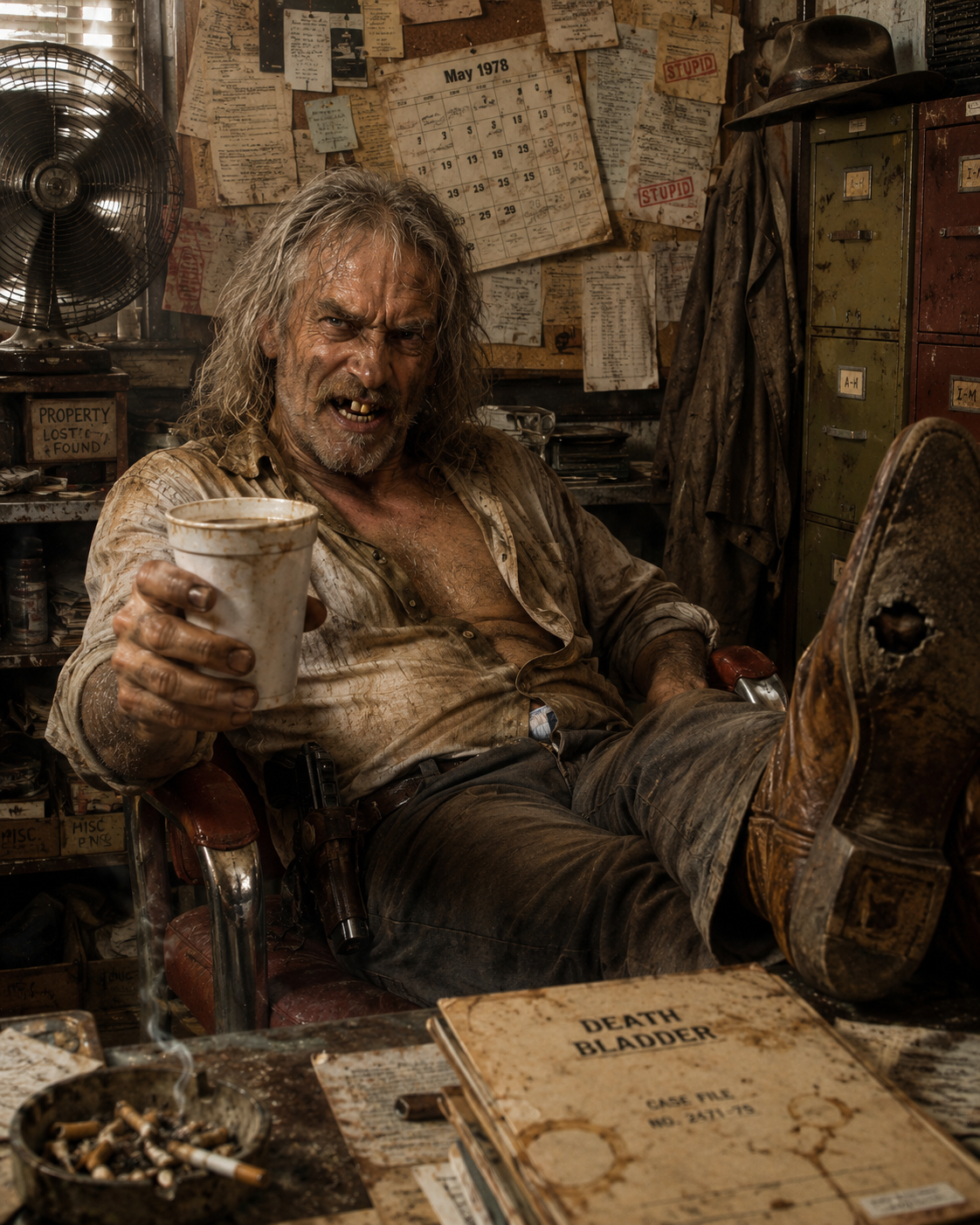
A weathered man in his late 60s with a gaunt, skeletal build and deeply lined face that speaks of hardship and age. He has long, straggly gray-white hair that falls past his shoulders, thinning at the crown with visible patchy baldness.
His eyebrows are sparse and wispy, while his eyelashes appear thin or absent, giving his eyes a stark, hollow quality. A full, unkempt gray beard covers his lower face and jawline.
His skin is sallow and heavily
His skin is sallow and heavily textured with deep wrinkles, age spots, and a weathered appearance suggesting years of poverty and neglect. He has prominent, sunken cheeks and a gaunt nose.
His typical wardrobe consists of a worn, cream or tan-colored linen shirt left partially unbuttoned, revealing a skeletal chest, often layered with a tattered brown or tan overcoat. He frequently wears a faded, creased fedora or wide-brimmed hat.
His overall appearance is one of destitute exhaustion and aged desperation, embodying a forgotten, impoverished figure from an earlier era.
Identity
- Born
- 1679
- Gender
- male
- Nationality
- Caribbean
- Origin
- Tortuga - mixed
- Ship · 1725
- Kingston
- Ship · 2025
- —
- Berth
- Crew
- Bounty
- 3
Frestagon Profile
Compiled by Dr. Frestagon from observation rather than testimony. Scores out of ten; the commentary is his own.
- Cunning (9) — at the ceiling. Assume premeditation.
- Command (8) — formidable; rarely caught improvising.
- Lore (7) — serviceable, and aware of its limits.
- Strategy (4) — middling; compensated for elsewhere.
- Charm (4) — middling; compensated for elsewhere.
- Navigation (4) — middling; compensated for elsewhere.
- Intuition (2) — a documented weakness. Exploit with care.
- Education (1) — a documented weakness. Exploit with care.
- Empathy (1) — a documented weakness. Exploit with care.
Filed under seal. The subject has not seen this assessment, which is for the best.
Saltwell Profile
Leadership, as the Admiral's office measures it.
Blackwater Profile
Intelligence and tradecraft, by Blackwater reckoning.
Tidecrest Profile
A woman's appraisal — of a woman as she is, or of a man as he believes himself to be.