Diego Ashbone
- Born
- 1682 · Vlissingen
- Faction
- Dock Rats
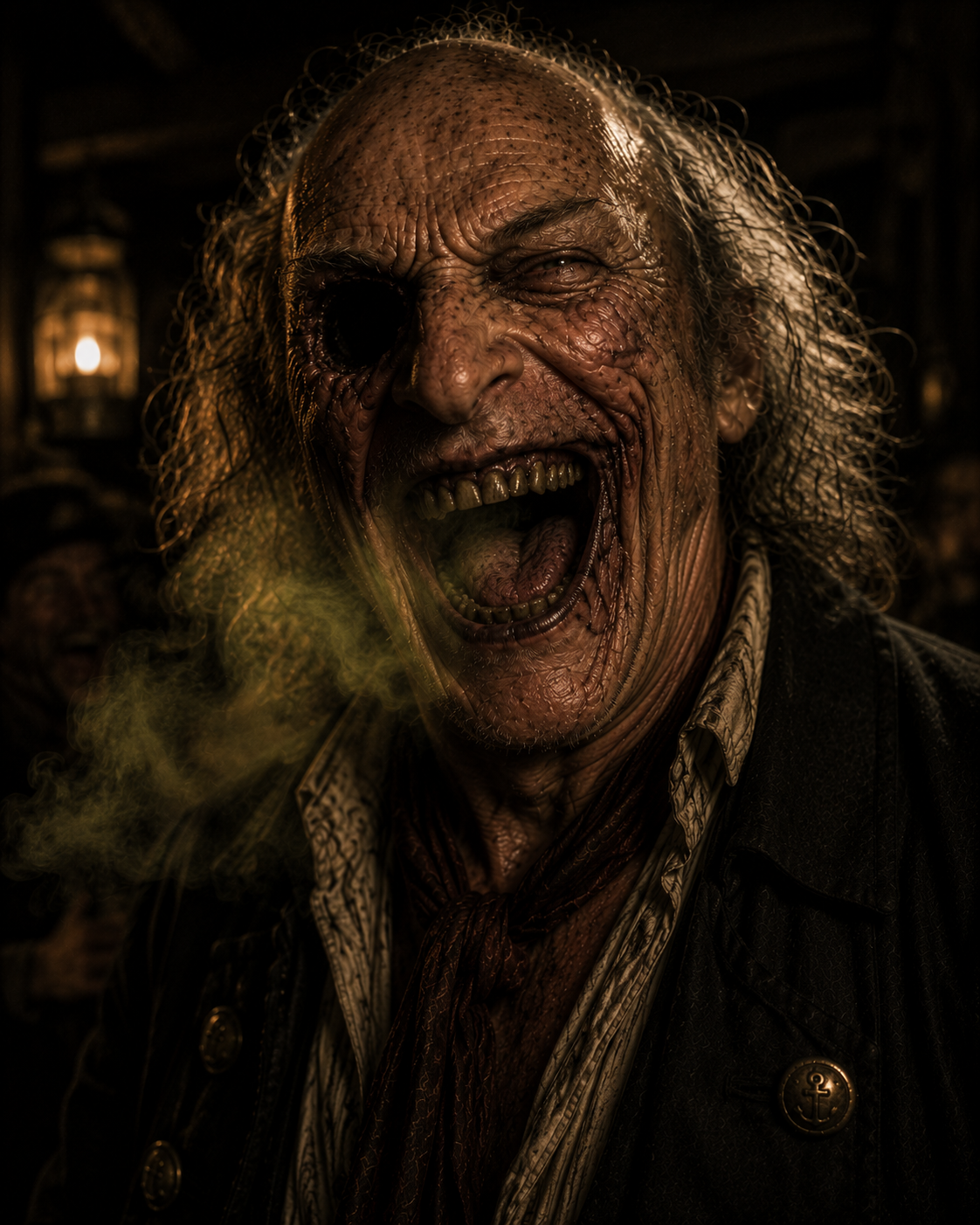
Backstory
THE RECKONING OF DIEGO ASHBONE: A CHRONICLE WRITTEN IN DEBT AND AMPUTATION
Part I: The Foot That Would Not Obey (1715)
The rope came down from the Mary Catherine’s rigging on an ordinary Tuesday in August, the kind of dock-day that Baltimore1 produced by the hundred — salt-smell, cordage-smell, the percussion of mallets on wood, the specific curse-language of men who knew their labour intimately and hated it with precision.
Diego Ashbone was forty-three years old
Diego Ashbone was forty-three years old, or thereabouts; the years before Baltimore had begun to blur in the way that years do when a man has lived across too many latitudes and too few stable anchors.
His right foot was pinned beneath a rope-coil and the wooden davit it rode on, and in the thirty seconds between the shout and the release, he felt his body negotiate a surrender that his mind would spend the next eight years refusing to accept.
The foot had been dying for months already. He knew this now, in retrospect. The burn on his heel that would not knit.
The toes that felt distant, as
The toes that felt distant, as though they belonged to some other man’s body — a man standing in another room, reporting back through increasingly garbled channels.
The fevers that came without rhythm, fever-patterns that made him doubt the evidence of his own skin, made him wonder if the corruption was not physical but moral, another installment of the soul-tax those priests in Havana2 had whispered over his cradle.
When the dockhands lifted the coil away, his ankle was already purple in the exact weave-pattern of the rope. He did not scream.
Men who screamed on the Baltimore
Men who screamed on the Baltimore wharves were remembered, and Ashbone had spent the last thirty years cultivating the opposite condition.
He crawled into the warehouse — or was carried, the memory fragmenting here like a boat breaking apart in a channel — and sat on a crate while a man named Perez looked at it and said the word gangrena with the certainty of someone who had buried men who had ignored that particular word.
The first surgeon came on a Thursday.
He was a man with trembling
He was a man with trembling hands and a bottle that never quite left his belt, and when he raised the saw — a carpenter’s tool, incongruous and obscene in its ordinariness — Ashbone felt something shift in the architecture of his own understanding.
This was not a metaphor. Those priests had meant something literal: the accumulated debt, rendered not in the currency of shame or loss of standing, but in actual flesh subtracted from the ledger of what he was.
When the blade met the marrow, he heard a high bone-pitched note that would live in his sleep for years, and with it came a clarity that might have been shock or might have been something closer to recognition. This, his body seemed to say. This is what you owe.
The recovery was a month of
The recovery was a month of fever-dreams above a tavern where spilled rum and piss never quite separated from the smell of his own wound.
The dressing was changed twice daily by a woman whose name he forgot, whose patience he did not deserve and therefore did not thank. He learned to envy unconsciousness. He learned to hate the surgeon. He learned that burning does not diminish; it evolves.
Part II: The Man Who Reads Water (1700-1715)
Before the rope, before the corruption
Before the rope, before the corruption had announced itself in gangrena and surgical saws, Ashbone had spent fifteen years working the margins that Guadarrama had taught him to navigate. Not the loud piracy that drew Spanish attention. The quiet kind. The profitable kind.
The Salamanca took a merchant off Hispaniola in 1719, four years after the dock accident, which means Ashbone had been operating with a wooden foot and a grudge.
The merchant was a modest prize — sugar and indigo, nothing that would make the broadsheets or draw a gallows warrant.
But it established something: that a
But it established something: that a man with a missing foot could still read the weather in the belly of the clouds, could still see the moment when a crew’s nerve was about to break the way a croc catcher reads the ripple before the reptile surfaces.
This was the skill that never abandoned him, even as everything else — the legs, the ships, the steady accumulation of prize-shares and silent arrangements — began their retreat.
He could watch a man’s posture and know which of them would betray, which of them would freeze, which of them would fight past the point of reason. It was a gift or a curse; the priests would have debated it endlessly, finding theological precedent for either interpretation.
The decade before the accident had
The decade before the accident had been his most productive. The Porto Bello bleed in 1701 — that was a Bartholomew Roberts3 venture, five ships coordinated, the Spanish treasure fleet caught in its own anchorage like roosting birds.
Ashbone had been younger then, two-legged and cunning at full measure, and he’d taken his share: forty pieces of eight, some emeralds, a merchant’s correspondence that proved useful later when leverage was needed.
The blood part came later, when the Spanish sent men, when the retribution became personal. He had not planned on that. Few men do.
By 1715, when the rope came
By 1715, when the rope came down, he had spent nearly thirty years reading the gaps between what the official ledgers said and what the actual weight told you.
He had forged documents with a precision that would have made the Spanish accountants doubt their own memories. He had captained a ship — the La Deuda, named with a directness that in retrospect seemed like tempting fate.
He had made men follow him into places where the risk was clear and the profit was speculative, and they had followed because he did not flinch, because his certainty was the kind that men recognized as the difference between living captains and drowned ones.
All of that — the command
All of that — the command, the certainty, the accumulated capital of reputation — turned to something closer to ash when the foot would not heal and the infection spiraled and the saw came down.
Part III: The Man After (1715-Present)
What becomes of a man when the body that carried his authority into rooms is no longer a functional instrument? Ashbone discovered that the answer was more complicated than simple diminishment.
He learned to move differently
He learned to move differently.
Not with the leverage and reach that dock-work demanded, but with the economy of a man negotiating permanent negotiation — the wooden foot, the altered gait, the specific geography of pain that never quite resolved into something manageable.
The Dock Rats4 took him in after the accident, not out of charity but out of practical necessity: he could still read men, still solve problems that required cunning more than muscle.
A man who cannot haul rope
A man who cannot haul rope can still watch the rope being hauled and tell you which dockhands are about to steal, which merchants are about to cheat, which captains are about to sink.
He became useful in a different register.
He taught younger men the skill that had marked him: how to read intention in the ripple-trace of a man’s posture, how to distinguish the betray-signs from the fear-signs, how to move through crowded docks and warehouses as though he belonged to every conversation happening in parallel.
The reputation that had once been
The reputation that had once been backed by the certainty of command became something more pedestrian and perhaps more durable: the reputation of a man who was bitter enough to be honest.
His contacts deteriorated. The captains who had once answered when he passed now looked through him, and he did not blame them; the pirate deck has no use for men who cannot climb the rigging. He drank more than was reasonable, less than would have killed him.
He kept a room above the same tavern that had housed his recovery, paying rent in the kind of slow, grudging installments that the landlord accepted because he understood the language of accumulated debt.
By 1725, he was a beggar
By 1725, he was a beggar in the formal sense — a man without a ship, without standing, without the structures that had once given his decisions weight. But the word never quite fit. A beggar asks.
Ashbone simply observed, and men around him adjusted themselves to accommodate his gaze, the way water adjusts itself around a stone.
The soul-tax, those priests had said. The debt, rendered in increments.
He was now seventy-three years old
He was now seventy-three years old, or so he reckoned. The priests, it turned out, had been remarkably precise in their accounting.
Appearance
COMPOSITE HEADSHOT: DIEGO ASHBONE (“CRIP”) A Portrait Written from Scar Tissue and Debt
---
The face that emerges from the gallery sequence is not a handsome one, nor does it aspire to be.
It is a face built from
It is a face built from calculation rather than inheritance — the bone structure of a man from mixed Spanish and Cuban stock, neither fully favored by either lineage, and rendered harder still by the arithmetic of living across three decades in waters that do not forgive soft men.
He carries the dark complexion of his mother’s line, the kind of weathered amber-brown that speaks less to ancestry than to salt-exposure and the particular bleaching that comes from squinting into Caribbean light for half a lifetime.
His skin has the texture of old canvas — not wrinkled in the manner of age alone, but creased in the specific patterns left by sun-damage and the tightening that follows prolonged fever. The scars are not particularly numerous; Ashbone has always preferred the kind of violence that leaves no mark.
His face is narrow through the
His face is narrow through the cheekbones, the jaw pronounced and set at an angle that suggests either a break healed poorly or simply the shape of a man who has learned not to soften his expression.
The eyes are the most arresting feature — dark, deeply set beneath a brow that carries a permanent crease between the temples, the kind of furrow that comes from forty years of reading water-patterns and crew-intention simultaneously.
There is no warmth in them, and no false depth. They are the eyes of a man who has learned that sentiment costs time, and time costs lives.
The pupils seem to dilate slightly
The pupils seem to dilate slightly in dim light, a hunting-cat adjustment, and in the gallery sequence you can see how he has learned to position himself in doorways and gangways such that the light never quite reaches both eyes equally — an asymmetry that reads as perpetual wariness.
His nose is straight but slightly flattened across the bridge, the mark of a poorly-reset break from his merchant-brigantine years.
Below it, his mouth is thin and habitually compressed, the corners drawn downward in what could be read as displeasure but is actually closer to permanent calculation.
The lower lip is slightly scarred
The lower lip is slightly scarred on the left side, a thin white line that pulls the mouth into an involuntary half-grimace when he speaks — a tell that he has long since ceased to hide, having learned that a visible flaw often prevents others from searching for invisible ones.
Hair: black in the earlier photographs, threaded through with iron-grey by the 1719 images, and in the most recent portraits (2025) entirely silver-white, though the density remains undiminished.
He wears it close-cropped, neither fashionably long nor aggressively short — a pragmatic length that resists salt-matting and requires minimal maintenance.
The texture is coarse, almost wire-like
The texture is coarse, almost wire-like, and shows the characteristic waviness of mixed heritage, occasionally darkening along the temples where sweat collects.
There is a scar that runs through the left temple-line and disappears into the hairline — a blade-cut from the Porto Bello incident, never quite healed cleanly enough to fade entirely.
The overall impression of the head is compression: a face narrowed by deliberate caloric restriction (poverty or habit, the gallery does not clarify), a jaw locked in perpetual half-clench, eyes that seem too large for the hollow spaces around them.
He carries the look of a
He carries the look of a man who has learned to occupy less space than his actual size requires, a posture of deliberate smallness that reads as either humility or predation, depending on the light.
---
Build and Bearing
The body itself is a study
The body itself is a study in asymmetry.
Even in the earlier portraits (1700s-era sketches), where both legs are theoretically intact, there is a visible favoring of the left side — the left shoulder slightly elevated, the left hand positioned prominently while the right tends toward stillness.
The amputation of the right foot and lower leg, documented in the Baltimore incident of 1715, creates a revision that the gallery registers without melodrama.
By 1719, in the Salamanca-prize images
By 1719, in the Salamanca-prize images, you can see a man who has learned to integrate the loss into his bearing rather than compensate for it. He does not lean.
He does not favor a crutch or cane in the photographs where he is upright; instead, he has learned a particular gait-pattern where the false foot strikes with the exact same cadence as the real one, creating an illusion of normalcy that is actually far more disturbing than any visible limp would be.
This control — this refusal of the sympathetic narrative — marks him as a man for whom the amputation is not trauma but simply the current ledger of what he owes.
The hands, visible in several frames
The hands, visible in several frames, are calloused across the palm and interior fingers in the exact pattern of rope-work and document-handling: the calluses are not uniform, but clustered at specific points that correspond to years of hauling and steering and, most tellingly, of holding a pen with such pressure that the instrument leaves a groove in the middle finger that is visible even in repose.
The fingernails are kept short and filed at a working angle, not for aesthetics but for the kind of grip-work that splinters require constant maintenance.
There are no rings, no jewelry of any kind — a deliberate erasure that suggests either extreme poverty or an equally deliberate refusal of the markers that would identify him as having held rank or wealth at any point.
The overall impression is of hands
The overall impression is of hands that are still working, still calculating, even when they are folded in his lap.
---
Dress and Habitual Presentation
The gallery sequence shows a marked
The gallery sequence shows a marked consistency in wardrobe that reads as either obsessive or tactical: earth-tones exclusively. Ochre linen in the earlier portraits, weathered to the color of old parchment. Russet wool in the cooler seasons.
Brown canvas breeches, grey wool stockings, leather that has faded from cognac to the color of old blood. Nothing bright, nothing that draws the eye.
The clothing is always clean but never new, always functional but never fashionable — the wardrobe of a man who understands that visibility is a liability.
A single visible concession to adornment
A single visible concession to adornment appears in the 1710 images: a leather cord around the left wrist, the kind that might have held a talisman or a charm, though the gallery does not resolve what hung from it. By 1719, the cord is gone.
His coat — where visible — fits loosely in the shoulders and chest, a deliberate bagging that allows for the kind of easy weapon-access that comes from years of working gangways and holds.
The left side of his coat shows slightly more wear than the right, consistent with the favoring documented in his bearing.
In the most formal images (the
In the most formal images (the 1710 Tortuga5 fence-compact photograph, where he wears something approaching a captain’s waistcoat), the garment sits on him like something borrowed from another man — well-made but worn with the air of someone who has simply put on what was available, rather than selected it.
---
The Habitual Expression and Voice
Across every photograph in the sequence
Across every photograph in the sequence, there is an absence of the expression that most men learn to manufacture for such occasions. No smile. No attempt at dignity or military bearing.
Instead, a kind of neutral watchfulness that reads as contempt precisely because it contains no judgment — he simply does not regard the moment of documentation as important enough to alter his resting face.
His eyes, in every frame, are looking slightly past the camera or painter, attending to something in the middle distance that no one else can see. This gives the portraits an unsettling quality: you are never quite the object of his attention, even when he is positioned directly facing the artist.
The voice, documented in the testimony
The voice, documented in the testimony fragments and crew-letters on file, is described consistently as quiet — not soft, but quiet, the kind of quiet that makes men lean closer to hear, which means they are already leaning into his gravity before they realize it.
He does not raise his voice to command; instead, men seem to lower theirs to listen.
The accent is Cuban-inflected but not densely — his Spanish is audible in the vowel-shapes, but the English he would have acquired in Baltimore and through maritime commerce sits atop it without displacing it, creating a hybrid diction that puts listeners slightly off-balance.
He does not repeat himself. If
He does not repeat himself. If a man does not hear the first time, that is registered as inattention, and inattention is a choice for which there are consequences.
---
Summary Impression
Diego Ashbone at seventy-three — or
Diego Ashbone at seventy-three — or thereabouts, the years blur — is a man whom the eye does not naturally seek out in a room.
He has learned, over five decades of living across waters and margins, to be the thing in the corner that you do not quite notice until it moves. The missing foot has not diminished this quality; if anything, it has refined it.
He is neither threatening nor pitiable, which makes him more genuinely dangerous than either. The face is a document written in debt and salt-damage and the particular clarity that comes from a life lived entirely without forgiveness.
He will not age the way
He will not age the way other men do; he is already worn to the grain, and grain does not deteriorate further, it only hardens.
Identity
- Born
- 1682
- Gender
- Male
- Nationality
- Dutch
- Origin
- Vlissingen
- Ship · 2025
- —
Frestagon Profile
Compiled by Dr. Frestagon from observation rather than testimony. Scores out of ten; the commentary is his own.
- Cunning (5) — middling; compensated for elsewhere.
- Intuition (4) — middling; compensated for elsewhere.
- Command (2) — a documented weakness. Exploit with care.
- Strategy (1) — a documented weakness. Exploit with care.
- Charm (1) — a documented weakness. Exploit with care.
- Lore (1) — a documented weakness. Exploit with care.
- Navigation (1) — a documented weakness. Exploit with care.
- Education (1) — a documented weakness. Exploit with care.
- Empathy (1) — a documented weakness. Exploit with care.
Filed under seal. The subject has not seen this assessment, which is for the best.
Saltwell Profile
Leadership, as the Admiral's office measures it.
Blackwater Profile
Intelligence and tradecraft, by Blackwater reckoning.
Tidecrest Profile
A woman's appraisal — of a woman as she is, or of a man as he believes himself to be.