Lorenzo Spinola
- Ship
- Embered Veil Captain
- Position
- Captain
- Faction
- Bog Witch Armada
Backstory
THE OWL OF THE BOG WITCH ARMADA A Chronicle of Lorenzo Spinola, Called The Owl
The Spinola counting-house occupied three stories of pale limestone near the Porto Antico in Genoa, where the afternoon light turned the harbor water the color of old bronze.
The eldest Spinola sons had managed merchant ventures since before Columbus sailed — spice routes, alum contracts, the careful triangulation of credit that kept the republic’s purse fat.
Lorenzo’s father, Giacomo, had added slave
Lorenzo’s father, Giacomo, had added slave ledgers to that inventory sometime in the 1660s, a diversification that had proven as reliable as the tides. Lorenzo was the fourth son, surplus to primary inheritance, and thus marked early for the Church.
He took minor orders at seventeen, keeping the company of Capuchin friars and Dominican scholars who noted his peculiar gift: Lorenzo could read a ledger the way other men read scripture.
Numbers spoke to him in sequences, in patterns that revealed the hidden architecture of commerce. His superiors intended him for a monastic counting-house, where his talents might serve both God and the ecclesiastical purse. The tonsure was shaved into his crown each quarter by a friar’s careful blade.
But in 1680, when Lorenzo was
But in 1680, when Lorenzo was barely thirty, his father sent word that a younger cousin had defaulted on investments in the Caribbean sugar trade.
The family required a man on the ground in Port Royal1 — someone educated enough to manage factors, ruthless enough to recover losses. The Church released him from his vows without ceremony. The tonsure grew back slowly, stubble by stubble, though it has never grown properly since.
Lorenzo arrived in Jamaica2 to find the Caribbean was not Genoa. In Genoa, credit flowed through channels worn smooth by centuries. Here, fortunes turned on weather, piracy, and the capricious whims of colonial governors.
He took lodging above a counting-house
He took lodging above a counting-house on the dock, purchased a small sloop, and began moving sugar, logwood, and indigo through ports where taxes were negotiable and manifests could be rewritten. By 1685, he had recovered the family’s losses and tripled them.
What he discovered in himself during those five years was that he preferred the disorder of the sea to the suffocating precision of legitimate commerce.
A merchant’s life demanded compliance to factors beyond his control — spoiled cargo, crown tariffs, the jealousy of competitors with better patronage. But the sea permitted a different mathematics.
If you knew your enemy’s manifest
If you knew your enemy’s manifest in advance, knew which routes the colonial Navy would not patrol, knew which officials could be bought with precisely the right sum — then the mathematics became elegant. Predictable.
In 1687, Lorenzo joined a consortium of buccaneers operating out of Tortuga3. He brought no bloodlust to the enterprise, only methodology. While other captains relied on ferocity and boarding assaults, Spinola cultivated intelligence.
He maintained correspondents in every significant port: chandlers, harbor masters, enslaved workers on the docks who observed the loading of merchant vessels. A ship’s worth was calculated before the flag was even sighted.
Crews that paid shares to the
Crews that paid shares to the common stock and proved useful were kept. Those who stole, who failed, who endangered the venture through stupidity or drink — they were removed, without ceremony or prolonged suffering. The Owl did not torture. He simply corrected.
The nickname emerged during this period, though its origin was disputed even then. Some crew swore it derived from his nocturnal habits — Spinola preferred to navigate at night, running dark with no lanterns, reading the stars with unnatural precision.
Others claimed it was the way he held his head during council, cocked at an angle, eyes unblinking, absorbing information before rendering judgment.
A few of the more superstitious
A few of the more superstitious whispered that it came from something older: that Spinola trafficked with the witches of the Bog, the women who dwelt in the mangrove swamps beyond civilization, who read bones and herbs and the movements of creatures unseen.
There was no truth to the witchcraft rumors, not in any conventional sense.
Yet by 1695, Spinola commanded the Marsh Hex4, a shallow-draft brigantine perfectly suited to threading through the coastal lagoons and hidden cays where the Spanish Navy could not follow.
His crew numbered forty, each man
His crew numbered forty, each man receiving shares calculated to the penny, each accounting logged in ledgers that Spinola maintained in his private cabin — ledgers written in cipher, in his careful Genoese script, a record of debts owed and obligations that extended backward and forward across years.
What separated Spinola from other successful captains was not cruelty but absence of sentiment. He had trained himself long ago, in his merchant days, to regard human beings as variables in a calculation.
A man’s utility could be measured: his skill, his loyalty if properly incentivized, his cost in food and water and shares.
When his utility declined — when
When his utility declined — when injury made him slow, when age made him unreliable, when vice made him unpredictable — then the mathematics demanded his removal. There were no personal grudges, no theatrical executions.
Spinola simply arranged for a man to be put ashore or, if discretion required it, to disappear between one watch and the next. The crew understood this. It was the logic that kept them safe and rich.
By the early 1700s, Spinola had amassed sufficient wealth to retire. He kept properties in three colonial ports, maintained accounts with Genoese merchant houses under assumed names, owned shares in legitimate ventures that laundered his pirate earnings.
He could have faded into respectable
He could have faded into respectable commerce, resumed his rightful place in the merchant world. Instead, he deepened his entanglement with the Bog Witch Armada5, that loose confederation of captains who had discovered that coordinated intelligence was more profitable than individual raids.
His greatest gift to the Armada was not seamanship but architecture — the systematic organization of information. He built networks. He trained agents in cipher and tradecraft.
He created systems by which a merchant vessel’s manifest could be known three ports before it sailed. Under his quiet direction, the Armada transformed from a loose association of brigands into something approaching an institution, with rules, hierarchies, and procedures that maximized profit while minimizing exposure.
Now, in his sixties, Spinola commands
Now, in his sixties, Spinola commands still, though the crew has learned not to remark on the tremor that occasionally seizes his left hand, or the way he sometimes loses the thread of conversations, his pale eyes going distant, as if reading text only he could see.
The Owl retains his four fingers on the right hand, though no man aboard knows how he lost the fifth — whether in combat, accident, or some older covenant. His hair, where it grows, has turned to iron wire. The gold ring in his left earlobe catches the Caribbean sun as it once caught the light in Genoa.
He moves still with the grace of a man who has read the world in ledgers and learned to move through it as calculated expenditure. When he speaks, men listen. When he judges, the Armada obeys.
The tonsure has never grown back
The tonsure has never grown back properly, leaving a pale scar of baldness that some say resembles an eye — unblinking, owlish, absorbing everything, forgetting nothing.
Appearance
THE OWL: A COMPOSITE HEADSHOT
Face & Build
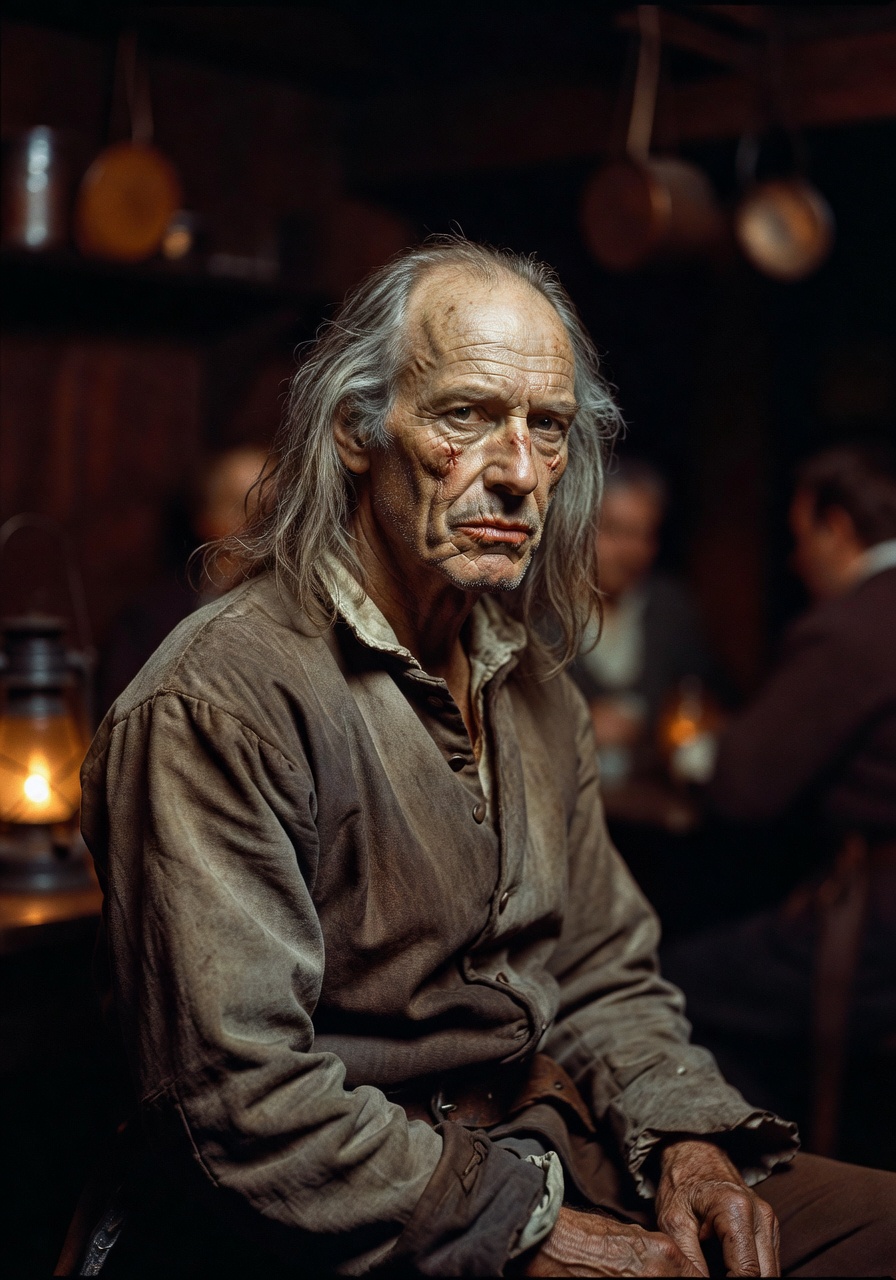
Lorenzo Spinola carries the architecture of his Genovese line in the bones of his face — a long, deliberate jaw that tapers toward a pointed chin, cheekbones that sit high and angular, lending the whole countenance a raptor’s severity.
His brow is broad and pale
His brow is broad and pale, lined now in the manner of a man who has spent four decades reading ledgers and navigating by starlight; the creases run deep between his eyes, two permanent furrows that give him the aspect of someone engaged in perpetual calculation.
His eyes themselves are pale — a grey that borders on colorless in certain light, ringed with the fine web of wrinkles that comes not from laughter but from sustained, unsentimental observation.
They are the eyes that earned him his name: they do not blink at the conventional pace. He holds them open longer than comfort dictates, a habit that causes men to look away first, a small but consistent surrender.
His skin retains the pallor of
His skin retains the pallor of northern European stock, though the Caribbean decades have weathered it to something closer to old parchment — the texture of a man who preferred shade and lamplight to the bleaching sun of the trade routes.
There is a pockmark or two along his left temple, barely visible unless the light catches them at a particular angle, the ghost of a childhood illness that never quite erased itself.
His hair, once black as pitch according to the elder merchants who remember him from the Port Royal days, has gone entirely silver-grey — not the soft silver of age but something harder, more metallic, like iron filings combed through with an old man’s deliberate care.
He wears it longer than fashion
He wears it longer than fashion dictates in the modern age, swept back from his face in a style that would have been ordinary in the 1690s, when he was young enough to sail without apology.
It reaches his collar now, kept neat but not fashionable, the grooming of a man who no longer concerns himself with the approval of establishments he has already outlived.
His build is spare. He is not tall — perhaps five foot nine or ten — but the thinness of his frame makes him appear longer than he is, stretched like a piece of old rope.
The Lyme disease that struck him
The Lyme disease that struck him in 2018 took what muscle he possessed and left him lean in a way that speaks less of asceticism than of depletion. His shoulders do not slope; they remain squared with an effort that is visible only if you know to look.
His hands are a cartographer’s hands — long-fingered, capable of precise notation, marked with the ink stains of a man who still writes his own ledgers when the tremor permits.
There is a slight palsy in his right hand, barely perceptible at rest but visible when he writes or pours drink, a neurological residue of the disease that he does not acknowledge and will not discuss.
His fingers are stained with nicotine
His fingers are stained with nicotine; he smokes a thin clay pipe constantly, a habit from the Tortuga years that has become as essential to him as breath.
Bearing & Expression
In repose, Spinola’s face is a blank page — not cruel, precisely, but empty of the social gestures that most men deploy instinctively. He does not smile unless calculation dictates it.
When he does, it is the
When he does, it is the smile of a man moving a piece on a board, the expression entirely unconnected to any warmth of feeling.
His habitual expression is one of listening: the jaw set, the eyes steady and unblinking, the whole apparatus of his face arranged to receive information without broadcast.
Men interpret this stillness variously — as menace, as intelligence, as the vacant stare of a man half-deaf. All three interpretations contain some truth.
He moves without haste. Even in
He moves without haste. Even in his youth, according to the Port Royal ledgers, he was never a man to run or gesticulate.
Now, with the neurological compromise of the Lyme, his gait has become deliberately economical — each step measured, each gesture considered before execution. There is no wasted motion, and there is no hurry. This measured quality extends to his speech.
He does not interrupt, does not raise his voice, and rarely speaks more than necessary.
When he does, his accent retains
When he does, his accent retains the precision of Genoese Italian overlaid with the Caribbean cant of three centuries of trade — a linguistic palimpsest that marks him as foreign everywhere and native nowhere.
His voice is not loud; it is simply clear, pitched low enough that men must lean in to hear him, creating a small island of intimacy around each conversation. The effect is deliberate and practiced.
Habitual Dress
Spinola adheres to an earth-tone palette
Spinola adheres to an earth-tone palette with the consistency of a man who has internalized a code of conduct so thoroughly that deviation is unthinkable.
His coat is usually a weathered ochre or russet wool, cut in a style that lags current fashion by fifteen to twenty years — not from poverty but from indifference. The buttons are pewter, tarnished to a dull grey.
Beneath the coat he wears a linen shirt of pale amber or dove-grey, stained at the cuff with ink and salt water in roughly equal measure. His breeches are brown canvas, practical and worn, the knees reinforced with patches of darker cloth.
His boots are black leather, cracked
His boots are black leather, cracked along the instep but maintained with the kind of care that suggests habit rather than vanity. He wears a tricorn hat, also ochre-brown, creased and re-creased so many times that it has taken on the texture of old suede.
The hat is always present, even indoors, removed only when protocol demands it — a gesture he performs with visible reluctance.
Around his neck he wears a cord of twisted hemp, knotted at intervals, with no apparent ornament or purpose.
Below the collar line, hidden from
Below the collar line, hidden from casual view, hangs a leather pouch containing what his crew assumes to be talismans — bone, dried herbs, materials that might be read as witchcraft or superstition depending on the observer’s inclination.
He does not deny the rumors. In the Bog Witch Armada, the rumors serve better than truth could.
His hands are rarely without tools: a piece of chalk for rapid calculation, a small leather journal bound in russet leather, a pair of spectacles on a cord despite the fact that his vision remains sharp.
These are not accessories but implements
These are not accessories but implements, the visible apparatus of a mind that operates perpetually in the register of commerce and strategy.
The Owl Itself
The nickname does not derive from a single incident but from the composite effect of his presence: the unblinking eyes, the nocturnal vigilance, the preference for high perches from which observation is possible, the lack of ceremony in the culling of inefficiency or prey.
He does not hoot or call
He does not hoot or call attention to himself. He does not need to.
Men simply come to understand, over time and repeated exposure, that there is nothing warm or forgiving in him, that he operates according to principles that do not include mercy, and that his patience is infinite only because he has internalized the knowledge that time itself is a weapon — that a man who will wait outlasts a man who will not.
This is the composite: a man at the intersection of medieval accounting and modern decay, still navigating by stars that ceased burning centuries ago, moving through the world with the precise economy of a creature that has learned to survive by seeing what others cannot, by calculating what others refuse to quantify, by acting at the moment when the leverage is perfect and the mathematics has resolved into inevitability.
Identity
- Gender
- Male
- Nationality
- English
- Origin
- England
- Ship · 1725
- Embered Veil
- Berth
- Captain
Frestagon Profile
Compiled by Dr. Frestagon from observation rather than testimony. Scores out of ten; the commentary is his own.
- Navigation (9) — at the ceiling. Assume premeditation.
- Cunning (8) — formidable; rarely caught improvising.
- Strategy (8) — formidable; rarely caught improvising.
- Charm (8) — formidable; rarely caught improvising.
- Intuition (7) — serviceable, and aware of its limits.
- Education (6) — serviceable, and aware of its limits.
- Lore (5) — middling; compensated for elsewhere.
- Command (4) — middling; compensated for elsewhere.
Filed under seal. The subject has not seen this assessment.
Saltwell Profile
Leadership, as the Admiral's office measures it.
Blackwater Profile
Intelligence and tradecraft, by Blackwater reckoning.
Tidecrest Profile
A woman's appraisal — of a woman as she is, or of a man as he believes himself to be.