Backstory
LIDDY BILGE: THE ARITHMETIC OF NOTHING
I. The Weight of Fiber
The oakum pile sat at the eastern edge of Nassau1’s dock in the spring of 1723, where the sun stayed longest and the smell of brine mixed with something fouler — the rot of old cordage, and underneath that, the particular stench of bodies that had labored until they stopped distinguishing hunger from work.
Liddy knelt there in the dust-bright
Liddy knelt there in the dust-bright afternoon, his club foot braced against the warped planking, his fingers already dark with tar that would not come clean.
The rope before him had been Navy stock once, salvaged from a merchant vessel that had rotted at anchor, and it carried in its fiber the memory of salt and time and the specific kind of abandonment that comes when a ship is too broken to be worth repair.
His hands moved through the motions without instruction from his mind. Separate the strand. Card the fiber with the wood comb. Shake loose the oakum. Stack it in the canvas sack at his knee.
The work required no cunning, no
The work required no cunning, no strategy, no charm — it required only that his body show up and repeat the same gesture until Fletcher, the foreman, weighed the pile and paid him in coppers that would buy bread that would keep him breathing another day.
Thirty-eight years old. He had never learned to want anything more complicated than that.
The woman beside him, Catherine, had told him once not to think about his hands. “Think about somewhere else,” she’d said, her remaining teeth yellow in the sun. “I think about my daughter in Philadelphia.
I think about the weight of
I think about the weight of the furniture in her house.” Liddy had tried this method. His mind, when he directed it anywhere at all, arrived at blank spaces. He had no daughter. He had no furniture. He had no “somewhere else” to retreat into.
What he had was the present rope and the present ache in his lower back and the copper taste in his mouth that came from hunger held at the exact level it needed to be — enough to keep him conscious, not enough to let him forget.
His education would not have let him calculate the economics of his own labor even if he’d possessed the will to try.
He could not read the ledger
He could not read the ledger Fletcher kept, could not negotiate any term of his own work, could not imagine a world in which a man like him might ask for more than what was given.
His intuition, equally meager, meant that the world arrived at him as a series of shocks rather than as a sequence he might anticipate. The rope was what it was. The sun was what it was. Pain was what it was.
A snivel escaped him — wet, involuntary, the sound of a nose running that he could not afford to have run. Fletcher glanced over, then away, as though Liddy were a natural phenomenon, like drizzle.
The nickname had attached itself to
The nickname had attached itself to him the first week: Snivel. Not mockery, exactly. Description. It was what he did. It was what he was.
II. The Accident of Desperation
The holy-water scheme arrived not as invention but as accident, the way all survival does in the dock quarters — as the convergence of two stupidities that briefly illuminated each other.
A woman had appeared on the
A woman had appeared on the customs steps in late March, her child fevering so badly that even fever could not keep him still. She had clutched Liddy’s arm — and this was the remarkable part, that anyone would touch him at all — and asked if he knew any blessing, any charm, anything that might turn the sickness back.
Liddy had done nothing to encourage this. But desperation has its own grammar, and it had chosen him because he was there, because he was the first thing her exhausted eyes had landed on that did not look like it might demand money.
He had opened his mouth to say no. Instead, words came out — not his words, but words he had heard in the almshouse chapel thirty years prior, Latin syllables that meant nothing to him but that seemed to carry weight in the shapes his mouth made. The woman had pressed a shilling into his palm.
Three days later, the child had
Three days later, the child had stopped crying. The fever had broken, or it had simply killed him quietly — Liddy would never know which.
But the woman had told three other women, and those women had told others, and by April he had accumulated a small and precarious business: sixpence for a blessing over water, threepence for a prayer whispered into someone’s ear, a copper or two for the mere act of his presence in a sick room, as though his accumulated damage might have transmuted into something holy.
He had never intended cunning. He had no strategy for expansion, no vision of himself as anything other than a man who broke ropes apart.
But his complete absence of charm
But his complete absence of charm worked in his favor — he could not persuade, could not con, could not deploy the small manipulations that would have made people suspicious. His snivel was authentic. His desperation was real.
His incomprehension of how he had stumbled into this work was visible on his pale, worn face. People believed him because he clearly did not believe himself.
The arrangement lasted four months. Fletcher discovered the side income in August when one of the other pickers reported Liddy absent three afternoons.
Fletcher had beaten him with professional
Fletcher had beaten him with professional economy — enough to hurt, not enough to prevent him from working — and had raised no objection to the blessing trade itself. What had offended Fletcher was the theft of time.
Liddy’s body belonged to the oakum pile until Fletcher decided otherwise. What happened in the interstices of that belonging was not theft. It was immaterial.
By September, the women had stopped coming. Word had spread that his blessings had lost their efficacy, or the season had turned, or people had simply forgotten him in the way the poor forget everything that does not feed them today.
He had earned perhaps three shillings
He had earned perhaps three shillings beyond his dock wages — not enough to change anything, not enough to have mattered at all, and yet it had cost him something he could not name. The experience of having been chosen, however briefly, by accident.
III. The Habit of Nothing
What Bourdieu would have called his habitus — the embodied, pre-conscious certainty of his place in the world — had crystallized long before Nassau, long before the almshouse, even long before the tobacco barrel had rolled toward him on the Liverpool wharf.
It had begun at birth, in
It had begun at birth, in the instant the midwife’s eyes had registered the twisted foot and she had simply left the garret without ceremony. That abandonment had been the first and truest lesson: he was not worth staying for.
His parents had reinforced it through the simple grammar of their own failure.
His father’s silence, his mother’s indifference — these were not cruelties so much as accurate reflections of what Liddy actually was: a mouth that consumed bread, a body that took up space, a minor problem that neither of them had the resources to solve.
The almshouse, when it came, had
The almshouse, when it came, had not been a shock. It had been a confirmation. The institution had simply made official what his family had already understood — that he was a unit of disposal, to be warehoused efficiently until he became productive or died.
The dock work had followed inevitably, because a man with a club foot could do very few things. Oakum picking required no strength, no agility, no judgment.
It required only that he stay still enough to not lose his balance and show up often enough to be remembered. In return, he received coppers, and coppers purchased the minimum necessary to stay alive. The equation was absolute.
There were no openings in it
There were no openings in it, no moments of negotiation. His low cunning — his inability to see angles, to imagine himself as capable of manipulation or improvement — was not a failing but a perfect adaptation to a world that had no use for his ambition.
This is what he was in 1725, and what he would remain: a man whose body had learned, before his mind could form words to resist, that he occupied the lowest stratum of a hierarchy with no exits. The snivel was not a symptom of weakness. It was the sound of accurate self-knowledge, made audible.
THE ORIGIN OF LIDDY BILGE
Birth, Damage, and the First Theft
Birth, Damage, and the First Theft
The midwife who delivered him in a Liverpool garret in 1705 did not stay long enough to see the foot. She had been paid sixpence by his mother, Jane Bilge, a woman who took in washing and kept her pregnancies secret until they could no longer hide in wool.
When the child emerged — undersized, grey-faced, with a caul that had to be torn — the midwife wrapped him in a scrap of linen that smelled of lye and old sweat, collected her coin, and descended the stairs.
By the time Jane had cleaned
By the time Jane had cleaned herself and gathered the strength to look at what she had made, the damage was already there: the left foot turned inward at a cruel angle, the toes curled as though the infant had been trying to fold himself back into the womb.
Jane Bilge was not a woman given to sentiment. She had borne two children before Liddy, both dead before their second year from the usual causes — cough, flux, the fever that came without warning in the Liverpool autumn.
She wrapped Liddy in what cloth remained, laid him in the wooden crate that served as a cradle, and returned to her washing. There was no money for physicians. There was barely money for bread.
His father, a man named William
His father, a man named William2 Bilge who worked the timber yards when he was sober, took one look at the foot and did not speak of it again. He did not speak much of anything.
He drank on Thursday and Friday, slept through Saturday, and returned to the yards on Monday with the same hollow expression that preceded his marriage and followed his daughter’s burial in 1703.
Liddy learned early that his presence in the garret was not protection but a state of weather — something that happened, that made noise, that passed.
The foot shaped everything that followed
The foot shaped everything that followed. Liddy could walk, after a fashion, by age three — a hitching sideways motion that made other children laugh and made adults look away.
By five, he was bringing water from the well, a task his mother assigned not from cruelty but from necessity: his older sister, Mary, had been sold into service in Manchester, and the washing required hands.
Liddy’s hands were small and would not grow less so, but they could carry a bucket if he stopped every ten strides to rest his hip.
The Liverpool docks were a geography
The Liverpool docks were a geography of hierarchies, and Liddy’s position within that geography was clarified on a Tuesday in 1713, when he was eight years old and already taller than he would ever be wide.
His father had been taken on as a temporary hauler for a merchant brig that had arrived with a cargo of Virginia tobacco.
William had brought his son to the wharf, not from paternal intent but because Jane had work that morning and William did not know what to do with him. The boy was told to sit on a bollard while the men worked.
What happened next was not dramatic
What happened next was not dramatic: a rope had come loose from a winch, and a tobacco hogshead had shifted. A man named Robert Hughes, a foreman, had cursed and kicked the barrel. It had rolled, slowly, toward where Liddy sat.
The boy had tried to move — his body had understood the danger before his mind had fully assembled it — but his foot had caught on the corroded iron ring bolted to the bollard. He had fallen sideways. The barrel had stopped a foot away from his head, resting against the very rope that had come loose.
Robert Hughes had looked at him for a long moment. Then he had looked at William Bilge, who was standing slack-armed fifteen feet away. Then he had turned to his men and said: “This one’s no use. He’ll lose a leg before summer.”
Liddy was paid nothing for the
Liddy was paid nothing for the morning. William was not hired again. That night, Jane had wept — not from sympathy, but from the mathematics of lost income. His father had struck her.
Liddy had lain in his corner of the garret and felt, for the first time, the clarifying sensation that comes when a person understands himself to be surplus.
By 1716, the almshouse gates were inevitable. His mother had fallen ill that winter — a cough that would become his first memory of her absence.
His father had simply vanished into
His father had simply vanished into the pattern of his own failing, leaving behind an empty garret and debts no one would collect. The parish officer came on a Tuesday, the same day of the week on which the tobacco barrel had rolled.
Liddy was eleven years old, pale from fever, his club foot wrapped in cloth that no longer bore the memory of any color.
He was taken to St. Giles Almshouse in London3, a place where the disposal of small, damaged, useless lives was conducted with the efficiency of a warehouse operation.
The almshouse did not educate him
The almshouse did not educate him — it sorted him. Boys who could be apprenticed were sorted one way. Girls who could be placed into service went another.
Liddy, marked by the foot and by the habitus it had installed in his body before consciousness could interfere, was sorted into the third category: those who would labor in place until they wore out.
By age thirteen he was in the oakum shed, his fingers separating the tar-stiffened fibers of old rope that no ship would use again, producing nothing of value except the substance of his own endurance. The work required no cunning.
It required only that his body
It required only that his body show up and repeat the gesture until Fletcher, the overseer, weighed the pile and allocated him his portion of gruel. The body learns before the mind can resist.
Bourdieu would have called it crystallization — the inscription into flesh and bone of a social position so durable that resistance itself becomes unintelligible.
By 1720, Liddy had become invisible in the way that is useful to institutions. He was paid almost nothing. He ate almost nothing. He asked for almost nothing. This last quality — the absolute absence of demand — made him valuable.
The other boys in the shed
The other boys in the shed occasionally spoke of running. Liddy did not speak of running. He had never left Liverpool. He had seen London once, from the inside of a parish cart. The world beyond the almshouse compound was not a place he inhabited in imagination. It was a place that happened to other people.
The first theft happened because of a snivel.
It was winter 1721, and Liddy was sixteen. A woman named Catherine had been brought into the shed — older, perhaps forty, marked by the same crystallized despair that characterized long-term inmates.
She had been beside him one
She had been beside him one afternoon in early December when the fever had come through the compound. Liddy’s nose had run continuously for three days. He could not afford a cloth. He sniveled.
Catherine had watched him work through the afternoon in this state and had spoken to him for the first time: “You need grease. Fat on your face, under the nose. Keeps the cold from getting in.”
Liddy had not responded. He did not know how to receive instruction that was not punishment.
That evening, Catherine had placed somethi
That evening, Catherine had placed something on the shelf above his sleeping place. A small pot of tallow, skimmed from the kitchen waste. She had done this despite the fact that taking anything from the kitchen was an offense that brought the strap.
She had taken a risk for him without asking anything in return, and this had broken something in his understanding of how the world worked. The kindness was so foreign that it had registered first as suspicion, then as debt.
Three days later, when Fletcher discovered the pot missing and the investigation had begun, Liddy understood what he had to do. He had claimed he had stolen it. Catherine had watched him take the strap without crying out.
Afterward, his back marked with the
Afterward, his back marked with the lines of the beating, he had understood something about himself that had not been available to him before: that he could act. That an action, even a false confession, could alter the trajectory of another person’s suffering.
That the habitus of absolute foreclosure — the sense that nothing could be changed, that all outcomes were predetermined by his club foot and his absence of charm and his utter lack of cunning — could be breached from the inside, not through brilliance, but through the simple willingness to absorb harm meant for someone else.
This was not a crime in the sense that the law would recognize. It was an act. It was the first time Liddy Bilge had moved against the current of his own disposal.
He did not know it yet
He did not know it yet, but it was also the beginning of the man who would, in the fractured arithmetic of later years, become something other than what Liverpool and London and the almshouse had decided he must be.
Appearance
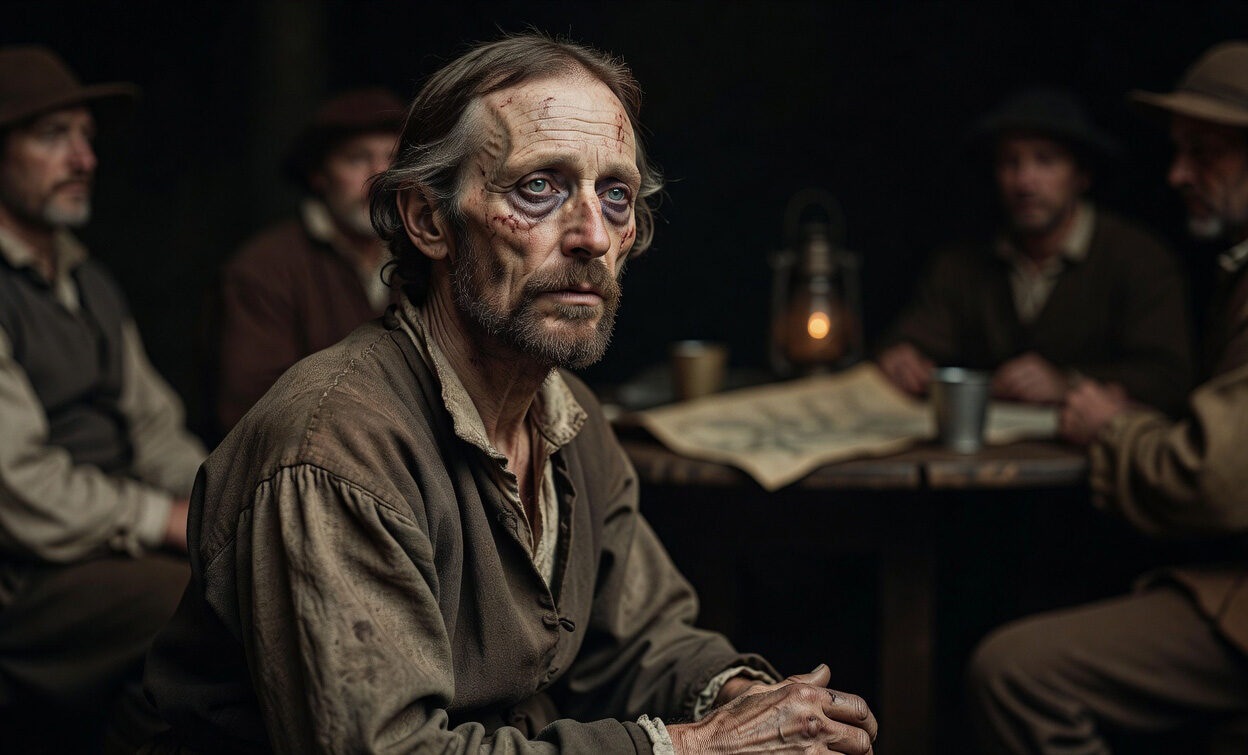
LIDDY BILGE: THE BODY AS LEDGER
A Composite from the Photographic Record
---
The face that emerges from the
The face that emerges from the gallery sequence is not the face of a man who has aged into dignity. It is the face of a body that has been subtracted from, year by year, until what remains is the minimum required to keep breathing.
The skull itself — high-cheekboned, narrow through the jaw — speaks of ancestral English stock, the kind that runs through the dock quarters of Liverpool and the workhouse wards of London, bloodlines that have seen neither wealth nor particular misfortune, only the grinding middle-register of survival.
The skin is pale, as it has always been pale, but not the pallor of aristocracy or ill health.
It is the colorlessness of someone
It is the colorlessness of someone who has spent decades indoors, in almshouses and shelter dormitories, or outdoors in the grey light of northern latitudes, where sun is a rumor rather than a fact.
There is a transparency to it now — in the most recent portraits — that comes from malnutrition held at a steady state, the skin stretched across the structure beneath like old linen.
The eyes are small, set deep, and possess the quality of objects that have learned not to expect anything from what they see. They are light in color — grey, or grey-blue, the kind that fade further with age — and they do not hold your gaze.
Instead, they move past you toward
Instead, they move past you toward something that may not exist, the perpetual orientation of a man whose attention has never been worth commanding. The brows above them are pale and sparse, barely visible against the forehead.
There is no intensity in the face, no suggestion of will or calculation. What there is instead is a kind of settled resignation, the expression that develops when a person has accepted, at the level of bone and blood, that the world will never ask his opinion.
The nose is narrow, English, unremarkable — the kind that breaks easily and heals without ever being attended to.
In the later portraits, there is
In the later portraits, there is a permanent slight deviation to the left, as though it had been struck at some point and simply abandoned to its new geometry.
The mouth is thin-lipped, and in the photographs where his lips are visible at all, they hold no expression — neither smile nor grimace, just the neutral closure of a mouth that has learned silence serves better than speech.
His teeth, visible in perhaps two of the images, are yellowed and broken in the pattern characteristic of lifelong poverty: the kind of damage that comes not from disease so much as from the simple fact of being unable to afford a dentist.
The lower front teeth are notably
The lower front teeth are notably absent, creating a slight concavity to the lower jaw that affects how he speaks — a slight whistle, a softening of certain consonants.
The hair in the earliest portraits is dark, nearly black, with the texture of someone who has never had the means to treat it with anything beyond cold water.
By the middle sequence of images, grey has begun to penetrate the dark, first at the temples, then spreading backward like frost across the crown.
In the most recent portraits —
In the most recent portraits — and this is the definitive image — the hair is substantially grey, thin enough that the scalp shows through in places, particularly at the crown where a permanent ridge has formed from decades of resting the back of his head against hard surfaces.
The hair is always unwashed, always matted slightly, always cut (when cut at all) with the brutal efficiency of institutional clippers. There is no vanity in it, no styling. It simply grows and is sometimes shortened, and that is the extent of the relationship.
The jaw and cheekbones carry the architectural legacy of his English heritage, but that architecture has been eroded by time and hunger into something more severe.
The cheekbones are high and prominent
The cheekbones are high and prominent — too prominent, in the way that comes when the face has lost the padding of adequate nutrition and sits directly against the skull. The jaw has become narrow with age, the muscles that once moved it now slack.
There is a particular quality to the lower face that repeats across the image sequence: a subtle asymmetry, a slight cant to the chin, that makes his expressions — what few he permits himself — appear perpetually on the verge of a wince or a snivel.
The neck in the photographs is thin, corded, the skin loose in a way that suggests he has lost significant weight at some point and never regained it.
The shoulders, visible in the full-frame
The shoulders, visible in the full-frame images, are narrow and slightly rounded forward — the posture of someone who has spent thousands of hours hunched over fine work or washing dishes, the body molded by repetition into its permanent shape.
The back, when visible, shows the curve of age and exhaustion, the spine no longer quite vertical.
His hands, visible in several of the portraits, tell their own history. They are small hands, fine-boned, with long fingers that seem poorly suited to the heavy labor they have performed.
The nails are permanently discolored —
The nails are permanently discolored — stained with the tar residue of oakum picking, yellowed from decades of industrial work, some missing or thickened with age or damage.
The joints are noticeably enlarged, the knuckles prominent, a deformation that speaks of arthritis or of years spent in cold water and rough handling.
There are permanent calluses across the palms, but they are the calluses of a man doing unskilled labor, not the specific, tool-earned calluses of a tradesman.
The skin on his hands is
The skin on his hands is weathered, spotted with age-marks and small scars — the accumulated damage of a lifetime of minor cuts and abrasions, most of which never healed quite right.
His feet — the one functional and the one permanently twisted inward at that cruel angle established at birth — are invisible in all but one photograph, and in that image the club foot is partially visible, wrapped in cloth that is clearly repurposed and grey with age.
The deformity is visible even through the wrapping: the unnatural angle, the way it causes his weight to sit unevenly, the permanent effect it has had on his gait and posture.
His habitual dress, consistent across the
His habitual dress, consistent across the image sequence, consists of garments that are institutional or salvage.
In the earlier photographs, there is a grey workhouse shirt, visible in several frames, with the fading and mending patterns characteristic of repeated laundering and repair. The fabric is always rough-spun, the kind made for durability rather than comfort.
Over this, he wears a jacket or waistcoat — and here the sequence shows variation, suggesting movement between different institutions or shelters — but the garments are always the same type: cast-off, worn-thin, the color faded to an indeterminate brown or grey.
In the most recent portraits, the
In the most recent portraits, the clothing is visibly worse: patched in multiple places, the patching itself deteriorating, the overall impression of someone dressed in the absolute minimum required to maintain a claim to human status.
His gait, inferred from posture across the photographs, is asymmetrical.
The club foot forces a hitching sideways motion, a compensatory lean to the right, a perpetual state of imbalance that is visible in how he holds his torso, how his spine has twisted slightly to accommodate decades of uneven weight distribution.
When he stands, he stands as
When he stands, he stands as though waiting to be dismissed. His habitual expression is absence — the face at rest shows no anticipation, no curiosity, no defensiveness. It is the expression of someone for whom facial display is wasted energy.
His voice, described in contemporary accounts and recurring in the socialization readings on file, carries the characteristics of someone whose education was truncated and whose accent has never shed its Liverpool origins: the dropped consonants, the vowel shifts, the particular clipping that came from speaking in the constant noise of docks and workhouses where volume mattered more than clarity.
There is a nasal quality to his speech, a slight whistle when he pronounces certain consonants — a consequence of the missing lower front teeth — and a tendency toward monotone, as though his voice exists in a narrow register that spans from silence to a flat, affect-free murmur.
The composite that emerges from the
The composite that emerges from the photographic sequence is of a man whose entire biology has been hollowed out by the simple fact of his disposability.
He is fifty-two years old in the most recent portrait, but the body is older than that — not from decrepitude, but from having been spent, without pause or mercy, on tasks that required nothing but persistence and the capacity to continue showing up.
This is not a face that has been lived in. It is a face that has been inhabited, the way a house can be inhabited by weather — marked by it, shaped by it, emptied by it, but never commanding anything from it except accommodation.
Identity
- Born
- 1705
- Gender
- Male
- Nationality
- English
- Origin
- Liverpool
Frestagon Profile
Compiled by Dr. Frestagon from observation rather than testimony. Scores out of ten; the commentary is his own.
- Education (2) — a documented weakness. Exploit with care.
- Intuition (2) — a documented weakness. Exploit with care.
- Cunning (1) — a documented weakness. Exploit with care.
- Strategy (1) — a documented weakness. Exploit with care.
- Charm (1) — a documented weakness. Exploit with care.
- Lore (1) — a documented weakness. Exploit with care.
- Navigation (1) — a documented weakness. Exploit with care.
- Command (1) — a documented weakness. Exploit with care.
- Empathy (1) — a documented weakness. Exploit with care.
Filed under seal. The subject has not seen this assessment.
Saltwell Profile
Leadership, as the Admiral's office measures it.
Blackwater Profile
Intelligence and tradecraft, by Blackwater reckoning.
Tidecrest Profile
A woman's appraisal — of a woman as she is, or of a man as he believes himself to be.