Edward Teach
- Ship
- Wolf Moon
- Born
- 1680 · England
- Faction
- Flying Gang
Backstory
Edward Teach moved through the colonial Caribbean as a figure who understood that the image of power could sometimes exceed power itself.
Born into bondage on a Barbadian sugar plantation around 1680, he learned early that the world was divided between those who owned and those who were owned—a lesson written in welts across his back and the scar tissue that would eventually dominate his left cheek.
His unusual height and intellectual precision caught overseers' attention, and he was set to maintaining plantation boats, where he absorbed navigation, seamanship, and the bitter calculus of hierarchy with the intensity of a man studying for survival.
The plantation years taught him that
The plantation years taught him that violence was the only language authority understood, and that reputation could be weaponized as effectively as cutlass or pistol.
His escape during the 1716 uprising was less flight than metamorphosis—he shed his slave name like a snake skin and constructed Edward Teach from pure will and theatrical violence.
In the lawless Caribbean, a man could become whatever he was strong enough to claim, and Blackbeard claimed dominion through psychology before bloodshed.
He employed terror as primary strategy
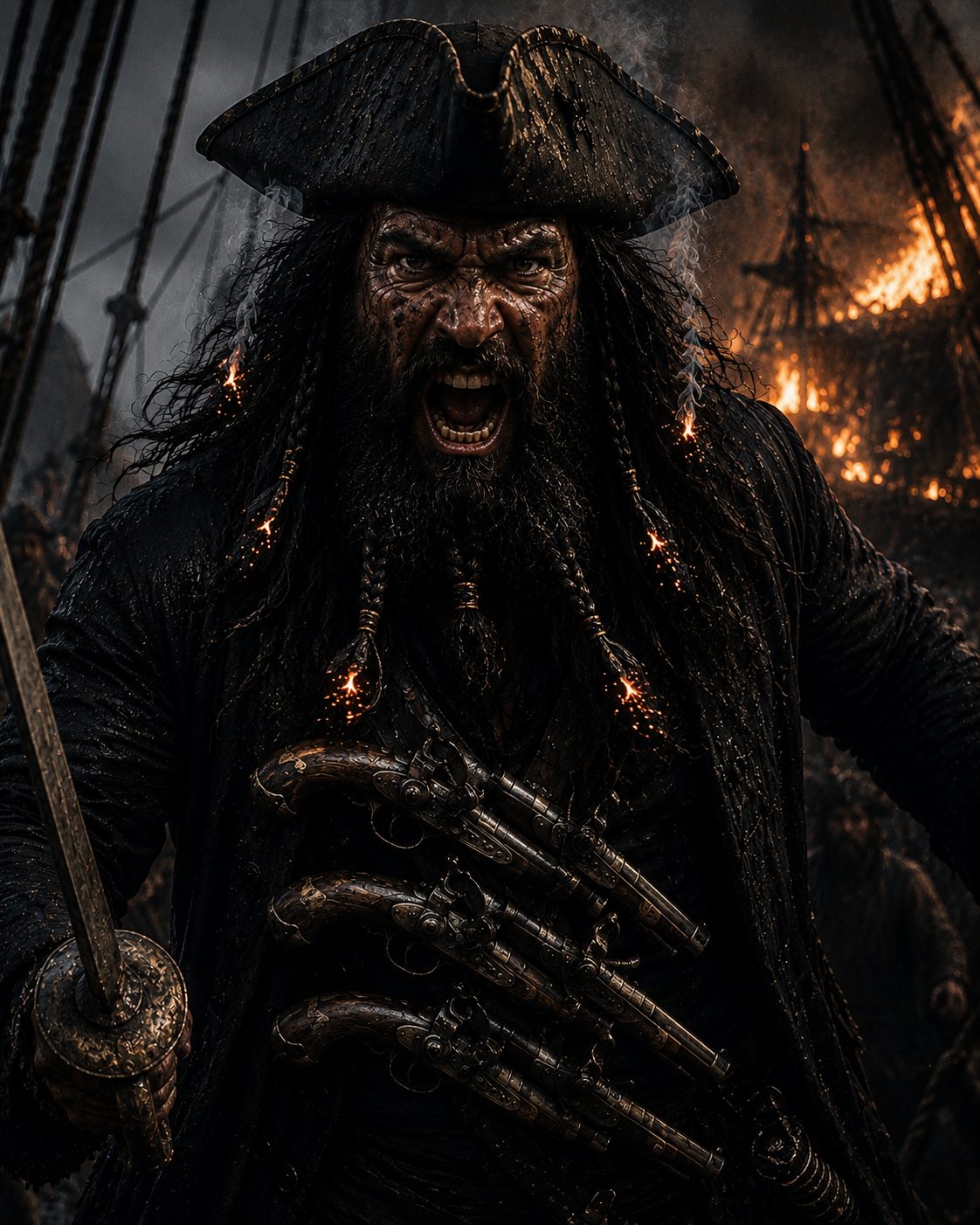
He employed terror as primary strategy: setting slow-burning fuses in his beard during combat, threatening crew with loaded pistols, orchestrating violence with such deliberate theatricality that merchants surrendered without fight, terrified by reputation alone.
His fair skin and formal education granted him access to colonial ports and merchants' parlors, where he negotiated like a diplomat, read contracts with a merchant's precision, and maintained the fiction of respectability that allowed him to purchase property and take legal marriage.
Contemporary accounts document few murders attributable directly to him—his genius lay in making the threat so vivid that actual bloodshed became unnecessary.
His operations culminated in the 1718
His operations culminated in the 1718 blockade of Charleston, a feat of political theater that forced colonial governors to negotiate with a pirate captain as though he were a sovereign power. This was his true ambition: not mere plunder, but recognition.
He understood that the golden age of piracy was burning away, and he operated with the urgent intensity of a man racing against time to build an empire before the window closed forever.
His final battle off the North Carolina coast in November 1718 was characteristically theatrical—a deliberate stand against overwhelming force that transformed his death into legend.
His severed head mounted on the
His severed head mounted on the bowsprit of HMS Pearl became the final chapter of his self-crafted mythology: Blackbeard would be remembered long after the man named Edward was dust.
**The Scar (circa 1716)**: The irregular slash across Teach's left cheek—running from eye to jaw, healed imperfectly and puckered from infection—marks his violent emergence into piracy.
Whether earned during his plantation escape or his initial assertion of authority among early crews, the scar was never discussed in his presence, suggesting either personal preference for silence or a previous confrontation brutal enough to close the subject forever.
The mark became his most recognizable
The mark became his most recognizable feature, transforming disfigurement into intimidation—merchants who heard "Blackbeard" could now visualize the face of their nightmare.
**Capture of La Concorde (1717)**: Teach's transition from crew member to captain was swift and bloody, marked by his seizure of the French slaver La Concorde off Honduras.
He recognized the vessel's superior design and armament, and converted her into Queen Anne's Revenge21 with methodical precision, transforming a merchant ship into a floating symbol of pirate sovereignty.
The capture demonstrated his strategic bri
The capture demonstrated his strategic brilliance: he didn't merely seize a prize, he claimed a flagship that would define his power.
**The Beard Theater (ongoing)**: During combat, Teach would affix slow-burning fuses to his beard, allowing them to smolder during boarding actions, creating an infernal halo around his head.
He would twist these burning fuses with his fingers, seemingly immune to flame, speaking through clenched teeth in his peculiar high-pitched voice as blood-soaked men fled in supernatural terror.
The performance was deliberate and calcula
The performance was deliberate and calculated—he understood that the image burned into a merchant's mind would do more work than any blade.
**Blockade of Charleston (May 1718)**: Teach executed a feat of political theater that forced Carolina's colonial governor into negotiation, anchoring his fleet outside Charleston harbor and halting commerce until merchants paid ransom.
The blockade was not mere piracy—it was an assertion of sovereign power, a demonstration that pirates could dictate terms to established governments.
For a brief moment, Blackbeard had
For a brief moment, Blackbeard had carved out the pirate territory he'd always envisioned, forcing the colonial world to acknowledge him as a political entity rather than a criminal.
**Negotiations with Governor Eden (1718)**: After Charleston, Teach maneuvered his way into North Carolina under the protection of Governor Charles Eden, obtaining a pardon and using his fair skin and educated accent to maintain the fiction of respectability.
He negotiated this arrangement with remarkable political acumen, understanding that governors could be corrupted, and that legitimacy—even false legitimacy—opened doors that violence alone could not.
His ability to move between pirate
His ability to move between pirate captain and property-owning gentleman revealed the depth of his transformation from enslaved man to self-made power.
**Final Battle and Execution (November 1718)**: Cornered on the Pamlico River by HMS Pearl under Lieutenant Robert Maynard, Teach fought with deliberate ferocity, sustaining multiple gunshot wounds and sword cuts before finally falling.
He died the way he lived—theatrically, ensuring that his final battle would be remembered and embellished by those who witnessed it.
His head was severed and mounted
His head was severed and mounted on the bowsprit of HMS Pearl as it sailed back to Bath, completing the mythology: Blackbeard had become immortal through spectacle, his death as legendary as his life.
**The Scar (circa 1716)**: The irregular slash across Teach's left cheek—running from eye to jaw, healed imperfectly and puckered from infection—marks his violent emergence into piracy.
Whether earned during his plantation escape or his initial assertion of authority among early crews, the scar was never discussed in his presence, suggesting either personal preference for silence or a previous confrontation brutal enough to close the subject forever.
The mark became his most recognizable
The mark became his most recognizable feature, transforming disfigurement into intimidation—merchants who heard "Blackbeard" could now visualize the face of their nightmare.
**Capture of La Concorde (1717)**: Teach's transition from crew member to captain was swift and bloody, marked by his seizure of the French slaver La Concorde off Honduras.
He recognized the vessel's superior design and armament, and converted her into Queen Anne's Revenge with methodical precision, transforming a merchant ship into a floating symbol of pirate sovereignty.
The capture demonstrated his strategic bri
The capture demonstrated his strategic brilliance: he didn't merely seize a prize, he claimed a flagship that would define his power.
**The Beard Theater (ongoing)**: During combat, Teach would affix slow-burning fuses to his beard, allowing them to smolder during boarding actions, creating an infernal halo around his head.
He would twist these burning fuses with his fingers, seemingly immune to flame, speaking through clenched teeth in his peculiar high-pitched voice as blood-soaked men fled in supernatural terror.
The performance was deliberate and calcula
The performance was deliberate and calculated—he understood that the image burned into a merchant's mind would do more work than any blade.
**Blockade of Charleston (May 1718)**: Teach executed a feat of political theater that forced Carolina's colonial governor into negotiation, anchoring his fleet outside Charleston harbor and halting commerce until merchants paid ransom.
The blockade was not mere piracy—it was an assertion of sovereign power, a demonstration that pirates could dictate terms to established governments.
For a brief moment, Blackbeard had
For a brief moment, Blackbeard had carved out the pirate territory he'd always envisioned, forcing the colonial world to acknowledge him as a political entity rather than a criminal.
**Negotiations with Governor Eden (1718)**: After Charleston, Teach maneuvered his way into North Carolina under the protection of Governor Charles Eden, obtaining a pardon and using his fair skin and educated accent to maintain the fiction of respectability.
He negotiated this arrangement with remarkable political acumen, understanding that governors could be corrupted, and that legitimacy—even false legitimacy—opened doors that violence alone could not.
His ability to move between pirate
His ability to move between pirate captain and property-owning gentleman revealed the depth of his transformation from enslaved man to self-made power.
**Final Battle and Execution (November 1718)**: Cornered on the Pamlico River by HMS Pearl under Lieutenant Robert Maynard, Teach fought with deliberate ferocity, sustaining multiple gunshot wounds and sword cuts before finally falling.
He died the way he lived—theatrically, ensuring that his final battle would be remembered and embellished by those who witnessed it.
His head was severed and mounted
His head was severed and mounted on the bowsprit of HMS Pearl as it sailed back to Bath, completing the mythology: Blackbeard had become immortal through spectacle, his death as legendary as his life.
The Making of Edward Teach
Bridgetown3, Barbados4, 1680–1698
The plantation manager’s wife called him
The plantation manager’s wife called him “the tall one” because his name was already forgetting itself.
Edward was perhaps seven when the sugar work hardened into rhythm — the pitch of the boiling house where his mother, María, stirred molasses in twelve-hour shifts, the salt-sting of the coastal wind that meant hurricane season was coming, the particular ache of a body too young for the labour his hands were already learning.
His father had been a ship’s carpenter named Thomas Teach, English-born, who had paid for his passage with seven years of indentured servitude and purchased his way into free status by 1678.
Edward’s existence — the product of
Edward’s existence — the product of Thomas’s liaison with an enslaved woman on Plantation Codrington — existed in the narrow ledge between: his father alive, employed, theoretically able to claim him; his mother property, her status transferring to the child by law and by the iron mathematics of colonial commerce.
Thomas tried. The boy remembered his father’s hands — calloused, precise, capable of reading wood grain the way priests read scripture.
He would take Edward to the boat repair yard near Carlisle Bay when the overseer’s attention slipped, teaching him the names of timber (white oak, mahogany, lignum vitae), how to caulk a seam so water would never find the crack.
Thomas spoke in two voices: the
Thomas spoke in two voices: the careful English of someone who had rehearsed respectability, and a rougher creole when he thought no white man was listening. He taught Edward both.
The violence came suddenly, as it always did.
Edward was twelve when Thomas died — not accident, not age, but fever, the kind that burned through a man in four days and left nothing but ash.
María had already been sold to
María had already been sold to a neighboring estate three years prior; Edward watched his father buried in the slave cemetery near the boiling house, unmarked except for a stone that would be gone within a season.
After the funeral, the manager’s wife — whose name was Margaret Thornton, who had called him “the tall one” since infancy — approached Edward with the tone women used when offering either mercy or ruin.
“Your father left some property papers,” she said. “Nothing considerable. But the lawyer will see you when you’re of age, if you prove useful.”
Useful meant the plantation boats. Edward
Useful meant the plantation boats. Edward was already tall — five feet seven by fourteen, and still growing — with his father’s skeletal efficiency and the mental architecture to absorb navigation the way another boy might learn prayer.
The plantation maintained a small sloop for moving sugar to Bridgetown, and the master shipwright, a Scotsman named MacRae with one eye and an almost grandfatherly indifference to Edward’s bloodline, took the boy as an apprentice.
MacRae taught him compass work, how to read a chart, the mathematics of rigging tension. He also taught him that a man who understood the mechanics of a ship — where its vulnerabilities lived, how to make it move against the wind — possessed a knowledge that no amount of ownership could fully suppress.
“They can own your body,” MacRae
“They can own your body,” MacRae said once, caulking seam while Edward held the pitch pot. “They cannot own what lives here.” He tapped his temple with a tarred finger, leaving a dark smudge. “You learn this trade proper, boy. You’ll have a bargain they can’t break.”
By sixteen, Edward was managing the boat’s maintenance, and by eighteen, he was making the runs to Bridgetown himself — ostensibly under the supervision of an older crew member named William5, who drank rum and slept through most voyages, leaving Edward functionally in command.
Bridgetown was a revelation: the water crowded with merchant vessels, slave ships discharging human cargo into the scramble markets on the waterfront, privateers taking on provisions, taverns where men spoke in Spanish and French and broken English and the pidgin creole that lived in the margins.
The port was a conversation in
The port was a conversation in a language his father’s books had never taught him.
The first theft was almost accidental.
A merchant captain — fat-faced, Portuguese, registered from Curaçao — left his navigation chest open on the dock while his crew loaded sugar.
Edward had been watching the instruments
Edward had been watching the instruments for months: a brass compass superior to anything the plantation possessed, a small astrolabe, a set of parallel rulers.
He took them during the chaos of a cargo dispute, moving with the unselfconscious efficiency of someone who had already learned that taking was sometimes the only bargain available. The merchant’s roar came when Edward was already in the boat, and William was too drunk to notice or care.
That night, alone in the repair yard, Edward assembled the stolen instruments like prayer beads and understood something that would remake him: the tools of navigation — the ability to read latitude from the stars, to move across open water without a master’s permission — were the only theft that mattered.
Everything else followed from this one
Everything else followed from this one.
He was nineteen when he jumped a merchant vessel bound for Jamaica6, using the name Edward Teach, carpenter and navigator. The plantation never retrieved him. Thomas’s property papers were never collected.
Some ghosts don’t haunt.
The Making of Edward Teach
The Making of Edward Teach
Bridgetown, Barbados, 1680–1698
The plantation manager’s wife called him “the tall one” because his name was already forgetting itself.
Edward was perhaps seven when the
Edward was perhaps seven when the sugar work hardened into rhythm — the pitch of the boiling house where his mother, María, stirred molasses in twelve-hour shifts, the salt-sting of the coastal wind that meant hurricane season was coming, the particular ache of a body too young for the labour his hands were already learning.
His father had been a ship’s carpenter named Thomas Teach, English-born, who had paid for his passage with seven years of indentured servitude and purchased his way into free status by 1678.
Edward’s existence — the product of Thomas’s liaison with an enslaved woman on Plantation Codrington — existed in the narrow ledge between: his father alive, employed, theoretically able to claim him; his mother property, her status transferring to the child by law and by the iron mathematics of colonial commerce.
Thomas tried. The boy remembered his
Thomas tried. The boy remembered his father’s hands — calloused, precise, capable of reading wood grain the way priests read scripture.
He would take Edward to the boat repair yard near Carlisle Bay when the overseer’s attention slipped, teaching him the names of timber (white oak, mahogany, lignum vitae), how to caulk a seam so water would never find the crack.
Thomas spoke in two voices: the careful English of someone who had rehearsed respectability, and a rougher creole when he thought no white man was listening. He taught Edward both.
The violence came suddenly, as it
The violence came suddenly, as it always did.
Edward was twelve when Thomas died — not accident, not age, but fever, the kind that burned through a man in four days and left nothing but ash.
María had already been sold to a neighboring estate three years prior; Edward watched his father buried in the slave cemetery near the boiling house, unmarked except for a stone that would be gone within a season.
After the funeral, the manager’s wife
After the funeral, the manager’s wife — whose name was Margaret Thornton, who had called him “the tall one” since infancy — approached Edward with the tone women used when offering either mercy or ruin.
“Your father left some property papers,” she said. “Nothing considerable. But the lawyer will see you when you’re of age, if you prove useful.”
Useful meant the plantation boats. Edward was already tall — five feet seven by fourteen, and still growing — with his father’s skeletal efficiency and the mental architecture to absorb navigation the way another boy might learn prayer.
The plantation maintained a small sloop
The plantation maintained a small sloop for moving sugar to Bridgetown, and the master shipwright, a Scotsman named MacRae with one eye and an almost grandfatherly indifference to Edward’s bloodline, took the boy as an apprentice.
MacRae taught him compass work, how to read a chart, the mathematics of rigging tension. He also taught him that a man who understood the mechanics of a ship — where its vulnerabilities lived, how to make it move against the wind — possessed a knowledge that no amount of ownership could fully suppress.
“They can own your body,” MacRae said once, caulking seam while Edward held the pitch pot. “They cannot own what lives here.” He tapped his temple with a tarred finger, leaving a dark smudge. “You learn this trade proper, boy. You’ll have a bargain they can’t break.”
By sixteen, Edward was managing the
By sixteen, Edward was managing the boat’s maintenance, and by eighteen, he was making the runs to Bridgetown himself — ostensibly under the supervision of an older crew member named William, who drank rum and slept through most voyages, leaving Edward functionally in command.
Bridgetown was a revelation: the water crowded with merchant vessels, slave ships discharging human cargo into the scramble markets on the waterfront, privateers taking on provisions, taverns where men spoke in Spanish and French and broken English and the pidgin creole that lived in the margins.
The port was a conversation in a language his father’s books had never taught him.
The first theft was almost accidental
The first theft was almost accidental.
A merchant captain — fat-faced, Portuguese, registered from Curaçao — left his navigation chest open on the dock while his crew loaded sugar.
Edward had been watching the instruments for months: a brass compass superior to anything the plantation possessed, a small astrolabe, a set of parallel rulers.
He took them during the chaos
He took them during the chaos of a cargo dispute, moving with the unselfconscious efficiency of someone who had already learned that taking was sometimes the only bargain available. The merchant’s roar came when Edward was already in the boat, and William was too drunk to notice or care.
That night, alone in the repair yard, Edward assembled the stolen instruments like prayer beads and understood something that would remake him: the tools of navigation — the ability to read latitude from the stars, to move across open water without a master’s permission — were the only theft that mattered.
Everything else followed from this one.
He was nineteen when he jumped
He was nineteen when he jumped a merchant vessel bound for Jamaica, using the name Edward Teach, carpenter and navigator. The plantation never retrieved him. Thomas’s property papers were never collected.
Some ghosts don’t haunt.
The Making of Edward Teach
Bridgetown, Barbados, 1680–1698
Bridgetown, Barbados, 1680–1698
The plantation manager’s wife called him “the tall one” because his name was already forgetting itself.
Edward was perhaps seven when the sugar work hardened into rhythm — the pitch of the boiling house where his mother, María, stirred molasses in twelve-hour shifts, the salt-sting of the coastal wind that meant hurricane season was coming, the particular ache of a body too young for the labour his hands were already learning.
His father had been a ship’s
His father had been a ship’s carpenter named Thomas Teach, English-born, who had paid for his passage with seven years of indentured servitude and purchased his way into free status by 1678.
Edward’s existence — the product of Thomas’s liaison with an enslaved woman on Plantation Codrington — existed in the narrow ledge between: his father alive, employed, theoretically able to claim him; his mother property, her status transferring to the child by law and by the iron mathematics of colonial commerce.
Thomas tried. The boy remembered his father’s hands — calloused, precise, capable of reading wood grain the way priests read scripture.
He would take Edward to the
He would take Edward to the boat repair yard near Carlisle Bay when the overseer’s attention slipped, teaching him the names of timber (white oak, mahogany, lignum vitae), how to caulk a seam so water would never find the crack.
Thomas spoke in two voices: the careful English of someone who had rehearsed respectability, and a rougher creole when he thought no white man was listening. He taught Edward both.
The violence came suddenly, as it always did.
Edward was twelve when Thomas died
Edward was twelve when Thomas died — not accident, not age, but fever, the kind that burned through a man in four days and left nothing but ash.
María had already been sold to a neighboring estate three years prior; Edward watched his father buried in the slave cemetery near the boiling house, unmarked except for a stone that would be gone within a season.
After the funeral, the manager’s wife — whose name was Margaret Thornton, who had called him “the tall one” since infancy — approached Edward with the tone women used when offering either mercy or ruin.
“Your father left some property papers,”
“Your father left some property papers,” she said. “Nothing considerable. But the lawyer will see you when you’re of age, if you prove useful.”
Useful meant the plantation boats. Edward was already tall — five feet seven by fourteen, and still growing — with his father’s skeletal efficiency and the mental architecture to absorb navigation the way another boy might learn prayer.
The plantation maintained a small sloop for moving sugar to Bridgetown, and the master shipwright, a Scotsman named MacRae with one eye and an almost grandfatherly indifference to Edward’s bloodline, took the boy as an apprentice.
MacRae taught him compass work, how
MacRae taught him compass work, how to read a chart, the mathematics of rigging tension. He also taught him that a man who understood the mechanics of a ship — where its vulnerabilities lived, how to make it move against the wind — possessed a knowledge that no amount of ownership could fully suppress.
“They can own your body,” MacRae said once, caulking seam while Edward held the pitch pot. “They cannot own what lives here.” He tapped his temple with a tarred finger, leaving a dark smudge. “You learn this trade proper, boy. You’ll have a bargain they can’t break.”
By sixteen, Edward was managing the boat’s maintenance, and by eighteen, he was making the runs to Bridgetown himself — ostensibly under the supervision of an older crew member named William, who drank rum and slept through most voyages, leaving Edward functionally in command.
Bridgetown was a revelation: the water
Bridgetown was a revelation: the water crowded with merchant vessels, slave ships discharging human cargo into the scramble markets on the waterfront, privateers taking on provisions, taverns where men spoke in Spanish and French and broken English and the pidgin creole that lived in the margins.
The port was a conversation in a language his father’s books had never taught him.
The first theft was almost accidental.
A merchant captain — fat-faced, Portuguese
A merchant captain — fat-faced, Portuguese, registered from Curaçao — left his navigation chest open on the dock while his crew loaded sugar.
Edward had been watching the instruments for months: a brass compass superior to anything the plantation possessed, a small astrolabe, a set of parallel rulers.
He took them during the chaos of a cargo dispute, moving with the unselfconscious efficiency of someone who had already learned that taking was sometimes the only bargain available. The merchant’s roar came when Edward was already in the boat, and William was too drunk to notice or care.
That night, alone in the repair
That night, alone in the repair yard, Edward assembled the stolen instruments like prayer beads and understood something that would remake him: the tools of navigation — the ability to read latitude from the stars, to move across open water without a master’s permission — were the only theft that mattered.
Everything else followed from this one.
He was nineteen when he jumped a merchant vessel bound for Jamaica, using the name Edward Teach, carpenter and navigator. The plantation never retrieved him. Thomas’s property papers were never collected.
Some ghosts don’t haunt
Some ghosts don’t haunt.
The Making of Edward Teach
Bridgetown, Barbados, 1680–1698
The plantation manager’s wife called him
The plantation manager’s wife called him “the tall one” because his name was already forgetting itself.
Edward was perhaps seven when the sugar work hardened into rhythm — the pitch of the boiling house where his mother, María, stirred molasses in twelve-hour shifts, the salt-sting of the coastal wind that meant hurricane season was coming, the particular ache of a body too young for the labour his hands were already learning.
His father had been a ship’s carpenter named Thomas Teach, English-born, who had paid for his passage with seven years of indentured servitude and purchased his way into free status by 1678.
Edward’s existence — the product of
Edward’s existence — the product of Thomas’s liaison with an enslaved woman on Plantation Codrington — existed in the narrow ledge between: his father alive, employed, theoretically able to claim him; his mother property, her status transferring to the child by law and by the iron mathematics of colonial commerce.
Thomas tried. The boy remembered his father’s hands — calloused, precise, capable of reading wood grain the way priests read scripture.
He would take Edward to the boat repair yard near Carlisle Bay when the overseer’s attention slipped, teaching him the names of timber (white oak, mahogany, lignum vitae), how to caulk a seam so water would never find the crack.
Thomas spoke in two voices: the
Thomas spoke in two voices: the careful English of someone who had rehearsed respectability, and a rougher creole when he thought no white man was listening. He taught Edward both.
The violence came suddenly, as it always did.
Edward was twelve when Thomas died — not accident, not age, but fever, the kind that burned through a man in four days and left nothing but ash.
María had already been sold to
María had already been sold to a neighboring estate three years prior; Edward watched his father buried in the slave cemetery near the boiling house, unmarked except for a stone that would be gone within a season.
After the funeral, the manager’s wife — whose name was Margaret Thornton, who had called him “the tall one” since infancy — approached Edward with the tone women used when offering either mercy or ruin.
“Your father left some property papers,” she said. “Nothing considerable. But the lawyer will see you when you’re of age, if you prove useful.”
Useful meant the plantation boats. Edward
Useful meant the plantation boats. Edward was already tall — five feet seven by fourteen, and still growing — with his father’s skeletal efficiency and the mental architecture to absorb navigation the way another boy might learn prayer.
The plantation maintained a small sloop for moving sugar to Bridgetown, and the master shipwright, a Scotsman named MacRae with one eye and an almost grandfatherly indifference to Edward’s bloodline, took the boy as an apprentice.
MacRae taught him compass work, how to read a chart, the mathematics of rigging tension. He also taught him that a man who understood the mechanics of a ship — where its vulnerabilities lived, how to make it move against the wind — possessed a knowledge that no amount of ownership could fully suppress.
“They can own your body,” MacRae
“They can own your body,” MacRae said once, caulking seam while Edward held the pitch pot. “They cannot own what lives here.” He tapped his temple with a tarred finger, leaving a dark smudge. “You learn this trade proper, boy. You’ll have a bargain they can’t break.”
By sixteen, Edward was managing the boat’s maintenance, and by eighteen, he was making the runs to Bridgetown himself — ostensibly under the supervision of an older crew member named William, who drank rum and slept through most voyages, leaving Edward functionally in command.
Bridgetown was a revelation: the water crowded with merchant vessels, slave ships discharging human cargo into the scramble markets on the waterfront, privateers taking on provisions, taverns where men spoke in Spanish and French and broken English and the pidgin creole that lived in the margins.
The port was a conversation in
The port was a conversation in a language his father’s books had never taught him.
The first theft was almost accidental.
A merchant captain — fat-faced, Portuguese, registered from Curaçao — left his navigation chest open on the dock while his crew loaded sugar.
Edward had been watching the instruments
Edward had been watching the instruments for months: a brass compass superior to anything the plantation possessed, a small astrolabe, a set of parallel rulers.
He took them during the chaos of a cargo dispute, moving with the unselfconscious efficiency of someone who had already learned that taking was sometimes the only bargain available. The merchant’s roar came when Edward was already in the boat, and William was too drunk to notice or care.
That night, alone in the repair yard, Edward assembled the stolen instruments like prayer beads and understood something that would remake him: the tools of navigation — the ability to read latitude from the stars, to move across open water without a master’s permission — were the only theft that mattered.
Everything else followed from this one
Everything else followed from this one.
He was nineteen when he jumped a merchant vessel bound for Jamaica, using the name Edward Teach, carpenter and navigator. The plantation never retrieved him. Thomas’s property papers were never collected.
Some ghosts don’t haunt.
Appearance
EDWARD TEACH: A COMPOSITE PORTRAIT
From the Ship’s Roll, circa 1718
The man who entered a cabin or a merchant’s parlor moved with the deliberate slowness of someone accustomed to being watched.
Edward Teach stood perhaps six feet
Edward Teach stood perhaps six feet in height — uncommonly tall for his era — with the particular carriage of a body that had learned early to occupy space as an act of will rather than permission.
His frame carried the lean muscularity of a man who had spent decades in labor and combat: not the bulk of a soldier drilled in formation, but the wired efficiency of someone whose strength had been forged through repetitive precision — hauling, climbing, the sustained tension of a ship under full sail.
His shoulders held a slight forward cant, as though perpetually braced against invisible resistance, a posture acquired in shipboard work and never quite surrendered even when standing on solid ground.
His face bore the character of
His face bore the character of someone who had lived through catastrophic interruption.
The skin was fair — the inheritance of his English father prominent in the lighter undertone — yet weathered to a deep amber-brown by equatorial sun and salt-spray, giving his complexion the appearance of old vellum left in a ship’s cabin for a season.
Across his left cheek ran the scar that had become his signature: an irregular slash running from the orbit of his eye downward to the angle of his jaw, healed imperfectly, the tissue raised and puckered from infection or crude closure, the line itself slightly twisted as though the blade that made it had caught bone.
The scar had the peculiar property
The scar had the peculiar property of making his expression difficult to read — the healed damage created a subtle asymmetry in his face that suggested either perpetual amusement or perpetual menace, depending on the light and the observer’s fear.
Merchants who had heard the name “Blackbeard” before seeing him remarked afterward that the scar had been worse than the legend, which was precisely the effect it created.
His eyes were dark — nearly black, with the alert intensity of a man trained to read wind and water in the smallest shifts of light.
They moved constantly, cataloging details:
They moved constantly, cataloging details: the cut of a merchant captain’s coat, the position of crew members on a deck, the quality of rope and the set of a ship’s canvas. There was no drowsiness in them, no moment of inattention.
Contemporaries noted an unsettling quality to his gaze — not precisely cruel, but absolutely measuring, as though the man behind those eyes was performing a rapid calculation of your usefulness and your capacity for harm, simultaneous.
When he smiled, which he did rarely and with calculated effect, the expression did not reach his eyes; the eyes continued their inventory work while the mouth performed a separate function.
His hair was black, wavy, with
His hair was black, wavy, with the texture and shine that suggested Mediterranean or Spanish ancestry — the visible mark of his mother’s heritage, though he never spoke of her.
He wore it long by the standards of the period, shoulder-length or beyond, with a particular vanity about its condition. Crew members reported that he kept it oiled, combed with deliberation, sometimes braided or tied with colored cord.
In combat — and this was the element that had birthed the “Blackbeard” legend — he wove slow-burning match-cord (the kind used to ignite cannon) directly into his beard and the hair above his ears, allowing them to smolder during boarding actions.
The effect was deliberate theater: a
The effect was deliberate theater: a man wreathed in smoke and spark, his features half-obscured by flame and shadow, moving through the chaos of a ship’s deck like a figure from a fever dream.
The beard itself, when worn unadorned, was full and luxuriant, well-kept, darkening his already weathered face so that only his eyes were clearly visible — a mask of sorts, which he appeared to understand had value.
His hands told a different story than his face.
The fingers were long and capable
The fingers were long and capable, the nails kept surprisingly clean for a seaman; the palms bore the thick calluses of rope-work accumulated over decades, but the knuckles showed the smooth scarring of old breaks, imperfectly set and healed.
These were hands trained to violence but also to precision — the same hands that could splice a line, navigate by the stars, and review account books with the focus of a merchant’s clerk.
He was observed to gesture minimally when speaking, as though words were sufficient and physical embellishment would be redundant. When he did move his hands, the gesture was decisive and economical.
His voice, by contemporary account, was
His voice, by contemporary account, was unremarkable — neither particularly deep nor high, with traces of a Caribbean patois underneath an educated English accent that suggested both his plantation origins and his later access to formalized speech.
He spoke less than most men, a habit that granted his words disproportionate weight. When he gave an order, it required no shouting; his crew attended to the statement itself rather than its volume.
In negotiation with merchants or colonial officials, he deployed language with the precision of someone who had studied it as a strategic tool: formal enough to command respect, colloquial enough to suggest danger might emerge should formality be abandoned.
The educated accent in particular seemed
The educated accent in particular seemed to unsettle those who encountered him, as it violated the expectation that a pirate captain would speak like a sailor. It reinforced the sense that Edward Teach had been educated — that he was not a man of circumstance but of choice.
His dress reflected a peculiar duality. On deck, he wore the practical clothing of a working seaman: linen breeches, a loose shirt, a canvas coat against weather, rope-soled shoes.
Yet the quality of these garments was consistently finer than those of his crew. The linen was better-woven, the colors brighter, the seams tighter.
He wore a wide leather belt
He wore a wide leather belt with a substantial silver buckle, and from it hung a cutlass of notable quality, the blade etched, the hilt wrapped in ray-skin — not the rough working blade of an ordinary sailor but the weapon of an officer.
When ashore or conducting negotiations, he affected a more genteel appearance: a coat of good wool in dark colors, a waistcoat, a cravat, a tricorn hat.
In these clothes, he could have passed for a merchant captain or a colonial official, which was precisely the intention. The switch between identities was so complete that witnesses to both versions sometimes failed to recognize them as the same man until the scar or the eyes confirmed it.
He moved with what observers called
He moved with what observers called “theatrical precision” — each gesture calculated for maximum effect, each position on a deck or in a cabin chosen to control the sight-lines of whoever was watching.
He would stand at an angle to give best view of the scar, or turn away from light to make his eyes less readable, or place himself between a merchant and the cabin door.
These adjustments were so subtle that most people did not recognize them as adjustments; they experienced them as the natural result of the man’s presence. This was perhaps his most dangerous quality: the ability to manipulate how he was perceived without appearing to manipulate anything at all.
In sum: a tall man of
In sum: a tall man of fair skin darkened by sun, marked by a terrible scar, moving with the controlled efficiency of a weapon, his dark eyes perpetually calculating, his voice controlled and economical, his dress shifting between the theatrical and the practical depending on his purpose.
Not beautiful by any standard. Not conventionally frightening.
But configured in such a way that once you had seen him, you understood why merchants surrendered their cargo without firing a shot, and why the name “Blackbeard” could empty a tavern or quiet a colonial governor’s council.
The legend and the man had
The legend and the man had fused into a single instrument — which had been, from the beginning, entirely the point.
Identity
- Born
- 1680
- Died
- 1718
- Gender
- Male
- Nationality
- English
- Origin
- England
- Ship · 1725
- Wolf Moon
- Ship · 2025
- —
Frestagon Profile
Compiled by Dr. Frestagon from observation rather than testimony. Scores out of ten; the commentary is his own.
- Cunning (9) — at the ceiling. Assume premeditation.
- Strategy (8) — formidable; rarely caught improvising.
- Command (8) — formidable; rarely caught improvising.
- Intuition (8) — formidable; rarely caught improvising.
- Charm (7) — serviceable, and aware of its limits.
- Navigation (7) — serviceable, and aware of its limits.
- Education (7) — serviceable, and aware of its limits.
- Lore (5) — middling; compensated for elsewhere.
Filed under seal. The subject has not seen this assessment.
Saltwell Profile
Leadership, as the Admiral's office measures it.
Blackwater Profile
Intelligence and tradecraft, by Blackwater reckoning.
Tidecrest Profile
A woman's appraisal — of a woman as she is, or of a man as he believes himself to be.