Backstory
The Account of Aldric Braeburn, Called Scarfaced Among the Sparrows1
The man who commands respect through stillness rather than speech arrived at Tortuga2 in the year of our Lord sixteen hundred and ninety-four, bearing a Dutch letter of marque that he burned the moment his boot touched sand.
He called himself Braeburn by then — a calculated fiction, as most things about him were — though the ledgers of Lisbon would have known him as Aldrich Ben-Shushan, son of merchants whose shop on Rua da Prata had stood three centuries in the family’s keeping. That ledger was ash. So was everything written in it.
He was a man fashioned by
He was a man fashioned by flame, though not in the manner that made most sailors. The ordinary wear of tar and rope, of salt-scalded skin and rope-burned palms, marked every man who went to sea.
But Braeburn bore the signature of intent — of hands applied deliberately to flesh, of a wound that had swallowed an eye and left a crater that would outlast empires.
The mark upon his mouth pulled his features into a perpetual grimace that made merchant captains surrender their cargo before a shot crossed their bow, made boarding crews hesitate the crucial fraction required for a skilled man to slit their throats.
His appearance became his capital, though
His appearance became his capital, though he had not chosen it.
A boy of fourteen, translucent with shock, had hidden in a Dutch merchantman’s bilge while screaming echoed from the streets behind him — his mother’s voice, his father’s, the hymns of the righteous that drowned them out.
When the ship reached Curaçao, he emerged a different creature entirely. The burns that marked his face as heretical merchandise transformed him. On the pirate coast, a man who looked like judgment itself required no pedigree, no letter of introduction.
He required only competence and the
He required only competence and the will to use what God and Spanish holy fire had provided.
Braeburn learned his trade with the methodical precision of one who had been raised to calculate value. Where other men saw plunder and glory, he saw accounting.
A merchant vessel carried not merely cargo but reputation, insurance ledgers, the fragile credit that kept colonial commerce flowing.
A ransom pitched too high and
A ransom pitched too high and the merchant refused payment, preferring to absorb the loss; too low and you starved your crew on hopes and promises.
Braeburn calculated as his father had calculated emeralds — weight, quality, market conditions, the desperation of the buyer. Within five years, he captained his own sloop under no flag but the black.
The scar that made him fearsome also made him merciful, though few understood the connection. A man shaped by institutional violence recognizes its contours in others.
He paid his crew in silver
He paid his crew in silver and on schedule, knowing that fear purchased only obedience and obedience failed when the test came.
Loyalty — genuine loyalty, the kind that made a man stand firm when cannons spoke — required that he be invested in his captain’s survival. Braeburn’s men were invested. They ate well, drank well, and when they were wounded, he kept a surgeon aboard who knew his business.
Captives taught him early that mercy was a currency with remarkable purchasing power.
A merchant’s wife treated with courtesy
A merchant’s wife treated with courtesy, a captain ransomed quickly and without torture, a crew member held for ransom returned whole and unbroken — these became rumors that preceded him into port.
Where other captains faced desperate resistance, Braeburn faced surrender.
A man who knew he would die hard fought with the fury of the doomed; a man who knew negotiation remained possible thought clearly, calculated odds, and usually concluded that his life was worth the price demanded. Braeburn’s greatest captures required almost no violence at all.
Yet he was not gentle. Men
Yet he was not gentle. Men who mocked his scars, or who spoke carelessly of his birth, or who failed to show proper respect discovered that a practical man could be creative in his vengeances.
Death itself became a negotiable instrument in his hands — not swift, not merciful, but meticulously drawn out. A reputation for both courtesy and cruelty proved more effective than either in isolation.
Women, particularly those whose features echoed his lost sisters’, sometimes mistook his gallantry for romantic inclination. He was courteous to them because he remembered his sisters’ laughter, remembered his mother’s hands correcting his letters.
That courtesy extended to their protection
That courtesy extended to their protection, to their safe return to whatever home remained. Few women stayed long in that protection, however. His face was not one that inspired tenderness, and his kindness could not quite overcome the visible evidence of suffering that marked him.
His wealth accumulated not through avarice but through the understanding of a dispossessed man who had learned that fortune’s wheel turned without warning or mercy.
When he could no longer sail, when age or injury claimed the hand that had gripped the cutlass with such precision, he would need reserves vast enough to purchase safety in a world that had never offered it freely.
Aldric Braeburn was, by all accounts
Aldric Braeburn was, by all accounts, a pragmatist shaped in the crucible of institutional cruelty and ocean wind. The Sparrows under his command prospered. The accounts were always balanced. The dead were always accounted for.
Appearance
ALDRIC BRAEBURN: A PHYSICAL ACCOUNT
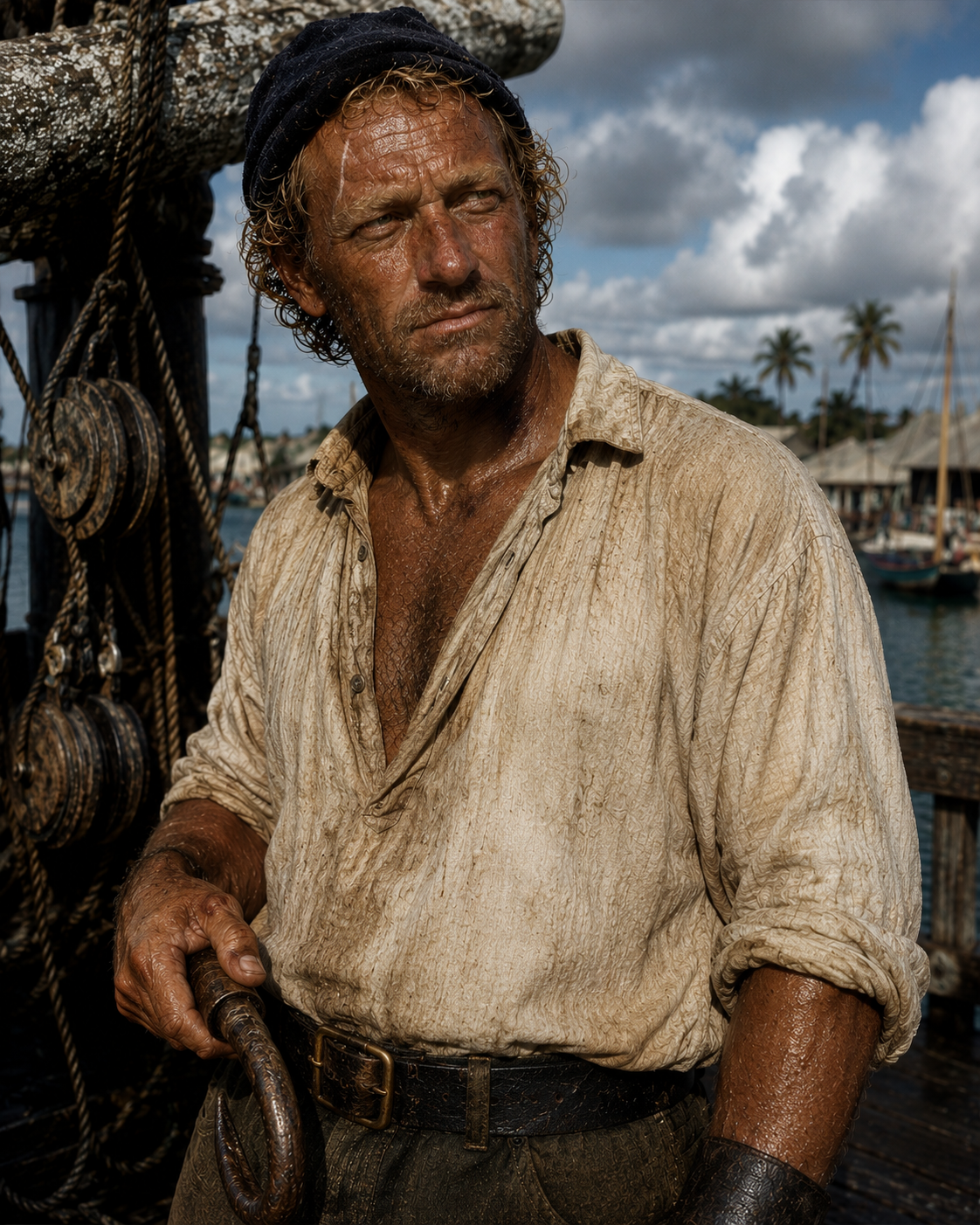
The first thing a man notices about Aldric Braeburn is not that he is scarred. It is that he is still.
In a port where motion is currency — where dockhands heave and merchants gesture and even the ship-rats possess a kind of kinetic desperation — Braeburn occupies space the way a anchor does.
His stillness is not the exhaustion
His stillness is not the exhaustion of age; he is perhaps fifty, lean and corded where other men his age have begun to thicken. It is a chosen stillness, the kind that makes you understand that every movement he permits himself will mean something. Every gesture has ledger-weight.
His skin is the color of old saddle leather — not brown, but a kind of perpetual weathered amber that suggests he has not been out of the sun in thirty years and has stopped registering objection to it.
The leather is creased in particular ways: deep lines bracket his mouth and fan from the corners of his eyes, as though he has spent decades in half-smile or half-squint. There is a pox-mark stippling on his left temple, small and white.
His hands are scarred across the
His hands are scarred across the knuckles and webbed with thin white lines — the signature of a man who has handled rope since boyhood and cut things that resisted.
His nails are kept short and scrupulously clean; he runs the edge of a knife under them each evening, a habit so ingrained it requires no thought. The hands themselves are broad and spare, more like a surgeon’s or a jeweler’s than a sailor’s, though the sailor’s work has remade them entirely.
But it is the scar that commands.
It runs from the outer corner
It runs from the outer corner of his right eye — which is milk-pale and sightless, a glassy blue-white that does not track — down across the cheekbone and the right side of his mouth, terminating at the corner of his jaw.
The wound was deep and old; the tissue has healed into a landscape of nested pleats and striations, the color a shade darker than the surrounding skin, as though the burn went down to a different layer and brought it up to the surface.
The scarring has pulled the corner of his mouth upward in a permanent quarter-smile, a rictus that makes him appear to be amused by everything he observes, even when he is not. Especially when he is not.
It transforms his entire face into
It transforms his entire face into something neither quite human nor quite mask — something that has been decided upon rather than grown.
The right eye itself, the ruined one, he does not attempt to conceal. No patch, no bandage. He looks directly at men with that milk-blind stare, and they feel the weight of it, the sense that he is calculating their worth while unable to properly see them.
It is a subtle, exquisite cruelty — and whether it was intended that way or has simply become true through repetition is irrelevant. The effect is the same.
His hair is iron-grey shot through
His hair is iron-grey shot through with traces of the copper it once was, pulled back in a simple braid that sits at the nape of his neck, the kind of braid a man maintains because it was fashionable forty years ago and he has seen no reason to change.
A few strands have escaped and hang past his jaw. His beard, which he keeps to perhaps a quarter-inch, is the same mixed grey-copper, and it gives his lower face a fine-ground appearance, like iron filings.
He dresses in the manner of a man who understands that clothing is armor and theater in equal measure.
His coat is charcoal wool, well-cut
His coat is charcoal wool, well-cut, the kind of coat a merchant captain or a minor nobility would wear to a formal dinner in Dublin or Edinburgh — not the ragged duffel of the ordinary sailor.
It is old enough to have softened with wear, and it fits him with the ease of something he has inhabited so long it has become a second skin. Beneath it, a linen shirt of cream-grey, the cuffs rolled back to expose the scar tissue on his forearms.
His breeches are a practical dark grey canvas, tucked into boots of black leather that he maintains with the same meticulous attention he gives his nails.
A broad leather belt, the buckle
A broad leather belt, the buckle brass and real, sits at his hips; a Spanish claymore hangs at his left side in a worn leather scabbard, the hilt wrapped in cord gone black with age and the oils of his hand.
His voice, when he uses it, is soft and carries an accent that is neither quite Scottish nor quite the creole English of the pirate coast — something that has been smoothed and shaped by travel and deliberate erasure. He does not waste words.
When he speaks to a crew member, it is a statement of fact. When he speaks to a prisoner, it is an offer, carefully pitched at the threshold of compliance. When he is silent — which is most of the time — his silence has weight. It fills a room.
He smells of tar, inevitably, and
He smells of tar, inevitably, and of the salt that never quite washes out of cloth kept in a shipboard locker. But beneath that: tobacco. Clove. Something faint and particular, like old paper or the insides of a leather chest where spices were once stored.
In motion, he walks with precision, each step deliberate, his weight balanced slightly forward on the balls of his feet — a man ready to shift direction or draw his blade in the same gesture. He does not swagger. He does not need to.
The scar does that work for him.
Identity
- Gender
- Male
- Nationality
- English
- Origin
- England
- Ship · 1725
- Assurance
- Bounty
- 4614
Frestagon Profile
Compiled by Dr. Frestagon from observation rather than testimony. Scores out of ten; the commentary is his own.
- Cunning (8) — formidable; rarely caught improvising.
- Strategy (8) — formidable; rarely caught improvising.
- Command (8) — formidable; rarely caught improvising.
- Education (7) — serviceable, and aware of its limits.
- Intuition (7) — serviceable, and aware of its limits.
- Charm (6) — serviceable, and aware of its limits.
- Navigation (5) — middling; compensated for elsewhere.
- Lore (4) — middling; compensated for elsewhere.
Filed under seal. The subject has not seen this assessment.
Saltwell Profile
Leadership, as the Admiral's office measures it.
Blackwater Profile
Intelligence and tradecraft, by Blackwater reckoning.
Tidecrest Profile
A woman's appraisal — of a woman as she is, or of a man as he believes himself to be.